Best Early Childhood Education Schools in Ohio
Compare 32 accredited Early Childhood Education programs in Ohio, with net price after aid, graduation rates, earnings and debt from IPEDS and the U.S. College Scorecard.

Which Ohio school fits your budget, your schedule and the license you want? A bachelor's degree in early childhood education, usually a Bachelor of Science, is the standard route to Ohio's PreK through grade 5 teaching license, but programs differ sharply in price, format and how they handle licensure.
Public universities and Ohio University's regional campuses cost far less than private schools, while online and birth-to-age-5 tracks suit working students. Some degrees in child development lead to careers outside the classroom, so check the license pathway before you apply.
Ohio ties classroom licensure to state exams and an Ohio-approved preparation program, so the school you choose shapes your options after graduation.
Key Points
- Miami University ranks first, pairing CAEP accreditation with 700-plus fieldwork hours.
- Ohio University's Eastern Campus posts the lowest net price: $3,925 a year.
- Ohio's PreK-5 Primary Education license requires three OAE exams in 2027.
Best Bachelor's Degree in Early Childhood Education Schools in Ohio
Miami University takes the top spot for a bachelor's degree in early childhood education in Ohio, pairing CAEP accreditation with a PreK through grade 5 licensure track and more than 700 hours of classroom fieldwork. The 10 programs below cover both routes a student might want: a license to teach preschool through grade five, or a birth through age 5 credential for work in child care and early learning settings. Net prices in the table are sector averages rather than quotes for an individual student, and graduation rates describe the whole university, not the early childhood major.
Miami University
#1Oxford, OH · $18,000 – $41,000/yr (est.)
Best for: PreK-5 teacher candidates wanting early fieldwork
Miami University takes the top spot because its primary education major is built for the job: a CAEP-accredited, four-year cohort program that leads to an Ohio license for prekindergarten through grade 5. Candidates log more than 700 hours of field experience before a 15-week, full-time student teaching term, and the department also runs an Urban Cohort, a blended inclusive education license, and a combined 4+1 master's option. The university's overall graduation rate is about 80%, and 138 bachelor's degrees were awarded in the field.
- CAEP-accredited, four-year cohort program with a combined 4+1 M.Ed. option
- Leads to an Ohio teaching license for prekindergarten through grade 5
- More than 700 hours of field experience before a 15-week student teaching term
- Urban Cohort and Inclusive Education blended licensure options
- 138 bachelor's degrees awarded in the field
- Median earnings of $39,155 one year out and $45,704 four years out
Ohio University
#2Athens, OH · ~$22,000/yr (est.)
Best for: Cohort learners in school-district partnerships
Ohio University's Patton College prepares teachers for preschool through grade five and does it through sustained school partnerships: candidates work in Professional Development Schools across five local districts and study in cohorts alongside both university and school faculty. An on-campus laboratory school, the Child Development Center, adds a second clinical setting, and a semester of student teaching overseas is available. The university's overall graduation rate is about 65%, and this is the largest early childhood program among the schools listed here, with 283 bachelor's degrees awarded.
- Leads to an Ohio teaching license for preschool (age 3) through grade 5
- CAEP-accredited and aligned with CAEP K-6 standards and NAEYC guidance
- Professional Development School placements with five local school districts
- Cohort year taught by both university faculty and school faculty
- On-campus laboratory school, the Child Development Center
- Requires OAE 055 and 190; edTPA can exempt OAE 057
- Semester of student teaching abroad through the Consortium for Overseas Student Teaching
- 283 bachelor's degrees awarded, the most among these Ohio programs
University of Cincinnati
#3Cincinnati, OH · ~$26,000/yr (est.)
Best for: Working adults needing fully online coursework
The University of Cincinnati's early childhood degree is CAEP accredited and built for adults who already hold some college credit: coursework is fully online, three start dates run each year, and no SAT or ACT score is required. The Birth to Age 5 curriculum depends on real classroom hours, including 150 hours in a preschool room and 70 hours each in infant and toddler rooms, then a 200-hour preschool internship and a capstone. The university's overall graduation rate is about 75%. Students should know that this program does not lead to Ohio's preK through grade 5 teaching license.
- Fully online with no campus visits and three start dates each year
- CAEP-accredited; does not lead to Ohio preK-grade 5 licensure
- 150-hour preschool practicum plus 70 hours each in infant and toddler rooms
- 200-hour preschool internship and a capstone course
- Prior college credit from a two-year institution required; 2.5 GPA recommended
- No SAT or ACT required and a $0 application fee
- Median earnings of $39,607 one year out and $47,019 four years out
Ohio State University
#4Columbus, OH · $17,000/yr (est. net price)
Ohio State's early childhood pathway sits inside the Child and Youth Studies major, where students choose one of five specializations and finish with a year-long internship in a community organization. It suits students aiming at child development, out-of-school programs, or youth policy more than at a classroom license, because the major is not a teacher licensure program and licensure seekers continue to the university's master's program. The university's overall graduation rate is about 88%, and 89 bachelor's degrees were awarded in the field.
- Five specializations, including Early Childhood Development and Education
- Year-long culminating internship in a community organization
- Two-semester community internship at a site the student chooses
- Not a teacher licensure program; licensure runs through the OSU M.Ed.
- 89 bachelor's degrees awarded in the field
- Median earnings of $36,483 one year out and $45,969 four years out
Kent State University
#5Kent, OH · ~$21,000/yr (est.)
Kent State's early childhood education degree is a 123-credit, cohort-based licensure program with roughly 1,200 clock hours of field experience in preschool and elementary classrooms. It is accredited by CAEP and the Ohio Department of Education and Workforce, is taught in person at Kent, Salem, and Tuscarawas, and requires a 2.750 GPA to enter advanced study. The university's overall graduation rate is about 64%.
- 123 credit hours in a five-block cohort sequence
- About 1,200 clock hours of field experience
- CAEP and Ohio Department of Education and Workforce accredited
- 2.750 GPA required for advanced study
- Ohio licensure valid for ages three through grade five
- Taught at the Kent, Salem, and Tuscarawas campuses
- International Baccalaureate recognition certificate available
- Median earnings of $33,040 one year out and $41,717 four years out
University of Toledo
#6Toledo, OH · $13,000 – $22,000/yr (est.)
Toledo places early childhood candidates in more than 150 area schools across four semesters of fieldwork, and its CAEP-accredited Bachelor of Education leads to the Ohio preK through grade 5 license. The program reports that more than 87% of candidates pass the Ohio Assessments for Educators on the first attempt, and a full-ride scholarship for future teachers covers in-state tuition plus room and board. The university's overall graduation rate is about 57%.
- Fieldwork in more than 150 Toledo-area schools across four semesters
- CAEP-accredited and aligned to the Ohio preK-grade 5 license
- More than 87% pass the Ohio Assessments for Educators on the first attempt
- Full-ride Herb Scholarship covers in-state tuition, room and board
- edTPA scores average four points above the required mark
- Median earnings of $38,625 one year out and $43,533 four years out
Otterbein University
#7Westerville, OH · ~$19,000/yr (est.)
Otterbein is a small private university in Westerville whose PreK-5 primary education major leads to Ohio's two-year PreK-5 Resident Educator License and requires 12 literacy hours, including phonics. The sequence is scaffolded tightly, from a 30-hour field component in the first education course to a fourth-year student teaching block and seminar, and entry to that first course requires a 2.5 GPA, test scores, and an FBI/BCI background check. The university's overall graduation rate is about 68%.
- Leads to Ohio's two-year PreK-5 Resident Educator License
- 12 literacy hours required, including phonics
- 30-hour field component in the first education course
- Fourth-year student teaching block plus a seminar
- 2.5 GPA, test scores, and FBI/BCI check required for entry
- PreK-5 Intervention Specialist concentration adds a license and exam
Ohio Northern University
#8Ada, OH · $24,000/yr (est. net price)
Ohio Northern University offers early childhood education as both a Bachelor of Arts and a Bachelor of Science, each laid out as a four-year, 120-credit plan with student teaching and a seminar in the senior year. The BA route can add an Intervention Specialist license for preK through grade 5, and the curriculum includes dedicated phonics and exceptional-learner courses. The university's overall graduation rate is about 75%.
- Offered as both a Bachelor of Arts and a Bachelor of Science
- 120 credit hours, with 12 credits of student teaching in year four
- BA option adds a PK-5 Intervention Specialist License
- Coursework includes Phonics & Word Study and Exceptional Learners
- Distribution requirements span humanities, fine arts, and sciences
Mount Vernon Nazarene University
#9Mount Vernon, OH · ~$22,000/yr (est.)
Mount Vernon Nazarene's early education and child studies concentration sits inside a broader Education and Social Policy Studies major that also covers curriculum and instruction, community leadership, and human services and social policy. That structure suits students who want to work with young children in community, ministry, or social-service settings as well as those exploring teaching. The university's overall graduation rate is about 68%.
- Early Education & Child Studies concentration within Education & Social Policy Studies
- Major also covers curriculum and instruction, community leadership, and human services
- On-campus program for traditional undergraduates
- Median earnings of $35,268 one year out and $38,001 four years out
Gods Bible School and College
#10Cincinnati, OH · ~$9,000/yr (est.)
Gods Bible School and College is a small Cincinnati institution whose education department offers early childhood education next to a bachelor's-with-licensure track, with CAEP and ACSI certification and coursework aimed at Christian classrooms and ministry settings. The early childhood major is offered on campus and online. The university's overall graduation rate is about 40%.
- Bachelor's in early childhood education through the Education department
- Education programs hold CAEP and ACSI certification
- Prepares teachers for Christian classrooms and ministry settings
- A bachelor's-with-licensure track is offered in the same department
- Early childhood major available on campus and online
Cost & outcomes by school
Federal data for the highest-earning Early Childhood Education programs, independent of the ranking above. Earnings are this field's bachelor's graduates four years after completing where the Scorecard reports them, else the school's undergraduate median.
| School | Net price / yr | Grad rate | Earnings | Debt | Grads/yr | Format |
|---|---|---|---|---|---|---|
| Ohio Northern University OH | $24,478 | 76% | $80,928 | $27,000 | 14 | Campus |
| Antioch University OH | — | — | $51,541 | $23,501 | — | Online |
| Mount St. Joseph University OH | $16,530 | 56% | $51,509 | $19,000 | 3 | Campus |
| Lourdes University OH | $23,206 | 33% | $48,150 | $30,937 | 11 | Campus |
| Otterbein University OH | $19,237 | 68% | $47,383 | $21,025 | 27 | Campus |
| University of Cincinnati OH | $25,648 | 75% | $47,019 | $25,000 | 214 | Online |
| Capital University OH | $22,576 | 60% | $46,055 | $27,000 | 22 | Campus |
| Ohio State University OH | $17,339 | 88% | $45,969 | $22,017 | 70 | Campus |
| Miami University OH | $28,384 | 80% | $45,704 | $23,000 | 162 | Campus |
| Bluffton University OH | $19,943 | 53% | $44,290 | $27,000 | 16 | Campus |
| University of Mount Union OH | $23,280 | 59% | $44,001 | $27,000 | 37 | Campus |
| Ohio University OH | $21,637 | 66% | $43,893 | $21,500 | 159 | Campus |
Sources: U.S. Department of Education. Net price, graduation rate, earnings and debt: College Scorecard (earnings and debt for this field's bachelor's graduates where reported, else school-wide); graduates: IPEDS. A dash means no figure is reported.
Cost, debt & payoff
Median earnings of this field's bachelor's graduates (4 yrs after completing, else the school's undergraduate median) vs. their median federal loan debt · U.S. College Scorecard
Across these programs the median graduate earns about $43,893 and finishes with roughly $24,625 in debt — a ratio that clears a common rule of thumb (keep debt below first-year salary). Net price and debt vary widely school to school, so check the per-school figures in the table above before you shortlist.
Most Affordable Ohio Schools for an Early Childhood Education Bachelor's
Ohio University's regional campuses post the lowest average net prices in our data for an early childhood bachelor's in Ohio. The Eastern Campus in Saint Clairsville comes in at $3,925 a year, and the other campuses fall between $5,650 and $5,993, all with the same $6,362 in-state tuition. Net price is the average yearly cost of attendance after grants and scholarships for students who receive aid, based on 2024 U.S. Department of Education data (IPEDS and College Scorecard). Because these are public campuses with state funding, their posted prices are lower than those of private colleges, which tend to rely more on institutional aid to bring costs down. Each campus offers the same Early Childhood and Elementary Education major, which covers preschool through grade 5, and West Virginia residents qualify for in-state tuition.
| School | City | Sector | Format | In-State Tuition and Fees | Average Net Price |
|---|---|---|---|---|---|
| Ohio University-Eastern Campus | Saint Clairsville | Public | Campus | $6,362 | $3,925 |
| Ohio University-Lancaster Campus | Lancaster | Public | Campus | $6,362 | $5,650 |
| Ohio University-Zanesville | Zanesville | Public | Campus | $6,362 | $5,746 |
| Ohio University-Chillicothe Campus | Chillicothe | Public | Campus | $6,362 | $5,755 |
| Ohio University-Southern Campus | Ironton | Public | Campus | $6,362 | $5,993 |
Online and Hybrid Bachelor's Options at Ohio Schools
One program built for online delivery
The University of Cincinnati's Bachelor of Science in Education in Early Childhood Education is offered 100% online with no required campus visits, and it spans birth to age 5. Gods Bible School and College lists its early childhood education program as available in both campus and online formats. Ohio University's B.S.Ed. in Early Childhood and Elementary Education runs through OHIO Online and at the university's regional campuses in Eastern, Lancaster, Zanesville, Chillicothe and Southern Ohio, so students in those parts of the state can study closer to home. Kent State University teaches its B.S.E. at Kent, Salem and Tuscarawas. The remaining schools ranked here, including Miami University, Ohio State University, Ohio Northern University, Otterbein University, the University of Toledo and Mount Vernon Nazarene University, publish campus-based early childhood programs.
Field hours still happen in person
"Fully online" almost never means no classroom time. Cincinnati's distance students complete their field work in approved early childhood classrooms: a 150-hour preschool student teaching placement, a 70-hour infant and 70-hour toddler practicum, and a 200-hour preschool internship. Ohio University interns complete a 15-week pre-primary internship and a 15-week primary internship in classrooms serving ages 3 through grade 5.
Ask about placements before you apply
Ohio University's online students get instructions, timelines, documentation and résumé guidance from the Field Experience Hub, but they still must secure their own placements; the Hub may help identify opportunities without obtaining them. Before applying, ask admissions whether the school arranges sites in your area, whether you can use a classroom where you already work, and how far from campus it will send you for a placement.
Admissions: GPA, Test Policy, and Transfer Credit
Admission to an Ohio early childhood program is a two-step process, and the second step, entry to the professional education sequence, usually carries the higher GPA bar. Published detail varies widely from school to school.
What Schools Publish
- Ohio University Chillicothe: The teacher-candidacy sequence asks for at least 30 completed credit hours and a cumulative 3.0 GPA. ACT and SAT appear among the criteria, but minimum scores are not stated, and neither is whether they are optional or required for a given entering class.
- University of Cincinnati: The online B.S. in Early Childhood Education (Birth to Age 5, Pre-K focus) lists a 2.50 minimum GPA for transfer students from the articulated associate pathway.1 SAT and ACT requirements and the full sequence policy were not stated in the materials reviewed.
- Kent State University: Transfer students must finish required bridge coursework and earn a 2.75 GPA, plus meet other requirements for advanced studies.2 Test minimums and the full list of those requirements are not spelled out.
For the remaining schools here, including Miami University, Ohio State, Toledo, and Otterbein, we found no stated minimum GPA or test policy in the materials reviewed. Do not assume a number. Ask the admissions office directly.
Transfer 36 and Transfer Assurance Guides
Ohio Transfer 36 is a statewide framework of general education courses guaranteed to transfer among public Ohio colleges and universities. Transfer Assurance Guides (TAGs) do the same for courses in a specific field. Career-technical courses can instead carry a CTAG designation, which is a different guarantee.
A community college associate degree in early childhood education is built for this route.4 One Ohio community college's 2026 sample pathway marks courses such as PSY121, COM121, ENG124, and BIO126 as OT36/TAG, while its EDU121, EDU123, and EDU124 courses are CTAG.3 The associate degree alone does not lead to a teaching license. It is a transfer pathway toward a bachelor's degree plus Ohio licensure.
A sample pathway is not a promise. A guaranteed transfer means the credit is accepted, not that the receiving school applies it to your major, professional sequence, or licensure requirements. The Cincinnati articulation shows the best case: students who follow the prescribed program and are accepted into the College of Education, Criminal Justice, and Human Services enter with 63 applicable transfer hours.1
Your Next Step
Before you enroll in any transfer course, ask the four-year school for a written course-by-course evaluation showing which credits count toward the professional sequence, not just toward general degree hours. Confirm the GPA you need at the moment you apply to that sequence.
Related Articles
What an Early Childhood Education Degree Costs in Ohio
Public universities charge Ohio residents far less in sticker price: Miami University lists $18,161 and the University of Cincinnati lists $13,976 in yearly tuition and fees, while private Ohio Northern University and the University of Mount Union charge $39,800 and $36,600. After grants, however, Ohio Northern's average net price ($24,478) comes in below Miami's ($28,384). Net price is an average for aided students, not a quote, and the in-state rate depends on each school's residency decision under Ohio rules. File the FAFSA by October 1 to be considered for the 2026-27 Ohio College Opportunity Grant (up to $4,000 at public and $5,000 at private nonprofit Ohio schools, applied to tuition and fees, for students with a Student Aid Index of 3,750 or less and household income of $96,000 or less), and ask your program about the federal TEACH Grant, which carries a teaching service obligation after graduation.
| School | Program | Sector | In-State Tuition and Fees | Out-of-State Tuition and Fees | Average Net Price |
|---|---|---|---|---|---|
| Miami University | Primary Education (Pre K-5) | Public | $18,161 | $41,221 | $28,384 |
| University of Cincinnati | Bachelor of Science in Education in Early Childhood Education | Public | $13,976 | $29,310 | $25,648 |
| Ohio Northern University | Early Childhood Education | Private nonprofit | $39,800 | $39,800 | $24,478 |
| University of Mount Union | Primary Education | Private nonprofit | $36,600 | $36,600 | $23,280 |
Ohio Licensure for Early Childhood Teachers: Grade Bands and Exams
Ohio's Primary Education license covers prekindergarten through grade 5 and, as of 2026, calls for three Ohio Assessments for Educators (OAE) exams: OAE 057, OAE 055, and OAE 190.1 That license is the standard target for a bachelor's degree in early childhood education in Ohio, and it is the band behind programs such as Miami University's Primary Education (Pre K-5) and Otterbein University's PreK-5 Primary Education.
Which Grade Band Fits Your Goal
If you want to teach kindergarten through grade 5, or lead a prekindergarten classroom in a school, the Primary (PK-5) license is the broad pathway. A prekindergarten endorsement for ages 3 to 5 sits alongside it and uses OAE 036 and 037 (Prekindergarten Subtests I and II).
Program marketing may mention "birth through age 8." Ohio's published licensure materials do not describe a current initial license with that band. The former Early Childhood license (PK-3) will be available only to current holders seeking renewal after December 31, 2031.2 State standards documents also note a shift from Primary PK-5 toward an Elementary and Middle Education PK-8 band, so confirm the current band with your program before you enroll.3
Required OAE Exams
- OAE 057: the Assessment of Professional Knowledge for Primary PK-5.
- OAE 055: the content exam.
- OAE 190: Foundations of Reading (OAE 090 is also accepted where a license requires this assessment).
Ohio requires only one professional knowledge assessment, or edTPA, and one Foundations of Reading assessment per educator career. Adding another license area later can bring additional content exams.
Preparation Program and Student Teaching
Licensure starts with an Ohio-approved educator-preparation program, approved by the chancellor of the Ohio Department of Higher Education. Your program's supervised student teaching leads to the institution's recommendation for the initial license. The professional license then requires the Resident Educator or Alternative Resident Educator license, the Ohio teacher residency, and a State Board-prescribed exam. The Primary professional license also requires 12 semester hours in teaching reading.
The Ohio Department of Education and Workforce issues licenses and is the authoritative source for current requirements.4 Check the department and your program's licensure office before you register for any exam.
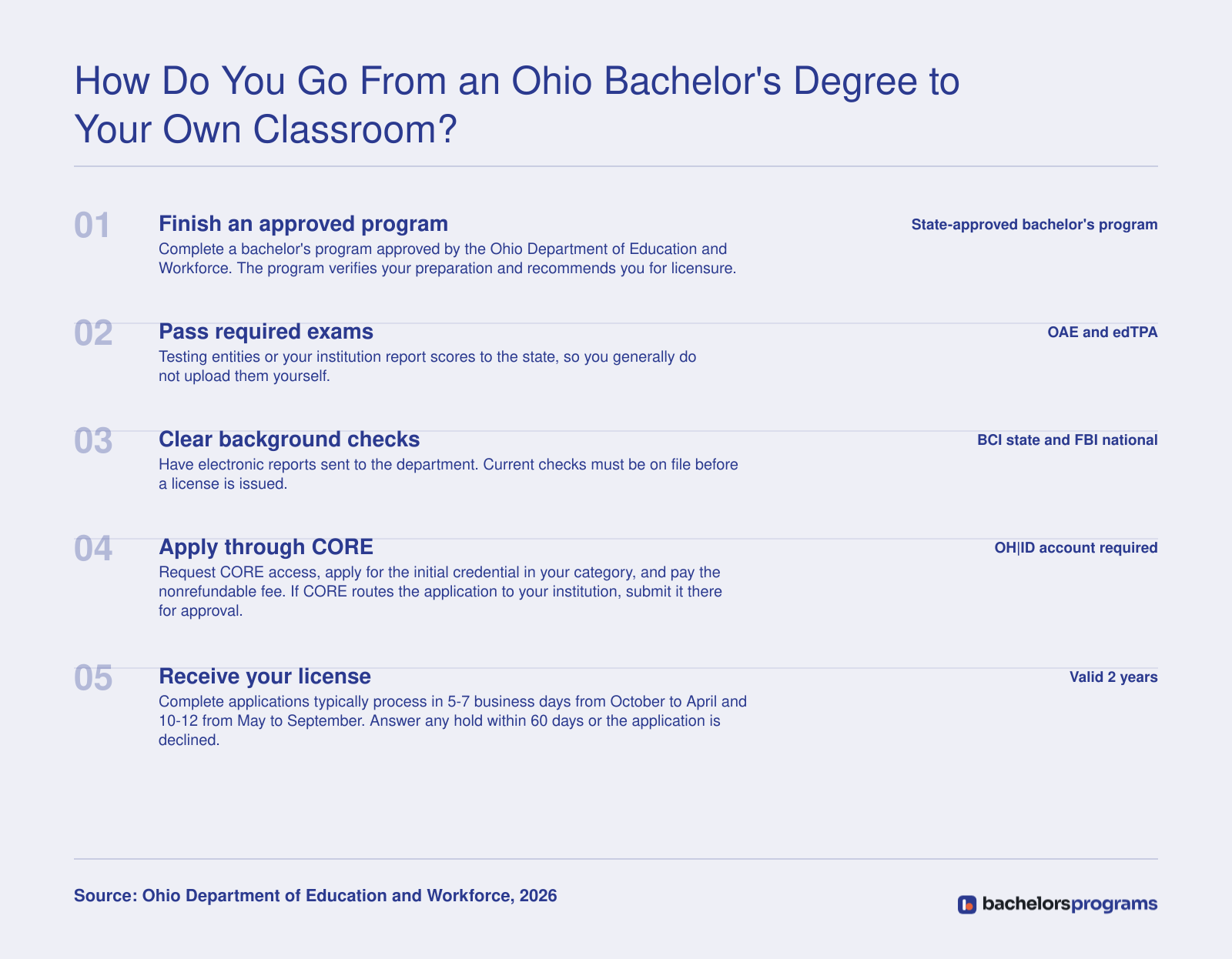
How Do You Go From an Ohio Bachelor's Degree to Your Own Classroom?
Ohio's first teaching credential is the 2-year Resident Educator License, issued by the Ohio Department of Education and Workforce. Your preparation program plays a direct role, so the order of these steps matters.
Careers and Salaries for Early Childhood Graduates in Ohio
Salary research for Ohio early childhood jobs takes an afternoon, and the Ohio numbers you pull yourself are worth more than any national average.
Step 1: Start With the Occupational Outlook Handbook
Open the Bureau of Labor Statistics Occupational Outlook Handbook entries for preschool teachers, kindergarten and elementary school teachers, and preschool and childcare center directors. Use these pages to understand the shape of each occupation, its entry requirements, and the current 2025-2035 projections window. Treat the median wages printed there as national context, not as Ohio pay.
Step 2: Pull Ohio Wage Data
Go to BLS.gov and open the Occupational Employment and Wage Statistics data for Ohio.1 Search by occupation title, then narrow by geography: statewide first, then metros such as Columbus, Cincinnati, Cleveland, Dayton, Akron, and Toledo. Record both the median and the range, because preschool pay varies widely between a public pre-K classroom and a private childcare center.
Step 3: Check State Labor Market Tools
OhioMeansJobs and the Ohio Department of Job and Family Services publish postings that show wage ranges and local demand. Search "preschool teacher," "lead teacher," and "childcare director" as separate queries; employers use different titles for similar work, and the title you type determines what you find.
Step 4: Read District Schedules and Center Postings
Every Ohio public school district posts its salary schedule and collective bargaining agreement. Find the bachelor's lane, read the step scale, and note that step placement often credits years of experience. For director roles, compare postings on local childcare center websites and regional job boards.
Step 5: Use Professional Associations
The National Association for the Education of Young Children, the Ohio Association for the Education of Young Children, and state teacher associations publish salary surveys, career guidance, and job boards. These are the fastest route to current openings and to members who will tell you what a role actually pays.
How We Ranked Ohio Early Childhood Education Schools
College Scorecard supplies the federal outcomes data behind every placement on this list, paired with our own verified program pages for each Ohio bachelor's program.
What Counts
Only bachelor's-level early childhood, primary education and child development programs at Ohio schools enter the ranking, whether they are taught on campus or online. A university's master's degrees, certificates and non-degree endorsements sit outside the set, so a strong graduate school does not lift a weak undergraduate program.
How Weighting Works
Earnings after graduation carry the most weight, followed by affordability and completion outcomes. We weight rather than average, so a program with high graduate pay but a steep net price does not automatically outrank one that is both affordable and steady on outcomes.
Known Limits
Neither graduation rate nor net price is reported at the program level; both describe the whole university rather than the education department alone. Some program-level figures are not published anywhere, and we leave those out instead of estimating them.
Sorting the Two Lists
The most affordable table orders schools by net price after aid, lowest first. The highest-earnings table orders them by median earnings for graduates, highest first. Both draw on the same ranked set.
Early Childhood Education in Ohio: Common Questions
How long does it take to earn a bachelor's degree in early childhood education?
Can you get an early childhood education degree online in Ohio?
What license do you need to teach preschool through grade 5 in Ohio?
Can I start at a community college like Stark State and finish a bachelor's in Ohio?
Do I qualify for a TEACH Grant as an early childhood education major?
Compare Early Childhood Education programs on the data that matters
Explore more Education & Teaching majors or browse every field of study.
All Education & Teaching programs Browse every field of study