Best Early Childhood Education Schools in Tennessee
Compare 17 accredited Early Childhood Education programs in Tennessee at 15 colleges, with net price after aid, graduation rates, earnings and debt from IPEDS and the U.S. College Scorecard.

A bachelor's degree in early childhood education, usually a B.S., is the standard route into Tennessee's PreK-3 classrooms. The state issues the license, not the school, so the program you pick has to be approved for licensure before anything else about it matters.
The practical tension is cost against approval. A degree from a school whose teacher preparation program does not lead to a Tennessee endorsement leaves you paying for credits that cannot get you hired in a public pre-K or elementary classroom.
Tennessee's PreK-3 endorsement covers pre-kindergarten through third grade. Programs that stop at birth through kindergarten prepare you for child care and early intervention instead, and the two are not interchangeable when a district reviews your application.
Key Points
- Five-year graduate earnings cluster tightly, between $43,222 and $45,926.
- Online and hybrid formats still require hands-on hours with young children.
- Tennessee PreK-3 licensure requires finishing a state-approved bachelor's program.
Best Early Childhood Education Schools in Tennessee: Our Ranked List
Schools appear here in our ranked order, which is anchored in how reliably students finish on time and what they actually pay after aid. Each card gives the essentials a comparison shopper needs: city, public or private, sticker tuition, typical net price after aid, and whether the program runs on campus, online or both.
Vanderbilt University
#1Nashville, TN · ~$16,000/yr (est.)
Best for: Research-minded students eyeing graduate study
Vanderbilt University is a private research university in Nashville, and its child development major sits inside Peabody College, the university's education school. Undergraduates study how children grow from infancy through adolescence, with close attention to family, school, community and cultural influences on learning. The major is built for students aiming at graduate work in psychology, medicine, nursing, social work, education or public policy rather than a direct route to a teaching license. The university's overall graduation rate is about 94 percent.
- Bachelor's major in Peabody College's Department of Psychology and Human Development
- Coursework covers biological, cognitive and social development
- Focus on family, peer, school, community and cultural contexts
- Prepares students for graduate study in psychology, medicine, nursing, social work
- Minors include Child Psychology and Mental Health, and Language Sciences
The University of Tennessee-Martin
#2Martin, TN · $11,000/yr (est. net price)
Best for: Aspiring special education PreK teachers
The University of Tennessee at Martin is a public university in rural northwest Tennessee where early childhood study is tied directly to licensure. Its integrated program pairs general education PreK-4 preparation with special education PreK-3 preparation, so graduates leave eligible for two classroom endorsements instead of one. Coursework covers literacy, math, science and social studies methods for inclusive classrooms, and the teacher preparation program is accredited by the Tennessee State Board of Education and CAEP. About 53 percent of undergraduates finish their degree.
- Leads to PreK-4 general education and PreK-3 special education licensure
- Accredited by the Tennessee State Board of Education and CAEP
- Methods coursework in English/language arts, science, social studies and math
- Built around inclusive classrooms serving children with and without disabilities
- One-up, one-down rule widens the ages a graduate may teach
- Financial aid and scholarships available
University of Memphis
#3Memphis, TN · $10,000 – $15,000/yr (est.)
Best for: Memphis-area future PreK-3 teachers
The University of Memphis is the city's public research university and an approved educator preparation provider in Tennessee. Its integrated early childhood degree runs 120 credit hours and threads field experience through the upper years, with two residency practica placed in partner schools. Students move into the teacher education program by the end of junior year and must clear Praxis content exams plus the edTPA before graduation. Roughly half of undergraduates complete a degree.
- 120 credit hours leading to PreK-3 licensure
- CAEP-accredited and approved by the state as an educator preparation provider
- Residency Practicum I and II plus a professional seminar
- Praxis 5025, 5205 and 5024 exams plus the edTPA required
- Teacher Education Program admission by the end of Junior I
- Grade of C- or better in all Junior I coursework
- Methods in literacy, math and science for inclusive early childhood settings
- Behavior management and assessment coursework
Tennessee Tech
#4Cookeville, TN · $10,000 – $15,000/yr (est.)
Tennessee Tech is a public university in Cookeville with a long-standing teacher preparation tradition. Its early childhood program carries a Birth-K concentration and folds special education licensure into the same degree, so graduates are prepared for both general and special education classrooms. Students get hands-on time in the on-campus Child Development Lab, and the university describes the program as nationally accredited. The institution's overall graduation rate is about 58 percent.
- Integrated special education licensure within the same degree
- On-campus Child Development Lab for observation and interaction
- Access to the Jeffers Learning Resources Center for materials and technology
- Described by the university as a nationally accredited early childhood program
- Bachelor of Science with a Birth-K concentration
Freed-Hardeman University
#5Henderson, TN · $22,000/yr (est. net price)
Freed-Hardeman University is a private university in Henderson, in West Tennessee, affiliated with the Churches of Christ. Its early childhood route runs through an interdisciplinary studies degree with a PreK-3 concentration and a heavy professional core in child development, literacy methods, classroom management and assessment. Students finish with a full practicum semester and a student teaching semester in public schools, and a 4+1 option lets them continue straight into a master's. About 71 percent of undergraduates complete their degree.
- 126 credit hours, typically four years of full-time study
- 54-hour professional core plus 30 hours of required courses
- Full semester of integrated professional practicum and a student teaching semester
- Leads to PreK-3 teaching licensure
- 4+1 option adds a master's degree in five years
- Dedicated early childhood education lab on campus
Middle Tennessee State University
#6Murfreesboro, TN · ~$13,000/yr (est.)
Middle Tennessee State University is a large public university in Murfreesboro, south of Nashville, with one of the state's biggest education colleges. It runs two distinct early childhood paths: a campus-based PreK-3 licensure track approved by the state and accredited by CAEP, and a partially online birth-to-age-5 track for people who want to work in Head Start, child care leadership or early intervention without a teaching license. The online-friendly option is designed for working professionals, with electives in administration, family support, health and nutrition.
- Non-licensure track for early learning and community settings
- Partially online and designed for working professionals
- Electives in administration and leadership, family support, health and nutrition
- Prepares graduates for Head Start teaching, center directorships and early intervention
- Emphasizes inclusive, relationship-based practice
- CAEP-accredited and approved by the Tennessee Department of Education
- Campus-based licensure track in the College of Education
- Adds a Teaching English Language Learners endorsement
- Career paths include Head Start teacher, child life specialist and early intervention specialist
- Access to the Handshake job and internship board
East Tennessee State University
#7Johnson City, TN · ~$16,000/yr (est.)
East Tennessee State University is a public university in Johnson City serving the Appalachian region. Its early childhood development degree is interdisciplinary, with a concentration aimed at child care and community agency work rather than a classroom teaching license. Licensed teachers can add a PreK-3 endorsement through a separate add-on route, and the university's certification office handles initial Tennessee licenses and out-of-state licensure paperwork for graduates.
- 120 credit hours, including 33 credits in the concentration on top of a 30-credit core
- Does not lead to licensure; prepares graduates for child care and community agencies
- Three-credit practicum included
- Grade of C or higher required in every major course
- PreK-3 add-on endorsement offered to educators who already hold a Tennessee license
- Minors available in early childhood and emergent inquiry
- Campus certification office processes initial Tennessee licenses
Christian Brothers University
#8Memphis, TN · ~$10,000/yr (est.)
Christian Brothers University is a private university in Memphis with a small, teaching-focused campus. Its integrated early childhood education degree is a 124-credit licensure program that pairs liberal arts coursework with 54 credits of early childhood major courses, and students apply separately to the teacher education program before entering the licensure track. Mentors are practicing Memphis classroom teachers, and the university is a state-approved teacher training institution with CAEP-accredited education programs. Around 55 percent of undergraduates finish their degree.
- 124 credit hours: 31 general education, 36 liberal arts, 54 early childhood major credits
- Meets Tennessee PreK-3 teacher licensure requirements
- CAEP-accredited and a state-approved teacher training institution
- Separate Teacher Education Program application for the licensure track
- Mentors are practicing Memphis classroom teachers
- Career paths include PreK teacher, Head Start teacher and private preschool director
The University of Tennessee-Chattanooga
#9Chattanooga, TN · ~$14,000/yr (est.)
The University of Tennessee at Chattanooga is a public university on the Tennessee River, and early childhood study there lives in the School of Education. Students can pursue an early childhood and early childhood special education concentration that leads to licensure through the teacher education program, or a child and family studies concentration focused on children, families and the programs that serve them. Coursework spans early literacy, assessment, child development and family interaction, and the college emphasizes professional practice and school partnerships.
- Combines early childhood and early childhood special education coursework
- Includes early literacy and assessment coursework
- Teacher Education Program requirements completed alongside the degree for licensure
- Housed in the School of Education
- Prepares graduates to support young children across settings
- Concentration within the Interdisciplinary Educational Studies B.S.
- Coursework in child development, family interaction and family stress
- Focus on children, families and family-serving programs
- Emphasizes professionalism, partnerships and performance
Belmont University
#10Nashville, TN · ~$33,000/yr (est.)
Belmont University is a private university in Nashville whose education college emphasizes early and frequent field experience. Its early childhood degree prepares students for dual licensure in early childhood and special education for pre-K through grade 3, with placements starting in the first year and ending with full-time student teaching. Students also work in the on-campus Little Bruins Preschool, and a 4+1 option adds a master's degree and licensure in one more year. The university's overall graduation rate is about 71 percent.
- Dual preparation in early childhood and special education licensure, pre-K through grade 3
- Field placements begin in the freshman year and finish with full-time student teaching
- Placements at the on-campus Little Bruins Preschool
- CAEP-accredited and approved by the Tennessee Department of Education
- Coursework includes Learning Through Play and Positive Behavioral Intervention and Support
- 4+1 option adds a master's degree and licensure
- Most students finish in four years of full-time study
Cost & outcomes by school
Federal data for the highest-earning Early Childhood Education programs, independent of the ranking above. Earnings are this field's bachelor's graduates four years after completing where the Scorecard reports them, else the school's undergraduate median.
| School | Net price / yr | Grad rate | Earnings | Debt | Grads/yr | Format |
|---|---|---|---|---|---|---|
| Christian Brothers University TN | $9,854 | 55% | $57,478 | $27,000 | — | Campus |
| Belmont University TN | $33,147 | 71% | $55,930 | $20,500 | 20 | Campus |
| Vanderbilt University TN | $15,846 | 94% | $55,188 | $14,000 | 35 | Campus |
| Middle Tennessee State University TN | $13,359 | 54% | $46,252 | $20,000 | 80 | Hybrid |
| The University of Tennessee-Chattanooga TN | $14,265 | 50% | $46,029 | $21,250 | 118 | Campus |
| Tennessee State University TN | $15,796 | 34% | $45,886 | $26,000 | 35 | Online or campus |
| University of Memphis TN | $12,397 | 51% | $44,293 | $26,750 | 54 | Campus |
| East Tennessee State University TN | $15,983 | 53% | $43,687 | $15,000 | 57 | Campus |
| Tennessee Tech TN | $14,246 | 58% | $43,264 | $13,000 | 170 | Campus |
| Freed-Hardeman University TN | $21,574 | 71% | $43,057 | $21,875 | 22 | Campus |
| The University of Tennessee-Martin TN | $10,701 | 53% | $42,481 | $19,500 | 61 | Campus |
| Carson-Newman University TN | $20,251 | 53% | $42,340 | $26,500 | 12 | Campus |
Sources: U.S. Department of Education. Net price, graduation rate, earnings and debt: College Scorecard (earnings and debt for this field's bachelor's graduates where reported, else school-wide); graduates: IPEDS. A dash means no figure is reported.
Cost, debt & payoff
Median earnings of this field's bachelor's graduates (4 yrs after completing, else the school's undergraduate median) vs. their median federal loan debt · U.S. College Scorecard
Across these programs the median graduate earns about $44,293 and finishes with roughly $21,250 in debt — a ratio that clears a common rule of thumb (keep debt below first-year salary). Net price and debt vary widely school to school, so check the per-school figures in the table above before you shortlist.
Most Affordable Early Childhood Education Schools in Tennessee
These schools are sorted by average annual net price, which is what students pay after grants and scholarships, based on 2024 U.S. Department of Education data from IPEDS and the College Scorecard. Sticker tuition can mislead: Christian Brothers University lists $38,420 in tuition and fees, but its average net price is $9,854. Check the licensure column too, since a non-licensure degree will not lead directly to a Tennessee PreK-3 teaching license.
| School | City | Average Annual Net Price | Tuition and Fees (In-State) | Program Format | Licensure Track |
|---|---|---|---|---|---|
| Le Moyne-Owen College | Memphis | $7,099 | $12,076 | Campus and online | Non-licensure (accreditation for licensure underway) |
| Christian Brothers University | Memphis | $9,854 | $38,420 | Campus | PreK-3 licensure |
| The University of Tennessee-Martin | Martin | $10,701 | $10,560 | Campus | PreK-4 general and PreK-3 special education licensure |
| University of Memphis | Memphis | $12,397 | $10,728 | Campus | PreK-3 licensure |
| Middle Tennessee State University | Murfreesboro | $13,359 | $10,266 | Hybrid | Non-licensure (birth to age 5) |
How We Ranked Tennessee's Bachelor's in Early Childhood Education Schools
How are the best early childhood education schools in Tennessee actually ranked?
We weigh what a degree costs, what graduates earn, and whether students finish it. Every school on the list offers a bachelor's-level early childhood program, campus or online, and the figures behind each position come from the College Scorecard's latest published snapshot.
The Five Signals
- Net price: What students pay after federal, state and institutional aid, not the published tuition.
- Graduation rate: The share of students who finish within the window federal data tracks.
- Earnings: Median pay for graduates of the specific program, a few years after completion.
- Debt: Typical federal borrowing among graduates, which shows how far an aid package really stretches.
- Completions: How many students actually finish, a rough signal of program scale and staying power.
Where the Data Stops Short
Two of those signals are measured for the whole institution rather than the early childhood department. Net price reflects every undergraduate at a school, and the graduation rate counts first-time, full-time students across all majors. A small, licensure-focused program can look very different from its university's overall profile, so treat those two figures as background on the school, not a verdict on the department.
Earnings are the larger gap. Federal data publishes program-level pay only where enough graduates exist to protect privacy, so some early childhood programs carry no earnings figure at all. Where that happens, we lean on the signals that are reported and skip the guesswork.
Tennessee Programs With the Highest Graduate Earnings
Vanderbilt's figure is measured four years after finishing and the others five years after, so compare the five-year rows with each other first: they sit within a narrow band of $43,222 to $45,926, while median debt ranges from $20,000 to $26,000. With earnings this close, the price you pay and the amount you borrow will shape your budget more than the program you choose, so weigh net price and loan totals as heavily as the salary column.
| School | Program | Median Earnings (Window) | Median Debt | Est. Monthly Loan Payment |
|---|---|---|---|---|
| Vanderbilt University | Child Development | $55,188 (four years after finishing) | N/A | N/A |
| Tennessee State University | Early Childhood Education | $45,926 (five years after finishing) | $26,000 | $276 |
| Middle Tennessee State University | Early Childhood Education (Integrated Birth to Age 5) | $44,313 (five years after finishing) | $20,000 | $212 |
| The University of Tennessee-Chattanooga | Early Childhood and Early Childhood Special Education | $43,652 (five years after finishing) | $21,250 | $225 |
| Freed-Hardeman University | B.S. in Interdisciplinary Studies (Early Childhood, PreK-3) | $43,222 (five years after finishing) | $21,875 | $232 |
Online and Hybrid Bachelor's Options at Tennessee Schools
An online or hybrid bachelor's in early childhood education moves some or all of the coursework online. The hands-on hours with young children still happen in a real classroom or child care center. That in-person requirement matters more than the course format when you compare the schools ranked here.
Campus, Hybrid, or Online
- Campus-based: Vanderbilt University, UT Martin, Tennessee Tech, Freed-Hardeman University, Christian Brothers University and UT Chattanooga run their programs on campus. Belmont University's program is fully in person in Nashville.
- Hybrid: Middle Tennessee State University's Integrated Birth to Age 5 program is partially online. It does not lead to teacher licensure.
- Mixed delivery: The University of Memphis offers PreK-3 classes face-to-face, online and in hybrid formats.
- Mostly online: East Tennessee State University offers a mostly online Early Care and Education track. It is also a non-licensure option.
How Field Hours and Student Teaching Work
ETSU's online students must have access to a 3-star child care center, where they complete a 130-hour practicum. The program page does not describe supervision arrangements or placements in a student's home district.
At Memphis, licensure candidates complete Residency I and II. This is a yearlong residency with supervising teachers in Shelby County and surrounding municipalities. Candidates also complete the edTPA and Praxis II. The program page does not say students can request placements elsewhere, so taking courses online does not remove the need to be near Memphis during residency.
Tennessee State University's 2025-2026 degree map points to a similar model: field experiences in local public schools, then a one-year clinical residency built on co-teaching with an in-service mentor teacher.
Practical Takeaways
- Settle the licensure question first: The most flexible formats here, at MTSU and ETSU, do not lead to a Tennessee teaching license.
- Plan around residency geography: Licensure tracks place you in local schools for a full year, whatever your course format.
- Out-of-state students, verify early: None of the program pages we reviewed promises placements outside Tennessee or confirms licensure eligibility in other states. Check with the program and your state's licensing agency before you enroll.
- Get supervision details in writing: Where a school does not publish who observes you or how often, ask before committing.
Related Articles
Tennessee Grants and Scholarships That Lower the Price
The cheapest route to a bachelor's degree takes more planning up front, and Tennessee's aid programs reward students who plan it early. Several programs also come with conditions that change what you actually receive, so confirm current details with the Tennessee Student Assistance Corporation (TSAC) before you rely on any figure.5
Programs at a Glance
- Tennessee Promise: A last-dollar scholarship that covers tuition and mandatory fees left after Pell, HOPE and other gift aid. You must be a Tennessee resident, enroll full time at an eligible community college or TCAT, stay continuously enrolled, and complete community service (16 hours per academic year starting in 2026-27, though TSAC rule text is not fully consistent on this).1 The award is not a fixed dollar amount. The deadline for the 2026 entering class was November 2, 20262, so future applicants should watch the TSAC and Tennessee Higher Education Commission announcements for their own cycle.
- Tennessee HOPE Scholarship: A lottery-funded award administered by TSAC.5 Eligibility rules and award amounts vary by school type and year, so check TSAC's current schedule instead of relying on older figures.
- HOPE teacher's scholarship: A state glossary lists $2,000 per year, up to $10,000 total, for aspiring teachers.4 Whether that is still the current teacher-aid program, and its service terms, should be verified with TSAC.
- Dual Enrollment Grant: For juniors and seniors with at least a 2.75 GPA, reapplied for each semester. It pays $500 for a first course, $500 for a second (HOPE eligibility required) and $200 for a third, with nothing for a fourth.3 The annual cap is $1,200.
How to Apply
Start with the FAFSA, since TSAC uses it for state aid, then complete any separate TSAC application the program requires. Deadlines shift each year, so confirm them on the TSAC site.
Community College Plus Transfer
Two years of Promise-covered tuition can remove roughly half the price of the bachelor's. Before enrolling, ask your target university's early childhood program which credits transfer, and whether the community college program follows a state transfer pathway.
The Cheapest Realistic Path
For a Tennessee resident, that means earning dual-enrollment credit in high school, using Promise for the first two years at a community college, then transferring to a public university on the list above and adding HOPE and any teacher aid.
Tennessee Prek-3 Licensure: What the Degree Needs to Lead To
The real decision is age range. A PreK-3 endorsement prepares you for pre-kindergarten through third-grade classrooms. The Integrated Early Childhood Education Birth-K endorsement centers on infants, toddlers and kindergartners, including children with disabilities. Both require a state-approved bachelor's program, so the degree you choose largely decides which license you can earn.
How PreK-3 Differs From Birth-K
Tennessee lists Early Childhood Education PreK-3 as its own endorsement, built on the state's early-childhood standards.1 The Integrated Birth-K endorsement aligns with NAEYC and Council for Exceptional Children standards, so it blends general and special education for the youngest learners. Settle on the age band before you settle on a school.
What Tennessee Requires
- Approved program: Complete an educator preparation program approved by the State Board and Department of Education, and earn its recommendation.2
- Content tests: Submit qualifying scores on required assessments, administered by ETS, NES or the Tennessee Language Center.3 Tests and passing scores vary by endorsement, so check the department's current Praxis chart. Praxis Core may be required to enter a program, not for the license itself.
- Pedagogy test: Under 2026 policy, candidates seeking licensure on or after July 1, 2026, through an approved program with department-approved clinical practice do not need a pedagogical assessment such as the PLT or edTPA.4 If your program finished before its clinical practice was approved, you may still need one.
- Application: Apply through TNCompass.5
If you hold a bachelor's degree and are still completing a preparation program, a Practitioner license gives you three years to finish and pass your tests, with a possible three-year renewal.6
Special Education Options
For young children with disabilities, the most relevant routes are the Special Education Preschool/Early Childhood PreK-3 endorsement and the Integrated Birth-K license. Tennessee also lists Special Education Interventionist K-8, which reaches into older grades. Ask each program which endorsements its coursework supports.
Which Programs Lead to PreK-3
Freed-Hardeman University, Christian Brothers University, Belmont University and Le Moyne-Owen College title their bachelor's programs for PreK-3. Tennessee Tech, Middle Tennessee State University and Tennessee State University offer early childhood education majors. The University of Tennessee-Martin and University of Memphis offer integrated early childhood tracks, and UT Chattanooga pairs early childhood with early childhood special education. Child development majors, like those at Vanderbilt University and East Tennessee State University, may not include licensure. Confirm state approval with each school, and look for an accreditor such as CAEP where the school publishes one.
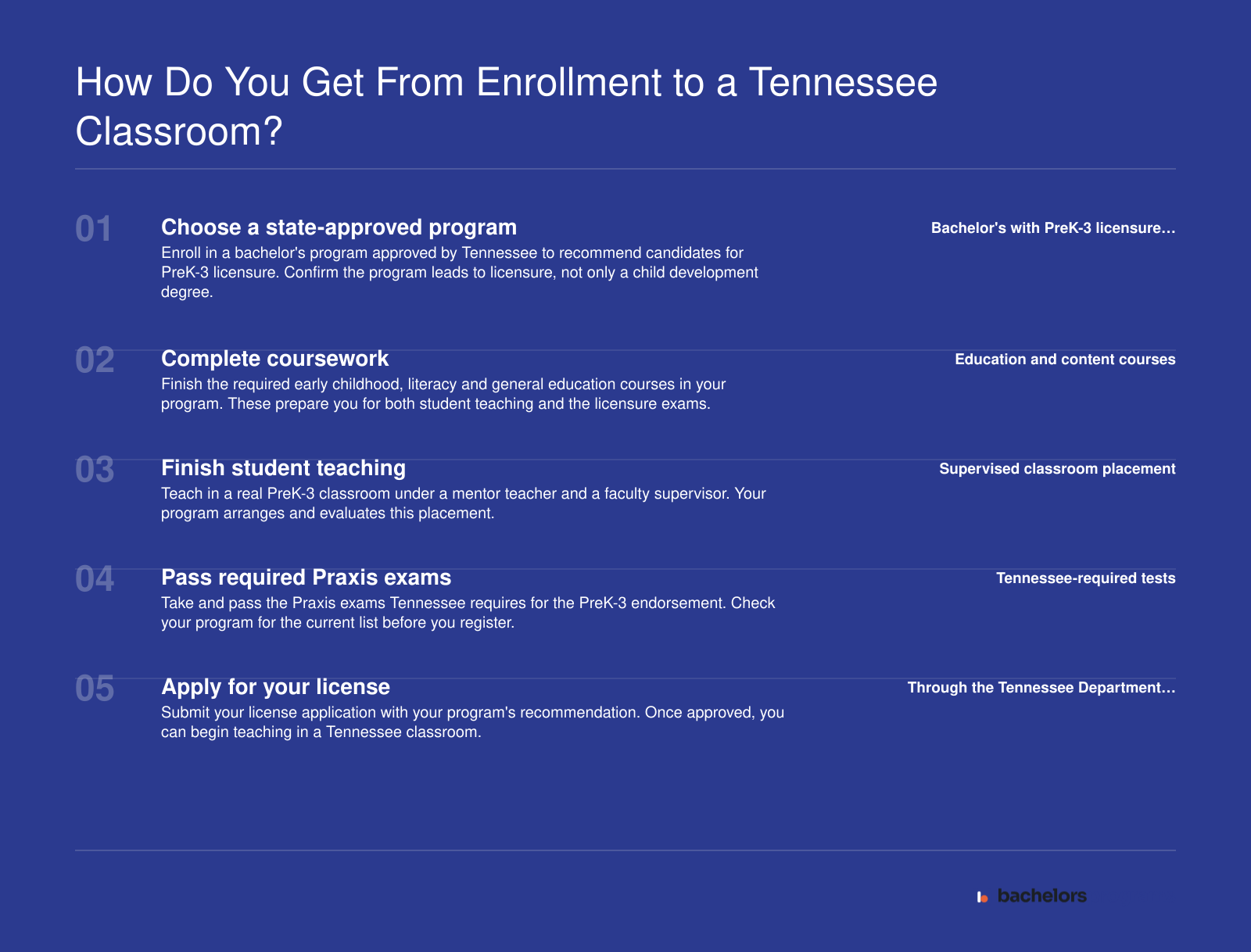
How Do You Get From Enrollment to a Tennessee Classroom?
A bachelor's degree in early childhood education is the starting point, but the license is what puts you in front of a Tennessee classroom. The path below follows the same order covered in the licensure section, so you can see where each requirement fits.
Compare Early Childhood Education programs on the data that matters
Explore more Education & Teaching majors or browse every field of study.
All Education & Teaching programs Browse every field of study