Best Early Childhood Education Schools in Virginia
Compare 7 accredited Early Childhood Education programs in Virginia at 6 colleges, with net price after aid, graduation rates, earnings and debt from IPEDS and the U.S. College Scorecard.

Virginia splits its early childhood degrees into two tracks, and only one ends in a licensed PreK-3 classroom.
The programs ranked here lead to a bachelor's degree in early childhood education in Virginia, most often the Bachelor of Science (B.S.) in Early Childhood Education. The comparison covers campus and online formats, admission rules and cost. The comparison assumes you are aiming at a teaching license. Child care and preschool-assistant searchers should start with the licensure section, where the two paths divide.
Demand for early childhood teachers holds steady, but pay follows the credential and the setting more than the degree title.
Key Points
- Virginia's PreK-3 endorsement requires a full approved preparation pathway, not a test.
- SCHEV puts 2026-27 in-state tuition and fees at $15,356 on average.
- Liberty's online, non-licensure graduates earned a $40,952 median by year four.
Best Bachelor's Degree in Early Childhood Education Programs in Virginia
Six Virginia institutions currently award a bachelor's degree in early childhood education, and they divide cleanly into programs that lead to a Virginia teaching license and programs that do not. The entries below move from the most selective campus program to the most flexible online options, and each card lists format, city, net price after aid and the institution-wide graduation rate.
University of Virginia
#1Charlottesville, VA · $22,000/yr (est. net price)
Best for: Current undergrads adding a teaching license
The University of Virginia runs its early childhood degree through the School of Education and Human Development, where students complete 120 credits and finish with initial Virginia licensure and an Early/Primary preK-3 endorsement. Admission is internal, aimed at current UVA undergraduates and transfer students, and current high school students are not considered. The university has announced plans for an early childhood learning center that would connect teacher preparation with research and community services. The institution-wide graduation rate is 95.6% and net price after aid averages $21,565.
- 120 credits over four years, or two academic years after admission
- Leads to initial Virginia licensure with an Early/Primary preK-3 endorsement
- Open to current UVA undergraduates and transfer students
- Priority deadline February 1; final deadline June 1
- External transfer applicants apply by March 1
- No applications accepted from current high school students
- Guaranteed admission to select UVA master's programs within five years
- Classes meet in person
George Mason University
#2Fairfax, VA · $15,000 – $20,000/yr (est.)
Best for: Northern Virginia residents wanting inclusive classrooms
George Mason University offers a Bachelor of Science in Education in Inclusive Early Childhood Education built around 120 credits, with coursework delivered in person on the Fairfax campus and no fully online option. The degree is non-licensure, aimed at readers who want to teach and support young children in early care, inclusion and family-service settings rather than pursue a Virginia teaching license. A semester-long full-time internship serves as the capstone, and an accelerated master's lets students finish an MEd within a year. The institution-wide graduation rate is 67.8% and net price after aid averages $17,915.
- 120 credits: 38 Mason Core, 33 program core, 12 internship
- Non-licensure track for early care and education settings
- Semester-long full-time internship in the final term
- Course work completed in person on the Fairfax campus
- $617 per credit for Virginia residents, plus a $350 new student fee
- Field observations in Northern Virginia schools
- Accelerated MEd possible within one year after the bachelor's
Liberty University
#3Lynchburg, VA · ~$29,000/yr (est.)
Best for: Working adults needing fully online study
Liberty University is the largest early childhood provider in this group and the most flexible, with two fully online bachelor's options in the field. Both are non-licensure, and the early childhood interdisciplinary studies degree is not a state-approved preparation program, so it does not lead to a Virginia teaching license on its own. Readers wanting a licensed classroom route should look at the campus programs above. The institution-wide graduation rate is 65.3% and net price after aid averages $29,357; graduates in this field reported median earnings of $40,952 four years after finishing and median federal debt of $24,500.
- Fully online, 120 credits across four years
- Non-licensure; not a state-approved program in Virginia
- 39 to 42 general education credits and 48 in the major
- Two areas of study: education and early childhood
- 2.0 GPA, 30 upper-level hours, C minimum in major courses
- 30 hours must be completed through Liberty
- Transferring 45 or more credits waives RLGN 104
- Fully online with asynchronous classes
- Eight start dates per year at $410 per credit
- $0 application fee and test-optional admission
- Transfer in up to 75% of credits
- Capstone required within 120 total credit hours
- Military tuition rate of $250 per credit
- Study development from birth through adolescence
- Electronic textbooks included
Virginia Commonwealth University
#4Richmond, VA · ~$23,000/yr (est.)
Virginia Commonwealth University awards a Bachelor of Science in Education in Early Childhood Education and Teaching with two tracks: one that leads to initial PK-3 licensure and one that does not. Students complete three practicums plus internships in PK-K and grades 1 to 3, with coursework in early literacy, math and science methods, arts integration and teaching multilingual learners. State funding authorized in the 2026 budget lets VCU continue and expand the Richmond Teacher Residency in partnership with Richmond City Public Schools. The institution-wide graduation rate is 63.2% and net price after aid averages $23,433.
- 120 credits; the sample plan of study runs four years
- Licensure track leads to initial PK-3 licensure from the Virginia Department of Education
- Non-licensure option is also available
- 2.8 GPA to enter teacher preparation; 3.0 for the clinical internship
- Three practicums plus PK-K and grades 1 to 3 internships
- Coursework in early literacy, math and science methods, and arts integration
- Focus on inclusive settings and teaching multilingual learners
Regent University
#5Virginia Beach, VA · ~$20,000/yr (est.)
Regent University delivers its Bachelor of Science in Early Childhood Education entirely online and deliberately blends education coursework with childcare business operations, from program funding to administration. The degree is non-licensure and covers development from birth through age 8, preparing graduates for preschool teaching, center direction and education consulting. The institution-wide graduation rate is 56.9% and net price after aid averages $19,923; graduates reported median earnings of $35,318 four years after finishing and median federal debt of $24,534.
- Fully online; 120 or more credit hours
- Non-licensure degree that does not lead to a Virginia license
- $415 per credit for full-time students, $470 part time
- $750 university services fee each semester
- Coursework blends education with childcare business operations
- Covers development from birth through age 8
- Student background checks required
- Prepares graduates for preschool teaching and center director roles
Bluefield University
#6Bluefield, VA · ~$26,000/yr (est.)
Bluefield University offers a Bachelor of Science in Early Childhood Education online, with 120 credits and a pace that lets students finish in one to four years using transfer and prior learning credit. Two practicums of 60 on-site hours each place students in local schools and early childhood centers, and the next online start is December 2026. The institution-wide graduation rate is 17.8% and net price after aid averages $25,573, so readers should weigh completion support carefully here. Graduates move into roles such as preschool teacher, kindergarten teacher and childcare center director.
- Online at $420 per credit
- 120 credits; completion in one to four years
- Practicum I and Practicum II, each 60 on-site hours
- Prior learning and transfer credit can shorten the degree
- Next online start is December 2026
- Coursework in child development, assessment, and family and community involvement
Cost & outcomes by school
Federal data for the highest-earning Early Childhood Education programs, independent of the ranking above. Earnings are this field's bachelor's graduates four years after completing where the Scorecard reports them, else the school's undergraduate median.
| School | Net price / yr | Grad rate | Earnings | Debt | Grads/yr | Format |
|---|---|---|---|---|---|---|
| University of Virginia VA | $21,565 | 96% | $86,863 | $17,500 | 24 | Campus |
| George Mason University VA | $17,915 | 68% | $76,343 | $19,500 | 77 | Campus |
| Virginia Commonwealth University VA | $23,433 | 63% | $58,128 | $21,500 | 49 | Campus |
| Bluefield University VA | $25,573 | 18% | $48,896 | $21,855 | 8 | Online |
| Liberty University VA | $29,357 | 65% | $40,952 | $25,664 | 518 | Online |
| Regent University VA | $19,923 | 57% | $35,318 | $22,542 | 18 | Online |
Sources: U.S. Department of Education. Net price, graduation rate, earnings and debt: College Scorecard (earnings and debt for this field's bachelor's graduates where reported, else school-wide); graduates: IPEDS. A dash means no figure is reported.
Cost, debt & payoff
Median earnings of this field's bachelor's graduates (4 yrs after completing, else the school's undergraduate median) vs. their median federal loan debt · U.S. College Scorecard
Across these programs the median graduate earns about $48,896 and finishes with roughly $21,855 in debt — a ratio that clears a common rule of thumb (keep debt below first-year salary). Net price and debt vary widely school to school, so check the per-school figures in the table above before you shortlist.
How We Ranked Early Childhood Education Schools in Virginia
A program's sticker price tells you what it costs. Its net price and its graduates' earnings tell you what it returns. Our order leans on the second set of numbers.
What Moves a School Up or Down
Schools are sorted using the latest College Scorecard snapshot. Net price, graduation rate, earnings for graduates of the early childhood education program, student debt, and the number of degrees the program awards all shape the position. Completions act as a sanity check: a program that steadily awards degrees is running on solid ground.
Whole-School Figures vs Program Figures
Net price, graduation rate, and debt describe the entire institution. Earnings and completions describe the early childhood education program itself. Keep the two apart. A well-regarded program inside a large university still carries that university's average price, not a price of its own.
Net price averages what students who receive aid actually pay; it is not a quote for you. Your number depends on family income, aid offers, and residency, so use it to compare schools and then run each college's net price calculator.
Only Virginia-based bachelor's programs count here, whether you study on campus or online.
Online and Hybrid Bachelor's Options at Virginia Schools
Online and hybrid study in early childhood education means taking classes remotely while completing supervised hours in a real classroom. The field component usually decides whether the format fits your schedule.
Which Formats Are Available
Liberty University, Regent University, and Bluefield University list fully online early childhood bachelor's options. Liberty's B.S. in Early Childhood Education Interdisciplinary Studies is online and non-licensure. Regent's online B.S. is also expressly non-licensure1; Regent directs licensure seekers to its B.Ed. in Early & Primary Education. Bluefield blends online coursework with a 60-hour on-site practicum and lists a December 2026 online start. The University of Virginia, George Mason University, and Virginia Commonwealth University list campus-based programs with in-person classes and local field placements.
Fieldwork and Student Teaching
Online does not mean hands-on-free. Bluefield requires its 60-hour practicum. Mason places students in Northern Virginia regional schools for observation and a full-time final-semester internship, with applications due the preceding semester. UVA's internship runs three days a week from mid-August through November. VCU integrates fieldwork and internship experiences. Ask who secures the site: the program or you.
Licensure Across State Lines
A Virginia-approved program prepares you for a Virginia license, not automatically for another state's. Out-of-state students should confirm with the program and their home state board whether the online version leads to licensure and where placements can be completed. Virginia residency does not turn a non-licensure online degree into a licensure program; Regent's online B.S. is one example. UVA notes graduates may apply to other states' boards.
Before enrolling, ask in writing how placement support works: who finds the classroom, whether your local district has an agreement, and what travel and background checks are required.
Admissions: GPA, Test Policy, and Transfer Credit
The hardest part of transferring into an early childhood education program in Virginia is rarely the coursework. It is the mismatch between the school that accepts the most credits and the school that is easiest to get into. The programs here sit at different points on that line, and their published rules are uneven, so read each one before you pay an application fee.
University of Virginia: the highest bar, the clearest rules
UVA publishes the most explicit transfer standards. A 3.0 cumulative GPA at the previous college is the stated minimum, and competitive applicants typically arrive with 54 to 60 transferable credits and general-education requirements essentially finished. SAT and ACT scores are not required from transfer applicants. Up to 60 credits transfer, and at least 60 of the 120 required credits must be earned after enrolling. An admit rate of roughly 17% and a 42% Pell share place it in a different selectivity bracket from the rest.
George Mason, VCU, Liberty, Regent, and Bluefield
- George Mason University: About 87% of applicants are admitted. The university runs a co-enrollment partnership pairing community college coursework with Mason advising, but the program page does not publish a minimum transfer GPA.
- Virginia Commonwealth University: A 2.8 GPA is the stated minimum, with a 3.0 required to enter the clinical internship.
- Liberty University: A 2.0 GPA minimum, at least 30 credit hours completed through Liberty, and 25% of the major finished there. Transferring 45 or more credits waives one general-education requirement.
- Regent University and Bluefield University: Neither program's materials state a minimum GPA. Both review applicants individually, so ask admissions directly.
Beyond UVA, the program materials reviewed here do not spell out a test policy. Confirm it with each admissions office rather than assuming a score is optional.
What community college credit actually guarantees
Guaranteed-admission agreements in Virginia are written around the transfer-oriented associate degree, not around individual courses. A student who finishes a career-technical associate degree in early childhood often gets course-by-course articulation instead of a guaranteed seat, which can mean arriving with credit for some classes but no assurance of admission. Ask two questions of every school: which credits count toward the 120-credit degree, and what GPA keeps them.
Cost in Virginia: In-State Tuition and Net Price After Aid
For 2026-27, SCHEV reports that average published in-state tuition and mandatory fees at Virginia's state-supported colleges is $15,356, up 3.4% ($510) from the prior year, so current bills may run above the federal figures shown below. The table pairs each school's published in-state tuition and fees with its average net price, which is what students actually paid after grants and scholarships. George Mason has the lowest net price here at $17,915, while the private schools (Regent, Bluefield, and Liberty) charge the same tuition to Virginia residents and out-of-state students.
| School | Location | Type | Published In-State Tuition and Fees | Average Net Price After Aid | Program Per-Credit Rate |
|---|---|---|---|---|---|
| George Mason University | Fairfax | Public | $14,220 | $17,915 | $617 |
| Regent University | Virginia Beach | Private nonprofit | $21,650 | $19,923 | $415 |
| University of Virginia | Charlottesville | Public | $21,803 | $21,565 | N/A |
| Virginia Commonwealth University | Richmond | Public | $16,945 | $23,433 | N/A |
| Bluefield University | Bluefield | Private nonprofit | $26,770 | $25,573 | $420 |
| Liberty University | Lynchburg | Private nonprofit | $22,465 | $29,357 | N/A |
Virginia Grants and Scholarships for Future Teachers
Virginia runs a handful of state aid programs for future teachers, each with its own eligibility rules and deadlines, and one with a teaching commitment.
Virginia Tuition Assistance Grant
VTAG is aid for Virginia residents at participating private colleges and is not based on financial need.1 Undergraduates need one year of Virginia domicile or military-dependent eligibility, full-time enrollment in an eligible degree program, and a separate VTAG application beyond the FAFSA. It can last up to four undergraduate years.1 Confirm the current award amount and fall priority deadline with SCHEV or your aid office.2
VGAP and the Teaching Scholarship Loan
The Virginia Guaranteed Assistance Program targets financially needy Virginia students at public two- and four-year colleges. It requires a 2.5 high school GPA, a 980 SAT or 19 ACT for home-school completers, and a FAFSA or VASA by the school's deadline.3 Awards start at $500 and can cover tuition, fees, and books; renewal requires a 2.0 GPA and 12 credits per semester.4 SCHEV says VGAP is being phased out at public institutions starting July 1, 2026, so confirm your cohort's status.5
The Virginia Teaching Scholarship Loan Program provides up to $10,000 per academic year for students preparing for teacher-shortage fields.6 It requires a 2.7 GPA and a post-graduation work agreement; participating Virginia institutions list it, and no residency restriction applies.6
Pell and Your Next Step
Pell Grants are the main federal need-based award for undergraduates, and the FAFSA is the only application. The share of students receiving Pell varies by school, and your own award depends on family income. Complete the FAFSA, then check each school's financial aid page for its VTAG, VGAP, and scholarship deadlines; they differ by program and by campus, and missing one can cost you aid.
Related Articles
Virginia Teaching License With Prek-3 Endorsement: What You Need
Virginia's PreK-3 credential, formally the Early/Primary Education PreK-3 endorsement, is an initial teaching endorsement. You cannot add it to a license you already hold by passing a test, so plan on a full approved preparation pathway rather than a quick endorsement.
The licensure path, in order
- Degree: a bachelor's degree completed through a state-approved teacher preparation program, including early childhood content and professional studies coursework.
- Clinical practice: supervised student teaching or an equivalent practicum.
- Assessments: the Virginia Communication and Literacy Assessment (VCLA), which is required for an initial license, plus one Praxis subject-area test that matches an endorsement area on that license.
- Statutory requirements: the background checks and other conditions the state sets for licensure.
- License type: a Provisional license is the entry-level option and carries conditions; the Collegiate Professional license is the standard credential once the approved program, assessments, and statutory requirements are complete.
VCLA is not required for add-on endorsements. For the PreK-3 reading requirement, the Virginia Department of Education lists Praxis Teaching Reading: Elementary (5205) with a passing score of 159, effective September 1, 2022, or the RVE Elementary and Special Education (5306). Test names and cut scores change, so confirm the current reading test and content test on VDOE's licensure assessment chart before you register.
PreK-3 or Early Childhood Special Education
Early Childhood Special Education is a separate endorsement authorizing special education services for young children with disabilities. VDOE guidance accepts PreK-3 with ECSE, PreK-6 with ECSE, or ECSE with the Early Childhood Three- and Four-Year-Old add-on, which covers ages 3 and 4 and is submitted by the school division. In an inclusive Virginia Preschool Initiative classroom, PreK-3 on its own qualifies; an ECSE-only classroom requires the ECSE endorsement. Licensed elsewhere? A comparable endorsement can qualify if you finished a state-approved program at an accredited four-year college, hold a valid out-of-state license without deficiencies, or hold active National Board certification.
Licensed teacher or preschool teacher?
Public school PreK-3 positions require the license. Child care centers and private preschools set their own hiring qualifications, so what degree you need to teach preschool in Virginia depends on the setting: a bachelor's in early childhood education is the strongest preparation, but the state teaching license is a public school requirement, not a universal one. Start with VDOE for licensing rules and ask individual employers about their own expectations.
Early Childhood Education Jobs and Pay in Virginia
Licensed classroom roles pay far more than preschool work in Virginia. In the U.S. Bureau of Labor Statistics wage estimates for May 2019, kindergarten teachers earned a median of $68,720 and elementary teachers $69,690, compared with $38,170 for preschool teachers, a gap of roughly $30,000 that makes the PreK-3 licensure route covered above worth planning for, while center directors, at $58,530, fall between the two groups. Elementary schools were by far the largest employer, with 38,700 jobs statewide, and because projections for the current 2025-2035 window are not available for these roles, the outlook column is marked N/A.
| Occupation | Virginia Employment | Median Annual Wage | Outlook |
|---|---|---|---|
| Preschool teachers, except special education | 10,360 | $38,170 | N/A |
| Kindergarten teachers, except special education | 4,030 | $68,720 | N/A |
| Elementary school teachers, except special education | 38,700 | $69,690 | N/A |
| Preschool and child care center directors | 1,040 | $58,530 | N/A |
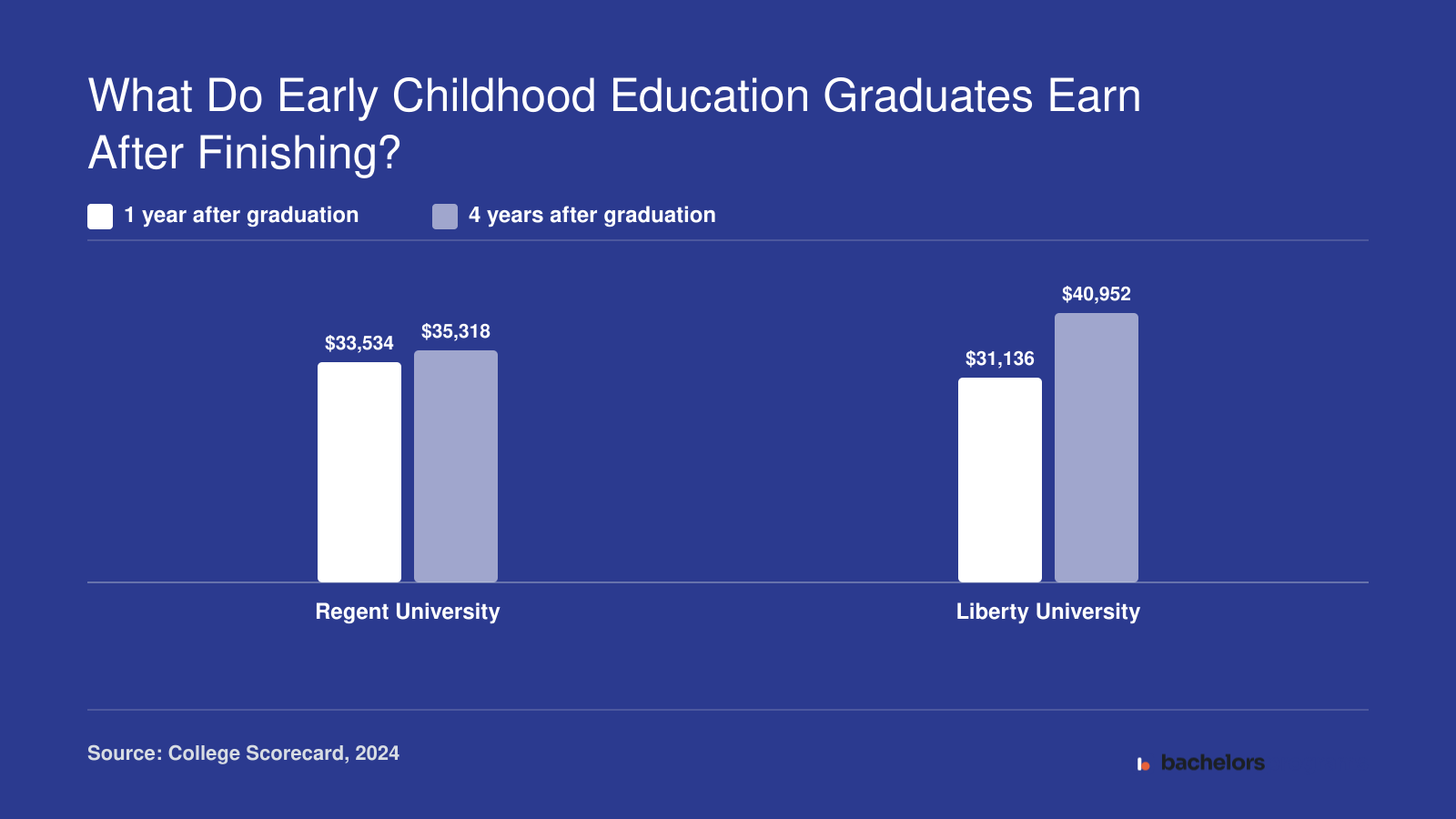
What Do Early Childhood Education Graduates Earn After Finishing?
Regent University graduates earned a median of $33,534 one year after finishing, and Liberty University graduates earned $31,136. By year four, Liberty graduates reached $40,952 and Regent graduates reached $35,318. Both are online, non-licensure programs. Set these figures beside the Virginia wage ranges in the previous section to see where new graduates start. Median federal loan debt is $25,664 at Liberty (about $272 a month) and $22,542 at Regent (about $239 a month). Regent's graduating group is small, so its figures can shift from year to year. The other schools ranked here do not report program-level earnings for this degree, so the chart shows these two only.
Common Questions About Early Childhood Education Degrees in Virginia
These answers draw on the program details and 2026-27 cost figures covered above. Always confirm licensure status and current rates with each school before you apply.
What are the best colleges for early childhood education in Virginia?
Can you get a bachelor's degree in early childhood education online in Virginia?
How much does an early childhood education degree cost in Virginia?
How long does a bachelor's degree in early childhood education take?
Does every online early childhood degree lead to a Virginia teaching license?
Compare Early Childhood Education programs on the data that matters
Explore more Education & Teaching majors or browse every field of study.
All Education & Teaching programs Browse every field of study