Best Elementary Education Degree Programs in Georgia
Compare 37 accredited Elementary Education programs in Georgia at 36 colleges, with net price after aid, graduation rates, earnings and debt from IPEDS and the U.S. College Scorecard.

Georgia certifies elementary teachers for pre-kindergarten through grade five, and the standard route is a bachelor's degree in elementary education, most often a Bachelor of Science (B.S.) in Elementary Education, from a state-approved program. The degree alone does not license you. A T-4 certificate also requires passing state assessments and completing supervised student teaching.
The top 10 ranked programs, all at Georgia-based schools on campus or online, come with the cheapest and highest-earning picks, plus admissions, cost, T-4 certification and career outcomes.
Certification rules are set by the state, not by the school. What varies between programs is price, format, and how selective the teacher education admission step is.
Key Points
- Dalton State College has the lowest average net price here: $5,012 yearly.
- Georgia's T-4 elementary certificate covers pre-kindergarten through grade five.
- Online students still complete supervised student teaching in a real classroom.
Best Bachelor's Degree in Elementary Education Schools in Georgia, Ranked
Georgia certifies elementary teachers for pre-kindergarten through grade five, and every program below prepares students for that credential. The list spans large public research universities, private liberal arts colleges, a women's HBCU, and two options that can be completed largely or fully online, so readers can weigh cost, class size, and classroom time against their own situation.
University of Georgia
#1Athens, GA · ~$14,000/yr (est.)
Best for: Future teachers wanting heavy classroom time
The University of Georgia is the state's flagship public university, and its elementary education degree is the most selective entry on this list, admitting a capped cohort each fall and spring. Students are in elementary classrooms in each of four semesters, logging more than 400 practicum hours before a final student-teaching semester. The program leads to Georgia certification for pre-kindergarten through grade five, and undergraduates can shorten the path to a master's through the Double Dawgs pathway.
- 2.8 GPA minimum plus specific core and education courses
- Admits up to 75 students per year, fall and spring cohorts
- 400+ practicum hours across four semesters
- Final semester dedicated to student teaching
- Leads to Georgia certification for PK-grade 5
- Fall 2027 application closes January 22
- Double Dawgs B.S.Ed./M.Ed. pathway available
- Study abroad options in Italy and Ghana
Berry College
#2Mount Berry, GA · $22,000/yr (est. net price)
Best for: Small-campus students adding ESOL endorsement
Berry College is a private residential college in Mount Berry, near Rome, built around a work-experience model that keeps campus jobs part of student life. Its elementary education major leads to a Bachelor of Science and to Georgia certification for pre-kindergarten through fifth grade, with field placements that put students alongside diverse and exceptional learners. ESOL endorsement coursework is required of every major, and an Autism endorsement is available as an add-on.
- Bachelor of Science leading to Georgia P-5 certification
- ESOL endorsement coursework required for all majors
- Autism endorsement option available
- Field-based experiences with diverse and exceptional learners
- Coursework in human growth and development
- Professional education sequence plus general education core
Spelman College
#3Atlanta, GA · $35,000 – $40,000/yr (est.)
Best for: Women considering urban teaching careers
Spelman College is a private women's liberal arts college and historically Black institution in Atlanta, and its elementary education major is one of the most structured on this list. The 63-credit major includes a junior research seminar, a senior thesis, and 12 credits of student teaching, and it is approved by the Georgia Professional Standards Commission through May 2030. An Urban Education endorsement gives graduates an extra credential for city classrooms.
- 63 credit hours including senior thesis
- 12 credits of student teaching across two seminars
- Apply to the certification program after EDU 206
- PreK-5 Georgia teacher certification track
- Urban Education endorsement available
- CAEP and GaPSC approved through May 2030
- Honor society: Kappa Delta Epsilon
Georgia College & State University
#4Milledgeville, GA · $9,000 – $30,000/yr (est.)
Georgia College & State University is a public liberal arts university in Milledgeville with a teacher education department that has earned national attention for reading instruction. Its elementary education bachelor's degree sits alongside middle grades and special education tracks in the same department, so students share faculty and advising across programs. The College of Education was accredited by the Council for the Accreditation of Educator Preparation in 2022, and the university reports that a large share of graduates finish debt-free.
- NCTQ A+ for preparing teachers to teach reading
- CAEP accreditation earned in May 2022
- B.S. tracks in elementary, middle grades, and special education
- GACE test information provided to teacher candidates
- Program co-coordinators serve on the faculty
Mercer University
#5Macon, GA · ~$24,000/yr (est.)
Mercer University is a private university in Macon whose elementary and special education degree is the most flexible entry on this list. Classes run online in 8-week terms with both synchronous and asynchronous options, five start dates a year, and completion in 18 to 24 months for students arriving with credit. Three to four field experiences are arranged in local schools, and an embedded reading endorsement adds a second credential to the P-5 certification path.
- 8-week online terms, synchronous or asynchronous
- Five start dates per year, completion in 18 to 24 months
- 2.5 GPA minimum for program entry
- GACE Program Admission assessment no longer required
- Three to four field experiences in local schools
- Embedded reading endorsement available
- Teacher candidacy application in sophomore year
- Leads to P-5 certification and Level 4 induction
Covenant College
#6Lookout Mountain, GA · $26,000/yr (est. net price)
Covenant College is a private Christian liberal arts college on Lookout Mountain in northwest Georgia, small enough that education majors know their professors well. Its Elementary Education Early Childhood major covers grades P-5 and sits within the Education Department's undergraduate offerings. The program publishes a downloadable overview for prospective students who want the full course sequence before applying.
- Covers grades P-5 within an early childhood focus
- Listed among the Education Department's undergraduate majors
- Program overview available for download
Georgia Southern University
#7Statesboro, GA · $15,000 – $20,000/yr (est.)
Georgia Southern University is a public university in Statesboro with a second campus in Savannah, and its education college has a long reach across the state. The elementary education certification track runs 123 credits and includes practicums in public school classrooms plus a capstone student teaching internship, with a fully online concentration for students who cannot attend in person. The university is also building a statewide literacy center supported by new state funding tied to the Georgia Early Literacy Act of 2026.
- 123 total credit hours
- Fully online Elementary P-5 concentration available
- NCTQ A grade for reading preparation in the 2026 review
- Practicums in public school classrooms plus capstone internship
- Prepares students for the GACE Elementary Education exam
- Certification meets requirements in 15 states
- $30 application fee
- Over 21,000 living education alumni
Georgia State University
#8Atlanta, GA · $9,000 – $25,000/yr (est.)
Georgia State University is a large public research university in downtown Atlanta with deep partnerships in metro area schools. Its elementary education degree offers two routes: a straight pre-K-5 certification track and a dual certification track that adds special education general curriculum. Both integrate field experiences into four semesters of coursework, and graduates are prepared for classrooms with ESOL and dual immersion learners.
- At least 120 semester hours
- 42 hours of Core IMPACTS plus 18 hours of major preparation
- Four semesters of coursework integrated with field experiences
- 2.75 overall GPA required for admission
- Georgia Educator Ethics Assessment required
- Fall application deadline of May 15
- $125 student teaching lab fee and $300 edTPA portfolio
- Study abroad options in six countries
Georgia State University
#9Atlanta, GA · $9,000 – $25,000/yr (est.)
Georgia State University is a large public research university in downtown Atlanta with deep partnerships in metro area schools. Its elementary education degree offers two routes: a straight pre-K-5 certification track and a dual certification track that adds special education general curriculum. Both integrate field experiences into four semesters of coursework, and graduates are prepared for classrooms with ESOL and dual immersion learners.
- 126 total credit hours
- Four semesters of integrated field experiences
- Semi-year-long student teaching placement
- Field placements in metro Atlanta partnership schools
- Prepares for ESOL and dual immersion settings
- 2.75 overall GPA required for admission
- $125 student teaching lab fee and $300 edTPA portfolio
- Study abroad in China, Sweden, and Norway
Kennesaw State University
#10Kennesaw, GA · ~$15,000/yr (est.)
Kennesaw State University is a large public university in the Atlanta metro with one of the biggest elementary education graduating classes in the state. Its 120-credit Bachelor of Science in Elementary Education is built around cross-disciplinary coursework with particular emphasis on mathematics and reading, plus a yearlong co-teaching clinical experience in a partner school. Students can start in fall, spring, or summer, and degree pathway maps show exactly which courses to take each term.
- 120 total credit hours
- Three start dates: fall, spring, and summer
- Yearlong co-teaching clinical experience
- Coursework emphasis on mathematics and reading
- Foundations of numbers and operations plus life, earth, and physical science
- Prepares for Georgia PK-5 certification
- Degree pathway maps courses by semester and year
- Double Owl combined degree pathway
Augusta University
#11Augusta, GA · $8,000 – $25,000/yr (est.)
Augusta University is a public university with a health sciences focus and a teacher preparation program that admits students separately from the university itself. Its elementary education bachelor's degree prepares candidates for pre-kindergarten through fifth grade classrooms, with coursework in child development, teaching strategies, and curriculum design. Admission to the educator preparation program requires its own application, a clean conduct record, and the Georgia ethics assessment.
- Separate admission to the educator preparation program
- 2.5 GPA minimum for program admission
- EDUC 2110, 2120, and 2130 required before entry
- GACE Ethics for Teachers (351) required, not scored
- Applications due June 2 for fall and December 1 for spring
- Classroom observations and participation in elementary schools
- Clean criminal and disciplinary record required
- Pre-admission advising available
Cost & outcomes by school
Federal data for the highest-earning Elementary Education programs, independent of the ranking above. Earnings are this field's bachelor's graduates four years after completing where the Scorecard reports them, else the school's undergraduate median.
| School | Net price / yr | Grad rate | Earnings | Debt | Grads/yr | Format |
|---|---|---|---|---|---|---|
| Point University GA | $25,335 | 34% | $55,626 | $25,250 | 8 | Campus |
| Georgia State University GA | $15,931 | 53% | $54,899 | $24,750 | 85 | Campus |
| Georgia College & State University GA | $20,686 | 64% | $52,509 | $24,165 | 71 | Campus |
| University of Georgia GA | $13,936 | 90% | $52,240 | $15,337 | 133 | Campus |
| Albany State University GA | $11,898 | 31% | $51,782 | $27,000 | 38 | Campus |
| Mercer University GA | $23,847 | 70% | $51,513 | $35,500 | 61 | Online |
| Georgia Gwinnett College GA | $15,844 | 22% | $51,472 | $18,369 | 73 | Campus |
| Kennesaw State University GA | $15,048 | 52% | $51,386 | $25,000 | 238 | Campus |
| Middle Georgia State University GA | $12,361 | 25% | $51,369 | $22,000 | 53 | Campus |
| Berry College GA | $22,320 | 70% | $50,413 | $23,988 | 35 | Campus |
| Spelman College GA | $38,967 | 79% | $50,364 | $27,000 | 17 | Campus |
| University of North Georgia GA | $9,823 | 37% | $50,102 | $18,500 | 204 | Online or campus |
Sources: U.S. Department of Education. Net price, graduation rate, earnings and debt: College Scorecard (earnings and debt for this field's bachelor's graduates where reported, else school-wide); graduates: IPEDS. A dash means no figure is reported.
Cost, debt & payoff
Median earnings of this field's bachelor's graduates (4 yrs after completing, else the school's undergraduate median) vs. their median federal loan debt · U.S. College Scorecard
Across these programs the median graduate earns about $48,001 and finishes with roughly $24,395 in debt — a ratio that clears a common rule of thumb (keep debt below first-year salary). Net price and debt vary widely school to school, so check the per-school figures in the table above before you shortlist.
Most Affordable Elementary Education Schools in Georgia
Dalton State College has the lowest average net price in this table, at $5,012 a year after grants and scholarships, according to 2024 IPEDS and College Scorecard data from the U.S. Department of Education. Net price is an institution-wide average for aided undergraduates, not a quote for the elementary education major, so your own cost will depend on your family income and aid package. Graduation rates are also school-wide: schools offering this program have graduation rates of 25% to 42%. Low cost is only one factor, and the least expensive options here also post the lower graduation rates, so weigh completion odds, format, and clinical placement support alongside price.
| School | City | Format | Average Net Price After Aid | In-State Tuition and Fees | Graduation Rate (School-Wide) |
|---|---|---|---|---|---|
| Dalton State College | Dalton | Campus | $5,012 | $3,336 | 25% |
| Savannah State University | Savannah | Campus | $8,172 | $5,750 | 28% |
| Clayton State University | Morrow | Campus | $8,365 | $5,180 | 40% |
| University of North Georgia | Dahlonega | Campus and online | $9,823 | $5,285 | 37% |
| Valdosta State University | Valdosta | Campus and online | $10,945 | $6,124 | 42% |
Online and Hybrid Elementary Education Options at Georgia Schools
Can you earn a bachelor's degree in elementary education online and still student teach? Yes, but the classroom part is never virtual. Every online student completes supervised hours in a real school, and for Georgia certification that school is generally a Georgia public or qualifying charter school.1
How Formats Compare
Most programs here are campus-based: University of Georgia, Berry College, Spelman College, Georgia College & State University, Georgia State University, Kennesaw State University and Augusta University. Mercer University's program is delivered online, with synchronous and asynchronous classes and three to four field experiences. Covenant College is hybrid. Georgia Southern University offers both campus and fully online routes, and Georgia Southwestern State University also offers an online path.
How Placements Work Online
Student teaching is supervised, not self-arranged. Georgia State routes placements through its Office of Field Placements and Certification, and students may not contact schools until a placement is confirmed. Georgia College uses a Mentor Leader model3, and some Georgia online pathways rely on a field placement director and a signed agreement with the local school system. Students usually cover their own transportation.
Georgia Southwestern lets qualifying paraprofessionals use their jobs for field work.4 Career changers get placement assistance but must spend the final semester full time in a PreK-5 classroom, verified by an advisor.
Three rules apply regardless of format:
- Pre-Service Certificate: The Georgia Professional Standards Commission requires one before any school-based fieldwork begins.1
- Mentor teachers: They need at least three years of experience.1
- Grade bands: Schools describe them differently. The state lists PK-K, 1-3 and 4-5, so confirm what your program requires.2
UGA requires more than 400 practicum hours before its full-time co-teaching semester.
What to Ask Before You Apply
Ask each program who finds and confirms your placement, and whether it works with districts near where you live. Ask whether your current job can count toward field hours, how supervisors observe you, and whether you will be placed outside your home district if none is available. Get the answers in writing; sources do not show Georgia colleges routinely approving out-of-state placements for online students.
Related Articles
Admission Requirements: GPA, Test Policy, and Transfer Credit
Getting into an elementary education program in Georgia happens in two stages: you are admitted to the college first, then you apply separately to the teacher education program. Passing the first stage does not guarantee the second, so plan for both.
Stage One: College Admission
Selectivity varies widely. Spelman College admits about 25 percent of applicants and the University of Georgia about 38 percent. Georgia State University admits roughly 55 percent, Berry College 64 percent, and Mercer University and Kennesaw State University about 69 percent. Georgia College & State University admits about 78 percent. Covenant College, Augusta University and Georgia Southern University all admit more than 85 percent.
Pell grant share shows who is enrolling. About 73 percent of Georgia State students receive Pell grants, versus roughly 51 percent at UGA and 39 percent at Berry.
Testing policy differs by program: Mercer's page says no entrance exam is required, while Augusta's lists one. The UGA, University of West Georgia and Columbus State pages state no SAT/ACT policy, so confirm with admissions.
Stage Two: Entry to Teacher Education
Program entry usually combines a GPA floor, a Georgia exam requirement or exemption, and a background check.
- University of Georgia: 2.80 GPA, plus prerequisites including EDUC 2110, 2120 and 2130, MATH 2003 and six science credits.
- Georgia State University: 2.8 GPA and the Georgia Educator Ethics Assessment.
- Mercer University and Augusta University: 2.5 GPA. Augusta runs a separate educator preparation application and requires a clean criminal and disciplinary record. Mercer's candidacy application comes in sophomore year.
- Clayton State University: 2.5 GPA, 45 credits and GACE Ethics (Test 360). Praxis Writing at 162 is required unless you score 1080 on the SAT or 43 on the ACT.1
UWG and Columbus State publish no GPA or entry criteria on their program pages. Ask the education department for current requirements, since these thresholds change.
Transfer Credit
UGA accepts transfer credit for Core Areas I through VI, but another school's elementary education courses cannot satisfy in-major requirements. Clayton State does not count credit by examination toward residency.1 UWG's Transfer Team evaluates credit and the department then applies it, but no cap is published. For the rest, transfer rules were not stated.
Finish general education at your first college, but hold off on education-specific courses until you have written confirmation that the Georgia school will accept them.
Cost of an Elementary Education Degree in Georgia
How much does a bachelor's degree in elementary education cost in Georgia? The answer depends mostly on whether you attend a public or private school and whether you qualify for state residency.
In-State vs Out-of-State Tuition
Public tuition in Georgia is much lower for residents. Dalton State College charges $3,336 in-state against $10,656 out-of-state. Savannah State University is $5,750 against $19,043, and Valdosta State University is $6,124 against $17,836. Private Wesleyan College charges $27,650 regardless of residency.
Net price, what students pay after grant aid, narrows the gap. Dalton State's is $5,012, Valdosta State's is $10,945, and Albany State University's is $11,898. Wesleyan's is $12,724, less than half its sticker price. That net price averages everyone who enrolls, so treat it as a benchmark and run each school's own net price calculator for your own number.
Georgia Aid for Education Majors
- HOPE Scholarship: For Georgia residents with a minimum 3.0 HOPE GPA.2 The 2025-26 award was $2,985 per semester, covering up to 15 hours at public schools and 12 at private ones.1 Keep a 3.0 at each checkpoint to hold it.
- Zell Miller Scholarship: A merit award for Georgia residents that covers full tuition at public institutions.3 Private-school awards vary by institution.
- HOPE Grant: Built for certificate and diploma programs, so it generally will not apply to a bachelor's degree.1
- Federal TEACH Grant: Available for teacher preparation coursework, but you must teach full time for four years within eight years of finishing. If you don't, the grant can convert to a loan.
HOPE and Zell Miller payments share a combined limit of 127 semester hours, so changing majors late can use up eligibility.4 Award amounts can change from year to year. Confirm current figures with the Georgia Student Finance Commission through GAfutures before budgeting.
Typical Debt at Graduation
Some programs publish median debt for graduates. Dalton State's elementary education graduates report $15,700, Middle Georgia State University's $22,000, and Valdosta State's $23,250. Many other programs do not publish a figure, so ask the financial aid office what recent graduates borrowed.
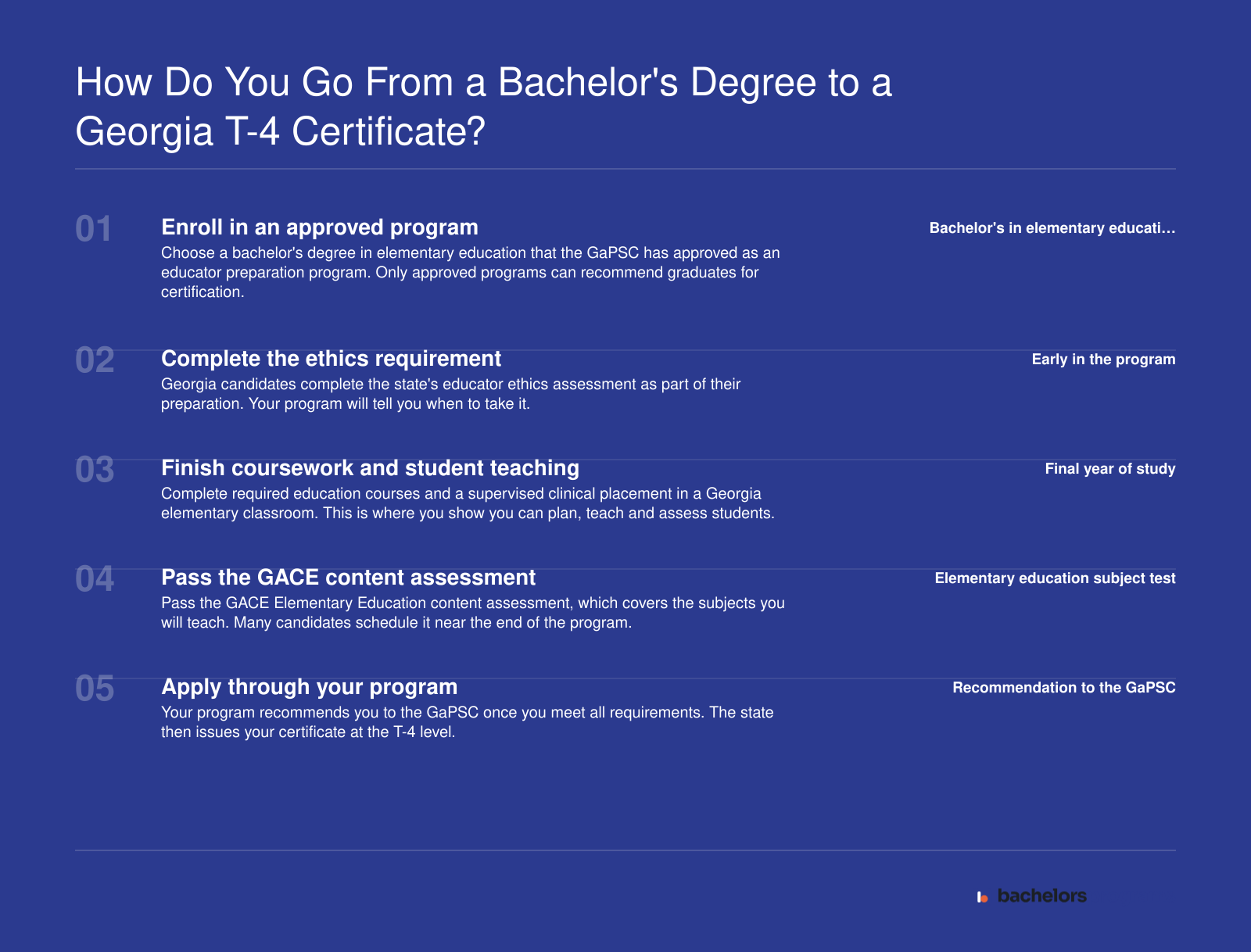
How Do You Go From a Bachelor's Degree to a Georgia T-4 Certificate?
Georgia's T-4 certificate is the bachelor's-level teaching credential, and the path to it runs through a state-approved educator preparation program. The steps below outline the usual order, from enrollment to recommendation for certification. Confirm current test and application details with your program and the Georgia Professional Standards Commission (GaPSC) before you register.
Compare Elementary Education programs on the data that matters
Explore more Education & Teaching majors or browse every field of study.
All Education & Teaching programs Browse every field of study