Best Elementary Education Degree Programs in Michigan
Compare 33 accredited Elementary Education programs in Michigan at 28 colleges, with net price after aid, graduation rates, earnings and debt from IPEDS and the U.S. College Scorecard.
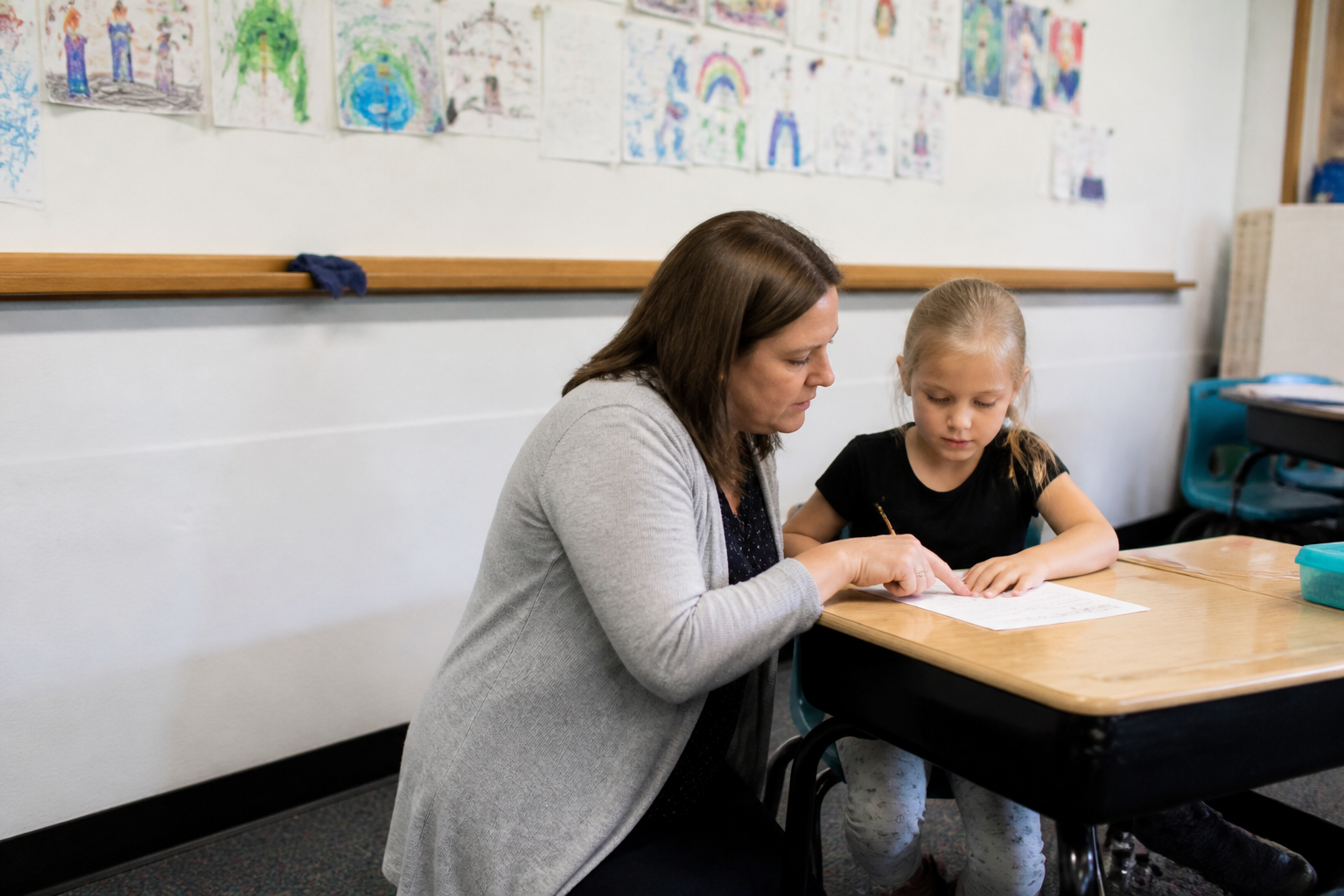
A bachelor's degree in elementary education is the standard entry point to a Michigan classroom, and most in-state programs award a Bachelor of Science (B.S.) in Elementary Education. The practical question is which schools pair solid outcomes with a price a family can manage. Published tuition runs from roughly $15,000 at several public universities to about $42,000 at private colleges such as Hope, Aquinas, and Calvin.
Those figures narrow after grant aid, and the cheapest route is not always the one with the strongest placement or earnings record. Every path still ends at the same gate: Michigan's MTTC exams and a state-approved preparation program.
Key Points
- University of Michigan-Flint had the lowest average net price in 2024 data.
- Michigan certification requires 6 reading credit hours and passing MTTC exams.
- Expect two admissions: one to the university, another to teacher education.
Best Elementary Education Schools in Michigan: Our Top 10
Michigan offers several routes into an elementary classroom, and the ten schools below cover the range: a large research university, regional publics with deep district partnerships, and private colleges with small cohorts. Each entry leads to a bachelor's degree and, in most cases, a recommendation for Michigan teacher certification. Compare grade-band options, field experience structure and cost before you apply.
University of Michigan
#1Ann Arbor, MI · $18,000 – $61,000/yr (est.)
Best for: Future teachers targeting PK-3 certification
The University of Michigan's Marsal Family School of Education runs one of the state's most selective elementary teacher preparation paths, pairing a 120-credit bachelor's with fieldwork every semester in Ann Arbor partner schools. Students choose a PK-3 or 3-6 focus, finish with a 14- to 15-week student teaching term, and are recommended to the state for elementary certification. An optional 17-credit English as a Second Language endorsement adds an MTTC exam pathway.
- 120 credits: 42 pre-professional, 45 professional core, 16 field
- 14 to 15 week student teaching term
- Prepares teachers for PK-3 or 3-6 self-contained classrooms
- Field placements guaranteed, with in-school work every semester
- Optional 17-credit ESL endorsement leads to an MTTC exam
- Graduates recommended to the state for elementary certification
- Fall admission deadlines of November 1 and February 1
Michigan State University
#2East Lansing, MI · $16,000 – $44,000/yr (est.)
Best for: Students wanting built-in ESL endorsement coursework
Michigan State's College of Education awards a Bachelor of Arts in Elementary Education built around two grade-band concentrations, PK-3 at 41 credits or 3-6 at 42 credits, with internships split across two semesters. ESL coursework of 25 to 29 credits can satisfy the state's additional endorsement requirement, and students may add a disciplinary teaching minor in a language such as Arabic, Chinese, French or Spanish. It is a large, research-intensive option in East Lansing with one of the widest course catalogs in the state.
- 120 total credits in the College of Education
- 15 credits of professional education plus 12 credits of elementary education
- PK-3 concentration at 41 credits or 3-6 concentration at 42 credits
- ESL coursework of 25 to 29 credits meets the added endorsement requirement
- Internships split across two semesters
- Optional teaching minors in Arabic, Chinese, French, German, Japanese or Spanish
Grand Valley State University
#3Allendale, MI · $15,000 – $20,000/yr (est.)
Best for: West Michigan students pairing two majors
Grand Valley's PCKET major is designed to be paired with a second major in Educational Studies or Special Education, giving students a broader credential than a stand-alone teaching degree. The Allendale program spans fine arts, social studies, integrated science, English language arts, mathematics and health and physical education, with pre-service field experiences and service learning in local schools. The university has expanded regional teacher-workforce partnerships with West Michigan districts and, in 2026, was named in state partnership agreements involving Wayne RESA schools.
- Paired with a major in Educational Studies or Special Education
- Variable-credit major taught face to face at the Allendale campus
- Coursework spans fine arts, social studies, integrated science, ELA and math
- Add an ESL endorsement or a core discipline concentration
- Study abroad can earn a Certificate of International Teaching
- Pre-service field experiences and service learning in local schools
- Scholarships include the Telephone Pioneers and Ram Chattulani awards
Andrews University
#4Berrien Springs, MI · $10,000 – $15,000/yr (est.)
Andrews University, a private, faith-based campus in Berrien Springs, awards a Bachelor of Science in Elementary Education and a Bachelor of Arts that also leads to elementary certification. The B.S. requires a content major or two minors, with emphases in integrated science, language arts, social studies or reading for grades K-8, and teacher preparation runs in three phases that end with at least 15 weeks of student teaching. The Michigan Department of Education rates the program "Exemplary."
- B.S. requires a content major or two minors
- Emphases in integrated science, language arts, social studies or reading (K-8)
- Teacher preparation runs in three phases
- Student teaching lasts at least 15 weeks in an elementary school
- Rated Exemplary by the Michigan Department of Education
- Optional B.A. route also leads to elementary certification
University of Michigan-Dearborn
#5Dearborn, MI · ~$9,000/yr (est.)
UM-Dearborn's Bachelor of Arts in Elementary Education requires at least two concentrations from four options, and one must be a grade band: PK-3 or 3-6, with ESL and Birth to Kindergarten as add-ons. Teacher candidates move through early clinical work, two part-time teaching apprenticeship semesters and a full semester of student teaching in Dearborn-area schools.
- Four concentrations: PK-3, 3-6, ESL and Birth to Kindergarten
- At least one concentration must be a grade band
- Two part-time teaching apprenticeship semesters
- Full semester of student teaching plus early clinical work
- Rolling admissions
- Approved by the Michigan Department of Education
Calvin University
#6Grand Rapids, MI · $23,000/yr (est. net price)
Calvin University splits elementary preparation into two grade bands, pre-kindergarten to grade 3 and grade 3 to grade 6, which students can earn separately or combine to cover the full elementary range. Field experiences begin in the freshman year through tiered placements with Grand Rapids partner schools, and classes stay small enough to watch teaching modeled and get feedback on your own practice. It is a private, faith-based option where teaching practice is framed within a Christian worldview.
- Two grade bands: pre-kindergarten to grade 3 and grade 3 to grade 6
- Bands can be earned separately or combined
- Tiered field experiences with Grand Rapids partner schools
- Field experiences begin in the freshman year
- Faith integrated into teaching practice
Wayne State University
#7Detroit, MI · ~$13,000/yr (est.)
Wayne State's College of Education awards a Bachelor of Science in Education in Elementary Education with PK-3, 3-6 and TeachDETROIT concentrations, and clinical courses run as co-requisites with methods courses rather than as a separate add-on. Students enter as pre-majors, apply to the professional program after their first two years of coursework, and finish with a full-time student teaching semester. Detroit's district partnerships make it the most urban-focused pathway on this list, and part-time plans of work are available.
- 120 total credits
- Certification band for grades PK-3
- Methods courses paired with clinical courses
- Final semester is full-time student teaching
- 2.50 cumulative GPA required to complete
- Certification band for grades 3-6
- Aligned to Michigan Department of Education preparation standards
- Part-time plan of work available
- Districts statewide recruit graduates
- Urban-focused track within the elementary B.S.Ed.
- Admitted as a pre-major, then apply to the professional program
- Leads to the Michigan Standard Teaching Certificate
- Several concentration options within one degree
Hope College
#8Holland, MI · $27,000/yr (est. net price)
Hope College prepares elementary teachers for preschool through grade 6 in two grade bands, and each student picks the band in which they will student teach. The program is a sequenced ladder of courses and clinical experiences taught in small classes, with an advisor-built four-year plan reviewed every semester. A major, minor or endorsement is not required, but students can add an early childhood minor, an ESL minor, a learning disabilities or emotional impairments endorsement, or a K-12 Spanish major.
- Prepares teachers for preschool through grade 6
- Student teaching happens in the chosen grade band, PK-3 or 3-6
- Sequential courses and clinical experiences in small classes
- No major, minor or endorsement required
- Add an early childhood minor or an ESL minor
- Add a learning disabilities or emotional impairments endorsement
- K-12 Spanish major available as an add-on
- Four-year plan built with an advisor and reviewed each semester
Oakland University
#9Rochester Hills, MI · $9,000/yr (est. net price)
Oakland University's elementary major leads to a Bachelor of Science in Elementary Education with dual endorsement in grades PK-3 and 3-6, so graduates are eligible to teach across the elementary span. Students complete more than 600 hours of field experience, student teaching included, and finish a 121-credit program as part of a full-time junior and senior cohort. Classes run on the Rochester campus and at the Macomb University Center on day or day and evening schedules.
- 121 total credits
- Dual endorsement in grades PK-3 and 3-6
- 600+ hours of field experiences including student teaching
- Full-time junior and senior cohort
- 2.8 cumulative GPA and 3.0 in pre-professional courses required
- Classes at Rochester and the Macomb University Center
- Day or day and evening schedules
- Second bachelor's option for degree holders
Aquinas College
#10Grand Rapids, MI · ~$17,000/yr (est.)
Aquinas College awards a Bachelor of Arts in Elementary Education with lower elementary (PK-3) and upper elementary (3-6) bands, and spreads the state's 600 classroom observation hours across every education semester instead of concentrating them in one term. The Grand Rapids program reports a 90% pass rate on the Michigan Test for Teacher Certification. Students can add Catechist certification for Catholic schools, a Deaf and Hard of Hearing endorsement, or PK-12 endorsements in music and Spanish, and approved career and technical education coursework can count for up to four credits.
- Lower elementary PK-3 and upper elementary 3-6 bands
- 600 clinical hours spread across every education semester
- Reports a 90% pass rate on the Michigan Test for Teacher Certification
- Catechist certification can be earned alongside the degree
- Deaf and Hard of Hearing endorsement available
- PK-12 endorsements in music and Spanish
- Up to 4 credits for approved CTE coursework (EDUC-200)
Cost & outcomes by school
Federal data for the highest-earning Elementary Education programs, independent of the ranking above. Earnings are this field's bachelor's graduates four years after completing where the Scorecard reports them, else the school's undergraduate median.
| School | Net price / yr | Grad rate | Earnings | Debt | Grads/yr | Format |
|---|---|---|---|---|---|---|
| Michigan State University MI | $19,680 | 81% | $67,253 | $23,250 | 12 | Campus |
| University of Michigan-Dearborn MI | $9,492 | 58% | $59,649 | $22,500 | 25 | Campus |
| Madonna University MI | $17,755 | 60% | $59,058 | $23,000 | 8 | Campus |
| Albion College MI | $14,301 | 62% | $58,799 | $27,000 | — | Campus |
| Siena Heights University MI | $17,124 | 39% | $57,529 | $18,750 | 16 | Campus |
| Grand Valley State University MI | $16,317 | 67% | $56,118 | $24,500 | 8 | Campus |
| Adrian College MI | $25,368 | 48% | $55,504 | $27,000 | 8 | Campus |
| University of Michigan MI | $13,138 | 93% | $54,558 | $14,375 | 48 | Campus |
| Andrews University MI | $12,547 | 72% | $53,187 | $26,000 | 9 | Campus |
| Spring Arbor University MI | $19,353 | 64% | $51,732 | $26,375 | 14 | Campus |
| Eastern Michigan University MI | $15,407 | 46% | $50,007 | $27,725 | 67 | Online or campus |
| Central Michigan University MI | $17,597 | 59% | $49,677 | $27,000 | 172 | Online or campus |
Sources: U.S. Department of Education. Net price, graduation rate, earnings and debt: College Scorecard (earnings and debt for this field's bachelor's graduates where reported, else school-wide); graduates: IPEDS. A dash means no figure is reported.
Cost, debt & payoff
Median earnings of this field's bachelor's graduates (4 yrs after completing, else the school's undergraduate median) vs. their median federal loan debt · U.S. College Scorecard
Across these programs the median graduate earns about $49,469 and finishes with roughly $26,375 in debt — a ratio that clears a common rule of thumb (keep debt below first-year salary). Net price and debt vary widely school to school, so check the per-school figures in the table above before you shortlist.
Most Affordable Michigan Schools for a Bachelor's Degree in Elementary Education
These Michigan schools are ordered by average annual net price, which is what students typically pay after grants and scholarships, based on 2024 U.S. Department of Education data from IPEDS and the College Scorecard. University of Michigan-Flint has the lowest net price at $7,007. Saginaw Valley State University has the lowest in-state tuition and fees ($12,930) but a higher net price once aid is counted, while Oakland University and University of Michigan-Dearborn also appear in our main ranking.
| School | City | Format | Average Net Price (After Aid) | In-State Tuition and Fees | Graduation Rate | Program Median Earnings, 1 Year After Graduation |
|---|---|---|---|---|---|---|
| University of Michigan-Flint | Flint | Campus | $7,007 | $14,704 | 40% | $41,809 |
| Ferris State University | Big Rapids | Campus and online | $8,624 | $14,778 | 47% | $42,608 |
| Oakland University | Rochester Hills | Campus | $9,120 | $15,262 | 58% | $42,440 |
| University of Michigan-Dearborn | Dearborn | Campus | $9,492 | $15,640 | 58% | N/A |
| Saginaw Valley State University | University Center | Campus | $10,775 | $12,930 | 48% | $43,151 |
Online and Hybrid Bachelor's Options at Michigan Schools
An online elementary education bachelor's and a campus-based one can lead to the same Michigan teaching certificate, but they ask different things of you. Online study bends around a job; campus programs build fieldwork into the weekday schedule.
Fully online, hybrid, and campus-based
At the Michigan schools covered here, campus-based delivery is the norm. The University of Michigan, Michigan State University, Wayne State University, and Grand Valley State University all describe on-campus elementary programs, and Michigan State requires department approval for each field placement.1
The best-documented online route is Eastern Michigan University's online Early Childhood Education 2+2. It is a degree-completion format rather than a full four-year program: you enter with an associate degree and current work in the field, and those credits carry into the bachelor's. EMU's certification track itself leads to a Bachelor of Science with B-K, PK-3, and 3-6 endorsements, and pairs more than 100 guided fieldwork hours with full-time student teaching.
So the direct answer to "Which Michigan schools offer online or hybrid elementary education degrees?" is that online delivery exists, but mostly as a completion path for people who already hold an associate degree.
Fieldwork stays in person
Every elementary certification program described here pairs coursework with classroom experience. Student teaching and clinical placements happen in real schools, usually in partner districts near campus.
If you live outside the area
Program pages rarely state whether out-of-area students may complete placements near home, and Michigan has no blanket rule allowing it. Get the answer in writing from the education department before you enroll.
Admissions: GPA, Test Policy, and Transfer Credit
What GPA do you need for a Michigan elementary education program, and does the SAT still count?
Admission usually happens twice in Michigan: once to the university, then again to the teacher-education program that controls methods courses, field placements, and student teaching.
Two gates, not one
The second gate is the one that surprises students. Wayne State University publishes a 2.5 GPA minimum for its elementary education program, and Oakland University publishes 2.8 alongside a cohort structure and prerequisite coursework before the clinical sequence. Elsewhere, the path runs through a pre-major or phased model: you finish foundational courses, then advance into the professional block. Where a program page does not print a cutoff, ask the education department directly. A number set for general university admission is not the teacher-education threshold.
Test scores and transfer credit
Test policy varies by campus, and a university that is test-optional for first-year applicants does not guarantee its education program is. Check both pages. The Michigan Test for Teacher Certification comes much later, at the certification stage, not at admission.
For transfer students, the Michigan Transfer Agreement lets a block of about 30 general education credits from a participating Michigan community college satisfy lower-division general education at participating four-year schools. Professional education coursework is different: methods courses and clinical placements generally have to be completed after you arrive, so have an advisor review your transcript before you enroll.
Three takeaways
- Expect two applications: university admission does not automatically seat you in the teacher-education program.
- GPA is checked twice: your overall GPA and your education-course GPA may both count.
- Verify transfer credit early: general education moves cleanly under the state agreement; education courses often do not.
Related Articles
What a Bachelor's in Elementary Education Costs in Michigan
Michigan's public universities and private colleges look far apart on sticker price, but the gap narrows after aid. For Michigan students, the comparison that matters is net price, not published tuition.
Sticker Price Versus Net Price
At Oakland University, in-state tuition is $15,262 and the average net price is $9,120. The University of Michigan lists $17,736 in-state tuition and a $13,138 average net price. Andrews University, a private school, posts $35,056 tuition but an average net price of $12,547, close to what public universities charge after aid. UM-Flint, listed in our directory, comes in at $14,704 in-state tuition and a $7,007 average net price. Compare those net figures side by side before ruling out a private college or assuming a public one is cheapest.
State Aid and the TEACH Trade-Off
The Michigan Achievement Scholarship pays up to $5,500 a year for up to five years, $27,500 total, for 2023-and-later high school graduates who are Michigan residents, file the FAFSA, enroll full-time, and have a Student Aid Index of $30,000 or less.1 The Michigan Competitive Scholarship adds up to $1,500 a year for up to 10 semesters with at least a 1200 SAT, a 2.0 GPA, and six credits.2 The MI Future Educator Fellowship provides up to $10,000 a year for three years, $30,000 total, for up to 2,500 recipients who are juniors or above in a State Board-approved educator preparation program with a 3.0 GPA and full-time enrollment; recipients sign a Commitment to Teach in Michigan agreement.3 The MI Future Educator Stipend pays $9,600 for the student-teaching semester.4 The federal TEACH Grant carries a four-year teaching commitment in a high-need field at a low-income school. Miss that obligation, and the grant converts to a loan.
Transfer Routes and a Realistic Total
Starting at a community college can lower the total: lower-division tuition costs less, and many credits move into a bachelor's program. Confirm the education sequence and clinical hours at the four-year school before enrolling. Four years of in-state tuition at the public universities here runs about $52,000 to $71,000 before scholarships. Average net prices over four years land closer to $28,000 to $53,000. Andrews' sticker price, projected over four years, exceeds $140,000, but its average net price brings four years near $50,000.
Michigan Teacher Certification at a Glance
MTTC Exams, Endorsements, and CAEP Accreditation for Michigan Elementary Teachers
What are the Michigan teacher certification requirements after graduation? The short version: finish a state-approved elementary preparation program, pass the MTTC subject tests tied to your endorsement, and secure your institution's recommendation for certification.
Endorsement Levels and the 103 Test
Michigan's revised structure splits elementary teaching into two endorsements1. Lower Elementary (code ZO) covers PreK-3 and requires MTTC 117-1202. Upper Elementary (code ZP) covers grades 3-6 and requires MTTC 121-1242. Programs under this structure began enrolling students in Fall 2021, and the first graduates were expected in Spring 20231.
The older K-5/K-8 All Subjects endorsement (ZG) relied on the Elementary Education (103) test3. MDE lists 103 as discontinuing in December 20261, so students starting or finishing now should confirm with their program which tests apply to them.
MTTC Pass Rates
The 2024-25 MTTC Annual Legislative Report from the Michigan Department of Education covers test-takers from August 1, 2022 through July 31, 2025. Statewide, 393 eligible first-time takers sat the 103 test and 62.6% passed. The cumulative rate, which counts later retakes, was 71.2%.
- Adrian College: 71.8% first-time, 81.5% cumulative
- Alma College: 76.4% first-time, 82.6% cumulative
- Andrews University: 78.6% first-time, 92.9% cumulative
- Aquinas College: 81.1% first-time, 86.6% cumulative
- University of Michigan-Flint: 85.1% first-time, 89.6% cumulative
Rates for the other ranked schools were not available in the material we reviewed, so check the full MDE report for those programs.
CAEP Accreditation and Fieldwork
CAEP is the national accreditor of educator preparation. Accreditation signals that a program meets peer-reviewed standards for coursework, clinical practice, and graduate outcomes. Among the ranked schools, Wayne State University and Aquinas College describe themselves as CAEP accredited. University of Michigan-Dearborn is listed as CAEP accredited. We could not confirm CAEP status for the remaining schools, so ask each admissions office directly.
Fieldwork varies. Oakland University and Aquinas both cite 600 clinical hours. Andrews University requires at least 15 weeks of student teaching, and the University of Michigan lists 14 to 15 weeks. UM-Dearborn requires a full semester.
A Practical Prep Tip
Don't wait until after graduation to study. Take MTTC practice tests while you are in your methods courses, find your weak subtest, and use your clinical placements to practice that content with real students.
Michigan Elementary Teacher Median Wage
Earnings are a practical factor when weighing a bachelor's degree in elementary education in Michigan.
Common Questions About Elementary Education Degrees in Michigan
These answers cover the questions Michigan students ask most often about timelines, accreditation, and program format. Details differ by school, so confirm specifics on each program page before you apply.
How long does it take to earn a bachelor's degree in elementary education in Michigan?
Which Michigan elementary education programs are CAEP accredited?
Which Michigan schools offer online or hybrid elementary education degrees?
Can transfer students finish a bachelor's degree in elementary education in two years?
Does a Michigan elementary education degree lead to teaching certification in other states?
Compare Elementary Education programs on the data that matters
Explore more Education & Teaching majors or browse every field of study.
All Education & Teaching programs Browse every field of study