Best Elementary Education Degree Programs in Minnesota
Compare 28 accredited Elementary Education programs in Minnesota, with net price after aid, graduation rates, earnings and debt from IPEDS and the U.S. College Scorecard.
What does it take to teach third grade in Minnesota? A bachelor's degree in elementary education from a state-approved preparation program, then a Tier 4 license from the Professional Educator Licensing and Standards Board. The credential is most often a Bachelor of Science (B.S.) in Elementary Education, covering grades K-6.
The decision rarely comes down to one number. Public universities post net prices well below private colleges, and net price and later earnings do not always move together. Online and hybrid options, now common at Minnesota schools, shift the arithmetic again, and transfer credit rules differ from campus to campus.
Key Points
- Aid sometimes makes a private Minnesota college cheaper than a public one.
- Rankings weigh College Scorecard net price, graduation rates, and graduate earnings.
- Graduates apply to PELSB for a first Tier 4 Minnesota teaching license.
Best Bachelor's in Elementary Education Programs in Minnesota: Our Top 10
Every card below lists an approximate average net price after aid, the school's institution-wide graduation rate, and median earnings for elementary education graduates four years after finishing. Graduation rates describe the whole institution rather than the education department, and net prices shift with each student's aid package and housing choice.
University of Minnesota-Twin Cities
#1Minneapolis, MN · ~$17,000/yr (est.)
Best for: Twin Cities students seeking urban field placements
The Twin Cities campus pairs a research university's resources with a foundations major built around three separate field experiences in local elementary schools. Undergraduates work in reading, special education and general classroom settings before choosing a licensure route. The university reports an institution-wide graduation rate of 85%, and elementary education graduates had median earnings of $53,276 four years after finishing.
- Three separate field experiences: elementary teaching, reading, special education
- Placements in Twin Cities elementary schools via the CEHD partnership network
- Foundations major sets up application to the licensure pathway after the bachelor's
- Teaching Practicum in France (Montpellier) fits two core courses into the curriculum
- Minors include racial justice in urban schooling, learning technologies and TESL
- Autism spectrum disorders certificate available alongside the major
Martin Luther College
#2New Ulm, MN · ~$18,000/yr (est.)
Best for: Lutheran school teachers headed to WELS classrooms
Martin Luther College exists to supply teachers to WELS Lutheran schools, and its elementary education major reflects that focus: 130 credits, four years, and student teaching split between elementary and middle school classrooms. The college reports an institution-wide graduation rate of 72%, and elementary education graduates had median earnings of $56,435 four years after finishing.
- 130-credit, four-year plan prepares teachers for WELS kindergarten through grade 8
- 27 credits of required content plus 37 credits of professional education
- 19 credits of field experience, with student teaching in elementary and middle schools
- Endorsement minors can add a Minnesota licensure endorsement
- New and transferring students admitted for 2026-27 are not eligible for Minnesota licensure
University of Minnesota-Morris
#3Morris, MN · ~$9,000/yr (est.)
Best for: Cohort learners preferring a small liberal arts campus
Morris is the small liberal arts campus in the University of Minnesota system, and its elementary education major runs as a cohort that students enter as sophomores. Beyond tuition, the only program add-ons are a $300 program fee and a $400 student teaching fee. The campus reports an institution-wide graduation rate of 63%, and elementary education graduates had median earnings of $48,987 four years after finishing.
- Bachelor of arts in elementary education meets Minnesota K-6 licensure requirements
- Students apply in sophomore year by December 1 and move through as a cohort
- Admission requires faculty recommendations, a personal statement and an interview
- Field experience attached to every education course, plus 10-12 weeks of spring student teaching
- AAQEP accredited, with a $300 program fee and $400 student teaching fee
- Endorsements in pre-primary education and middle level language arts, science, math or social studies
- Optional Chicago cross-cultural experience and paid literacy tutoring opportunities
Saint Mary's University of Minnesota
#4Winona, MN · $12,000/yr (est. net price)
Saint Mary's runs a K-6 elementary education major on its Winona campus with room for endorsements in Spanish, general science or mathematics. STEM candidates can tap the ISTEP-Noyce project for funding and mentoring, and study abroad spans six sites in Europe, Mexico, Cuba and Puerto Rico. The university reports an institution-wide graduation rate of 66%, and elementary education graduates had median earnings of $40,804 four years after finishing.
- Bachelor of arts in Elementary Education: K-6 prepares students for Minnesota K-6 licensure
- Optional endorsements in Spanish, general science or mathematics for middle school
- Clinical and field experience aligned with partner schools and areas of interest
- Study abroad in Italy, France, Spain, Mexico, Cuba or Puerto Rico
- ISTEP-Noyce project gives STEM teacher candidates funding, training and mentoring
- Coursework spans biology, mathematics, reading, music, history and psychology
- 20 minors available alongside the major
University of St Thomas
#5Saint Paul, MN · ~$29,000/yr (est.)
St. Thomas builds its elementary education major around a year-long clinical practice in a single classroom, which the program describes as the only undergraduate placement of that length in the Twin Cities metro. Teaching experience starts in the first education course rather than waiting for junior year. The university reports an institution-wide graduation rate of 76%, and elementary education graduates had median earnings of $47,712 four years after finishing.
- Bachelor of science in elementary education leads to K-6 generalist licensure
- Year-long clinical practice in one classroom with scheduled seminars alongside
- Teaching experience begins in the first education course
- Program reports a 95% first-attempt pass rate on Basic Skills and Pedagogy exams
- Concentration or minor recommended in STEM, engineering education, ESL or exceptionalities
- Eight graduates named Minnesota Teacher of the Year since 2000
- A four-year plan is built with each student by faculty
College of Saint Benedict
#6Saint Joseph, MN · $27,000/yr (est. net price)
Coordinated with Saint John's University, the elementary education major requires 75 to 76 credits and admits students to teacher education in sophomore year at a 2.50 GPA. Students can stack a grades 5-8 license, a K-8 Spanish endorsement or a K-12 ESL license onto the base credential. The college reports an institution-wide graduation rate of 77%, and elementary education graduates had median earnings of $51,487 four years after finishing.
- Elementary education major makes graduates eligible for Minnesota teacher licensure
- 75 to 76 required credit hours within a 132-credit four-year plan
- Sophomore-year admission with a 2.50 GPA, an Intent to Apply form and a faculty recommendation
- Classroom teacher shadow required before admission to teacher education
- Student teaching plus seminar built into the required coursework
- Add grades 5-8 licensure in communication arts, mathematics or general science
- Optional K-8 Spanish endorsement or K-12 ESL license
- Elementary Block courses taken together as a cohort
The College of Saint Scholastica
#7Duluth, MN · $28,000/yr (est. net price)
St. Scholastica puts students into Duluth elementary classrooms in their first semester and keeps fieldwork heavy relative to peer programs. The teacher education unit holds AAQEP accreditation and PELSB approval through 2032, and every new first-year applicant receives the Benedictine Scholarship or the Access Award. The college reports an institution-wide graduation rate of 71%, and elementary education graduates had median earnings of $47,432 four years after finishing.
- Bachelor of science in elementary education taught on the Duluth campus
- Classroom experience begins in the first semester
- AAQEP accredited with PELSB unit approval through June 2032
- Full-time faculty with K-12 classroom experience teach the courses
- Above-average fieldwork before student teaching, with emphasis on emerging literacies
- Background check required for all enrolled students
- Every new first-year applicant receives the Benedictine Scholarship or Access Award
Bethel University
#8Saint Paul, MN · $29,000/yr (est. net price)
Bethel admits students to the university first and to the education department later, after two introductory courses and a 2.75 GPA. Fieldwork begins in year one and ends with a 14-week full-time placement, with an optional year-long residency available on top of standard fieldwork. The university reports an institution-wide graduation rate of 71%, and elementary education graduates had median earnings of $47,556 four years after finishing.
- Bachelor of arts in elementary education prepares students for Tier 4 K-6 licensure
- Classroom observation begins in the first year
- Final semester is a 14-week full-time student teaching placement
- Department admission after EDU 200 and EDU 201 with a 2.75 GPA, statement, references and interview
- Preparation for MTLE basic skills exams and edTPA
- Optional year-long classroom residency beyond conventional fieldwork
- 90% of graduates who applied for a license in the past five years are teaching
- Placements span public, private and charter partner schools
Winona State University
#9Winona, MN · ~$18,000/yr (est.)
Winona State's K-6 major is one of the larger elementary education pipelines in the state, with 76 program credits and placement partnerships across more than 90 school districts. Fall and spring starts give transfer students more than one entry point. The university reports an institution-wide graduation rate of 57%, and elementary education graduates had median earnings of $46,863 four years after finishing.
- Elementary Education (K-6) major requires 76 program credits within a 120-credit degree
- Fall and spring start dates
- Partnerships with more than 90 school districts for field placement
- Early clinical experience plus student teaching in the final semester
- On-campus Children's Center used for field experience
- Four middle-level teaching minors available
- Approved by the Minnesota Professional Educator Licensing and Standards Board
University of Northwestern-St Paul
#10Saint Paul, MN · ~$28,000/yr (est.)
Northwestern runs four levels of practicum on its St. Paul campus, ending with full-time student teaching in a chosen licensure field. Endorsements extend the degree into grades 5-8 subjects or preprimary classrooms for ages 3 to 5. The university reports an institution-wide graduation rate of 68%, and elementary education graduates had median earnings of $45,195 four years after finishing.
- Bachelor of science in elementary education prepares students to teach grades K-6
- 127 to 144 credits required, delivered on campus
- Four levels of classroom practicum ending in full-time student teaching
- Endorsements in communication arts and literature, mathematics and social studies for grades 5-8
- Preprimary endorsement for ages 3 to 5
- Approved by the Minnesota Professional Educator Licensing and Standards Board
- Featured courses include kindergarten methods, mathematics methods K-6 and music methods
Cost & outcomes by school
Federal data for the highest-earning Elementary Education programs, independent of the ranking above. Earnings are this field's bachelor's graduates four years after completing where the Scorecard reports them, else the school's undergraduate median.
| School | Net price / yr | Grad rate | Earnings | Debt | Grads/yr | Format |
|---|---|---|---|---|---|---|
| Saint Johns University MN | $25,672 | 75% | $76,786 | $27,000 | — | Campus |
| University of Minnesota-Duluth MN | $18,743 | 65% | $62,616 | $20,500 | 13 | Campus |
| Hamline University MN | $20,744 | 61% | $61,106 | $23,770 | 1 | Campus |
| University of Minnesota-Crookston MN | $12,212 | 50% | $58,056 | $20,500 | 6 | Campus |
| Martin Luther College MN | $18,463 | 72% | $56,435 | $20,695 | 65 | Online or campus |
| University of Minnesota-Twin Cities MN | $16,778 | 85% | $53,276 | $19,497 | 103 | Campus |
| College of Saint Benedict MN | $26,640 | 77% | $51,487 | $26,943 | 27 | Campus |
| Augsburg University MN | $23,873 | 52% | $49,698 | $25,924 | 10 | Campus |
| Metropolitan State University MN | $16,863 | 44% | $49,025 | $27,778 | 29 | Online or campus |
| University of Minnesota-Morris MN | $8,837 | 63% | $48,987 | $22,866 | 9 | Campus |
| Minnesota State University-Mankato MN | $19,139 | 54% | $48,632 | $25,000 | 78 | Online or campus |
| Crown College MN | $26,672 | 45% | $48,057 | $22,500 | 6 | Campus |
Sources: U.S. Department of Education. Net price, graduation rate, earnings and debt: College Scorecard (earnings and debt for this field's bachelor's graduates where reported, else school-wide); graduates: IPEDS. A dash means no figure is reported.
Cost, debt & payoff
Median earnings of this field's bachelor's graduates (4 yrs after completing, else the school's undergraduate median) vs. their median federal loan debt · U.S. College Scorecard
Across these programs the median graduate earns about $47,593 and finishes with roughly $23,125 in debt — a ratio that clears a common rule of thumb (keep debt below first-year salary). Net price and debt vary widely school to school, so check the per-school figures in the table above before you shortlist.
How We Ranked Minnesota's Elementary Education Bachelor's Programs
College Scorecard, the U.S. Department of Education's public database of college costs and outcomes, supplies the numbers behind this ranking. We looked at several measures together, so no single figure decides where a school lands.
What We Looked At
- Net price: What students typically pay after grants and scholarships are subtracted from the sticker price.
- Graduation rate: The share of students who complete a degree, a basic signal of whether the school helps them finish.
- Program earnings: What graduates of the elementary education program earn after leaving school.
- Debt: The typical federal loan balance graduates carry out of the program.
- Completions: How many students finish the program each year, which hints at its size and stability.
Where the Numbers Fall Short
These two measures describe the whole institution, not the education department alone. Net price is also an average across aided students and is calculated differently for public and private schools, so your actual bill could land well above or below it depending on your family income and residency.
Who Qualified
Only bachelor's programs at Minnesota-based schools qualified, whether taught on campus, online or a mix of both. The final order comes from our internal analysis of the measures above. Treat the list as a starting point, then confirm current tuition, admission requirements and state licensure approval directly with each school before you apply.
The Cheapest Bachelor's in Elementary Education Programs in Minnesota
These Minnesota schools are sorted by average annual net price, which is what students actually pay after grants and scholarships. The figures come from IPEDS and College Scorecard (2024) data. University of Minnesota-Morris and Saint Mary's University of Minnesota are ranked schools, and the University of Minnesota-Crookston, Fond du Lac Tribal and Community College, and Saint Cloud State University appear in our directory. Sticker price can mislead: Saint Mary's lists $45,080 in tuition and fees but averages $11,704 after aid, while Fond du Lac has the lowest in-state tuition at $6,006.
| School | City | Format | In-State Tuition and Fees | Average Net Price | Graduation Rate | Median Graduate Debt (school-wide) |
|---|---|---|---|---|---|---|
| University of Minnesota-Morris | Morris | Campus | $14,526 | $8,837 | 62.5% | $18,995 |
| Saint Mary's University of Minnesota | Winona | Campus | $45,080 | $11,704 | 66.0% | $21,500 |
| University of Minnesota-Crookston | Crookston | Campus | $13,288 | $12,212 | 49.8% | $20,500 |
| Fond du Lac Tribal and Community College | Cloquet | Campus | $6,006 | $12,677 | 25.7% | $14,181 |
| Saint Cloud State University | Saint Cloud | Hybrid | $10,245 | $13,529 | 40.3% | $21,058 |
What a Bachelor's in Elementary Education Costs in Minnesota, and Aid That Lowers It
The sticker price at a Minnesota college tells you little about what an elementary education degree will actually cost you. Aid reshapes the numbers, and sometimes reverses the public vs. private gap.
Tuition vs. Net Price
In-state tuition and fees are $14,526 at University of Minnesota-Morris and $17,214 at University of Minnesota-Twin Cities, while Winona State University charges $10,576. Saint Mary's University of Minnesota charges $45,080. Average net price after grants tells a different story: $8,837 at Morris and $11,704 at Saint Mary's, against $16,778 at the Twin Cities and $17,503 at Winona State. Net price also folds in living costs, so it can exceed tuition. Treat it as a comparison tool, not a bill.
State Aid Programs
- Minnesota State Grant: Open to Minnesota residents with financial need taking at least 3 credits. The 2026-27 formula uses a $12,690 living allowance, an $18,071 four-year tuition and fee cap and a $7,395 Pell maximum. Awards start at $100, a full award generally needs 15 credits a term, and you must reapply yearly. Recent four-year averages were about $6,439, but that is history, not a promise.
- North Star Promise: Covers tuition and fees left after other gift aid at Minnesota public and Tribal colleges, for residents with family income under $80,000 and no prior bachelor's degree. It runs up to 8 semesters for a four-year degree. University of Minnesota campuses are all covered. Check the current application deadline, since the 2026-27 cutoff was June 1.
- UMN Promise: No separate current formula is established. UMN students are considered for North Star at any campus.
Teacher-Specific Help
The Student Teacher Grant pays up to $7,500 (minimum $50) toward unmet need during a student-teaching term in a PELSB-approved program. Those figures are from 2025-26, so confirm them. Ask each school's aid office about teacher scholarships and loan forgiveness, because eligibility rules vary.
Your Actual Award
That figure is only an average. Your own aid depends on the FAFSA, or the Minnesota Dream Act application if you qualify.
File that application as early as it opens: state aid and school scholarships both build on it. Then apply for institutional awards, and reapply every year.
Related Articles
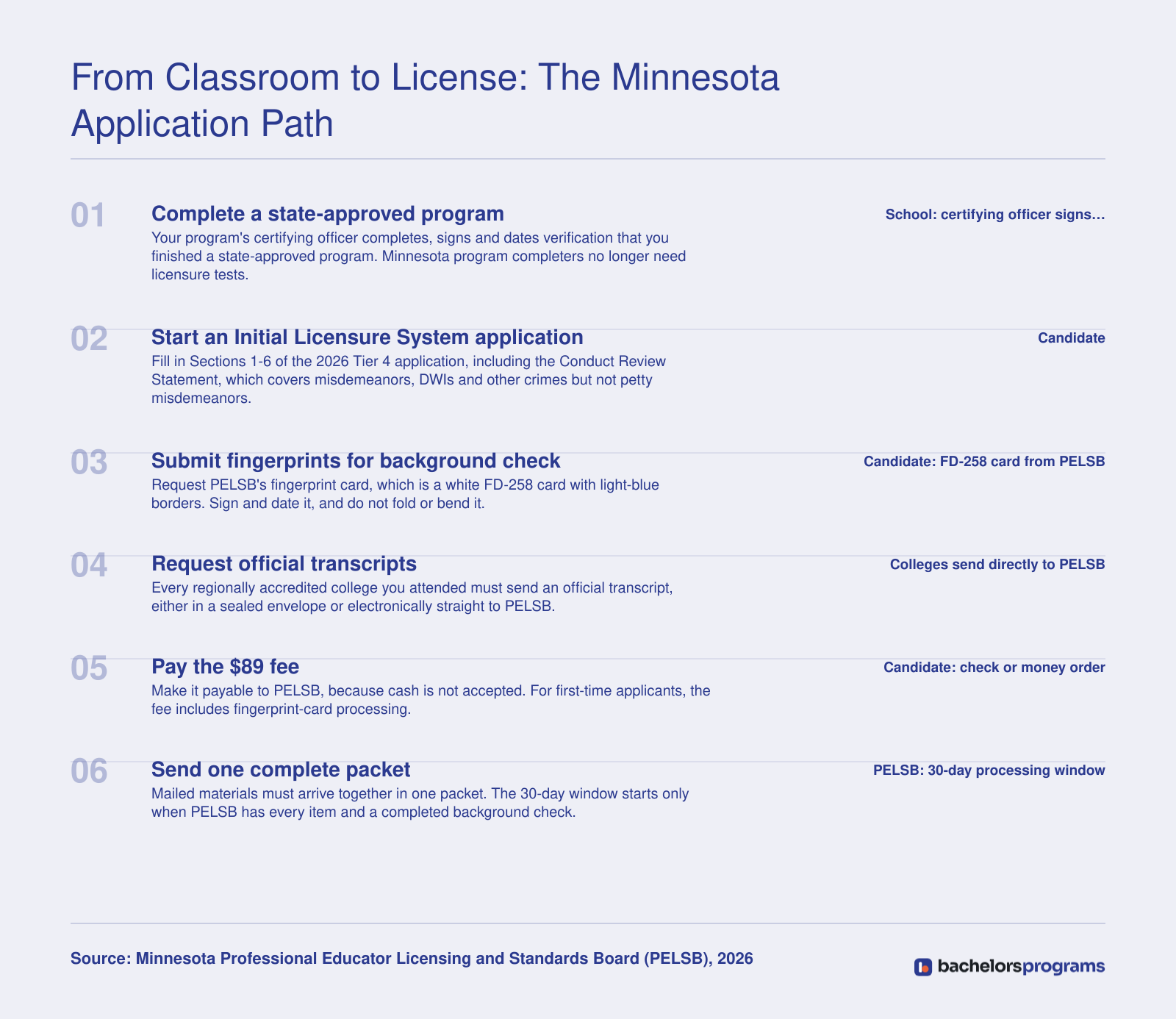
From Classroom to License: The Minnesota Application Path
Earning a bachelor's degree in elementary education is the first half of the job. The second is applying to PELSB for a first Tier 4 teaching license. Your program handles the verification, and you assemble the rest.
Common Questions About Elementary Education Degrees in Minnesota
What is the cheapest elementary education degree in Minnesota?
Can you get an elementary education degree online in Minnesota?
Do you need to pass the MTLE exams before you can be admitted to a program, or only before getting licensed?
Can transfer students finish a bachelor's in elementary education in Minnesota in four years?
Compare Elementary Education programs on the data that matters
Explore more Education & Teaching majors or browse every field of study.
All Education & Teaching programs Browse every field of study