Best Elementary Education Degree Programs in North Carolina
Compare 41 accredited Elementary Education programs in North Carolina, with net price after aid, graduation rates, earnings and debt from IPEDS and the U.S. College Scorecard.
The standard route to a K-6 teaching license in North Carolina is a bachelor's degree in elementary education, earned on campus or through online tracks at North Carolina schools. The common credential is the Bachelor of Science (B.S.) in Elementary Education, though some universities award a B.A. instead.
Cost is the sharpest divide. In-state tuition and fees run from $4,630 at Western Carolina University to $67,642 at Wake Forest University. College Scorecard net price, graduation rates and program earnings narrow that gap considerably, and they drive the ranked top 10, the cheapest and highest-earning picks, and the online, admissions and licensure comparisons.
Most programs build a semester or a full year of student teaching into the degree, so the license is earned alongside the diploma.
Key Points
- The largest programs charge in-state tuition and fees under $9,000.
- Net price, after grants, often exceeds tuition once housing and books count.
- UNC Wilmington pairs a distance track with 1,000-plus partner-school classroom hours.
Best Schools for a Bachelor's Degree in Elementary Education in North Carolina
The ten programs below are the strongest bachelor's-level routes to an elementary teaching license in North Carolina for 2026, balancing flagship research universities, regional publics, and two private campuses. Institution-wide, the schools on this list graduate between roughly 56% and 91% of their undergraduates, and net price after aid runs from around $11,000 at the public options to more than $40,000 at the private ones. Each entry names the credential and format so you can compare like with like.
University of North Carolina at Chapel Hill
#1Chapel Hill, NC · ~$12,000/yr (est.)
Best for: Dual licensure in elementary and special education
UNC-Chapel Hill is the state's flagship public university, and its School of Education pairs a research-intensive campus with a licensure path built on early classroom experience. The B.A.Ed. in Elementary Education takes its first class in fall 2026 and lets students add a second license in special education or English as a Second Language, with classroom and community placements every semester. Admission runs through a sophomore-year application requiring at least a 2.7 UNC GPA and C-or-better grades in prerequisites. NC Teaching Fellows forgivable loans of up to $5,000 per semester are available to students who commit to teaching in the state.
- B.A.Ed. in Elementary Education, first classes fall 2026
- Dual licensure: Elementary K-6 plus Special Education or ESL K-12
- Year-long student teaching internship in a nearby public school
- Classroom and community-setting experience every semester
- CAEP accredited; approved by the NC State Board of Education and NCDPI
- NC Teaching Fellows forgivable loans up to $5,000 per semester
- Applicants need a 2.7 UNC GPA and C or better in prerequisites
- A+ rating for reading instruction preparation
North Carolina State University at Raleigh
#2Raleigh, NC · $9,000 – $33,000/yr (est.)
Best for: STEM-focused future elementary teachers
NC State is a large public research university in Raleigh whose College of Education trains teachers through a STEM-heavy lens. Its Elementary Education BS requires two calculus courses, statistics, conceptual physics, and a chemistry or biology sequence alongside the usual methods coursework, and a B or higher is needed to be considered for candidacy. Students who want to teach science and math well in a K-5 classroom will find more quantitative content here than at most North Carolina schools.
- Elementary Education BS with a STEM concentration, 120 credits
- Two calculus courses, statistics, conceptual physics, chemistry or biology
- STEM electives in math, science, and engineering, technology and design
- Reading instruction courses for grades K-2 and 3-5
- Student teaching semester carries 9 credit hours
- B or higher required to be considered for program candidacy
- World language proficiency requirement
- Prepares for elementary teacher and instructional coordinator roles
Appalachian State University
#3Boone, NC · $8,000 – $25,000/yr (est.)
Best for: Students seeking campus or online flexibility
Appalachian State is a public university in Boone whose Reich College of Education has built its reputation on teacher preparation. The BS in Elementary Education (K-6) builds classroom experience into every teacher education degree, requires no minor, and is offered at the Boone campus, the Hickory campus, and fully online. The university cites its standing as a leading source of National Board Certified Teachers and points to repeated recognition for innovation.
- BS in Elementary Education, K-6, no minor required
- Offered at the Boone campus, Hickory campus, and fully online
- Classroom experience built into all teacher education degrees
- Coursework includes Foundations of Educational Equity and classroom community
- Scholarships and financial aid opportunities available
- Cited as a leading source of National Board Certified Teachers
- Prepares for elementary and charter school teaching careers
Wake Forest University
#4Winston-Salem, NC · $25,000 – $30,000/yr (est.)
Wake Forest is a private university in Winston-Salem where elementary education sits inside a broad liberal arts undergraduate experience. The B.A. splits into a non-licensure track for students heading toward policy, nonprofit work, or graduate study and a professional licensure track that adds student teaching, a seminar, and literacy intervention coursework. A small graduating cohort means close faculty contact, but the price before aid is the highest in this group.
- B.A. in Elementary Education with non-licensure and professional licensure tracks
- 29-hour education core spans literacy, math methods, science methods
- Non-licensure track: 35 hours including 6 hours of approved electives
- Licensure track: 47 hours with student teaching and literacy interventions
- Licensure candidates need C or better and a 2.7 GPA in the teacher education program
- Qualifying edTPA scores and state tests required for licensure
University of North Carolina at Charlotte
#5Charlotte, NC · $15,000 – $20,000/yr (est.)
UNC Charlotte is the largest public university in the Charlotte region, and its education programs feed one of the state's biggest school districts. The B.A. in Elementary Education leads to K-6 initial professional licensure with clinical placements every semester and a separate online TA to Teacher route for working teaching assistants. Part-time students can stretch the 120-credit degree across roughly five to five and a half years.
- B.A. in Elementary Education leading to K-6 Initial Professional Licensure
- 120 credit hours; four years full time or five to five and a half part time
- Clinical experiences in elementary schools every semester
- Final semester is a full-time student teaching internship
- Separate two-year online TA to Teacher pathway for NC K-5 teaching assistants
- Education Honors Program open to education majors and minors
- Coursework in classroom management, curriculum design, and varied learning needs
University of North Carolina Wilmington
#6Wilmington, NC · $7,000 – $24,000/yr (est.)
UNC Wilmington is a mid-size public university on the coast whose Watson College runs a licensure-focused elementary program. Students choose from 10 concentrations, from ESL and special education to math, science and health, and can complete the degree on campus or fully online. Formal Professional Development School agreements with 12 southeastern North Carolina school systems support field placements, and a first-year learning community eases the transition into the college.
- B.A. in Elementary Education leading to North Carolina K-6 licensure
- 10 concentrations, including ESL, Early Childhood, Special Education, and Math
- Available on campus or fully online
- One-on-one tutoring in the on-campus Education Lab
- Full-time internship in the final semester
- Professional Development School agreements with 12 school districts
- Two-step admission: UNCW first, then Watson College in sophomore or junior year
East Carolina University
#7Greenville, NC · ~$16,000/yr (est.)
East Carolina University in Greenville describes itself as the largest producer of new teachers in North Carolina, and its elementary education program is built for both volume and flexibility. The BS in Elementary Education (K-6) carries 11 concentrations, runs on campus and fully online, and places students in eastern North Carolina classrooms every semester before a yearlong internship. A separate Partnership Teach route lets community college students transfer into an online ECU cohort with a reading concentration.
- BS in Elementary Education (K-6), at least 120 semester hours
- 11 concentration options, from gifted education to reading add-on licensure
- On campus and fully online; Partnership Teach transfer route available
- Practicum in eastern North Carolina classrooms every semester
- Yearlong internship in a K-6 classroom
- Described by ECU as the largest producer of new teachers in NC
- Curriculum meets North Carolina licensure requirements
Elon University
#8Elon, NC · ~$42,000/yr (est.)
Elon University is a private university in Alamance County known for an engaged residential undergraduate model. Its elementary education major leads to K-6 licensure through a CAEP-accredited program that starts field experience in the introductory course and closes with a full semester of student teaching in the candidate's licensure area. Education majors can spend a semester abroad in New Zealand, and the program earned an A+ from the National Council on Teacher Quality for reading preparation in June 2026.
- B.A. in elementary education meeting North Carolina K-6 licensure requirements
- CAEP-accredited initial licensure program
- Field experiences begin in the introductory course
- Full semester of student teaching in the licensure area
- Semester abroad in New Zealand with the University of Otago and Arcadia
- A+ from NCTQ for science-of-reading preparation, June 2026
- Teacher education admission via an introductory course with C or better
Western Carolina University
#9Cullowhee, NC · ~$13,000/yr (est.)
Western Carolina University sits in Cullowhee in the state's mountain west, and its College of Education and Allied Professions serves a largely rural region. The B.S.Ed. in Elementary Education is a 120-hour degree with field experience in area public schools and a yearlong capstone internship, offered full time or part time on the main campus. Students who already hold a bachelor's in another field can pursue the program as a second degree, and graduates are recommended for North Carolina K-6 initial licensure.
- B.S.Ed. in Elementary Education, 120 hours total
- 42 liberal studies, 30 professional education, and 48 major hours
- Year-long capstone internship in a participating public school
- Field experiences in area public schools
- Full-time or part-time at the Cullowhee campus
- Graduates recommended for NC K-6 initial teaching licensure
- Second degree option for holders of a non-education bachelor's
University of North Carolina at Greensboro
#10Greensboro, NC · $11,000/yr (est. net price)
UNC Greensboro is a public university whose School of Education runs elementary preparation in small cohorts and backs it with unusually deep academic support. The BS in Elementary Education leads to K-6 licensure through a CAEP- and NCDPI-accredited program with more than 1,000 hours of classroom experience and free tutoring for the Praxis and Pearson reading exams. Named awards, including Spartan Education Scholars and the Haggai Academy, cut costs for eligible students, and classes meet in person.
- BS in Elementary Education with K-6 teacher licensure
- CAEP and NCDPI accredited
- More than 1,000 hours of classroom experience
- Professional studies cohorts of about 25 with a faculty field supervisor
- No-cost tutoring and prep for Praxis Core, Praxis Math CKT, Pearson Reading
- Spartan Education Scholars up to $28,000; Haggai Academy up to $8,000 yearly
- Classes meet in person
Cost & outcomes by school
Federal data for the highest-earning Elementary Education programs, independent of the ranking above. Earnings are this field's bachelor's graduates four years after completing where the Scorecard reports them, else the school's undergraduate median.
| School | Net price / yr | Grad rate | Earnings | Debt | Grads/yr | Format |
|---|---|---|---|---|---|---|
| Wake Forest University NC | $28,719 | 89% | $78,158 | $21,500 | 13 | Campus |
| Elon University NC | $41,555 | 84% | $63,041 | $20,000 | 49 | Campus |
| North Carolina Central University NC | $15,359 | 42% | $53,794 | $27,000 | 74 | Campus |
| University of North Carolina at Greensboro NC | $10,965 | 56% | $51,778 | $22,354 | 67 | Campus |
| Pfeiffer University NC | $19,076 | 35% | $51,562 | $26,163 | 5 | Campus |
| Meredith College NC | $22,488 | 70% | $51,539 | $25,000 | — | Campus |
| Winston-Salem State University NC | $13,479 | 47% | $51,520 | $27,225 | 16 | Campus |
| High Point University NC | $38,707 | 74% | $51,469 | $24,500 | 30 | Campus |
| North Carolina Wesleyan University NC | $17,432 | 42% | $50,733 | $25,000 | 3 | Campus |
| Fayetteville State University NC | $7,892 | 39% | $50,732 | $27,000 | 35 | Campus |
| Wingate University NC | $20,748 | 46% | $50,391 | $25,925 | 12 | Online or campus |
| Elizabeth City State University NC | $6,364 | 44% | $50,146 | $21,463 | 22 | Campus |
Sources: U.S. Department of Education. Net price, graduation rate, earnings and debt: College Scorecard (earnings and debt for this field's bachelor's graduates where reported, else school-wide); graduates: IPEDS. A dash means no figure is reported.
Cost, debt & payoff
Median earnings of this field's bachelor's graduates (4 yrs after completing, else the school's undergraduate median) vs. their median federal loan debt · U.S. College Scorecard
Across these programs the median graduate earns about $47,980 and finishes with roughly $25,304 in debt — a ratio that clears a common rule of thumb (keep debt below first-year salary). Net price and debt vary widely school to school, so check the per-school figures in the table above before you shortlist.
How We Ranked These North Carolina Elementary Education Schools
This ranking favors programs that combine manageable cost with solid graduate outcomes, and it rests on federal data you can check yourself.
What Went Into the Ranking
Four inputs shaped the order:
- Net price: the average cost after grants and scholarships, taken from the College Scorecard.
- Program-level earnings: what graduates of the elementary education program earn after finishing.
- Completions: how many students earn the degree, a rough signal of program size and stability.
- Graduation rate: the share of students who finish at the school overall.
What the Numbers Can't Tell You
Graduation rate and net price are school-wide averages. They cover every major and every kind of student, not just future elementary teachers. Net price also shifts with family income and aid eligibility, so treat it as a guide, not a quote. Ask each school for a personalized estimate before you decide.
Scope and Gaps
Only bachelor's programs based in North Carolina are included, whether you attend on campus or online through a North Carolina school.
The ranking does not measure admissions policies, curriculum, or licensure pass rates. Those matter, and later sections take them up directly. Use the order as a starting point, then compare the details that fit your situation.
Most Affordable Elementary Education Bachelor's Programs in North Carolina
Published tuition is the sticker price for classes and fees. Net price is what a student actually pays for a full year, including housing, books and other costs, after grants and scholarships are subtracted, which is why net price can run higher than tuition at several schools below. Because cost-ranked rows may be public or private, each net price is the average reported for that school's sector (for public universities like these, it reflects in-state students receiving federal aid), based on 2024 U.S. Department of Education data from IPEDS and the College Scorecard.
| School | Location | Program | Sector | In-State Tuition and Fees | Average Annual Net Price |
|---|---|---|---|---|---|
| Elizabeth City State University | Elizabeth City, NC | Elementary Education | Public | $6,536 | $6,364 |
| Fayetteville State University | Fayetteville, NC | Elementary Education (BS) | Public | $4,353 | $7,892 |
| University of North Carolina at Pembroke | Pembroke, NC | Elementary Education | Public | $3,648 | $10,260 |
| North Carolina A & T State University | Greensboro, NC | Bachelor of Science (B.S.) - Elementary Education (K-6) | Public | $6,813 | $10,846 |
| University of North Carolina at Greensboro | Greensboro, NC | Elementary Education with K-6 Teacher Licensure | Public | $7,661 | $10,965 |
Online and Hybrid Elementary Education Bachelor's Options at North Carolina Schools
UNC Wilmington requires more than 1,000 classroom hours at partner school sites before graduation, and its elementary education B.A. runs either on campus or through a distance track. That combination, an online route plus heavy in-school time, is the central question for anyone comparing online options in North Carolina.
Which North Carolina schools offer an online or hybrid route
- UNC Wilmington: On-campus and online delivery for the Elementary Education B.A., which leads to North Carolina K-6 licensure. The program reports partnerships with 12 school districts.
- Appalachian State University: The Elementary Education (B.S.) - K-6 lists a fully online option alongside the Boone campus program.
- East Carolina University: The Elementary Education (K-6) program offers a fully online option as well as campus study, with a yearlong internship in a K-6 classroom.
- University of Mount Olive: A fully online Bachelor of Science in Elementary Education taught in a cohort format. Graduates are eligible for an initial North Carolina license, which requires edTPA, the Pearson Foundations of Reading (890) and the Praxis CKT Mathematics subtest (7813).1
How fieldwork works for online students
Mount Olive requires field experiences supervised by a credentialed, experienced teacher, plus a full-time, 16-week student teaching internship.1 UNCW's clinical requirement applies whatever the delivery format: 1,000+ hours in classrooms before graduation.
Questions to ask before you enroll
Neither UNCW nor Mount Olive publishes how placements are assigned for online candidates: who arranges the school, whether the placement must sit in North Carolina, and whether you can complete fieldwork near home. Appalachian State and East Carolina publish fully online options but do not spell out online-specific placement rules on their program pages. Get those answers in writing from an admissions advisor before you commit.
Related Articles
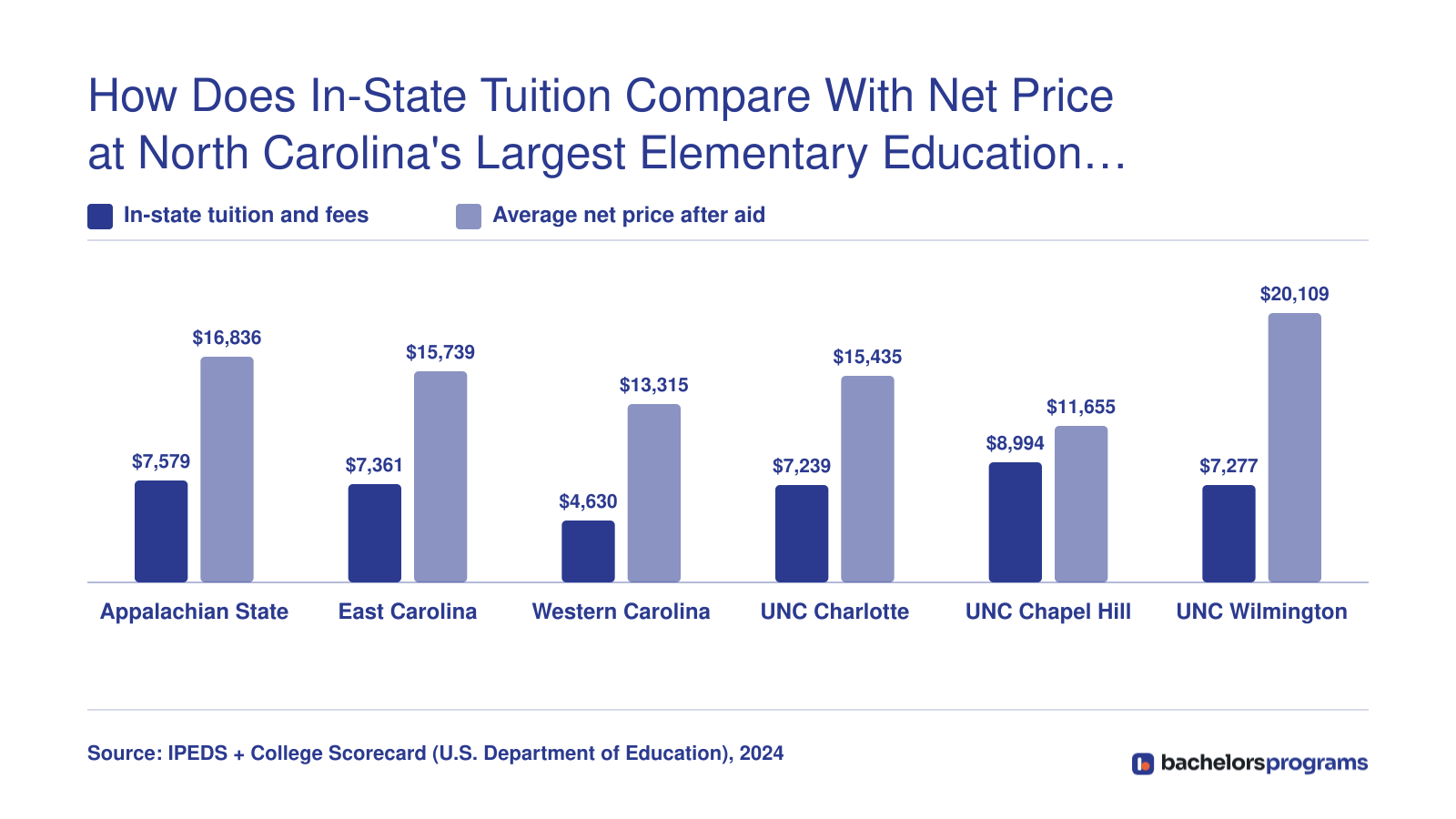
How Does In-State Tuition Compare With Net Price at North Carolina's Largest Elementary Education Programs?
The schools that graduate the most elementary education majors all charge in-state tuition and fees under $9,000, yet the average net price students actually pay runs higher once housing, books and other costs are counted. UNC Chapel Hill has the highest sticker price of this group but the lowest net price, while Western Carolina posts the lowest tuition. Net price shown is an institution-wide average after grants and scholarships, not a quote for any one student or for the education program specifically.
Frequently Asked Questions About Elementary Education Degrees in North Carolina
These answers draw on the program details covered above. Confirm current requirements with each school and the North Carolina Department of Public Instruction before you apply.
What are the best colleges for elementary education in NC?
Which elementary education programs in North Carolina lead to teacher licensure?
How long does it take to get an elementary education degree in North Carolina?
Can you get an elementary education degree online in North Carolina?
How much does an elementary education degree cost in North Carolina?
Compare Elementary Education programs on the data that matters
Explore more Education & Teaching majors or browse every field of study.
All Education & Teaching programs Browse every field of study