Best Elementary Education Degree Programs in Ohio
Compare 49 accredited Elementary Education programs in Ohio, with net price after aid, graduation rates, earnings and debt from IPEDS and the U.S. College Scorecard.

Sticker-price in-state tuition for a bachelor's degree in elementary education in Ohio ranges from $7,710 a year at Gods Bible School and College to $61,640 at The College of Wooster. Public universities, private colleges and Ohio-based online programs all award it, with wide gaps in cost and graduate earnings.
The most common credential, the Bachelor of Science (B.S.) in Elementary Education, leads to the Ohio PreK-5 license.
The diploma does not put you in a classroom. Ohio licensure requires passing the Ohio Assessments for Educators and completing supervised student teaching, so program quality shows up in pass rates and field hours.
Key Points
- Most Ohio programs admit you twice: university first, teacher education later.
- Online and campus bachelor's routes can lead to the same Ohio license.
- Net price after aid includes living costs, so compare it, not tuition.
Best Elementary Education Schools in Ohio: Our Top 10 Ranked Programs
Ohio's strongest elementary education bachelor's programs come in several shapes: a flagship research university in Columbus, mid-sized private colleges with deep field placements, and a small Cincinnati Bible college whose teacher education track meets state licensure standards. Every program below leads to an Ohio teaching license or a recognized alternative credential, and each one pairs classroom preparation with the school-wide outcomes and price data families need to compare them side by side.
Ohio State University
#1Columbus, OH · $17,000/yr (est. net price)
Best for: Students wanting a big-campus elementary pathway
Ohio State is the state's flagship public research university, and its Columbus campus anchors one of the largest teacher preparation pipelines in Ohio. Elementary licensure candidates train in school-based placements throughout metropolitan Columbus, with coursework that stresses inquiry-based and cooperative learning across the full pre-K through grade 5 range. It is the choice for students who want a big-university setting inside Ohio's public system.
- 120 total credit hours, including 32 to 39 in general education
- 50 credit hours in the education major
- B- minimum in major courses and in student teaching
- Ohio Assessment for Educators exams required before student teaching
- Coursework spans literacy, math, science and social studies for Pre-K-5
- School-based placements across metropolitan Columbus
- 2.75 cumulative GPA and 2.75 content GPA required
- Prepares students for recommendation for Ohio teacher licensure
University of Dayton
#2Dayton, OH · ~$30,000/yr (est.)
Best for: Future teachers focused on literacy instruction
The University of Dayton is a private Catholic university whose teacher education department holds A+ ratings from the National Council on Teacher Quality in both reading and math. Licensure candidates log more than 800 hours in Dayton-area schools, beginning with classroom observation in the first year and ending with a full semester of student teaching. The education school also carries an Accredited Plus rating from the International Dyslexia Association and partners in regional pre-K through 16 access work.
- Two licensure tracks: elementary (Pre-K-5) or middle grades (4-9)
- Middle grades candidates choose two of four content concentrations
- 800+ hours in local schools, starting with observation in year one
- Full semester of student teaching plus a capstone seminar
- 96% first-time pass rate on the Ohio Resident Educator license
- A+ NCTQ rating in reading and math, plus Accredited Plus from the IDA
- Test optional, no entrance exam and a $0 application fee
- Optional certificates in dyslexia, TESOL and STEM
Otterbein University
#3Westerville, OH · ~$19,000/yr (est.)
Best for: Students considering an intervention specialist license
Otterbein University is a private liberal arts institution in Westerville, just north of Columbus, where teacher candidates move through field-based education courses starting in their first year. Elementary licensure students complete 12 literacy hours, including a dedicated phonics course, before a year-four student teaching block. An optional Intervention Specialist concentration adds a second license, though it may extend time to graduation.
- Leads to an Ohio two-year PreK-5 Primary Education Resident Educator License
- 12 literacy hours required, including a dedicated phonics course
- EDUC 1600 includes a 30-hour field component in the first year
- Admission to Teacher Education in year two, during EDUC 2000
- 2.5 GPA plus FBI/BCI background check to enter EDUC 1600
- Student teaching is 10 credits plus a 2-credit seminar in year four
- Optional PreK-5 Intervention Specialist concentration adds a license exam
- Intervention Specialist path may add a semester
Miami University
#4Oxford, OH · $18,000 – $41,000/yr (est.)
Miami University is a public university in Oxford with a cohort-based teacher education program that the department says students finish in four years. Primary education candidates log over 700 hours of field experience beginning sophomore year and close with a 15-week, full-time student teaching placement. An annual teaching-specific job fair and a student teaching abroad option round out the experience.
- B.S. in Education plus an Ohio teaching license in four years
- 700+ hours of field experience beginning sophomore year
- 15-week full-time student teaching placement to close the degree
- Accredited by the Ohio Department of Education and CAEP
- 93% licensure exam pass rate reported in Title II data
- Cohort-based structure with a TESOL endorsement option
- Urban Cohort option and student teaching abroad available
- Annual teaching-specific job fair on campus
University of Cincinnati
#5Cincinnati, OH · ~$26,000/yr (est.)
The University of Cincinnati runs its elementary education program inside a large urban research university, with full-time weekday classes and field placements that follow students from first-year observation through a senior internship. More than 1,000 hours of practicum and internship work are built into the degree, and the School of Education reports a 95% licensure pass rate. Students can stack add-on certifications in special education, TESOL, digital learning design or deaf studies.
- 1,000+ hours of practicum and internship experience
- Field placements every year, from observation to senior internship
- Preschool practicum at the Arlitt Center laboratory school
- Kindergarten placement in junior fall; grades 4 and 5 in junior spring
- Full-time weekday classes between 8 a.m. and 4 p.m.
- School of Education reports a 95% licensure pass rate
- Add-on certifications in special education, TESOL, digital learning and deaf studies
- ACT or SAT scores optional for admission
The College of Wooster
#6Wooster, OH · ~$23,000/yr (est.)
The College of Wooster is a private liberal arts college where education is a double major by design, pairing licensure coursework with a second field such as psychology, sociology, communication or political science. The Primary (Elementary) Education track sits among eleven fields inside the education major. Small cohorts complete three P-5 student teaching and seminar courses, and graduates earn an Ohio four-year Resident Educator license that many have transferred to other states.
- Double major: education plus any second discipline the college offers
- Primary (Elementary) Education is one of 11 fields in the education major
- Coursework in phonics, reading assessment and intervention
- STEM in P-5 learning environments plus integrated social studies and arts
- Three P-5 student teaching and seminar courses (EDUC 49000, 49100, 49200)
- Earns an Ohio initial four-year Resident Educator teaching license
- Graduates have transferred the license to other states
University of Toledo
#7Toledo, OH · $13,000 – $22,000/yr (est.)
The University of Toledo places teacher candidates in more than 150 Toledo-area schools, with at least five semesters of field experience before graduation. Its educator preparation program is accredited by the Council for the Accreditation of Educator Preparation and reports that more than 87% of candidates pass the Ohio Assessments for Educators on the first attempt. A full-ride scholarship for future teachers covers in-state tuition plus room and board for four years.
- Leads to the Ohio preK-5 teaching license
- Field experience in more than 150 Toledo-area schools
- Four semesters in local classrooms; at least five semesters in the field
- Accredited by the Council for the Accreditation of Educator Preparation
- 87%+ first-attempt pass rate on the Ohio Assessments for Educators
- edTPA scores average four points above the required mark
- Full-ride Herb Scholarship covers in-state tuition, room and board
- Meets 100% of Ohio's Science of Reading Success metrics
Bowling Green State University
#8Bowling Green, OH · ~$24,000/yr (est.)
Bowling Green State University says it graduates more teacher education students than any other Ohio school, and its inclusive preK-5 program blends elementary and special education practice. Candidates earn two Ohio licenses, one for preK-5 classrooms and one as an intervention specialist, and finish with more than 1,000 hours of field experience. The College of Education and Human Development awards 180 or more scholarships worth over $1 million.
- Dual Ohio licenses: preK-5 primary education and intervention specialist
- Blends elementary and special education practice for ages 3 to 11
- 1,000+ field hours by graduation, with student teaching senior year
- Advanced Study admission after the sophomore year
- 3.0 GPA and passing OAE scores required for licensure recommendation
- 180+ scholarships totaling more than $1 million
- Mursion virtual simulation classrooms for practice
- Study abroad in England, Ireland and Spain
Franciscan University of Steubenville
#9Steubenville, OH · ~$24,000/yr (est.)
Franciscan University of Steubenville is a private Catholic university that pairs teacher preparation with its Catholic identity, placing candidates in local Catholic schools for observation and student teaching. Education programs are CAEP accredited and lead to Ohio licensure, with an international field placement option in Austria. The university also points students toward the Teach Grant and Teacher Loan Forgiveness programs.
- CAEP-accredited education programs leading to Ohio licensure
- Primary (P-5) Education is one of seven concentration areas
- Observation and student teaching in local Catholic schools
- International field placement option in Austria
- Research integrated into upper-level education courses
- Guidance on the Teach Grant and Teacher Loan Forgiveness
- Kappa Delta Pi education honor society on campus
- Graduates teach in public, Catholic, charter and private schools
Gods Bible School and College
#10Cincinnati, OH · ~$9,000/yr (est.)
Gods Bible School and College is a small private Bible college in Cincinnati whose teacher education track is CAEP accredited and meets Association of Christian Schools International requirements alongside Ohio licensure standards. The degree carries 30 credits of Bible and theology next to its education core. The elementary track prepares graduates for preschools, child-care centers and private religious schools, with sample coursework in Bible methods, child development and educational psychology.
- 135 to 141 credits total, including 30 in Bible and theology
- CAEP accredited and eligible for Ohio teacher licensure
- Meets Association of Christian Schools International requirements
- $295 per credit hour
- Four-year standard completion time
- Prepares graduates for preschools, child-care centers and private religious schools
- Sample courses include Bible Methods in the Elementary School and Child Development
Cost & outcomes by school
Federal data for the highest-earning Elementary Education programs, independent of the ranking above. Earnings are this field's bachelor's graduates four years after completing where the Scorecard reports them, else the school's undergraduate median.
| School | Net price / yr | Grad rate | Earnings | Debt | Grads/yr | Format |
|---|---|---|---|---|---|---|
| John Carroll University OH | $28,746 | 79% | $62,860 | $26,000 | 2 | Campus |
| The College of Wooster OH | $23,458 | 74% | $59,629 | $26,500 | 23 | Campus |
| Marietta College OH | $21,083 | 61% | $57,180 | $27,000 | 2 | Campus |
| Ohio Wesleyan University OH | $20,897 | 59% | $55,624 | $27,000 | 5 | Campus |
| Hiram College OH | $21,058 | 55% | $54,311 | $27,000 | 10 | Campus |
| Franklin University OH | $25,243 | 11% | $51,892 | $20,836 | 27 | Online |
| Mount St. Joseph University OH | $16,530 | 56% | $51,509 | $19,000 | 3 | Campus |
| Heidelberg University OH | $20,556 | 52% | $48,466 | $27,000 | 10 | Campus |
| Lourdes University OH | $23,206 | 33% | $48,150 | $30,937 | 11 | Campus |
| University of Dayton OH | $29,533 | 80% | $47,775 | $20,872 | 87 | Campus |
| Otterbein University OH | $19,237 | 68% | $47,383 | $21,025 | 27 | Campus |
| University of Cincinnati OH | $25,648 | 75% | $47,019 | $25,000 | 214 | Campus |
Sources: U.S. Department of Education. Net price, graduation rate, earnings and debt: College Scorecard (earnings and debt for this field's bachelor's graduates where reported, else school-wide); graduates: IPEDS. A dash means no figure is reported.
Cost, debt & payoff
Median earnings of this field's bachelor's graduates (4 yrs after completing, else the school's undergraduate median) vs. their median federal loan debt · U.S. College Scorecard
Across these programs the median graduate earns about $43,893 and finishes with roughly $24,063 in debt — a ratio that clears a common rule of thumb (keep debt below first-year salary). Net price and debt vary widely school to school, so check the per-school figures in the table above before you shortlist.
Highest-Earning Bachelor's Programs in Elementary Education in Ohio
The table below shows program-level median earnings for bachelor's degree graduates in elementary education at five Ohio schools, measured one, four and five years after finishing, with median program debt and completions from federal IPEDS and College Scorecard data (2024 release). University of Dayton graduates post the highest five-year median here at $48,689, followed by Miami University and Capital University. First-year earnings range from $38,492 to $42,094 against median program debt of $20,872 to $27,000, about $221 to $286 a month on a 10-year repayment plan, so early teaching pay can usually cover typical borrowing.
| School | Median Earnings, 1 Year After Completion | Median Earnings, 4 Years After Completion | Median Earnings, 5 Years After Completion | Median Program Debt | Est. Monthly Loan Payment (10-Year Plan) | Completions |
|---|---|---|---|---|---|---|
| University of Dayton | $38,492 | $47,775 | $48,689 | $20,872 | $221 | 103 |
| Miami University | $39,155 | $45,704 | $47,204 | $23,000 | $244 | 138 |
| Capital University | $42,094 | $46,055 | $47,168 | $27,000 | $286 | 32 |
| University of Cincinnati | $39,607 | $47,019 | $47,072 | $25,000 | $265 | 211 |
| Xavier University | $39,217 | $40,443 | $45,957 | $27,000 | $286 | 18 |
How We Ranked Ohio's Elementary Education Bachelor's Programs
A program can look affordable and still fail the one requirement that decides whether you can teach: approval to recommend you for an Ohio license. That is why accreditation and state approval carry as much weight here as cost and earnings.
What the numbers cover, and where they stop
Net price, program-level earnings and debt, completions and graduation rates come from federal College Scorecard data. Two limits matter. Graduation rate and net price are reported for the whole institution, not the elementary education major, and earnings are program medians measured at a stated window after graduation, so they describe one cohort, not a guarantee.
Verify accreditation for the program, not the university
CAEP accredits educator-preparation providers, generally at the provider level, on a review cycle of about seven years, so a provider's status may not cover every pathway or endorsement. Separate from CAEP is Ohio Department of Education and Workforce approval, the status that authorizes a program to prepare candidates for an Ohio teaching license.1 Check the CAEP accreditation decisions list for the provider's current decision and the ODEW approved educator-preparation programs list for the specific licensure area, then confirm scope and expiration on the school's own educator-preparation page.
What the list covers
The ranking is ranked-only and covers bachelor's degree programs in elementary education at Ohio-based schools, campus and online.
Related Articles
Online and Hybrid Elementary Education Bachelor's Options at Ohio Schools
A fully online bachelor's degree in elementary education and a campus-based one can lead to the same Ohio teaching license. The difference is where you spend your week, and how much of that week happens in a school building rather than in front of a screen.
Which programs list an online or hybrid format
Gods Bible School and College in Cincinnati lists its elementary teacher education bachelor's as available in both formats, with a fully online option for most tracks. It is CAEP accredited, and the program is designed to meet Ohio teacher licensure requirements.
Ohio State, Miami University, the University of Cincinnati, the University of Dayton and Bowling Green State University all list campus-based programs. Cincinnati runs full-time weekday classes from 8 a.m. to 4 p.m., which limits how much of a job or commute can fit around them2.
Coursework online, classrooms in person
No Ohio program lets you earn the license entirely from a laptop. Field experience and student teaching are built into every approved pathway. Shawnee State's on-campus program in Portsmouth starts clinical work in the first semester and passes 700 hours before graduation1; Cincinnati spreads field experiences across years two, three and four2.
Online students still complete those placements in approved Ohio classrooms. Before enrolling, ask three questions: how the school finds a placement near your home, who approves the site, and what happens if a district says no.
Accreditation and licensure to confirm
Check that the online track itself, not just the campus version, is CAEP accredited or state-approved to recommend you for an Ohio teaching license.
Admission Requirements: GPA, Test Policy and Transfer Credit
The harder gate is not the university's admissions office. It is the teacher-education program two years in. Most Ohio elementary education bachelor's programs admit you to the university first, then require a second step into a pre-major or into teacher candidacy, each with its own GPA minimum, prerequisite courses and testing. Knowing both thresholds before you apply saves a semester of backtracking.
What Ohio University and Cincinnati Publish
At Ohio University, selective admission to the Early Childhood and Elementary Education B.S.Ed. requires at least 30 credit hours and a 3.0 cumulative GPA, and the 2026 catalog specifies a 3.0 in Ohio University coursework. Applicants also need a C or better in EDTE 1000, EDEC 1600 and the required English, history or political science, math and science courses. Testing belongs to this step: Praxis Core, ACT or another catalog-listed score. The program is not test-optional, and it publishes no separate first-year high school GPA for the major, so treat the 3.0 as the candidacy standard.
At the University of Cincinnati, Elementary Teacher Candidacy requires a 3.0 GPA.1 An ACT of 22 or an SAT of 1080 is recommended rather than required; students who do not submit one take the UC Math Placement Assessment and need a score of 30.
Transfer Credit and Community College Pathways
Ohio University applies the statewide articulation and transfer policy to external credit.2 Cincinnati transfer applicants generally must have been admissible from high school and hold a 3.0 across all prior institutions; otherwise they need 24 semester hours (36 quarter hours) and a 3.0. Transfers are admitted separately to the major and to candidacy. Neither publishes a program-specific Ohio Transfer 36 policy, so ask how those modules map before you commit. The statewide Education Transfer Pathway lists a 2.75 minimum, a 3.0 target, and ACT or Praxis 1.3
Before You Apply
- Candidacy cutoff: confirm the GPA you must hold, not just the one you enter with.
- Background checks: Ohio schools require BCI and FBI checks before field placement; start early.
- Placement deadlines: clinical semesters fill on their own calendar, often months ahead.
- Course equivalencies: get general education credit reviewed in writing.
What Do Ohio's Most Affordable Elementary Education Programs Really Cost?
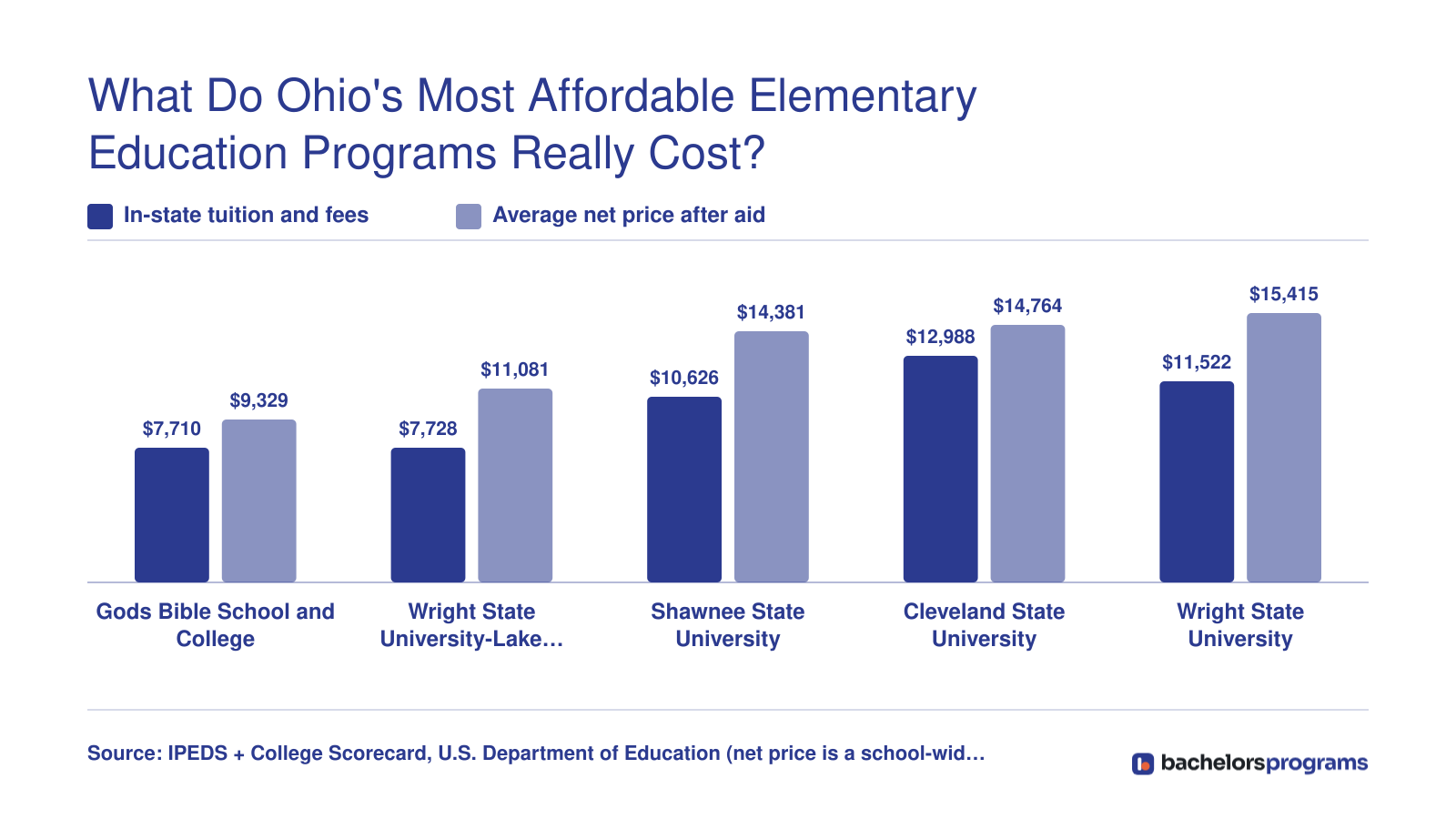
Published in-state tuition is only part of the bill. Average net price is what students actually pay per year after grant aid, and it includes living costs and books, so it can run higher than tuition alone. Gods Bible School and College, a small private college, posts the lowest figures, but public universities such as Shawnee State University, Cleveland State University and Wright State University generally cost less than most private colleges. Treat net price as approximate: it is a school-wide average, not a figure for the elementary education program alone.
Compare Elementary Education programs on the data that matters
Explore more Education & Teaching majors or browse every field of study.
All Education & Teaching programs Browse every field of study