Best Elementary Education Degree Programs in Rhode Island
Compare 8 accredited Elementary Education programs in Rhode Island at 5 colleges, with net price after aid, graduation rates, earnings and debt from IPEDS and the U.S. College Scorecard.

How far will you drive for student teaching in Rhode Island? Rarely far. The state is small enough that most campuses sit a short commute from the districts that host placements, which matters because a bachelor's degree in elementary education ends in a full semester in a classroom. The most common credential is the Bachelor of Science (B.S.) in Elementary Education.
Ranked programs come first, then side-by-side comparison, online options, admissions, cost and Rhode Island Department of Education (RIDE) licensure.
Every route passes through the same gate: a RIDE-approved program with at least 12 weeks of student teaching, so placement access matters as much as tuition.
Key Points
- Rhode Island College has the lowest average annual net price: $9,478.
- RIDE-approved programs require at least 12 weeks of student teaching.
- University of Rhode Island graduates earn a $44,363 median after one year.
Best Bachelor's in Elementary Education Schools in Rhode Island, Ranked
The five Rhode Island schools below are ordered using institutional and program records on completion, cost and program size, and each entry covers only the elementary education bachelor's programs a school actually enrolls students into. Figures such as graduation rate and net price describe the whole school rather than a single major, and net price is an average after aid rather than a quote for any one student.
University of Rhode Island
#1Kingston, RI · ~$21,000/yr (est.)
Best for: Students pairing certification with liberal arts breadth
The University of Rhode Island is the state's public research university, located in Kingston, and it awards a B.A. in Elementary Education that leads to K-6 teaching certification. The program pairs broad liberal arts study with pedagogy, and students can add a second major or minor, pursue an extended middle level certification, or begin graduate work in special education or TESOL. The school admits about 72% of applicants, in-state tuition is $16,942, and the average net price after aid is $21,440. It reported 120 elementary education completers and a 73% graduation rate.
- Leads to K-6 elementary teaching certification in Rhode Island
- Fully accredited certification program within a liberal arts degree
- Add a second major or minor to build a subject specialty
- Middle level extended certification option for grades 5-8
- Broad coursework in culturally responsive teaching and assessment
- Early pathway into an M.A. in special education or TESOL/BDL
Providence College
#2Providence, RI · ~$49,000/yr (est.)
Best for: Dual elementary and special education certification seekers
Providence College is a private college in Providence whose merged Elementary/Special Education major leads to certification in both elementary education (K-6) and special education (K-8). Candidates complete more than 750 hours of teaching across greater Providence and southeastern Massachusetts, with field experience built into every methods class and student teaching running across a full year. It is the most selective school on this list, admitting about 51% of applicants, with tuition of $63,550 and an average net price after aid of $48,523. The school reports an 86% graduation rate.
- Merged major leads to K-6 elementary and K-8 special education certification
- More than 750 hours of clinical teaching across Rhode Island and nearby Massachusetts
- Field experience in every methods class, beginning in the freshman year
- Reading science and structured literacy aligned with the Right to Read Act
- Approved by the Rhode Island Department of Education; licensure eligible in 45-plus states
- 93% of 2021-2025 education graduates employed, in graduate school, or both
- Semester abroad options in Florence, Italy or Belfast, Northern Ireland
Rhode Island College
#3Providence, RI · $9,000/yr (est. net price)
Best for: Career changers seeking a second bachelor's degree
Rhode Island College is a public college in Providence and the state's largest educator preparation program, with the school reporting that about 70% of Rhode Island teachers are RIC graduates. It offers a B.A. plus three B.S. tracks that pair elementary certification with special education, and none requires a secondary admissions process. Admission is broad, at about 92% of applicants, in-state tuition is $11,300, and the average net price after aid is $9,478. The school reports a 48% graduation rate.
- Leads to full elementary certification for grades 1-6
- No secondary admissions process; apply through general admission
- Add-on middle level credential qualifies graduates for grades 5-8
- Classroom experience beginning in the first year
- Coursework in literacy, math, science, social studies and special education
- Described by literacy experts as a national model for reading instruction
- Dual certification track in elementary and special education
- Licensed to teach grades K-6 and special education K-8
- Field work in schools plus student teaching or an internship
- Three concentration options within the B.S. program
- Focus on severe intellectual disabilities, ages 3 to 21
- Graduates licensed for grades K-6 and special education K-8
- General education requires 40 credits across nine categories
- Pathway from the B.S. into the Special Education M.Ed.
- Combined concentration pairs elementary, special education and severe disabilities
- Coursework includes literacy intervention
- Largest educator preparation program in Rhode Island
- Student teaching or internship included in the program
Salve Regina University
#4Newport, RI · ~$37,000/yr (est.)
Salve Regina University is a private university in Newport offering a Bachelor of Science in elementary education that leads to Rhode Island K-6 teacher certification. Students enter real classrooms in sophomore year and build three full years of field experience, finishing with two semesters of student teaching in partner elementary schools, and a double major in elementary and special education is available. About 68% of applicants are admitted, tuition is $50,100, and the average net price after aid is $36,967. The school reports a 77% graduation rate.
- Bachelor of Science leading to Rhode Island K-6 certification
- Three full years of field experience starting in sophomore year
- Two semesters of student teaching in partner elementary schools
- Double major in elementary and special education available
- Science of reading instruction meets Right to Read Act requirements
- Combined bachelor's/master's option in special education
- Credentials transfer to 45 states, Washington, D.C., Puerto Rico and Guam
Roger Williams University
#5Bristol, RI · ~$38,000/yr (est.)
Roger Williams University is a private university in Bristol whose elementary education bachelor's program builds four years of clinical experience into the curriculum, from first-year classroom observations with professors to a full-year elementary school residency and senior student teaching. Its teaching lab uses a virtual simulation that the school describes as the only one of its kind in Rhode Island. Admission is less selective than at the state's other private options, at about 88% of applicants, with tuition of $44,418 and an average net price after aid of $37,999. The school reports a 69% graduation rate.
- Four years of clinical experience woven through the curriculum
- First-year students observe elementary classrooms alongside professors
- Full-year residency in an elementary school during sophomore year
- Student teaching completed in the senior year
- Virtual teaching simulation lab, described as unique in Rhode Island
- Certification eligible in every state except Alaska, Iowa and Minnesota
- Partner schools across Rhode Island and southeastern Massachusetts
Cost & outcomes by school
Federal data for the highest-earning Elementary Education programs, independent of the ranking above. Earnings are this field's bachelor's graduates four years after completing where the Scorecard reports them, else the school's undergraduate median.
| School | Net price / yr | Grad rate | Earnings | Debt | Grads/yr | Format |
|---|---|---|---|---|---|---|
| Providence College RI | $48,523 | 86% | $87,054 | $27,000 | — | Campus |
| Salve Regina University RI | $36,967 | 77% | $59,178 | $27,000 | 46 | Campus |
| University of Rhode Island RI | $21,440 | 73% | $56,999 | $21,875 | 135 | Campus |
| Roger Williams University RI | $37,999 | 69% | $52,114 | $26,949 | 45 | Campus |
| Rhode Island College RI | $9,478 | 48% | $49,069 | $24,481 | 27 | Campus |
Sources: U.S. Department of Education. Net price, graduation rate, earnings and debt: College Scorecard (earnings and debt for this field's bachelor's graduates where reported, else school-wide); graduates: IPEDS. A dash means no figure is reported.
Cost, debt & payoff
Median earnings of this field's bachelor's graduates (4 yrs after completing, else the school's undergraduate median) vs. their median federal loan debt · U.S. College Scorecard
Across these programs the median graduate earns about $50,592 and finishes with roughly $24,481 in debt — a ratio that clears a common rule of thumb (keep debt below first-year salary). Net price and debt vary widely school to school, so check the per-school figures in the table above before you shortlist.
How Rhode Island's Top Elementary Education Schools Compare
Rhode Island College has the lowest average annual net price here at $9,478 and the largest Pell Grant share at 64.3 percent, while Providence College is the most selective, admitting 50.9 percent of applicants, and posts the highest graduation and retention rates. These figures come from the U.S. Department of Education's 2024 IPEDS and College Scorecard data and describe each institution as a whole, not its elementary education program specifically. Use them as context on cost, selectivity, and student success, then check each program's own details in the sections that follow.
| School | Control | Acceptance Rate | Average Net Price (per year) | Graduation Rate | Retention Rate | Pell Grant Share | Delivery Format |
|---|---|---|---|---|---|---|---|
| University of Rhode Island | Public | 72.2% | $21,440 | 73.3% | 84% | 41.4% | Campus |
| Providence College | Private nonprofit | 50.9% | $48,523 | 85.8% | 94% | 26.6% | Campus |
| Rhode Island College | Public | 91.8% | $9,478 | 48.1% | 73% | 64.3% | Campus |
| Salve Regina University | Private nonprofit | 68.2% | $36,967 | 76.9% | 83% | 31.6% | Campus |
| Roger Williams University | Private nonprofit | 87.7% | $37,999 | 68.7% | 81% | 27.5% | Campus |
Online and Hybrid Elementary Education Options at Rhode Island Schools
Every elementary education bachelor's program from the Rhode Island schools on this list is delivered on campus. None is published as a hybrid or fully online bachelor's degree in elementary education, and the fieldwork rules explain why that distinction matters more here than in most majors.
What each campus program looks like
- Rhode Island College: The B.A. and B.S. are campus-based. Majors get classroom experience as early as the first year, and 100% of programs include fieldwork plus student teaching. The 14-week student teaching placement is arranged by the college's Office of Partnerships and Placements; candidates may not set up their own, and they need a 2.75 GPA plus a RIDE e-cert Student Teaching Permit.
- Roger Williams University: Listed as in person, with four years of clinical experiences, first-year classroom work in local schools, a full-year elementary residency in the sophomore year under a host teacher and RWU faculty, and student teaching in the senior year.1
- Providence College and Salve Regina University: Both campus programs. Providence College builds clinical hours into the degree and starts student teaching in the freshman year; Salve Regina spreads field experience across three years with two student-teaching semesters.
- University of Rhode Island: The Elementary Education B.A., which leads to K-6 certification, is campus-based.
The one fully online degree, and what it is not
URI's Early Childhood Care and Education B.S. is fully online, runs in 7-week accelerated terms, and is built as a degree-completion program for working professionals, with Pre K-3 certificate eligibility and a practicum course. It is early childhood education, not elementary education. Readers who already hold college credit and want to work with young children should look at it; anyone set on a K-6 classroom should not treat it as a substitute.
Who should choose which
Working adults, transfer students and career changers ask about online formats because they need to keep earning while they study. Even for them, student teaching and field placements are always in person, in a Rhode Island or partner-district classroom under a supervising teacher. Anyone who wants continuous classroom experience, close faculty supervision and a cohort should pick campus.
Admissions for a Bachelor's Degree in Elementary Education: GPA, Test Policy, and Transfer Credit
Getting into an elementary education program in Rhode Island usually takes two steps: admission to the university, then a separate entry into the education program itself. The University of Rhode Island publishes the most detail on both steps.
School-by-School Policies
- University of Rhode Island: Transfer admission GPA is tiered: 2.8 with fewer than 24 transferable credits, 2.5 with 24 or more, and 2.4 with a completed associate's or bachelor's degree. Program entry (the Professional Course Sequence) requires 24 credits and a 2.75 cumulative GPA. Test policy: SAT/ACT not required for transfer admission, though College of Education competency evidence lists SAT scores of 480 in Evidence-Based Reading and Writing and 530 in Math, with Praxis Core as another route. Field hours: a 1-credit supervised field experience early on, plus 124 clinical hours before student teaching (an average across several education programs, not an elementary-only figure). Transfer credit: C or better, evaluated after admission.
- Rhode Island College: No published policy.
- Providence College: No published policy.
- Salve Regina University: No published policy.
- Roger Williams University: No published policy.
"No published policy" means the school's admissions and education pages do not state one. Confirm GPA, testing, and field-hour details with each admissions office before you apply.
The Common Pattern
General admission does not guarantee a seat in the education major. At URI, the 2.75 cumulative GPA for the professional sequence is higher than most transfer admission thresholds. Students between 2.5 and 2.74 may be accepted conditionally, but only with at least 45 credits and a GPA rising toward 2.75. Expect the same kind of gate at other schools, and ask about it early.
What GPA Do You Need?
At URI, you need roughly a 2.4 to 2.8 to be admitted as a transfer student, depending on your credits, and a 2.75 to enter the professional course sequence. The curriculum also lists a 2.5 elementary education GPA requirement. Aim for 2.75 or higher and you will clear the published bar. At the other schools here, ask the admissions office directly.
Transfer Credit Rules
URI accepts courses similar in content and scope to its own, with a C or better. Grades of C- and lower do not transfer, and neither do remedial, developmental, culinary, or applied technical science courses. Credits are reviewed only after you are admitted, so you will not see a final count beforehand.
Related Articles
Cost of an Elementary Education Degree in Rhode Island
Tuition Versus Net Price
Sticker price and what families actually pay can sit far apart. Rhode Island College lists in-state tuition and fees of about $11,300, while its approximate sector-average net price is about $9,478. The University of Rhode Island lists $16,942 in-state, but its net price of about $21,440 runs higher because it counts housing, food and books after aid, not tuition alone. Treat net price as a rough guide, not a quote for your own situation.
The private schools show a wider drop from list price to net price. Providence College lists $63,550 against a net price near $48,523. Salve Regina University lists $50,100 against about $36,967, and Roger Williams University lists $44,418 against about $37,999.
Public Versus Private, and the Out-of-State Premium
In-state tuition at Rhode Island College is roughly $33,000 a year below Roger Williams and about $52,000 below Providence College. Out-of-state students at the public schools pay more: about $27,299 at Rhode Island College (roughly $16,000 above the in-state rate) and $37,146 at the University of Rhode Island (about $20,200 above).
Institution-wide median debt among graduates is about $20,500 at Rhode Island College and $22,250 at the University of Rhode Island. It is about $27,000 at Salve Regina and Providence College, and about $26,940 at Roger Williams. These figures cover every graduate at the school, not elementary education majors specifically.
State Aid and Teacher Scholarships
Rhode Island offers need-based state grant aid for undergraduates, and there are scholarship and loan-assistance options aimed at future teachers, particularly in high-need fields. Eligibility rules and award amounts change, so confirm current terms with the Rhode Island Office of the Postsecondary Commissioner and each school's financial aid office. Most state aid starts with the FAFSA. Education departments can also tell you about teacher-specific awards when you apply.
Ways to Cut the Cost
- File the FAFSA early: Submit it as soon as it opens, and check each school's priority date, since some institutional and state aid is limited.
- Check Pell eligibility: Pell Grants do not need to be repaid, and they stack with state and school aid.
- Compare net price, not list price: A private school's aid package can narrow the gap with a public option, so request offers from several schools before deciding.
How to Become a Certified Elementary Teacher in Rhode Island
A Rhode Island Department of Education (RIDE) approved preparation program requires at least 12 weeks of student teaching in the certification area, plus at least 60 field-experience hours before that placement.1 Completing one is the first step toward the Initial Educator Certificate. The University of Rhode Island, Providence College, Rhode Island College, Salve Regina University, and Roger Williams University each offer elementary education programs, so any of them can serve as your preparation route.
The Steps in Order
- Approved program: Finish a bachelor's degree in elementary education through a RIDE-approved route, including the field experience and student teaching.
- Exams: Pass the Praxis Elementary Education: Multiple Subjects test (7001). Passing scores are 143 for Teaching Reading (7002), 157 for Mathematics (7003), 155 for Social Science (7004), and 159 for Science (7005).1
- Application: Apply through RIDE's form or electronic system with official transcripts or program documentation, plus an official test report if it has not already been sent.2 Approved-program applicants also submit program documentation and the required fee.
- Background check: Complete the background check RIDE requires, following the instructions on its certification page.
- Initial certificate: RIDE reports processing times of about 8 to 10 weeks, so apply well before hiring season.
RIDE has also opened Praxis Bridge to Rhode Island candidates who take eligible Praxis tests on or after November 1, 2025 and score just short of passing. Ask your program which subtests it covers.
Grade Band and Add-Ons
RIDE lists elementary certification for kindergarten through grade 6.1 Its published materials differ on how many elementary grade-level certificates exist, so confirm the current structure with your program's certification officer. Special education is a separate certification area, so ask whether your program prepares you for an add-on. Providence College's Elementary/Special Education program is the one on this list built around that pairing.
Teaching Outside Rhode Island
Program completers may pursue certification elsewhere through NASDTEC interstate agreements.4 These do not create an automatic nationwide license, and the receiving state decides what to accept. Expect to submit transcripts and test scores, and possibly take that state's exams or coursework.
The same logic applies in reverse. Rhode Island accepts a state-approved out-of-state program or a valid, full out-of-state certificate that is comparable in area and grade span, but not temporary certificates.1 Applicants generally must meet Rhode Island's testing requirements or show three years of effective teaching, unless an interstate-flexibility exemption applies. RIDE identifies 24 exempt jurisdictions.3
Check Official Sources
Exam requirements, fees and exemptions change, so check RIDE's How to Get Certified page and the Praxis testing service's current Rhode Island requirements before you register or apply.
Licensure Exam Pass Rates for Rhode Island Elementary Education Completers
These figures come from The Initial Report of the Secretary on the Quality of Teacher Preparation, the U.S. Department of Education's first federal Title II report. They reflect elementary education completers who took the Principles of Learning and Teaching (PLT): Grades K-6 exam in 1997-1998, so treat them as a historical baseline rather than a current picture of these programs. A pass rate shows the share of test-takers who met the state's cut score. It does not measure teaching quality or classroom readiness, and it does not count students who left a program before testing. In small cohorts, one or two results can move a percentage by several points. Roger Williams University has no figure in this source. Rhode Island's testing requirements have changed since that report, so ask each school for its most recent Title II results before you decide.
| Institution | Exam / Assessment | Pass Rate | Reporting Year |
|---|---|---|---|
| University of Rhode Island | PLT: Grades K-6 | 100% | 1997-1998 |
| Providence College | PLT: Grades K-6 | 100% | 1997-1998 |
| Rhode Island College | PLT: Grades K-6 | 97% | 1997-1998 |
| Salve Regina University | PLT: Grades K-6 | 100% | 1997-1998 |
How Much Do Elementary Education Graduates in Rhode Island Earn?
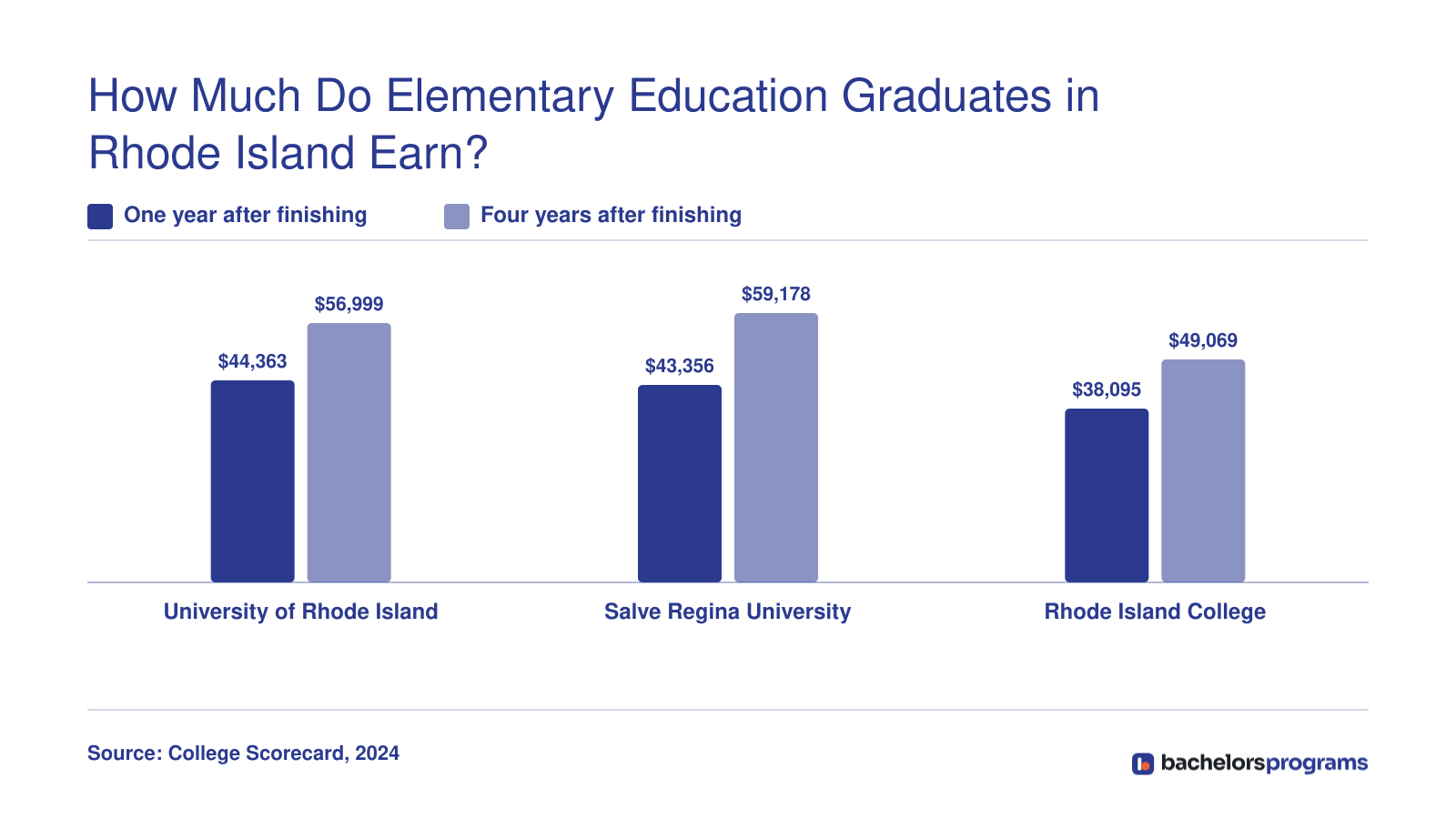
Graduates of the University of Rhode Island and Salve Regina University start close together, with median earnings of $44,363 and $43,356 one year after finishing, while Rhode Island College graduates start at $38,095. Four years after finishing, medians rise to $59,178 at Salve Regina, $56,999 at URI and $49,069 at Rhode Island College. Five years after finishing, they run from $51,204 at Rhode Island College to $57,326 at Salve Regina.
Elementary Teacher Salaries and Job Outlook in Rhode Island
Rhode Island elementary teaching pays modestly at the start and well later in a career, so the number that matters depends on which year you have in mind: your first or your tenth.
What Elementary Teachers Earn
The Rhode Island Department of Labor and Training's most recent occupational wage report for elementary school teachers (SOC 25-2021) estimates about 4,080 jobs and a median annual wage of $86,900.1 The range runs from $48,600 at entry to $62,080 at upper entry and $94,200 for experienced teachers.1 A bachelor's degree is the typical entry credential.
For a national comparison, the latest BLS state figures are from May 2021.2 They show a Rhode Island mean annual wage of $72,510 across 3,870 jobs, against $67,080 nationally across roughly 1.33 million jobs.3 That comparison uses means from a different year than the state median above, so treat it as a direction rather than an exact gap: Rhode Island pays above the national average.
Starting Pay
The $48,600 entry wage is an occupational estimate, not a contractual starting salary. Each district sets its own salary schedule, so check the published schedule of any district you want to teach in before budgeting.
Local Demand
The 2026-27 statewide shortage listing includes elementary special educator among its many shortage areas. It does not name general elementary classroom teaching as a statewide shortage. That makes a dual-focus preparation, such as the Elementary/Special Education program at Providence College, worth a look if you want an edge in hiring. Without a 2025-2035 growth or openings projection, demand is best read as steady rather than booming.
Why Program Earnings Look Different
Program-level earnings data reflect people in the first years after finishing, when they sit on the lowest steps of a salary schedule. Occupational medians include teachers at every experience level, which pulls the figure up. Expect your pay to start near the entry end of this range and climb with each year of service.
How to Choose a Bachelor's Degree in Elementary Education in Rhode Island
When every bachelor's degree in elementary education ends at the same Rhode Island teaching certificate, what should you compare first? The right comparison depends on the student you are.
Pick the profile that fits you
- Cost first: Compare net price after aid, not sticker tuition. URI and Rhode Island College charge in-state public rates, while Providence College, Salve Regina and Roger Williams are private. If you plan to borrow, the net price gap is the number that stays with you longest.
- Selectivity and prestige: A smaller, seminar-style setting points toward Providence College or Salve Regina. Confirm the program-entry GPA and any later application gate, since admission to the college and admission to the education major are separate steps.
- Career changer or transfer: Ask how many credits actually transfer and whether part-time or evening coursework exists. Rhode Island College offers both a BA and a BS route, which gives transfers more room to place completed coursework.
- Special education: Providence College's Elementary/Special Education program pairs the two certifications. If you want an inclusive classroom or a resource-room role, that dual credential widens your options in Rhode Island districts.
Three tie-breakers when programs look alike
- Licensure exam pass rates for program completers.
- Student-teaching placement: which districts, and how far you travel.
- Commute and schedule fit for the next four years.
Rhode Island is small, so the placement district matters more than the campus address. A student-teaching year in the district where you hope to be hired beats a shorter drive to class.
Your next step
Request information from two or three schools and ask each one the same four questions: entry GPA, transfer credit, placement districts, and dual-certification options. Put the answers side by side and the choice usually makes itself. Start with the request-information form on each program page and compare what comes back before you commit to a deposit.
Compare Elementary Education programs on the data that matters
Explore more Education & Teaching majors or browse every field of study.
All Education & Teaching programs Browse every field of study