Best Elementary Education Degree Programs in Tennessee
Compare 30 accredited Elementary Education programs in Tennessee, with net price after aid, graduation rates, earnings and debt from IPEDS and the U.S. College Scorecard.

Tennessee requires elementary teachers to hold a license earned through a State Board-approved educator preparation program, and the most direct route to a K-5 endorsement is a bachelor's degree in elementary education. Most candidates earn a Bachelor of Science (B.S.) in Elementary Education, though some schools use a B.A. or an interdisciplinary major.
The real tension is between cost and fit. A large public campus and a small private college can lead to the same license, yet net price, delivery format, and admission to the teacher education program differ sharply. The rankings draw on College Scorecard data and net price to compare campus and online options at Tennessee-based schools.
With pay for classroom teachers modest, graduates feel the price difference for years.
Key Points
- Tennessee's K-5 Transfer Pathway carries 60 credits toward a bachelor's degree.
- East Tennessee State and Middle Tennessee State offer hybrid elementary education.
- Teacher licensure comes through a State Board-approved EPP, not direct application.
Best Bachelor's Degree in Elementary Education Programs in Tennessee
Tennessee's elementary education bachelor's programs run from a small, research-driven cohort at Vanderbilt's Peabody College to large public licensure pipelines at UT Knoxville, Memphis and Middle Tennessee State. Every program below awards a bachelor's degree and prepares candidates for a Tennessee K-5 license, and several add a second endorsement in special education or English as a Second Language.
Vanderbilt University
#1Nashville, TN · ~$16,000/yr (est.)
Best for: High-achieving students wanting research-driven teacher preparation
Vanderbilt's Peabody College awards a Bachelor of Science in Elementary or Secondary Education, with the elementary track leading to Tennessee licensure. Undergraduates study in the Department of Teaching and Learning, whose faculty focus on mathematics and science education, language and literacy, and classroom environments and management. Admission is highly selective, and the program is the smallest of those ranked here.
- Two concentration options: Elementary and Secondary Education
- Elementary track is research-grounded and practice-intensive
- Leads to Tennessee teacher licensure
- Secondary track prepares teachers for grades 7-12
- Housed in the Department of Teaching and Learning
- Faculty focus on math and science education and literacy
The University of Tennessee-Knoxville
#2Knoxville, TN · ~$19,000/yr (est.)
Best for: Future teachers wanting a large public research campus
UT Knoxville offers a Bachelor of Science in Education with an Elementary Education concentration and seven specialization options, from English as a Second Language to interventionist special education and middle grades math and science. The flagship campus pairs K-5 and K-8 licensure routes with traditional and five-year pathways. In 2026 the university and Knox County Schools launched the Teach Knox Fellows initiative, a local preparation pipeline focused on special education teachers.
- Seven concentration options within the major
- Prepares for teacher education in grades K-5 and K-8
- Leads to a Tennessee teaching license
- Traditional and 5-year pathways offered
- K-8 dual licensure option available
- Options in ESL and interventionist special education
The University of Tennessee-Martin
#3Martin, TN · $11,000/yr (est. net price)
Best for: Budget-minded rural students near Martin
UT Martin's Integrated Studies degree with a K-5 concentration is one of the state's more affordable licensure routes, with published in-state tuition below the two UT flagships. Coursework spans English language arts, science, social studies and math, with field experiences in elementary classrooms and student teaching in K-5 settings. A non-licensure option exists for students who want the degree without certification.
- 120 credit hours, including 59 concentration hours
- Educator Preparation Program admission requires a 2.75 GPA
- ACT super score of 21 or SAT of 1080 for program admission
- TBI/FBI background check and admission interview required
- Non-licensure K-5 option available
- Accredited by the Tennessee State Board of Education and CAEP
- Student teaching placements in K-5 classrooms
East Tennessee State University
#4Johnson City, TN · ~$16,000/yr (est.)
ETSU's Clemmer College pairs a K-5 elementary license with a K-12 English as a Second Language endorsement, so graduates leave with two credentials. Candidates log more than 250 hours in classrooms before a year-long residency with a mentor teacher. Partnerships with Kingsport City Schools and rural districts through the RITE initiative give students placements across the region, and classes run in person or hybrid.
- Dual license: K-5 elementary and K-12 ESL
- More than 250 classroom hours before student teaching
- Year-long residency with a mentor teacher
- Offered in person or hybrid
- Internships with Kingsport City Schools and rural RITE districts
- District-recognized interns may earn a year of teaching experience
University of Memphis
#5Memphis, TN · $10,000 – $15,000/yr (est.)
The University of Memphis awards the Teaching All Learners BSEd, a 120-credit dual-licensure program that pairs Elementary Education K-5 with Special Education Interventionist certification. Students move through pre-residence practicums into Residency I and Residency II. The College of Education finalized agreements with 26 school and district partners for 2026-27, including Hardeman County Schools, Henderson County Schools and Perea School.
- 120 credits leading to elementary and special education licensure
- Dual pathway: Elementary K-5 and Special Education Interventionist
- Pre-residence practicums plus Residency I and Residency II
- Praxis Elementary Education Multiple Subjects subtests required
- Praxis deadlines tied to each residency stage
- Hands-on co-teaching in local classrooms
Tennessee Tech
#6Cookeville, TN · $10,000 – $15,000/yr (est.)
Tennessee Tech's Department of Curriculum and Instruction awards a nationally accredited Bachelor of Science in Elementary Education leading to K-5 licensure. Students work in the VISION Virtual Learning Lab, the Jeffers Learning Resources Center and the Millard Oakley STEM Center. A 2+2 route with regional community colleges lets students finish the degree close to home, and the university's primary district partnerships center on Putnam and White counties.
- Nationally accredited K-5 licensure track
- 2+2 program with regional community colleges
- Complete the degree close to home
- Access to the VISION Virtual Learning Lab
- Millard Oakley STEM Center and Jeffers Learning Resources Center
- Classes meet on campus in Bartoo Hall
- Clinical placements through Putnam and White county partners
Freed-Hardeman University
#7Henderson, TN · $22,000/yr (est. net price)
Freed-Hardeman's Bachelor of Science in Interdisciplinary Studies with an Elementary Education concentration runs a 46-hour professional core plus 33 to 36 hours of supporting coursework. Candidates complete at least 100 clock hours of field experience and a full semester of integrated practicum and student teaching in public schools. The CAEP-accredited program is grounded in Christian values and publishes four-year plans through 2026-2027.
- 46-hour elementary education professional core
- 33 to 36 hours of required supporting coursework
- At least 100 clock hours of field experience
- Full semester of integrated practicum and student teaching
- Praxis Core and Elementary Education Multiple Subjects required
- CAEP accredited, leads to K-5 certification
- Elementary Spanish I and II required
Milligan University
#8Milligan, TN · ~$21,000/yr (est.)
Milligan University offers a bachelor's degree in education with a K-5 elementary and P-12 English as a Second Language licensure track, one of five licensure levels listed for the bachelor's program. Licensure coursework runs from Introduction to Teaching through assessment and classroom management, with supervised field experiences beginning in the first education class. Milligan is CAEP accredited, and students may qualify for a TEACH Grant.
- K-5 elementary plus P-12 ESL licensure track
- Field experience starting in the first education class
- Coursework in classroom management and exceptional students
- Supervised field experiences and student teaching
- Prepares students for Tennessee teaching licensure
- CAEP accredited
- TEACH Grant eligibility possible
Lipscomb University
#9Nashville, TN · ~$25,000/yr (est.)
Lipscomb University's B.A. in Education: Elementary Education K-5 is a required double major, paired with Special Education K-8 Interventionist or K-12 English Language Learning. Graduates earn both endorsements at graduation. Clinical Experience Labs I through III lead into a 12-credit K-5 student teaching placement, and the university's Grow Your Own LIFT partnership covers tuition and fees for a cohort of 10 Metro Nashville Public Schools students each year.
- Elementary K-5 is a required double major
- Paired with Special Education K-8 or K-12 ELL
- Dual endorsement: both licenses at graduation
- Clinical Experience Labs I, II and III before student teaching
- Student teaching in K-5 at 12 credits
- Methods courses in math, social studies, science and literacy
- Grow Your Own LIFT partnership with Metro Nashville schools
Middle Tennessee State University
#10Murfreesboro, TN · ~$13,000/yr (est.)
Middle Tennessee State University's Elementary Education B.S. was the first program of its kind approved by the Tennessee Department of Education. The 120-credit degree stacks three licensure areas: Elementary Education K-5, Special Education Interventionist K-8 and English as a Second Language K-12. Residency 1 places students in schools two full days a week, and Residency 2 is five-day student teaching; a statewide A.S.T. transfer pathway lets community college graduates finish in two years.
- 120 credit hours with four-year completion
- Three licensure areas in one degree
- First TDOE-approved program of its kind
- Residency 1: two full days weekly in schools
- Residency 2: five-day student teaching
- ESL, literacy and math field experiences
- A.S.T. transfer pathway from participating community colleges
- CAEP accredited
Cost & outcomes by school
Federal data for the highest-earning Elementary Education programs, independent of the ranking above. Earnings are this field's bachelor's graduates four years after completing where the Scorecard reports them, else the school's undergraduate median.
| School | Net price / yr | Grad rate | Earnings | Debt | Grads/yr | Format |
|---|---|---|---|---|---|---|
| The University of Tennessee-Knoxville TN | $18,976 | 74% | $60,249 | $20,500 | — | Online or campus |
| Cumberland University TN | $18,759 | 46% | $57,687 | $17,952 | 13 | Campus |
| Christian Brothers University TN | $9,854 | 55% | $57,478 | $27,000 | — | Campus |
| Belmont University TN | $33,147 | 71% | $55,930 | $20,500 | 20 | Campus |
| Vanderbilt University TN | $15,846 | 94% | $55,188 | $14,000 | 35 | Campus |
| Bryan College-Dayton TN | $20,614 | 50% | $54,434 | $23,000 | 19 | Campus |
| Union University TN | $27,171 | 66% | $53,990 | $20,714 | 8 | Campus |
| Southern Adventist University TN | $24,345 | 49% | $50,119 | $24,249 | 17 | Campus |
| Maryville College TN | $19,360 | 50% | $49,279 | $25,375 | 11 | Campus |
| Bethel University TN | $12,595 | 35% | $47,482 | $27,249 | 4 | Campus |
| Tennessee Wesleyan University TN | $14,836 | 48% | $46,925 | $20,000 | 10 | Campus |
| Middle Tennessee State University TN | $13,359 | 54% | $46,252 | $20,000 | 80 | Hybrid |
Sources: U.S. Department of Education. Net price, graduation rate, earnings and debt: College Scorecard (earnings and debt for this field's bachelor's graduates where reported, else school-wide); graduates: IPEDS. A dash means no figure is reported.
Cost, debt & payoff
Median earnings of this field's bachelor's graduates (4 yrs after completing, else the school's undergraduate median) vs. their median federal loan debt · U.S. College Scorecard
Across these programs the median graduate earns about $44,348 and finishes with roughly $21,375 in debt — a ratio that clears a common rule of thumb (keep debt below first-year salary). Net price and debt vary widely school to school, so check the per-school figures in the table above before you shortlist.
Most Affordable Elementary Education Bachelor's Programs in Tennessee
This table sorts Tennessee elementary education bachelor's programs by average annual net price, which is what students pay after grants and scholarships, using 2024 IPEDS and College Scorecard data from the U.S. Department of Education. UT Martin and the University of Memphis, both public universities ranked on this page, keep in-state tuition and fees under $11,000. Christian Brothers University and Bethel University list higher private tuition, but aid brings their net prices close to the public options. Le Moyne-Owen College, an HBCU in Memphis, shows the lowest net price, but its program does not currently lead to a teaching license while the college seeks licensure approval, so confirm its status before you enroll.
| School (City) | Type | Program | In-State Tuition and Fees | Average Net Price After Aid | Graduation Rate | Median Earnings 10 Years After Entry (All Programs) |
|---|---|---|---|---|---|---|
| Le Moyne-Owen College (Memphis) | Private nonprofit, HBCU | Elementary Education K-5 (non-licensure, online option) | $12,076 | $7,099 | 27% | $35,594 |
| Christian Brothers University (Memphis) | Private nonprofit | Liberal Studies (K-5, Licensure) | $38,420 | $9,854 | 55% | $57,478 |
| The University of Tennessee-Martin (Martin) | Public | B.S.Ed., Major in Integrated Studies (K-5) | $10,560 | $10,701 | 53% | $44,213 |
| University of Memphis (Memphis) | Public | Teaching All Learners (TALN), Elementary K-5 and Special Education | $10,728 | $12,397 | 51% | $48,458 |
| Bethel University (McKenzie) | Private nonprofit | Interdisciplinary Elementary Education, B.S. | $18,712 | $12,595 | 35% | $47,482 |
Online and Hybrid Elementary Education Options at Tennessee Schools
Most Tennessee elementary education programs still center on campus, with hybrid delivery the main flexible option. East Tennessee State University and Middle Tennessee State University are listed as hybrid, and ETSU says its major can be taken in person or hybrid. The University of Tennessee-Knoxville is listed with both campus and online formats. Vanderbilt, UT Martin, the University of Memphis, Tennessee Tech, Freed-Hardeman, Milligan and Lipscomb are listed as campus programs.
How Student Teaching Works
No Tennessee program lets you skip the classroom. The state requires an approved preparation program with clinical practice, whether that is student teaching, an internship or job-embedded practice.1 Hybrid students still complete that work in person, in a school.
ETSU describes 250 clinical hours and a year-long residency with a mentor teacher, with placements in urban and rural schools, including Kingsport City Schools and rural districts through its RITE initiative. MTSU pairs two days a week in schools during Residency 1 with a five-day student-teaching residency. Ask the program before you enroll whether it arranges a placement near your home or expects you to find your own site; the sources reviewed do not say which.
Accreditation and State Approval
Tennessee's State Board of Education approves preparation programs through CAEP, AAQEP or a state-managed review.2 UT Martin, Freed-Hardeman, Milligan and MTSU each describe CAEP accreditation. For Christian Brothers University, a 2023 state document records full approval of its K-5 program, and it shows the University of Memphis programs recommended for full approval.3 The accreditor and approval status of the remaining schools, Vanderbilt, UT Knoxville, ETSU, Tennessee Tech and Lipscomb, could not be verified from the sources reviewed here. Check the state's approved-program directory.
Same Licensure Path
A degree from a Tennessee-approved program leads to the same K-5 licensure path whether you attend on campus or in a hybrid format.4 Online programs offered by institutions based outside Tennessee are not covered here.
Related Articles
Admission Requirements: GPA, Test Policy, and A.S.T. Transfer Credit
The Tennessee Transfer Pathway for K-5 Elementary Education is built on 60 credits, divided into 41 hours of general-education core and 19 hours of pre-major and elective coursework1, and every one of those hours is meant to count toward the bachelor's at a participating Tennessee university.
The A.S.T. Pathway in Plain Terms
The Associate of Science in Teaching (A.S.T.) is the community-college half of that route. Published pathway guidance from Tennessee community colleges typically lists a 2.75 cumulative GPA, a Praxis Core exam or a 21 ACT as the entry gate, and a satisfactory suitability or disposition review (three separate assessments at some colleges)2. SAT thresholds differ between published pages, 1020 on one and 1080 on another, so confirm the number with the college you plan to attend. The K-5 Elementary Education pathway is scheduled for statewide review on February 10, 20271, which means requirements can change after that date.
What the Universities Publish
Minimum GPA and ACT/SAT policy vary by institution and shift from year to year, and some admissions pages state neither a GPA floor nor a test rule. Read each university's current admissions page before you apply. Expect a second gate: most education preparation programs add their own step into the major, whether a GPA check, a Praxis Core score or waiver, or a disposition review.
Deadlines and Transfer Credit
Freshman deadlines cluster in the fall and winter before the term you want, with transfer deadlines often later; verify each date directly. The pathway works as an advising agreement, meaning approved community-college courses satisfy major-preparation requirements at Tennessee public universities and select regionally accredited nonprofit private institutions. If you transfer to a school outside that agreement, confirm credit with the receiving advisor first. That step is where credit loss happens.
How Long It Takes
Four years of full-time study is standard for the bachelor's. An A.S.T. transfer usually leaves about two years of major and licensure coursework, so the total timeline stays close to four years.
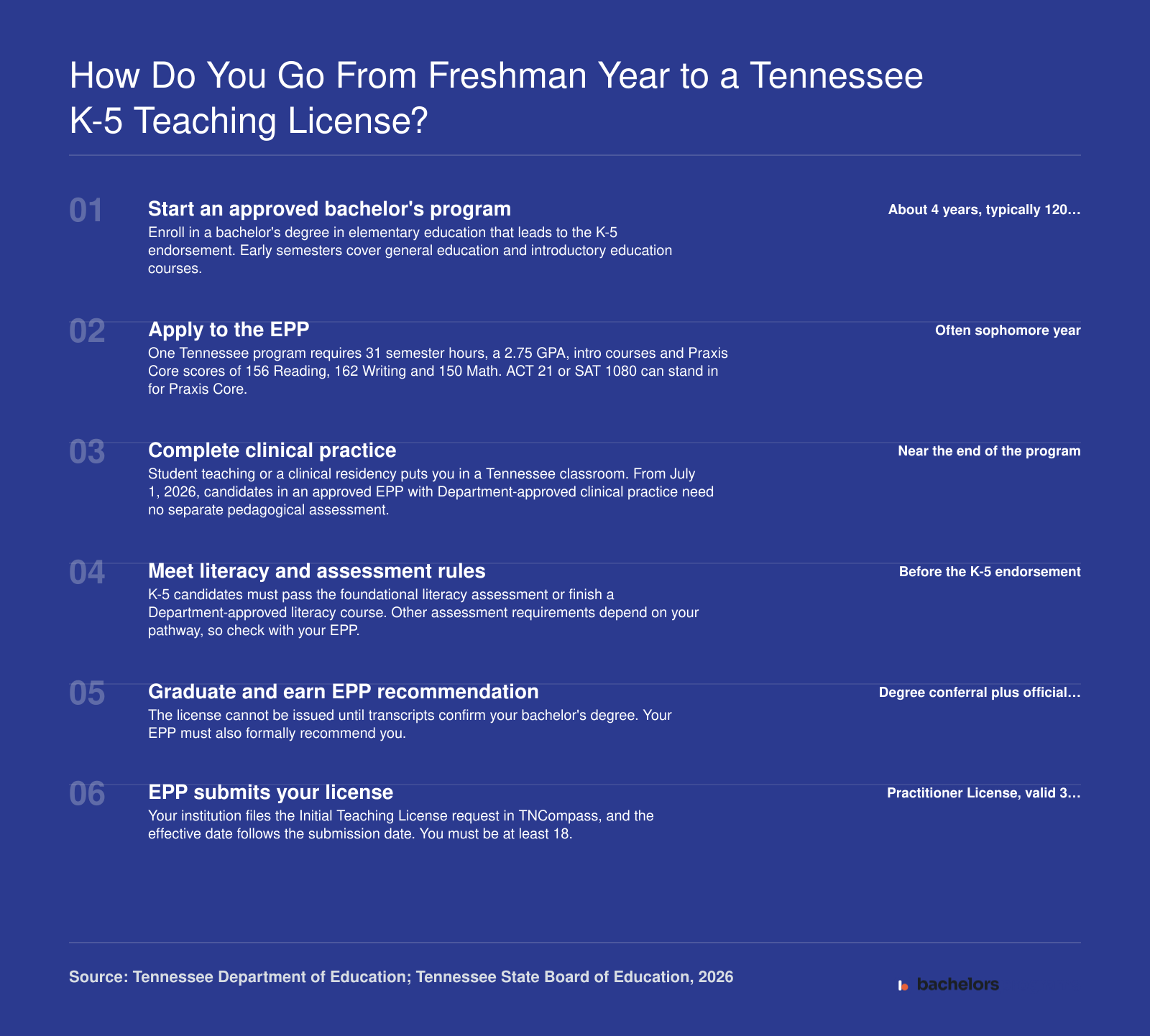
How Do You Go From Freshman Year to a Tennessee K-5 Teaching License?
In Tennessee, a K-5 license comes through a State Board-approved educator preparation program (EPP), not a direct application to the state. The steps below follow a traditional bachelor's degree in elementary education. Exact entry requirements vary by school, so confirm the details with your program.
Median Pay for Tennessee Elementary School Teachers
For graduates of a bachelor's degree in elementary education, this is the typical salary for a Tennessee classroom teacher.
Compare Elementary Education programs on the data that matters
Explore more Education & Teaching majors or browse every field of study.
All Education & Teaching programs Browse every field of study