Best Elementary Education Degree Programs in Virginia
Compare 31 accredited Elementary Education programs in Virginia, with net price after aid, graduation rates, earnings and debt from IPEDS and the U.S. College Scorecard.
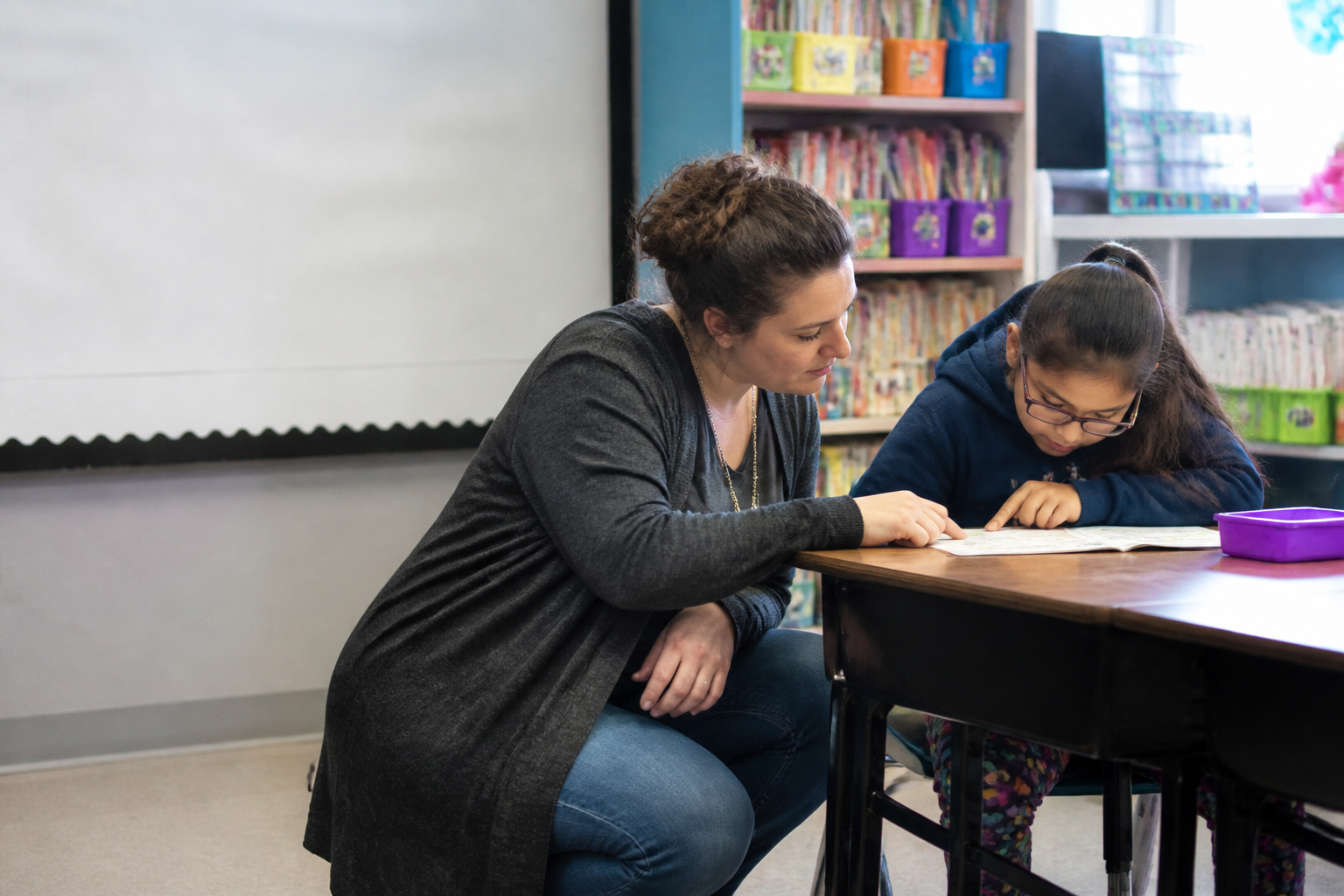
You get into a Virginia elementary classroom through a bachelor's degree in elementary education, and which license you qualify for depends on the program behind it. Most schools here award a Bachelor of Science (B.S.) in Elementary Education, though some use a B.A. or B.Ed. Each must be a state-approved preparation program to lead to a PreK-6 endorsement.
The top 10 programs are ranked below, alongside shorter lists of the cheapest options and the highest-earning graduates. Online options, admissions, cost after aid, and Virginia licensure get their own sections.
Virginia elementary teachers earned a median of $65,550 as of May 2025. The harder question is which program gets you licensed without excess debt.
Key Points
- Virginia elementary teachers earned a $65,550 median wage in May 2025.
- Virginia's PreK-6 license requires completing a state-approved educator preparation program.
- Expect two admission gates: the university first, then the education program.
Best Bachelor's Programs in Elementary Education in Virginia: Our Top 10 Ranked
Ten Virginia colleges award a bachelor's degree in elementary education that leads to a teaching license, and the strongest of them put candidates in real classrooms early and often. Each card below gives the one reason the school sits where it does, plus the specifics of its program. Tuition, net price and graduation rate figures on this page describe the whole institution, not the elementary education major alone.
University of Virginia
#1Charlottesville, VA · $22,000/yr (est. net price)
Best for: Future teachers drawn to literacy research
UVA's School of Education and Human Development runs the elementary education major as a 120-credit B.S.Ed. that finishes with a full-time student teaching internship from January through April. The school houses statewide Virginia Literacy Partnerships that have worked with the Virginia Department of Education for more than two decades on reading screening, curriculum review and teacher training, and candidates also practice in mixed-reality classroom simulations before and alongside live placements. It is the most selective option in the state for this major, and graduates leave with a preK-6 endorsement and guaranteed admission to select UVA master's programs.
- 120-credit, four-year degree on campus in Charlottesville
- Two practicum field experiences during year three
- Full-time student teaching January through April
- 12-credit student teaching internship in spring
- Mentor teacher placement three days per week
- Leads to initial Virginia licensure, preK-6 endorsement
- Guaranteed admission to select UVA master's within five years
- February 1 priority deadline; transfer entry for first- or second-years
William & Mary
#2Williamsburg, VA · $15,000 – $20,000/yr (est.)
Best for: Liberal arts students adding ESL credentials
William & Mary's education school is small, and its elementary education major is arranged so students are in schools early: field experience begins before admission and totals more than 80 hours before student teaching, followed by over 300 hours of student teaching. Candidates can add optional concentrations in ESL or special education, and Praxis exams in teaching reading and elementary multiple subjects are required to graduate. The program reported that every 2026 student teacher was offered a job by a local school district. Undergraduates typically declare after 39 credit hours, so the major fits comfortably alongside a second field of study.
- 44 total credit hours in the major
- 80+ field hours before student teaching
- 300+ student teaching hours
- Optional concentrations in ESL and special education
- 2.0 GPA minimum to apply after 39 credit hours
- Praxis Teaching Reading and Multiple Subjects required to graduate
- Prepares for Virginia Collegiate Professional Licensure, PK-6
- All 2026 student teachers offered jobs by a local school district
Virginia Polytechnic Institute and State University
#3Blacksburg, VA · $25,000/yr (est. net price)
Best for: STEM-minded students wanting math and science methods
Virginia Tech's elementary education major sits in the School of Education inside the College of Liberal Arts and Human Sciences, and it draws on the university's broader strength in science and technology. Coursework includes dedicated methods work in elementary mathematics, science and STEM, alongside reading, social studies and educational psychology. Students apply for admission to the educator preparation program, and a progress review follows at 72 semester hours. Field studies carry variable credit at three points across the degree rather than being confined to the final year.
- 120 total credit hours, including 20 credits of degree core
- 2.5 overall GPA and 3.0 in-major GPA for licensure
- Acceptance into the educator preparation program required
- Field studies carry 3, 6 and 9 credits
- Progress review after 72 semester hours
- Methods courses in elementary math, science and STEM
- 13 credits of free electives plus Pathways general education
- Must pass state licensure examinations to graduate
George Mason University
#4Fairfax, VA · $15,000 – $20,000/yr (est.)
George Mason's elementary education bachelor's is built around a junior-year cohort and a year-long student teaching placement in a school in one of five Northern Virginia partner districts. Students choose between a PK-6 licensure track and a non-licensure educational studies track. Most classes meet once a week, and some mix on-campus and online instruction, which suits students who already work in schools. The college also maintains a dedicated transfer path with Northern Virginia Community College.
- Two concentration options: PK-6 licensure or educational studies
- 120 total credit hours over four years
- 2.5 GPA minimum to join the cohort after 45 credits
- Year-long student teaching in a PDS Network school
- Praxis Elementary Multiple Subjects and Teaching Reading before internship
- CPR, AED and First Aid certification required for internship
- Upper-level ELED courses offered once a year
- Classes meet weekly on the Fairfax campus, some hybrid
University of Richmond
#5University of Richmond, VA · ~$31,000/yr (est.)
Richmond treats elementary education as a liberal arts major inside the School of Arts and Sciences rather than as a stand-alone teacher training track. Students declare in sophomore year and can pair the major with any of the university's 80-plus other programs, minors or concentrations. Education courses are grounded in practice but sit inside a broad liberal arts sequence, and graduates are prepared for preK-6 classrooms. It is a small, selective private option for students who want a teaching credential without narrowing the rest of their degree.
- Bachelor of Arts conferred through the School of Arts & Sciences
- Declare the major in sophomore year
- Combine with other majors, minors or concentrations
- 80+ programs available for a second field of study
- Coursework embedded in the liberal arts tradition
- Prepares candidates for preK-6 classrooms
University of Mary Washington
#6Fredericksburg, VA · $21,000/yr (est. net price)
Mary Washington runs its elementary education major in five phases, with licensure candidates completing 46 credits of education coursework inside a 120-credit degree. Admission to the program is separate from admission to the university and requires a 3.0 in two introductory education courses plus a 2.5 overall GPA. Students can add a special education endorsement track or take the major-only route without licensure. Field experiences are spread across the phases and end with a full-time spring internship in senior year.
- 46 credits of education coursework inside a 120-credit degree
- Major organized in five sequential phases
- 3.0 or better in EDUC 206 and EDUC 207, plus 2.5 overall GPA
- Phase II applications due February 15 or October 1
- Two start points per year, fall and spring
- Special education endorsement track available
- Major-only option without licensure
- Full-time teaching internship in senior spring
Eastern Mennonite University
#7Harrisonburg, VA · $25,000/yr (est. net price)
Eastern Mennonite's elementary education program is built on early and frequent school time: students observe in a classroom by week five and return to field placements nearly every semester. Candidates choose a PreK-3 or PreK-6 licensure path and complete 24 semester hours of professional studies alongside 21 hours of practica. Student teaching is full-time, with feedback from both a classroom teacher and a university representative. The university reports that in four of the past five years, every completer who sought a PreK-12 teaching position was employed in a school.
- 24 semester hours of professional studies plus 21 hours of practica
- Classroom observation by week five
- Field experiences nearly every semester
- PreK-3 or PreK-6 licensure paths
- Full-time student teaching with teacher and faculty feedback
- Declaring the major may qualify students for a $3,000 renewable scholarship
- Reflective seminar covers job searches and hiring
- Meets all requirements for a Virginia teaching license
Virginia Commonwealth University
#8Richmond, VA · ~$23,000/yr (est.)
VCU's elementary education bachelor's is one of the larger urban preparation programs in the state, with three sequenced practica and two full-time internships split between preK-2 and grades 3-5. Courses include dedicated work in numbers and operations and in algebra, functions and geometry, so candidates build the math content behind the elementary curriculum. Full-time students finish in about four years, while a part-time pace of 11 credits or less typically takes four to six years. A non-licensure option exists for students who want the education background without a teaching license.
- 120 total credit hours, fall or spring start
- 2.8 GPA required for admission to teacher preparation
- VCLA and Praxis II passing scores before internship enrollment
- Three practica followed by two full-time, seven-to-eight-week internships
- Internships split between preK-2 and grades 3-5
- Math content courses in numbers and operations and algebra
- Non-licensure option available
- Transfer students can finish in about two years
Liberty University
#9Lynchburg, VA · ~$29,000/yr (est.)
Liberty's residential elementary education program is one of the largest producers of new elementary teachers among the Virginia schools ranked here, and admission is test optional for entering students. Candidates choose from six concentrations, including middle grades subject areas and special education, and complete practicum hours plus student teaching placements across Virginia. The university allows transfer of up to 75% of the degree and participates in the TEACH Grant program. Faculty in the program hold active teaching licenses, and courses run on the Lynchburg campus.
- 120 total credit hours, about four years on campus
- Six concentration options, including middle grades subjects and special education
- Test optional: SAT, ACT or CLT scores not required for admission
- No entrance exam required
- Transfer up to 75% of the degree
- TEACH Grant eligibility
- Practicum and student teaching placements across Virginia
- Next start date January 18, 2027
Longwood University
#10Farmville, VA · ~$19,000/yr (est.)
Longwood's teacher preparation program is the university's signature offering, and elementary education candidates complete roughly 180 field hours embedded in their coursework rather than saved for the end. Admission to the Teacher Preparation Program is a separate step requiring a 3.0 GPA, two faculty recommendations and passing VCLA scores. Student teaching placements run across Virginia with a virtual seminar and support from a university supervisor and faculty coach. Classes are small, and graduates move into classroom roles or instructional leadership positions.
- Approximately 180 clinical hours embedded in coursework
- 3.0 GPA minimum for the Teacher Preparation Program
- TK20 application plus two faculty recommendations
- Passing VCLA scores required for program admission
- Praxis II Elementary Multiple Subjects and Praxis Teaching Reading for licensure
- Student teaching across Virginia with a virtual seminar
- Coursework in reading and literacy, assessment and behavior management
- Field observations led by full-time faculty
Cost & outcomes by school
Federal data for the highest-earning Elementary Education programs, independent of the ranking above. Earnings are this field's bachelor's graduates four years after completing where the Scorecard reports them, else the school's undergraduate median.
| School | Net price / yr | Grad rate | Earnings | Debt | Grads/yr | Format |
|---|---|---|---|---|---|---|
| University of Virginia VA | $21,565 | 96% | $86,863 | $17,500 | 24 | Campus |
| Virginia Polytechnic Institute and State University VA | $24,953 | 86% | $81,698 | $21,500 | 44 | Campus |
| George Mason University VA | $17,915 | 68% | $76,343 | $19,500 | 77 | Hybrid |
| University of Richmond VA | $31,309 | 85% | $76,178 | $21,000 | 6 | Campus |
| William & Mary VA | $19,096 | 89% | $73,490 | $18,500 | 15 | Campus |
| Marymount University VA | $29,137 | 54% | $67,516 | $25,000 | 4 | Online or campus |
| University of Mary Washington VA | $20,667 | 66% | $60,613 | $20,500 | 40 | Campus |
| Hampton University VA | $25,319 | 57% | $59,159 | $25,442 | 8 | Campus |
| Randolph-Macon College VA | $27,866 | 71% | $58,448 | $27,000 | 7 | Campus |
| Shenandoah University VA | $30,298 | 67% | $58,433 | $25,000 | 12 | Campus |
| Virginia Commonwealth University VA | $23,433 | 63% | $58,128 | $21,500 | 49 | Campus |
| Roanoke College VA | $24,503 | 67% | $58,047 | $27,000 | 17 | Campus |
Sources: U.S. Department of Education. Net price, graduation rate, earnings and debt: College Scorecard (earnings and debt for this field's bachelor's graduates where reported, else school-wide); graduates: IPEDS. A dash means no figure is reported.
Cost, debt & payoff
Median earnings of this field's bachelor's graduates (4 yrs after completing, else the school's undergraduate median) vs. their median federal loan debt · U.S. College Scorecard
Across these programs the median graduate earns about $53,409 and finishes with roughly $25,000 in debt — a ratio that clears a common rule of thumb (keep debt below first-year salary). Net price and debt vary widely school to school, so check the per-school figures in the table above before you shortlist.
Most Affordable Virginia Bachelor's Programs in Elementary Education
Sticker price rarely matches what a family actually pays, so the average net price after grants and scholarships is the better yardstick when comparing a bachelor's degree in elementary education. The figures below come from 2024 IPEDS and College Scorecard data (U.S. Department of Education); net price is a school-wide average for all aided undergraduates rather than a program-specific figure, so treat it as approximate. For Virginia residents, Virginia State University posts the lowest in-state tuition and fees at $10,043, while Mary Baldwin University shows the lowest average net price at $12,756.
| School | City | Sector | Format | In-State Tuition and Fees | Average Net Price After Aid |
|---|---|---|---|---|---|
| Mary Baldwin University | Staunton | Private nonprofit | Campus and online | $34,152 | $12,756 |
| Virginia Union University | Richmond | Private nonprofit | Campus | $17,450 | $13,235 |
| Old Dominion University | Norfolk | Public | Campus and online | $12,750 | $14,638 |
| Norfolk State University | Norfolk | Public | Campus | $10,180 | $15,282 |
| Virginia State University | Petersburg | Public | Campus | $10,043 | $15,840 |
Online and Hybrid Bachelor's Degree Options in Elementary Education at Virginia Schools
Online programs trade a fixed campus schedule for self-directed coursework, while campus programs trade flexibility for built-in placement support. Yes, Virginia-based schools offer both online and hybrid paths, but the choice is narrower than for most majors.
Which Schools Offer What
Liberty University runs an online Bachelor of Education (B.Ed.) in Elementary Education in 8-week courses, leading to Virginia licensure with an elementary endorsement. Mary Baldwin University offers a fully online Bachelor of Arts in Elementary Education aimed at the PK-6 endorsement, with entry to licensure tied to acceptance into its Teacher Education Program. Among the schools ranked here, George Mason University and the University of Virginia are listed as hybrid, with Mason's classes meeting once weekly on its Fairfax campus. The other ranked programs, including Virginia Commonwealth University and Longwood University, are listed as campus-based.
Student Teaching Is Always In Person
Student teaching happens in a school building, not online. Liberty's online students complete three practicums, 90+ hours of clinical work and a full semester of student teaching at an approved school near home, so travel to Lynchburg is not required. George Mason works differently: the program assigns placements in its partner-school network across five districts, and the clinical sequence lasts a full year. Mary Baldwin confirms practicums and student teaching, but its page does not say how out-of-area placements work. Ask any school whether it arranges placements or you do, and whether out-of-state sites qualify for Virginia licensure.
How the Formats Compare
- Online: Most flexible on pace and location. Placement is typically local to you, and you may carry more of the coordination.
- Hybrid: Set weekly meetings add structure and peer cohorts. Placements are usually school-assigned, but you need to live within reach of campus.
- Campus: Fixed full-time schedule, with the strongest built-in placement support and field experience through nearly every semester.
How Fast Can You Finish?
A bachelor's degree in elementary education is a four-year, 120-credit program at most Virginia schools. Neither Liberty nor Mary Baldwin publishes a standard online completion time, so transfer credit is the main way to shorten the degree. Liberty accepts up to 75 percent of the degree in transfer, and VCU says transfer students finish in about two years. Confirm your credit count with an admissions advisor before you plan a timeline.
Admission Requirements: GPA, Test Policy and Transfer Credit
Do you need a high GPA to study elementary education at a Virginia school? It depends on which gate you mean. Most programs here have two: admission to the university, then a separate entry step into the education program, usually after the first two years.
University Admission and Selectivity
Admission rates show how competitive the first gate is. University of Virginia (about 17%), University of Richmond (22%) and William & Mary (34%) are selective. Virginia Tech admits roughly 55%. George Mason, University of Mary Washington, Longwood, VCU, Liberty and Eastern Mennonite fall between about 80% and 100%.
Test policy is thinly published. Liberty lists itself as test optional with no entrance exam. For the other schools we have no general SAT/ACT policy to report, so confirm it on each admissions page. UMW and VCU do list an entrance exam tied to the education program itself.
The Program Entry Step
This is where GPA minimums appear:
- Longwood: 3.0 minimum, two letters of recommendation and prerequisite courses.
- VCU: 2.8 minimum.
- George Mason, Virginia Tech, UMW: 2.5 minimum. Mason's cohort begins junior fall, and Virginia Tech requires acceptance into its educator preparation program, with a progress review after 72 semester hours.
- William & Mary: 2.0 minimum, with applications after 39 credit hours.
- Old Dominion: 2.75 overall, in the major and in the professional-education core (or 2.80 overall with C or better in required courses), plus an approved application, Praxis Core or an approved SAT/ACT alternative, a background check and a disciplinary-records release.1
- Virginia, Richmond, Eastern Mennonite: no GPA minimum published in our data.
Transfer Credit
Liberty accepts up to 75% of the degree in transfer. UVA has a transfer entry route for first- and second-year students, and VCU says transfer students can finish in about two years. George Mason offers an ADVANCE transfer path with a partner community college. For the remaining schools, including Old Dominion's elementary degree, we found no published transfer-credit rules.
A Tip for Community College Transfers
Before you enroll, ask the education department which courses count toward program prerequisites, not just general education. Then protect your GPA in those courses: a 2.75 or 3.0 cutoff can decide admission to the program after you arrive.
Related Articles
Virginia Approved-Program and CAEP Status at a Glance
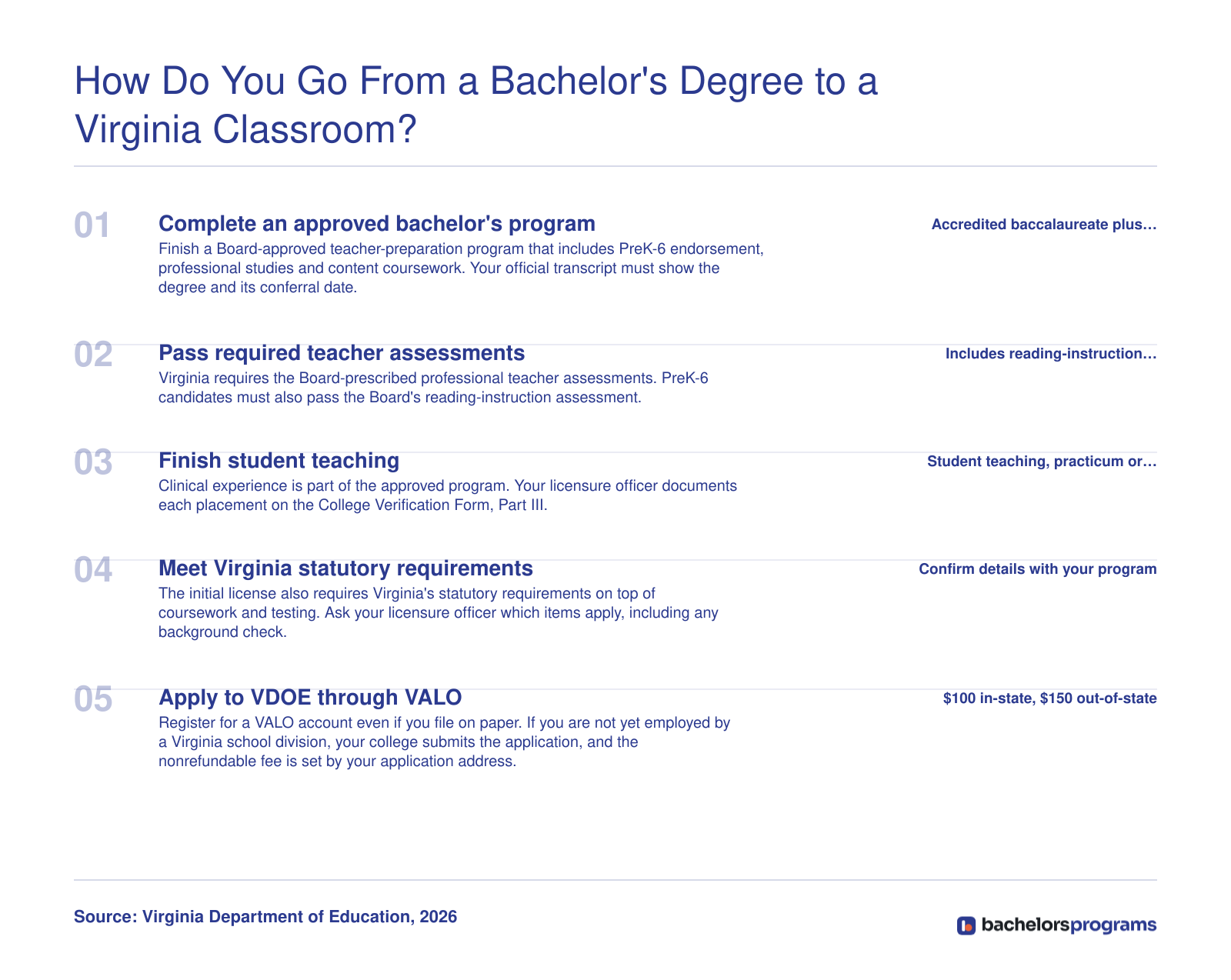
How Do You Go From a Bachelor's Degree to a Virginia Classroom?
Virginia issues an initial teaching license with a PreK-6 endorsement to graduates of a Board-approved bachelor's-level teacher-preparation program. The steps below follow the order most candidates complete them, based on current Virginia Department of Education (VDOE) requirements. Your program's certification or licensure officer is your main contact throughout.
What Virginia Elementary Teachers Earn
Elementary school teachers in Virginia earned a median annual wage of $65,550 as of May 2025. That is above the national median of $63,970 for the same occupation and $9,860 above Virginia's median for all jobs.
Common Questions About Elementary Education Degrees in Virginia
These answers draw on published program details for 2026. Costs, accreditation dates and testing rules can change, so confirm specifics with each school before you apply.
What is the cheapest way to get an elementary education degree in Virginia?
Can you get an elementary education degree online in Virginia?
How fast can you get a teaching degree online?
Which Virginia elementary education programs are CAEP accredited?
What licensure do you get with a Virginia elementary education bachelor's degree?
Compare Elementary Education programs on the data that matters
Explore more Education & Teaching majors or browse every field of study.
All Education & Teaching programs Browse every field of study