Best Elementary Education Degree Programs in Washington
Compare 22 accredited Elementary Education programs in Washington, with net price after aid, graduation rates, earnings and debt from IPEDS and the U.S. College Scorecard.
A Washington teaching career asks for two things that rarely line up: a program approved to recommend you for a K-8 certificate, and a price you can carry. The bachelor's degree in elementary education, most often a Bachelor of Arts or a Bachelor of Applied Science in Elementary Education, is the standard route to the Residency Teacher certificate issued by the state.
The route is not uniform. Large public universities, small private colleges, and community colleges offering applied bachelor's degrees all prepare elementary teachers, and they differ sharply in cost and format.
Most programs also add a second application to teacher education after general admission, so the degree you choose sets your timeline as much as your tuition.
Key Points
- Public college BAS in Teacher Education degrees post the lowest net prices.
- Highline College offers a hybrid program with evening and weekend classes.
- Graduates pursue OSPI's Residency Teacher First Issue certificate to begin teaching.
Best Bachelor's Degree in Elementary Education Programs in Washington
The strongest elementary education bachelor's programs in Washington share two things: an early start in real classrooms and a clear path to state certification. The ten programs below range from large public universities with statewide district networks to private colleges and bachelor's completion options for students who already hold an associate degree. Read each entry for the structure of the field experience, the credit load, and what the school asks of you before you can start student teaching.
Washington State University
#1Pullman, WA · ~$15,000/yr (est.)
Best for: Future teachers wanting multi-campus options
Washington State University runs one of the largest elementary education pipelines in the state, with the Bachelor of Arts in Elementary Education taught on the Pullman, Vancouver and Tri-Cities campuses. Practicum hours and student teaching are threaded through the degree, and faculty keep working relationships with more than 150 school districts. Undergraduates can join faculty-guided research, and transfer credit from AP, IB and CLEP exams is accepted.
- Teacher Education Program leads to K-12 teacher certification
- Practicum hours and student teaching integrated across the degree
- Faculty ties with more than 150 school districts statewide
- Taught on campus at Pullman, Vancouver and Tri-Cities
- Undergraduate research guided by faculty
- Transfer credit from AP, IB and CLEP exams
- One general scholarship application covers 700+ WSU programs
Western Washington University
#2Bellingham, WA · $10,000 – $29,000/yr (est.)
Best for: Social-justice-minded future elementary teachers
Western Washington University's elementary education major in Bellingham is capacity-constrained and built around a one-year teaching internship. The department pairs an anti-bias, anti-racist, social justice philosophy with certification sequences delivered in Bellingham and at off-campus sites in Everett, Seattle and Kitsap County. Students finish with part-time and full-time student teaching placements, usually in Whatcom or Skagit counties.
- Capacity-constrained major leading to K-8 teacher certification
- Anti-bias, anti-racist, social justice philosophy
- One-year internship with two quarters part-time student teaching
- One quarter of full-time student teaching under a certificated teacher
- Placements typically in Whatcom or Skagit counties
- Certification sequences also at Everett, Seattle and Kitsap County sites
Grays Harbor College
#3Aberdeen, WA · $4,800/yr (est. net price)
Best for: Associate degree holders adding certification
Grays Harbor College in Aberdeen builds its teacher preparation on top of an associate degree, so most students arrive with two years of college already finished. The Bachelor of Applied Science in Teacher Education leads to K-8 certification with an English Language endorsement, and new cohorts begin each fall. The college also awards bachelor's degrees in computer science, organizational management and forest resources management, and classes stay small.
- Two years of full-time study on top of an associate degree
- Leads to K-8 certification with an English Language endorsement
- New cohorts start each fall with a fixed course sequence
- Applicants come from an AAS in Early Childhood Education or a prior degree
- Prerequisite courses required before entry
- Coursework emphasizes academic rigor and cultural competency
- Graduates may apply directly to master-level programs in the state
Pacific Lutheran University
#4Tacoma, WA · ~$20,000/yr (est.)
Pacific Lutheran University in Tacoma awards a Bachelor of Arts in Education in which every student earns an Elementary Education endorsement. Candidates add a second endorsement in an area such as Health & Fitness Education or Music Education, so they leave qualified to teach a second subject. Practicum work in a working teacher's classroom precedes a final spring semester of six weeks of student teaching.
- Every student in the degree earns an Elementary Education endorsement
- Add a second endorsement such as Health & Fitness Education or Music Education
- Classroom practicum with a working teacher before the final semester
- Six weeks of student teaching running a classroom on your own
- Endorsements define the subjects a graduate is prepared to teach
- School of Education posts WEST-B, WEST-E and NES test resources
Highline College
#5Des Moines, WA · ~$10,000/yr (est.)
Highline College in Des Moines offers a bachelor's completion route for people who already hold an associate degree and want to become certified elementary teachers. Classes run online and hybrid, with face-to-face coursework in the evenings and on weekends, which suits students who keep working while they study. Three practicum courses place candidates with children and families in schools and community agencies.
- Built for students holding, or within 30 credits of, an AA or AAS degree
- AAS in Early Childhood Education is the recommended entry credential
- 2.5 GPA minimum with no class below 2.0
- WEST-B basic skills test and fingerprint background check required
- Online and hybrid classes with evening and weekend face-to-face sessions
- Three practicum courses in schools and community agencies
- Emphasizes K-8 certification and the English Language Learner endorsement
Seattle Pacific University
#6Seattle, WA · ~$24,000/yr (est.)
Seattle Pacific University offers a K-8 certification track in elementary education through its Division of Education, with a Professional Year sequence and a 30-credit student teaching internship. Admission to the division is selective and includes an interview, recommendations and basic skills scores. The 140-credit degree pairs elementary content in English language arts, math, science, health and the arts with methods coursework and a capstone.
- 140 credits required, including 66 upper-division credits
- 3.0 cumulative GPA, or 3.3 in the last 45 credits, to enter the division
- Two recommendations, an interview and WEST-B or SAT/ACT scores
- 30-credit student teaching internship plus a Teacher as Person capstone
- Professional Year sequence with methods courses and elementary content
- Prepares for WEST-E or NES endorsement exams and OSPI clearance
Seattle University
#7Seattle, WA · ~$35,000/yr (est.)
Seattle University approaches elementary teacher preparation through its humanities core, pairing a 55-credit humanities foundation with 54 credits of elementary education specialization. Students enter as first-year students into a cohort and follow a prescribed sequence, adding endorsement areas, a second major or a minor where they want more depth. Coursework covers literacy, math and science instruction, special education foundations, ELL instruction, assessment and a clinical internship.
- At least 180 credits, including a 55-credit humanities core
- 34 credits of Humanities for Teaching major coursework
- 54 credits of elementary education specialization coursework
- Admits first-year students only into a cohort
- 2.00 cumulative and major GPA required to stay in the sequence
- Prepares students to apply for a Washington K-8 teaching certificate
- Add endorsement areas, a second major or a minor
Heritage University
#8Toppenish, WA · $15,000/yr (est. net price)
Heritage University in Toppenish runs its elementary education degree as a four-semester evening program designed for students who already have two years of college credit. The Innovate pathway pairs an English Language Learner endorsement with an Elementary STEM focus and a 450-hour internship. Candidates are recommended for a Washington State Residency Teacher Certificate after passing the NES or WEST-E exams.
- Four semesters and 121 total credits
- English Language Learner endorsement with an Elementary STEM focus
- Evening courses
- Admission needs an AA-DTA or 60 credits, including Math 116 and 117
- 2.6 GPA over the last 30 semester credits, plus a Teacher Preparation interview
- 450-hour internship, portfolio assessment and Professional Growth Plan
- 3.0 GPA must be maintained once enrolled
- WATCH background clearance and WEST-B, ACT or SAT scores required
Whitworth University
#9Spokane, WA · ~$27,000/yr (est.)
Whitworth University in Spokane awards a Bachelor of Arts in Education with majors in elementary, secondary and special education. Elementary candidates start classroom field experience in their first education course and move into a cohort in junior year, adding two special education courses and an intercultural field experience. The university says its education graduates have one of the highest job placement rates in Washington.
- Majors in elementary, secondary and special education
- K-12 classroom field experience starting in the introductory course
- Cohort model beginning junior year
- Two required special education courses
- Intercultural field experience, with placements such as Hawaii, Spain and Australia
- Completes Washington state teacher certification requirements
- Certification and career services office on campus
Central Washington University
#10Ellensburg, WA · ~$18,000/yr (est.)
Central Washington University prepares K-8 teachers through a Bachelor of Arts in Education major in Elementary Education, with field experience in elementary schools every quarter. Students may add a second endorsement from 25 major and minor options, including bilingual education, math and science. The program is delivered at five locations across the state.
- Field experience in elementary schools every quarter
- Coursework in classroom management, instruction and assessment
- Any elementary education major may add a second endorsement
- 25 major and minor endorsement options, including bilingual education, math and science
- Delivered at five locations across Washington
- Graduates eligible for a Washington certificate with an Elementary Education endorsement
Cost & outcomes by school
Federal data for the highest-earning Elementary Education programs, independent of the ranking above. Earnings are this field's bachelor's graduates four years after completing where the Scorecard reports them, else the school's undergraduate median.
| School | Net price / yr | Grad rate | Earnings | Debt | Grads/yr | Format |
|---|---|---|---|---|---|---|
| Gonzaga University WA | $35,119 | 86% | $78,892 | $24,454 | — | Campus |
| Seattle University WA | $34,662 | 76% | $75,272 | $19,883 | — | Campus |
| City University of Seattle WA | — | — | $69,460 | $25,000 | 8 | Hybrid |
| Pacific Lutheran University WA | $19,589 | 69% | $66,848 | $19,500 | 18 | Campus |
| Seattle Pacific University WA | $24,488 | 62% | $64,506 | $24,000 | 4 | Campus |
| Western Washington University WA | $21,193 | 65% | $62,500 | $20,043 | 49 | Campus |
| Walla Walla University WA | $23,329 | 60% | $61,885 | $27,381 | 8 | Campus |
| Washington State University WA | $14,971 | 61% | $61,304 | $20,819 | 155 | Campus |
| Heritage University WA | $14,598 | 54% | $60,999 | $18,750 | 32 | Campus |
| Whitworth University WA | $26,534 | 71% | $60,010 | $26,799 | 50 | Campus |
| Whitworth University-Adult Degree Programs WA | — | — | $60,010 | $26,799 | 4 | Online |
| Central Washington University WA | $18,476 | 54% | $59,659 | $20,205 | 179 | Campus |
Sources: U.S. Department of Education. Net price, graduation rate, earnings and debt: College Scorecard (earnings and debt for this field's bachelor's graduates where reported, else school-wide); graduates: IPEDS. A dash means no figure is reported.
Cost, debt & payoff
Median earnings of this field's bachelor's graduates (4 yrs after completing, else the school's undergraduate median) vs. their median federal loan debt · U.S. College Scorecard
Across these programs the median graduate earns about $59,835 and finishes with roughly $20,043 in debt — a ratio that clears a common rule of thumb (keep debt below first-year salary). Net price and debt vary widely school to school, so check the per-school figures in the table above before you shortlist.
Most Affordable Elementary Education Bachelor's Programs in Washington
Washington's public colleges that offer a Bachelor of Applied Science in Teacher Education have the lowest costs for an elementary education bachelor's degree. They are shown below from lowest to highest average net price, using 2024 IPEDS and College Scorecard data from the U.S. Department of Education. Grays Harbor College in Aberdeen has the lowest average net price here at $4,783 a year. Columbia Basin College has paused admissions for fall 2026, expects to reopen in fall 2027, and is redesigning its program toward a K-8 endorsement.
| School | City | Degree | Format | In-State Tuition and Fees | Average Net Price | Median Debt at Graduation |
|---|---|---|---|---|---|---|
| Grays Harbor College | Aberdeen | Bachelor of Applied Science in Teacher Education (K-8 certification) | Campus | $5,593 | $4,783 | $11,075 |
| Lower Columbia College | Longview | Bachelor of Applied Science in Teacher Education | Hybrid | $4,626 | $7,630 | $10,506 |
| Columbia Basin College | Pasco | Bachelor of Applied Science in Teacher Education (P-3 endorsement) | Campus | $6,555 | $8,317 | $14,829 |
| Centralia College | Centralia | Bachelor of Applied Science Teacher Education | Hybrid | $5,266 | $9,862 | N/A |
| Highline College | Des Moines | Bachelor of Applied Science in Elementary Education | Hybrid | $4,772 | $9,879 | $9,500 |
Online and Hybrid Elementary Education Bachelor's Options at Washington Schools
Highline College lists its Bachelor of Applied Science in Elementary Education as a hybrid program, with evening and weekend face-to-face classes, and the other elementary education programs in our ranking are listed as campus-based. Flexible study in Washington looks like this: some coursework moves off campus, but the school-based portion stays local.
What Hybrid Looks Like in Practice
Highline pairs seated evening and weekend classes with three required practicum courses, so the schedule fits around a working week while candidates stay in classrooms. Heritage University teaches its elementary education cohort in evening courses. Central Washington University delivers its elementary education major at five locations and builds field experience into every quarter, which helps if you cannot relocate to Ellensburg.
Student Teaching Is Always in Person
Washington's Residency Teacher Certificate requires a supervised internship inside a real school, so no program can move that term online.2 Western Washington University places its one-year internship in Whatcom and Skagit counties, with two quarters part-time and one quarter full-time. Pacific Lutheran University adds six weeks of student teaching after an earlier classroom practicum, and Whitworth University starts field experience in the introductory course before the junior-year cohort begins.
Ask About Placement Geography First
Before applying to a program outside your own county, ask one question: where, exactly, will I student teach? A program that places candidates only in its home region can force a move or a long commute during the term when you can least afford either.
Limits for Out-of-State Students
Washington's route for out-of-state applicants requires a bachelor's degree, an approved teacher preparation program that includes a supervised internship, and the basic-skills and content-area tests.1 A regular certificate from another state plus three years of teaching there is the alternative.1 If you intend to teach somewhere other than Washington, ask the program directly whether its internship meets that state's rules, because the program pages reviewed here do not spell out how graduates are certified outside Washington.
Admission Requirements for Elementary Education Bachelor's Programs in Washington
Teacher preparation in Washington now asks applicants to clear two separate gates, not one. A bachelor's degree in elementary education in Washington typically starts with general university admission, then adds a second, later application to the professional teacher-education program that recommends you for certification.
The Two-Step Pattern
Expect to be admitted to the university first and to the education program second, usually after a set of prerequisite courses and often at the start of the junior year. Whitworth University's cohort begins junior year, and Western Washington University labels elementary education a capacity-constrained major, which means meeting the minimums does not guarantee a seat. Grays Harbor College takes applicants into its applied bachelor's after an associate's degree in early childhood education, so its entry point is the transfer transcript rather than the freshman application.
Minimum GPA and Testing
Published thresholds differ enough that the program page matters more than the university page: - Seattle Pacific University: 3.0 GPA minimum, with the SAT or ACT named among entrance exam requirements and at least two letters of recommendation. - Heritage University: 2.6 GPA to enter and 3.0 once enrolled, plus a teacher preparation interview and background clearance. - Highline College: 2.5 GPA minimum and an entrance exam for the applied bachelor's. - Seattle University: 2.0 GPA minimum, and it admits first-year students only.
Test policy is not uniform. Some programs list the SAT or ACT as a program entrance requirement even when the university's general admission is test-optional, so confirm which rule applies to you before you commit.
Transfer Credit and Community College Pathways
Washington's applied bachelor's degrees were built for transfer students, and the community college route shows up often in elementary education. Washington State University publishes transfer credit for AP, IB, and CLEP exams. Where a school holds a direct transfer agreement with a community college, a transfer advisor can confirm it; ask for the agreement in writing and check how prerequisite courses map before you register.
Read the Program Page, Not Just the Admissions Page
General admissions pages rarely describe the teacher-education gate. When a school publishes no separate program-level policy, ask an advisor directly for the prerequisite list, the GPA cutoff, and the application deadline.
Related Articles
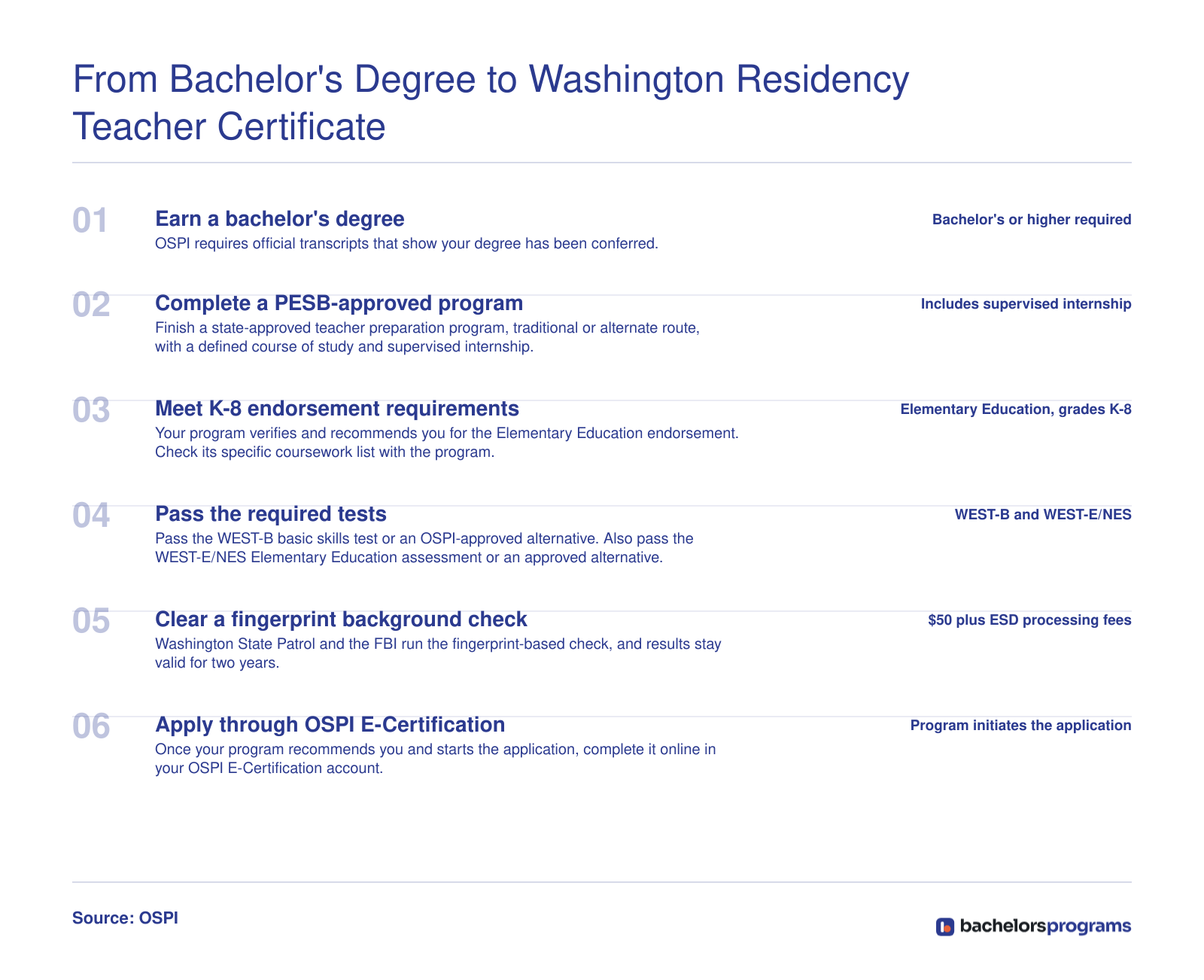
From Bachelor's Degree to Washington Residency Teacher Certificate
Washington's entry-level credential for new teachers is the Residency Teacher First Issue certificate, issued by OSPI. The steps below show the usual order for elementary candidates. Confirm program-specific details with your PESB-approved program.
Common Questions About Elementary Education Degrees in Washington
These answers draw on the program details and costs covered above. Washington's Professional Educator Standards Board (PESB) keeps the authoritative directory of approved preparation programs, so confirm current offerings there before you apply.
Which Washington elementary education programs lead directly to a Washington K-8 teaching certificate?
How much does an elementary education degree cost in Washington?
Can you get an elementary education degree online in Washington?
Which Washington schools accept the most transfer credits for elementary education?
Compare Elementary Education programs on the data that matters
Explore more Education & Teaching majors or browse every field of study.
All Education & Teaching programs Browse every field of study