Best Online Health Sciences Degree Programs
Compare 210+ accredited online Health Sciences programs, with net price after aid, graduation rates, earnings and debt from IPEDS and the U.S. College Scorecard.
A health sciences bachelor's is the nonclinical entry point into healthcare: usually a Bachelor of Science (B.S.), built for working adults, career changers and pre-health students who need flexibility more than clinical hours.
Every program ranked below is 100% online; hybrids that pull students to campus are excluded. Cost and outcomes figures come from the College Scorecard.
Cost is the sorting variable. Published tuition at the schools here runs from about $2,500 to $25,000 a year, a spread wide enough to decide where you apply.
Key Points
- Every ranked program is fully online, with no campus labs or residencies.
- A B.S. in Health Sciences is nonclinical and doesn't grant licensure.
- Medical school applicants need science prerequisites beyond the general curriculum.
Top 10 Fully Online Health Sciences Bachelor's Programs
Every program below can be completed fully online, and none requires hybrid or in-person attendance. Entries appear in the order of our composite of cost, completion, and outcomes, which is explained in the next section.
American College of Healthcare Sciences
#1Portland, OR · ~$24,000/yr (est.)
Best for: Aromatherapy and herbal studies specialists
American College of Healthcare Sciences is a private Portland institution focused entirely on integrative health and wellness, and its bachelor's tracks reflect that specialization. The online B.S. in Integrative Health Sciences splits coursework evenly across general education, a science core, an aromatherapy and herbal studies major core, and electives or a specialization. Students choose from four concentration areas, and graduates typically move into wellness coaching, herbal medicine, aromatherapy, or community health work.
- Four concentration tracks: aromatherapy, herbal studies, holistic nutrition, wellness coaching
- 30 semester credits of general education plus a 30-credit science core
- 30-credit major core in aromatherapy and herbal studies
- Curriculum meets NAHA Level II aromatherapy standards
- $52,200 total program tuition; about $71,513 including books and supplies
- NANP-approved; 500 professional experience hours for board exam eligibility
- Credit transfers and challenge exams can reduce total cost
- Badge in Applied Skills in Botanicals available
University of South Florida
#2Tampa, FL · ~$10,000/yr (est.)
Best for: Florida residents wanting a public university option
The University of South Florida is a large public research institution, and its health sciences degree is housed in the College of Public Health on the St. Petersburg campus. Students complete eight foundational courses and then commit to one of four concentrations, ranging from biological health sciences to health information technology. The Innovation District location puts students near the Florida Department of Health and several hospital systems, and the listed career paths include physician assistant, health policy analyst, and clinical informatics analyst.
- Eight foundational courses plus one of four concentrations
- Concentrations include Biological Health Sciences and Health Information Technology
- Also offers Healthcare Administration and Social and Behavioral Health Sciences
- Based at the St. Petersburg campus in the Innovation District
- Connections to the Florida Department of Health and area hospitals
- Hospital partners include Johns Hopkins All Children's, Bayfront and BayCare
- Career paths include physician assistant and clinical informatics analyst
St Luke's College
#3Sioux City, IA · ~$20,000/yr (est.)
Best for: Degree completers with prior college credits
St. Luke's College is a small private institution in Sioux City, Iowa, connected to a regional health system, and its health science offering is built for people who already hold college credit. The Bachelor of Health Science is a 120-credit degree-completion program with upper-division coursework in informatics, finance, leadership, law and ethics, plus an independent research project and statistics. Full- and part-time schedules let working students move at their own pace.
- Online degree-completion program for students with prior college credit
- 120 total credit hours; full-time and part-time schedules
- Upper-division core covers informatics, finance, leadership, law and ethics
- Includes an independent research project and statistics I
- Electives include pathophysiology, quality management and health promotion
- Accredited by the Higher Learning Commission
Florida Atlantic University
#4Boca Raton, FL · $4,900 – $17,000/yr (est.)
Florida Atlantic University is a public research university in Boca Raton with a health science degree that leans toward flexibility rather than a single clinical track. The Bachelor of Arts in Health Science sequences a three-course core, two science sets, and 21 credits of concentration work, with internships that can count for up to nine credits. Five concentrations let students shape the degree toward management, behavioral health, public and environmental health, or science and wellness.
- Five concentrations, including Behavioral and Mental Health and Health Management
- Core sequence: Foundations of Health and Illness, Evaluating the Evidence, Capstone
- Two sequential science sets totaling 15-16 credits
- 21 concentration credits, with 15 in one area
- Internships can count for up to nine credits
- Other tracks: Public/Global/Environmental Health, Science and Wellness
California State University-Sacramento
#5Sacramento, CA · $8,000 – $21,000/yr (est.)
California State University, Sacramento is a large public university whose health science major is a common route into graduate clinical study. The B.S. in Health Science requires 57 to 61 units in the major, including an anatomy and physiology series and general chemistry, followed by upper-division health science, aging, and ethics coursework. Advisors publish sample two-year and four-year roadmaps, and the major waives the foreign language graduation requirement.
- 120 units total, with 57-61 units in the major
- Lower division includes an anatomy and physiology series plus general chemistry
- Prepares students for graduate study in nursing, PA studies and occupational therapy
- Credit by examination available; foreign language requirement waived
- Sample two-year and four-year roadmaps published
- Individualized course of study possible through 15 units of electives
- Minimum grade of C- required in every course
University of West Florida
#6Pensacola, FL · $5,000 – $10,000/yr (est.)
The University of West Florida is a public institution in Pensacola, and its health sciences degree is housed in the Usha Kundu, MD College of Health. Students choose a general Health Sciences degree, a Healthcare Administration specialization, or a Behavior Analysis specialization that includes an undergraduate ABA certificate. Internships require background checks and drug screening, and the university notes that not every state authorizes its online programs.
- General Health Sciences degree plus a Healthcare Administration specialization
- Behavior Analysis specialization prepares students for BCaBA and QASP-S exams
- Includes the Undergraduate ABA Certificate
- 120 semester hours, with at least 48 upper-division hours
- Core includes Career Essentials for Healthcare and a capstone course
- Internships require a background check and drug screening
- Not all states authorize the online program
Cabarrus College of Health Sciences
#7Concord, NC · $15,000 – $20,000/yr (est.)
Cabarrus College of Health Sciences is a small private college in Concord, North Carolina, tied to Atrium Health. Its B.S. in Health Sciences Leadership and Development is a degree-completion program for associate degree holders, with Leadership and Education tracks and coursework in quality, compliance, informatics, and team development. Classes run online with an internship, and students can finish in about two years.
- Degree-completion program for students who already hold an associate degree
- Two tracks: Leadership and Education
- Finish in as little as two years, full-time or part-time
- Online classes plus an internship
- Coursework in informatics, healthcare quality, law and ethics, and management
- Atrium Health teammates and affiliate alumni pay no fees
- Healthcare experience preferred for admission
Thomas Edison State University
#8Trenton, NJ · $5,000 – $10,000/yr (est.)
Thomas Edison State University is a public institution in Trenton, New Jersey, built around adult learners and credit for prior learning. Its B.S. in Health Studies requires 120 credits and awards college credit for healthcare credentials, licenses, and certifications, which makes it one of the more transfer-friendly options on this list. The degree targets nonclinical healthcare roles and can serve as a stepping stone to an accelerated BSN.
- 120 credits, delivered online
- Transfer-friendly for associate degree holders
- College credit awarded for healthcare credentials, licenses and certifications
- Pathway to the Accelerated BSN program
- Prepares graduates for nonclinical careers in healthcare
- General education courses fulfill Accelerated BSN prerequisites
- Area of Study in Health Studies plus electives, license credit or a concentration
Appalachian State University
#9Boone, NC · $8,000 – $25,000/yr (est.)
Appalachian State University is a public university in Boone, North Carolina, with a health sciences degree designed specifically for community college transfer students. The B.S. in Health Sciences accepts an Associate in Applied Science from a North Carolina community college and can be finished in as little as two years, with coursework in healthcare management, community health, and public health interventions. Electives let students tailor the degree, and an accelerated bachelor's-to-master's pathway is available.
- Built for holders of a North Carolina Associate in Applied Science
- Finish in as little as two years
- Coursework in managing health care organizations and community health
- Elective hours to tailor the degree to career goals
- Accelerated bachelor's-to-master's pathway available
- Complementary minors include exercise science and public health
- Transfer equivalency course search tool available
Eastern Florida State College
#10Melbourne, FL · $5,000 – $10,000/yr (est.)
Eastern Florida State College is a public college in Melbourne with an applied health sciences degree aimed at people who already hold an associate degree. The B.A.S. in Applied Health Sciences offers five specializations, from advanced allied health and biomedical science to medical imaging and informatics. Coursework covers healthcare systems management, ethics and law, evidence-based practice, and informatics, and graduates have continued into master's, doctoral, and medical school programs.
- Five specializations, including Advanced Allied Health and Biotechnology
- Also Medical Imaging tracks in Cardiac/Vascular Sonography and Informatics/PACS
- Requires an associate degree for admission
- Eligible for the state's $10,000 Bachelor Degree Program
- Coursework in healthcare informatics, ethics and law, and systems management
- Medical Imaging and Veterinary Technology tracks have certification requirements
- Graduates have continued to master's, doctoral and medical school programs
Cost & outcomes by school
Federal data for the highest-earning Health Sciences programs, independent of the ranking above. Earnings are this field's bachelor's graduates four years after completing where the Scorecard reports them, else the school's undergraduate median.
| School | Net price / yr | Grad rate | Earnings | Debt | Grads/yr | Format |
|---|---|---|---|---|---|---|
| Samuel Merritt University CA | — | — | $143,238 | $20,825 | — | Online or campus |
| George Washington University DC | $36,586 | 84% | $90,873 | $20,449 | — | Hybrid |
| Northwestern University IL | $29,167 | 95% | $89,363 | $15,000 | — | Online |
| University of Washington-Bothell Campus WA | $12,319 | 65% | $78,466 | $14,615 | — | Hybrid |
| Rutgers University NJ | $24,406 | 84% | $74,479 | $21,500 | — | Hybrid |
| California State University-East Bay CA | $9,320 | 48% | $71,401 | $16,544 | — | Online or campus |
| University of Illinois Chicago IL | $10,974 | 62% | $68,740 | $16,704 | — | Hybrid |
| California State University-Sacramento CA | $9,338 | 56% | $64,876 | $15,000 | — | Online or campus |
| California State University-Stanislaus CA | $6,067 | 54% | $63,188 | $13,540 | — | Hybrid |
| Arizona State University AZ | $14,967 | 68% | $62,668 | $19,500 | — | Online or campus |
| St Luke's College IA | $19,820 | 100% | $61,033 | $15,000 | — | Online |
| Cabarrus College of Health Sciences NC | $17,618 | 71% | $58,708 | $16,000 | — | Online |
Sources: U.S. Department of Education. Net price, graduation rate, earnings and debt: College Scorecard (earnings and debt for this field's bachelor's graduates where reported, else school-wide); graduates: IPEDS. A dash means no figure is reported.
Cost, debt & payoff
Median earnings of this field's bachelor's graduates (4 yrs after completing, else the school's undergraduate median) vs. their median federal loan debt · U.S. College Scorecard
Across these programs the median graduate earns about $53,739 and finishes with roughly $23,000 in debt — a ratio that clears a common rule of thumb (keep debt below first-year salary). Net price and debt vary widely school to school, so check the per-school figures in the table above before you shortlist.
How We Ranked These 100% Online Programs
Every program here clears three filters before it is ranked: it confers a bachelor's degree, it is delivered fully online, and it is not a hybrid that requires campus visits for labs or residencies.
Rankings draw on program-level earnings and debt from the College Scorecard, along with each school's graduation rate and average net price. Those last two describe the whole institution, not the health sciences major alone.
"Fully online" does not guarantee zero in-person work. Several programs here build in an internship, practicum, or capstone.1 Some allow those hours at an approved site near home; others do not. Liberty University, for one, permits approved local placements under your degree-completion plan. Confirm the requirement, the hours, and whether local completion is allowed before you enroll.
Cheapest Online Health Science Degrees by Net Price
These online health sciences bachelor's options carry the lowest average net price in our data, based on U.S. Department of Education IPEDS and College Scorecard figures. Net price is an institution-wide average of what students pay per year after grants and scholarships, so your actual cost may be higher or lower depending on your aid. A lower net price usually means less borrowing: Gulf Coast State College has both the lowest net price and the lowest median federal debt at completion here, at $7,147.
| School | Location | Program | Average Net Price (per year) | Graduation Rate | Median Federal Debt at Completion (Institution-Wide) |
|---|---|---|---|---|---|
| Gulf Coast State College | Panama City, FL | Health Sciences (RN to BSN) | $4,709 | 43.5% | $7,147 |
| Sinclair Community College | Dayton, OH | Bachelor of Applied Science in Health Sciences | $5,992 | 41.1% | $12,000 |
| Eastern Florida State College | Melbourne, FL | Applied Health Sciences Bachelor of Applied Science | $6,440 | 52.1% | $12,250 |
Related Articles
What a Bachelor's Degree in Health Sciences Prepares You For
A B.S. in Health Sciences is a broad, nonclinical degree. On its own, it does not qualify you for clinical licensure, such as a registered nurse or physical therapist license. Those require separate accredited programs and exams. Instead, the degree leads to education, outreach and administrative roles.
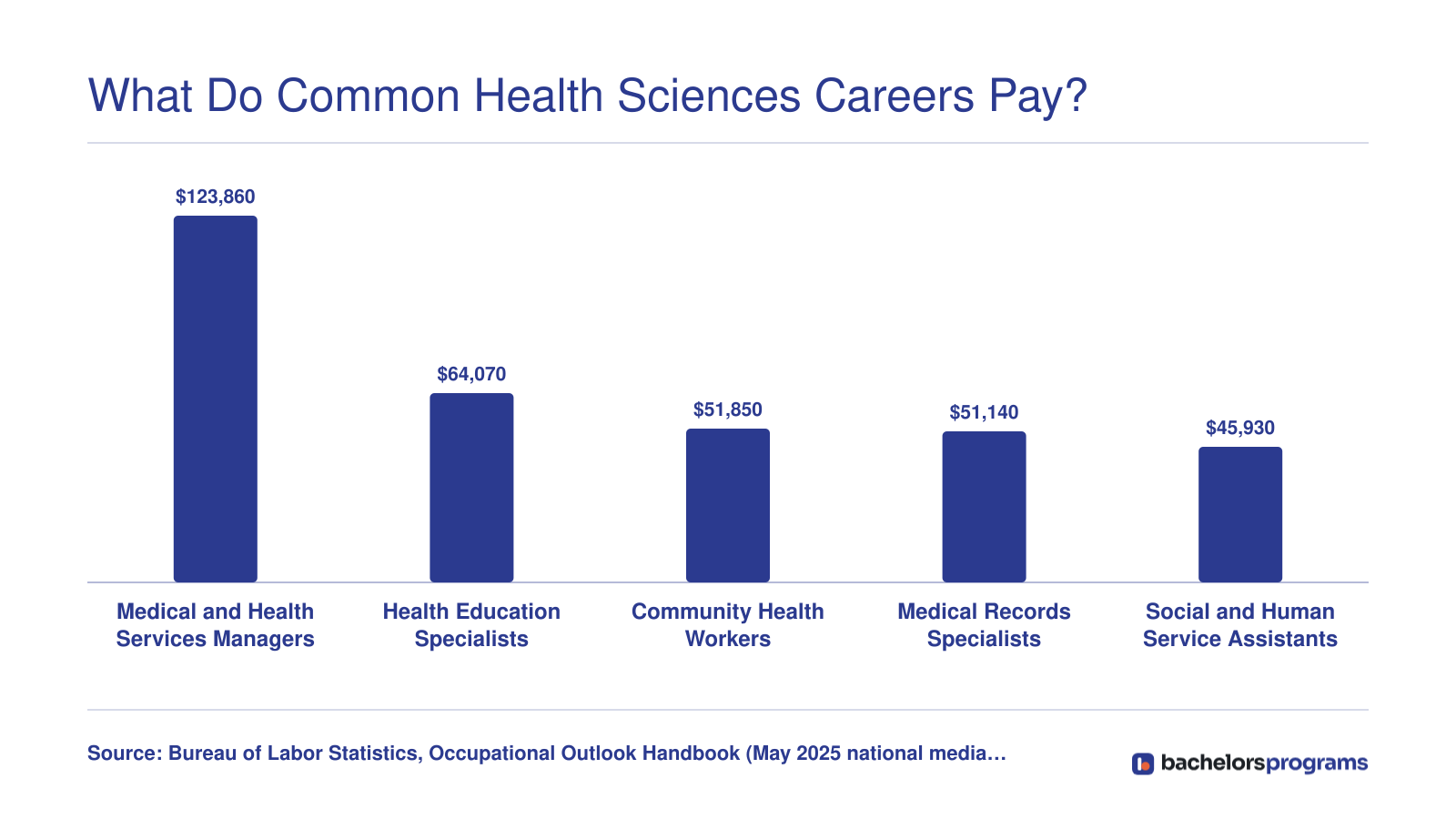
- Health education specialist: A bachelor's is the typical entry credential. The Bureau of Labor Statistics (BLS) reports a May 2025 median wage of $64,070 and 6% projected growth from 2025 to 2035.1
- Community health worker: Employers typically require a high school diploma, though some prefer postsecondary education, so the degree can set you apart. Median pay was $51,850, with 13% projected growth.2
- Medical and health services manager: The best-paying path, at a $123,860 median and 24% projected growth.3 BLS lists a bachelor's plus related work experience as typical.3
If you want online healthcare degrees that pay well, be realistic: management pays the most, but most graduates reach it after time in entry-level roles. These BLS figures cover all workers in each occupation. For what graduates of specific programs earn, check the ranking cards above.
What Do Common Health Sciences Careers Pay?
These figures are national median annual wages for each occupation from BLS May 2025 data, not earnings reported by graduates of the programs on this page. Medical and health services manager roles typically call for several years of related work experience, and many employers prefer a master's degree, so treat that figure as a longer-term target. The other roles shown are more common entry points with a bachelor's degree in health sciences.
Transfer Credits and Degree-Completion Pathways
Most students in online health sciences programs arrive with credit already in hand, and the degree you choose should reward it. You can start as a freshman with no prior college work, or enter a degree-completion track built for students who hold an allied-health associate degree or a block of transfer credit.
Completion programs typically cap transfer credit near 90 of the 120 required, as University of Cincinnati Online and Touro University Worldwide both do, which leaves roughly 30 credits to finish at the school.1 Residency rules vary widely. Ohio State University Online sets no transfer ceiling but requires at least 30 credits earned there2, while Southern California University of Health Sciences expects 48 of its 120 in residence.3
Plan on about four years from scratch. With an associate degree, 18 to 24 months full-time is realistic, and accelerated 7 to 8 week terms are common at online-focused schools.
Request an unofficial transcript evaluation before you apply. It tells you exactly which credits count, and that answer varies by school.
Questions to Ask Yourself
Do you want a nonclinical career right after graduation, or is this degree a stepping stone to PA school, medical school, or an MPH?
How many credits can you transfer, and does the program offer a degree-completion track that fits them?
Does your target career call for a concentration such as health administration or public health, or will a general track work?
Can you complete lab science prerequisites near home if the program doesn't offer them in person?
Is a Health Sciences Degree Good for Medical School and Other Graduate Paths?
An online health sciences degree can lead to medical school, but only if you treat the prerequisites as the real admission test. A general health sciences curriculum alone will not satisfy most schools.
Medical School
The AAMC outlines a common pattern: one year of biology, one year of English, and two years of chemistry1, with many schools also expecting organic chemistry, physics, and the accompanying labs2. Whether online coursework counts is decided case by case in 20261. Some schools listed in the AAMC's MSAR directory accept online prerequisite lectures and labs; others say they generally do not recommend online coursework and will not consider an all-online bachelor's degree3.
PA, Nursing, and Public Health
PA programs set their own rules. Typical requirements run 8 to 12 subject areas plus patient-care hours that range from no stated minimum to 1,000 or more, and online lab acceptance varies by program. Accelerated BSN, MPH, and MHA programs are usually more flexible about online prerequisites.
Before you register, pull the prerequisite list for each target program and match your courses to it.
How to Choose an Accredited Online Health Sciences Program
Run through this checklist before you apply to any online health sciences degree.
- Verify institutional accreditationSearch the school's exact legal name in the U.S. Department of Education's DAPIP database, then cross-check the CHEA directory. Look for a recognized accreditor such as HLC, MSCHE, NECHE, SACSCOC, NWCCU or WSCUC. The status should be current, not probation, warning or show-cause.
- Don't expect programmatic accreditationNo single accreditor covers general health sciences bachelor's degrees, so the school's institutional accreditation is what counts. If a school claims programmatic accreditation, confirm that exact program in the CHEA or accreditor directory.
- Confirm you can enroll from where you liveState authorization is separate from accreditation. Confirm the school can enroll students in the state where you physically live, either through NC-SARA or under that state's own rules. NC-SARA covers only U.S. states and territories, so international applicants should ask the school directly.
- Ask about student supportAsk about help finding internship or capstone placements, how transfer credits are evaluated and whether online students get dedicated advisors.
- Match the concentration to your goalChoose a track that fits your plans, such as health administration, public health or pre-professional study.
Health Sciences programs by state
Compare Health Sciences programs on the data that matters
Explore more Healthcare majors or browse every field of study.
All Healthcare programs Browse every field of study