Best Online Nutrition Degree Programs
Compare 16 accredited online Nutrition programs, with net price after aid, graduation rates, earnings and debt from IPEDS and the U.S. College Scorecard.

Tuition for an online bachelor's degree in nutrition runs from $302 per credit hour at Arkansas State University to $493.95 at Kansas State University, but the cheapest program is not always the one that leads toward the registered dietitian (RDN) credential.
The credential itself is a Bachelor of Science (B.S.); titles vary, from dietetics to food and nutrition to human nutrition. Each program on the list is 100% online; hybrid formats are excluded.
The RDN path is the real constraint. Only ACEND-accredited coursework counts toward it, and since 2024 the exam also requires a graduate degree, so a bachelor's alone does not qualify you.
Key Points
- Cal State Sacramento has the lowest average net price: $9,338 a year.
- Every ranked program can be completed fully online, with no campus residencies.
- Reaching RDN status, graduate degree included, commonly takes 5.5 to 7 years.
Best Fully Online Bachelor's Degree in Nutrition Programs: Our Ranked List
Every program below is a bachelor's degree in nutrition that can be completed entirely online, and no hybrid or campus-based option was eligible for this list. Schools appear in the order they land on our blend of cost, outcomes, and completion, and each card pairs the institution's average net price after aid and its graduation rate with program-level earnings and debt where federal data reports them.
Kansas State University
#1Manhattan, KS · $11,000 – $29,000/yr (est.)
Best for: Cost-conscious students continuing to a master's
Kansas State University is a public land-grant institution in Manhattan, Kansas, and its online nutrition and health bachelor's is built on 32 credits of professional study in human nutrition, food science, nutritional assessment, and public health nutrition. The 120-credit degree is priced among the most affordable online options the university offers, and a concurrent arrangement lets students apply nine graduate credits toward a master's in dietetics, nutrition and sensory sciences, or public health. Students who want a broader health-and-wellness focus can shape their upper-level work with personal wellness courses.
- 120 credit hours, including 32 in professional nutrition studies
- Courses in human nutrition, food science, nutrition assessment and research
- Fully online option; admission follows general university requirements
- Concurrent master's option applies 9 graduate credits to the bachelor's
- Customize upper-level work with personal wellness courses
- Listed among the university's five most affordable programs
Weber State University
#2Ogden, UT · ~$10,000/yr (est.)
Best for: Integrative nutrition career changers
Weber State University in Ogden, Utah, offers a Bachelor of Science in Nutrition Education with a concentration in integrative nutrition, and it is the only nutrition education major in the state with that focus. Students learn through a farm-to-fork approach that includes a nutrition food laboratory, garden, and greenhouse, alongside coursework in diet design, health across the lifespan, cultural sensitivity, and fitness. The degree is aimed at careers outside registered dietetics, such as research laboratories, sports teams, health clubs, food distributors, and community organizations, and it also prepares graduates for graduate study.
- Two concentration options, including Integrative Nutrition
- Farm-to-fork learning in a nutrition food laboratory, garden and greenhouse
- Coursework in diet design, lifespan health, fitness and cultural sensitivity
- Prepares graduates for non-registered-dietitian nutrition roles
- Career paths include sports teams, health clubs and research labs
- Builds a foundation for graduate study in nutrition
The University of Alabama
#3Tuscaloosa, AL · ~$22,000/yr (est.)
Best for: Working adults pursuing dietitian eligibility
The University of Alabama delivers a Bachelor of Science in Food and Nutrition built for working adults, with rolling admissions, no entrance exam, and coursework in human nutrition, food science, medical nutrition therapy, and community nutrition. It is one of a small group of distance dietetics programs in the country, and a didactic program in dietetics track adds a capstone and a verification statement for students heading toward the registered dietitian credential. Courses run at a flat per-credit rate, and financial aid and scholarships are available.
- 120 credit hours with rolling admissions and no entrance exam
- One of only about 11 distance dietetics programs in the U.S.
- $399 per credit hour, with aid and scholarships available
- Test-optional admission; no SAT or ACT scores needed
- Coursework in nutritional biochemistry and food service management
- Designed for working adults, fully online
University of North Dakota
#4Grand Forks, ND · ~$19,000/yr (est.)
Eastern Michigan University
#5Ypsilanti, MI · $15,000 – $20,000/yr (est.)
California State University-Sacramento
#6Sacramento, CA · $8,000 – $21,000/yr (est.)
Appalachian State University
#7Boone, NC · $8,000 – $25,000/yr (est.)
Arkansas State University
#8Jonesboro, AR · $8,000 – $15,000/yr (est.)
University of Alaska Anchorage
#10Anchorage, AK · ~$15,000/yr (est.)
Cost & outcomes by school
Federal data for the highest-earning Nutrition programs, independent of the ranking above. Earnings are this field's bachelor's graduates four years after completing where the Scorecard reports them, else the school's undergraduate median.
| School | Net price / yr | Grad rate | Earnings | Debt | Grads/yr | Format |
|---|---|---|---|---|---|---|
| California State University-Sacramento CA | $9,338 | 56% | $64,876 | $15,000 | — | Online |
Sources: U.S. Department of Education. Net price, graduation rate, earnings and debt: College Scorecard (earnings and debt for this field's bachelor's graduates where reported, else school-wide); graduates: IPEDS. A dash means no figure is reported.
Cost, debt & payoff
Median earnings of this field's bachelor's graduates (4 yrs after completing, else the school's undergraduate median) vs. their median federal loan debt · U.S. College Scorecard
Across these programs the median graduate earns about $56,733 and finishes with roughly $21,522 in debt — a ratio that clears a common rule of thumb (keep debt below first-year salary). Net price and debt vary widely school to school, so check the per-school figures in the table above before you shortlist.
How We Ranked These 100% Online Nutrition Programs
Only programs that can be completed entirely online made the first cut. Hybrids with required campus residencies, including short summer intensives, were set aside, so the schools ranked here work for students who cannot relocate.
What Went Into the Composite
- Net price after aid: the average price students actually pay, not the sticker tuition.
- Graduation and retention rates: institution-wide signals that students finish and stay enrolled.
- Program-level earnings and debt: median earnings and typical federal loan debt for graduates, drawn from College Scorecard.
- Completions: how many students actually finish the program, a rough proxy for size and staying power.
Where the Data Stops
The data has limits. Graduation rates and net price describe the whole institution rather than the nutrition department, so a strong number may say more about the university than about the major. Some programs have too few graduates for published earnings to appear at all; those entries rely on the remaining measures rather than a guess.
Why Not Student Reviews?
Review-driven rankings reward marketing and volume of feedback as much as outcomes. This list leans on federal data instead, and treats ACEND accreditation as a separate check: we confirmed each program's status with the accreditor rather than folding it into a score. A program either carries the credential or it does not, and for anyone aiming at the RDN path that distinction matters more than a decimal.
The Most Affordable Online Nutrition Degrees by Net Price
The cheapest online nutrition degree by average net price is at California State University-Sacramento ($9,338 a year), followed by Weber State University ($10,258) and Arkansas State University ($12,366), according to 2024 IPEDS and College Scorecard data. All of these are public universities. Many public schools charge online students a flat or in-state rate (Arkansas State, for example, lists $302 per credit), while private schools usually post higher sticker prices and rely on institutional aid to lower them. Net price is a school-wide average after grants and scholarships, not a personal quote, so run each school's net price calculator to estimate your own cost.
| School | Location | In-State Tuition & Fees | Out-of-State Tuition & Fees | Average Net Price | Median Debt at Graduation |
|---|---|---|---|---|---|
| California State University-Sacramento | Sacramento, CA | $8,018 | $20,618 | $9,338 | $15,000 |
| Weber State University | Ogden, UT | $6,557 | $17,545 | $10,258 | $15,113 |
| Arkansas State University | Jonesboro, AR | $8,090 | $14,522 | $12,366 | $20,500 |
Earnings, Debt, and Return on Investment for Online Nutrition Graduates
Pay in nutrition starts modest and climbs with experience, so the window attached to each figure matters. Program-level results exist for only a few schools here, and each is measured at a different point after completion.
Program-Level Earnings
- University of Alabama (Food and Nutrition): $57,002 median earnings four years after completion.
- Kansas State University (Nutrition and Health): $53,757 median earnings five years after completion.
- Weber State University (Nutrition Education): $28,714 median earnings one year after completion.
These numbers are not directly comparable. Weber State's one-year figure is a first-job snapshot from a small graduating group, while Alabama's four-year figure reflects a larger cohort and more time in the workforce.
Debt and Monthly Payments
Alabama is the one program here with nutrition-specific borrowing data. Its graduates carry median federal debt of $23,719, which works out to roughly $251 a month on a 10-year repayment plan. That is about 5 percent of the four-year median earnings above, a manageable burden for most households.
For the other schools, the only debt figures describe the whole institution, not the nutrition major. Median debt for graduates across all majors is $22,750 at Alabama, $21,250 at Kansas State, and $15,113 at Weber State. Treat those as context about each university, not as outcomes for nutrition students.
Are Graduates Working?
Earnings only matter if graduates find jobs. One year after completing the program, 87.3 percent of Alabama's nutrition graduates were employed, and at Weber State the share was 90.9 percent. Those are solid rates, though neither school reports how many graduates earn above the poverty line.
Institution-wide, median earnings ten years after entry run $59,221 at Alabama, $57,262 at Kansas State, and $56,287 at Weber State. Those figures cover every major at each university, not nutrition alone. Before you commit, ask any program you are considering for nutrition-specific placement and salary data.
Related Articles
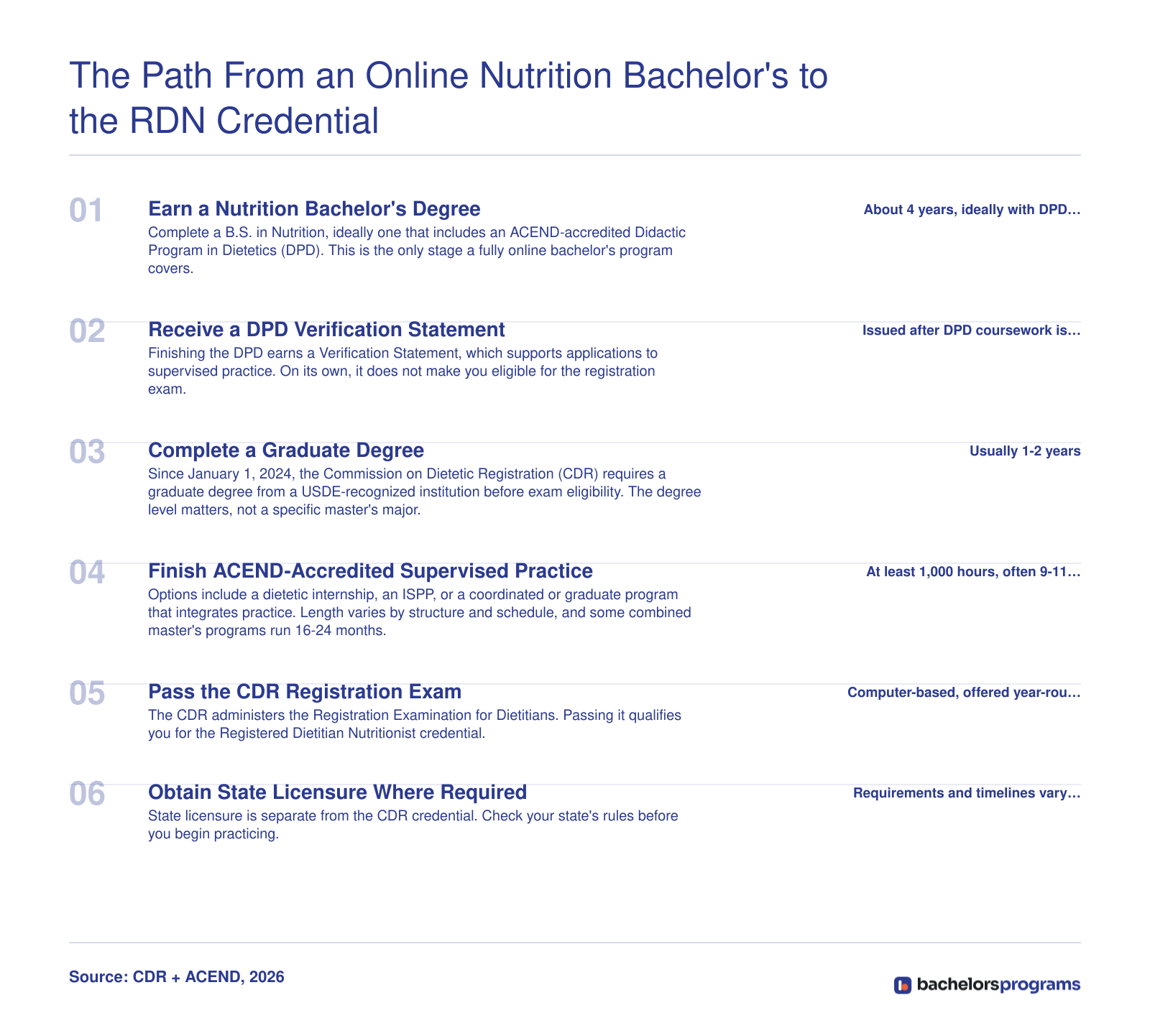
The Path From an Online Nutrition Bachelor's to the RDN Credential
An online bachelor's degree in nutrition covers only the first step toward becoming a Registered Dietitian Nutritionist (RDN). The traditional sequence of bachelor's degree, graduate degree, and supervised practice commonly takes about 5.5-7 years, not counting application delays, exam prep, or licensure processing. Combined graduate programs that build in supervised practice typically take about 2-3 years after undergraduate prerequisites.
What Dietitians and Nutritionists Earn Nationally
Federal wage data offers a useful benchmark for what a bachelor's degree in nutrition can lead to once you enter the field.
What You Need to Apply to an Online Nutrition Program
Requirements differ by school, so check each program's admissions page. Admission rates shown in our ranking come from federal College Scorecard data. Here is what the schools ranked here typically ask for.
- High school diploma or equivalentPlan to show high school completion. Arizona State University Online also expects 14 specified high school courses.
- Minimum GPA (first-time vs. transfer)First-year benchmarks run around 3.0. That is Arkansas State's auto-admission mark for recent graduates and one of ASU Online's qualifying routes. Transfer minimums sit near 2.0 at Arkansas State (13+ transferable credits) and Alabama (more than 24 credits).
- Science and math prerequisitesDietetics-oriented tracks can be stricter than general nutrition tracks. Pitt's pathway asks for a 2.8 GPA, 54 to 60 credits, biology and chemistry with labs, organic chemistry, human nutrition and statistics.
- Test scoresKentucky is test-optional through 2028-29, and Alabama does not require scores through Fall 2026. Arkansas State requires ACT or SAT scores from first-year applicants.
- Official transcriptsKentucky requires an official high school transcript showing its pre-college curriculum. Transfer applicants should also send college transcripts.
- Deadlines and start datesArkansas State's deadline is December 28, 2026 for a January 11, 2027 start. Kentucky's regular deadline is February 15, 2027, and Alabama accepts applications year-round.
Nutrition programs by state
Compare Nutrition programs on the data that matters
Explore more Healthcare majors or browse every field of study.
All Healthcare programs Browse every field of study