Best Public Health Schools in Hawaii
Compare 3 accredited Public Health programs in Hawaii, with net price after aid, graduation rates, earnings and debt from IPEDS and the U.S. College Scorecard.

The list of public health bachelor's degrees in Hawaii is short. Only three ranked programs qualify, all in Honolulu, so we don't pad it with adjacent majors.
The common credential is the Bachelor of Science (B.S.) in Public Health, offered by Hawaii Pacific University and Chaminade University of Honolulu. The University of Hawaii at Manoa awards a BA instead. Manoa charges residents far less than either private school, but CEPH accreditation status, online access, and admissions requirements differ across all three.
Those differences matter most at graduation. Local public health jobs are concentrated in Honolulu, and employers there often weigh program credentials and island ties alongside the degree itself.
Key Points
- University of Hawaii at Manoa charges residents $12,186 in tuition and fees.
- Hawaii Pacific University's BSPH holds CEPH accreditation, though on probationary terms.
- Chaminade University of Honolulu offers its B.S. Public Health online.
Best Schools for a Bachelor's Degree in Public Health in Hawaii
Only three Hawaii schools in our current data offer an enrollable bachelor's degree in public health, so this list has three entries and is not padded with adjacent majors. All three sit in Honolulu, which keeps students close to state health agencies, hospitals, and community nonprofits. The schools offering these programs report institution-wide graduation rates between 35% and 64%, a figure that describes each campus overall and not the public health program itself.
University of Hawaii at Manoa
#1Honolulu, HI · $15,000 – $20,000/yr (est.)
Best for: Hawaii residents seeking public university value
The flagship campus of the University of Hawaii system sits in Honolulu and houses public health within the Thompson School of Social Work and Public Health. Its bachelor's program pairs population-based prevention coursework with Hawaii-specific health topics, a capstone, and a language requirement, so graduates leave with both technical and cultural grounding. As a large public research university, it gives students access to state agencies, health sciences departments, and study abroad options that the smaller Honolulu campuses cannot match.
- CEPH-accredited public health program
- 120 credits, including 30 at Manoa and 45 upper division
- Three-course capstone project
- Covers epidemiology, public health biology, and global health
- Built around Hawaii-specific health issues
- Hawaiian or second language requirement
- Study abroad option available
- Internal transfers need a B-minus or better in PH 201
Hawaii Pacific University
#2Honolulu, HI · $30,000/yr (est. net price)
Best for: Internship-focused learners in downtown Honolulu
Hawaii Pacific University is a private, career-focused institution in downtown Honolulu, steps from the public health agencies, hospitals, and nonprofits where its students train. The bachelor's program in public health is built around hands-on application, with two practicum courses and more than 120 supervised internship hours, plus faculty who dedicate most of their time to teaching and advising. Students who want an urban campus with tight employer and internship connections tend to fit well here.
- 120 credits of interdisciplinary coursework
- Two practicum courses with more than 120 internship hours
- Downtown Honolulu campus near public health agencies
- Coursework in epidemiology, health policy, and program planning
- Faculty spend up to 80% of their time teaching and advising
- Military benefits accepted
- Public Health Club and employer networking events
- Study abroad and conference opportunities
Chaminade University of Honolulu
#3Honolulu, HI · $25,000 – $30,000/yr (est.)
Best for: Working adults wanting flexible online concentrations
Chaminade University of Honolulu is a small private university in Honolulu with a strong student-support orientation and institutional ties to Native Hawaiian communities. Its bachelor's program in public health builds skills in epidemiology, biostatistics, health policy, and data analytics, and lets students choose among four concentrations to shape the degree toward their goals. A capstone, preparation for the Certified Health Education Specialist exam, and research collaborations with Johns Hopkins give the program an applied, project-based feel.
- Concentrations in Community Health Worker and Data Analytics
- Also Environmental and Health, and Non-profit Administration
- Capstone project required
- Four-year graduation guarantee
- Prepares students for the Certified Health Education Specialist exam
- Coursework in epidemiology, biostatistics, and data analytics
- Research collaborations with Johns Hopkins University
- Prerequisite courses required for admission
Cost & outcomes by school
Federal data for the highest-earning Public Health programs, independent of the ranking above. Earnings are this field's bachelor's graduates four years after completing where the Scorecard reports them, else the school's undergraduate median.
| School | Net price / yr | Grad rate | Earnings | Debt | Grads/yr | Format |
|---|---|---|---|---|---|---|
| Hawaii Pacific University HI | $29,657 | 35% | $59,593 | $22,000 | 14 | Campus |
| University of Hawaii at Manoa HI | $15,664 | 64% | $56,371 | $19,205 | 69 | Campus |
| Chaminade University of Honolulu HI | $28,856 | 55% | $52,343 | $23,250 | — | Online |
Sources: U.S. Department of Education. Net price, graduation rate, earnings and debt: College Scorecard (earnings and debt for this field's bachelor's graduates where reported, else school-wide); graduates: IPEDS. A dash means no figure is reported.
Cost, debt & payoff
Median earnings of this field's bachelor's graduates (4 yrs after completing, else the school's undergraduate median) vs. their median federal loan debt · U.S. College Scorecard
Across these programs the median graduate earns about $56,371 and finishes with roughly $22,000 in debt — a ratio that clears a common rule of thumb (keep debt below first-year salary). Net price and debt vary widely school to school, so check the per-school figures in the table above before you shortlist.
How We Ranked Hawaii's Public Health Bachelor's Programs
Cost and flexibility often pull in opposite directions: the program that fits your budget may not fit your schedule or your island. We compared programs on four factors you can check yourself.
- Accreditation: whether the program holds CEPH accreditation, the field's main quality marker for a bachelor's degree in public health.
- Cost: published tuition for Hawaii residents, and net price after grant and scholarship aid.
- Outcomes: federal earnings reported for graduates in the field, plus the school's completion rate.
- Flexibility: whether you study on campus in Honolulu, online, or in a hybrid format.
Two Kinds of Numbers
Accreditation and format describe the program itself. Graduation rate and net price describe the whole institution, not the public health major, and earnings are reported by field of study rather than by individual program. Treat net price as an average across students who receive aid, not a quote; your own aid package will differ.
The comparison covers Hawaii-based schools offering a bachelor's program on campus or online: University of Hawaii at Manoa, Hawaii Pacific University and Chaminade University of Honolulu.
CEPH Accreditation for Hawaii Public Health Bachelor's Programs
Is Hawaii Pacific University's public health program accredited? Yes. The Council on Education for Public Health (CEPH) lists it, but under probationary terms that anyone enrolling now should understand before committing.1
What CEPH Accreditation Means
CEPH is the independent body that accredits public health schools and programs in the United States. Its reviews measure curriculum, faculty, and student outcomes against national standards. For a bachelor's student, CEPH accreditation carries weight with employers and with graduate admissions offices.
Where UH Mānoa and HPU Stand
- University of Hawaii at Mānoa: CEPH lists its Public Health Program, with a Community Health concentration, as accredited since June 1, 2002. The current term runs through December 31, 2030.1
- Hawaii Pacific University: CEPH lists HPU's Programs in Public Health, first accredited on June 24, 2017, with a current status of Probationary Accreditation.1 The probationary term ends July 1, 2027.
What Probation Means If You Enroll Now
Probationary accreditation is still accreditation. It means CEPH identified areas the program must address within a set window. HPU's Bachelor of Science in Public Health remains on the accredited list today, but the outcome after July 1, 2027 has not yet been decided. A student starting in 2026 would still be enrolled when that decision comes, so understand the plan before you commit.
How to Check Status Yourself
Search the CEPH Accredited Programs Directory by school name. Each listing shows the program's status and term dates. Run the same search for Chaminade University of Honolulu or any program you're weighing, since status can change between application season and your first semester. Then ask admissions directly:
- What led to the probationary status, and what has changed since?
- When does the program expect CEPH's next decision?
- How would a change in status affect students already enrolled?
Related Articles
HPU vs. UH Mānoa Bachelor's in Public Health, Side by Side
Hawaiʻi Pacific University and the University of Hawaiʻi at Mānoa both offer a bachelor's degree in public health in Honolulu, but they award different credentials and describe their programs in different levels of detail. HPU's program page and its 2024-2025 four-year plan spell out a supervised field sequence. UH Mānoa's Bachelor of Arts is best compared by reviewing its current catalog with an advisor. The comparison below sticks to what each school's materials show. Treat credit values from HPU's older sample plan as a guide and confirm them against the 2026-2027 catalog before you register.
| Feature | Hawaiʻi Pacific University | University of Hawaiʻi at Mānoa |
|---|---|---|
| Credential | Bachelor of Science in Public Health (BSPH) | Bachelor of Arts (BA) in Public Health |
| Location | Honolulu | Honolulu |
| Field experience | Two practicum courses with more than 120 internship hours, according to the program page | Ask the department how internships or field placements fit into the BA |
| Supervision | Faculty, public health practitioners and researchers | Confirm placement and supervision details with a UH Mānoa advisor |
| Practicum sequence | PH 4030 Pre-Practicum and PH 4910 Practicum, 3 credits each in the 2024-2025 plan | Review the current UH Mānoa catalog for upper-division requirements |
| Capstone | PH 4920 Public Health Capstone Seminar, 3 credits in the 2024-2025 plan | Review the current UH Mānoa catalog for any capstone requirement |
| Culture and health coursework | PH 3015 Culture & Health appears in the sample plan. Ask whether it covers Native Hawaiian or Pacific health. | Ask which courses address Native Hawaiian and Pacific Islander health |
| Best fit | Students who want a structured, hands-on field sequence built into the degree | Students who want a liberal arts BA at the state's flagship public university |
Online and Hybrid Bachelor's in Public Health Options at Hawaii Schools
Can you earn a bachelor's degree in public health in Hawaii without driving to campus? At Chaminade University of Honolulu, yes: its B.S. Public Health is listed as an online program, with concentrations in community health worker, environmental and health, nonprofit administration, and data analytics. Ask an advisor which courses run online in a given term, since delivery can shift.
Hawaiʻi Pacific and UH Mānoa
HPU lists its BSPH as a campus program at its downtown Honolulu location. The 2026-2027 student handbook defines online courses as fully asynchronous, with no campus attendance and no fixed meeting time, while hybrid courses require weekly campus visits and virtual courses meet online at a set hour. A working student can mix formats term by term, but HPU does not publish a guaranteed fully online route to the BSPH.
UH Mānoa's BA in Public Health is likewise a campus degree, at 43 to 46 major credits. Its fall, spring, and two summer sessions give you room to spread coursework. The asynchronous distance option in public health at Mānoa is the MPH, which is graduate study and outside this page.
Working-student tactics
- Ask each department for a term-by-term plan built around a part-time load.
- Request evening sections in writing; neither HPU nor UH Mānoa publishes a standing evening-only schedule for the major.
- Apply community college coursework toward lower-division requirements before you enroll.
Admission Requirements: GPA, Test Policy, and Transfer Credit
Getting into a public health classroom in Hawaii takes two separate steps: admission to the university, then entry to the major. The numbers that clear the first step are not always the ones that clear the second.
Hawaii Pacific University
HPU asks for a preferred minimum cumulative transfer GPA of 2.5. Applicants with 24 or more transferable university-level credits are reviewed on the college record alone; below that, high school transcripts are also required. HPU is test-optional for domestic undergraduates and weighs classroom performance alongside the essay, recommendations and activities. First-year deadlines for 2026-27 are Nov. 15, 2026 (binding Early Decision, nonbinding Early Action), Jan. 15, 2027 (Regular) and Mar. 1, 2027 (Priority), then rolling. Transfer applicants are encouraged to apply by June 15 for fall and Nov. 15 for spring. Unofficial transcripts can support review, but official copies are needed before enrollment and before any credit evaluation. HPU evaluates coursework from accredited or recognized institutions and may request syllabi, though its transfer page says only regionally accredited credits transfer. No public-health-specific GPA, test policy or major-declaration process appears on the pages reviewed.
University of Hawaii at Manoa
UH Mānoa requires a 2.00 cumulative transfer GPA for Hawaii residents and 2.50 for nonresidents at 24 or more transferable semester credits; below that, both transfer and freshman requirements apply. UH calls these minimums and notes that some programs demand higher GPAs and prerequisites, without saying whether public health is one, so confirm with the department. Fall deadlines are Jan. 5 priority and Apr. 1 final; spring runs Sept. 1, Oct. 1 and Nov. 3 late, and incomplete or late files are not considered. The $70 fee is waived for Hawaii residents. The public health BA is listed as open to freshmen, so students typically declare it after admission to the university rather than through a separate program application. A general 2026 test-optional policy is not established on the pages reviewed; the Self-Reported Application lets you report curriculum, scores and GPA.
Reading the Admission Rate
The federal Scorecard puts UH Mānoa's admission rate at 86.6 percent and HPU's at 85.9 percent. Those figures describe the university, not the major.
How Do Tuition and Net Price Compare at Hawaii's Public Health Schools?
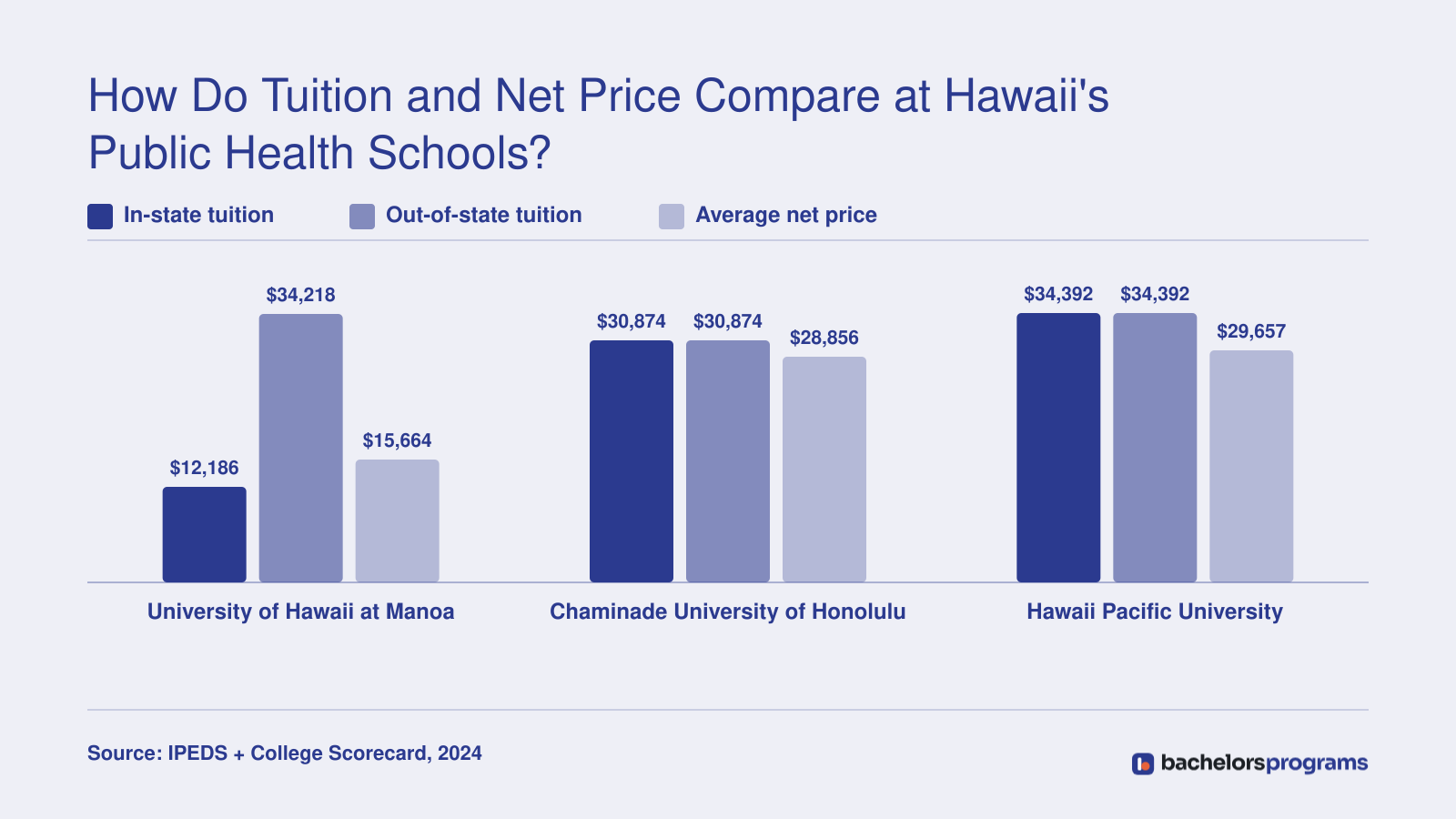
University of Hawaii at Manoa charges Hawaii residents $12,186 in tuition and fees, compared with $34,218 for out-of-state students. Chaminade University of Honolulu ($30,874) and Hawaii Pacific University ($34,392) are private schools and charge every student the same rate. Net price is an institution-wide average after grants and scholarships, not a quote for any one student or for the public health program alone, so use each school's net price calculator for your own estimate.
What Health Education Specialists Earn in Hawaii
A bachelor's degree in public health often leads to health education roles. Hawaii's latest state wage survey puts the median pay for that work at $63,740 a year.
Questions to Ask Yourself
Do you need an in-state tuition rate, or can you afford private-school pricing?
Does your plan depend on a CEPH-accredited degree, for example a later MPH or a federal or state job?
Do you want Native Hawaiian or Pacific health coursework and community-based practicum placements built in?
Quick Answers About Public Health Bachelor's Programs in Hawaii
These answers cover the questions Hawaii students ask most often about accreditation, cost, online study, and career entry. Confirm details with each school's admissions office before you apply.
Is Hawaii Pacific University's public health program accredited?
What is the cheapest way to earn a bachelor's degree in public health in Hawaii?
Can you get a bachelor's degree in public health online from a Hawaii school?
Do I need a master's degree to work in public health in Hawaii?
Compare Public Health programs on the data that matters
Explore more Healthcare majors or browse every field of study.
All Healthcare programs Browse every field of study