Best Public Health Schools in South Carolina
Compare 18 accredited Public Health programs in South Carolina, with net price after aid, graduation rates, earnings and debt from IPEDS and the U.S. College Scorecard.

A bachelor's degree in public health, most often a Bachelor of Science (B.S.) in Public Health, costs $10,730 a year in tuition and fees at University of South Carolina Beaufort and $59,770 at Furman University. That gap shapes the decision for most students.
The programs here run from Clemson University to small private colleges, on campus and online, all at South Carolina-based schools.
South Carolina issues no license for entry-level public health work. Employers hire on the degree, internship experience and, for health education roles, the CHES credential.
Key Points
- University of South Carolina Aiken posts the lowest net price: $11,641 yearly.
- Clemson, University of South Carolina and College of Charleston carry CEPH accreditation.
- For a fully online option, look to University of South Carolina Beaufort.
Best Bachelor's Degree in Public Health Schools in South Carolina, Ranked
South Carolina's public health bachelor's programs range from a large land-grant campus with a health administration track to small private colleges and a public option that can be finished entirely online. Each card below lists delivery format, in-state tuition, approximate net price after aid, the institution's overall graduation rate, and admission selectivity. A bachelor's degree in public health opens roles in health education, program coordination, and policy work, and these ten programs are ordered by how well they fit that goal.
Clemson University
#1Clemson, SC · $20,000 – $25,000/yr (est.)
Best for: Students drawn to health services administration
Clemson University's public health offering is the Public Health Sciences B.S. with a Health Services Administration concentration, plus tracks in health promotion and behavior, pre-professional studies, and language and international health. Ties to Prisma Health Upstate and an accelerated pathway with MUSC support applied research and in-state graduate study. The campus program runs about $15,600 in tuition and fees for South Carolina residents, with an average net price near $22,300 after aid; roughly 38% of applicants are admitted and the university graduates about 87% overall.
- Health Services Administration concentration
- Additional tracks in health promotion and behavior
- Pre-professional studies and language and international health options
- Joint degree programs with other Clemson units
- Campus-based program in Clemson, South Carolina
University of South Carolina
#2Columbia, SC · ~$23,000/yr (est.)
Best for: In-state students seeking a dedicated public health school
The University of South Carolina's Arnold School of Public Health in Columbia is the state's only CEPH-accredited school of public health, and its B.A. in Public Health draws on social and behavioral sciences, epidemiology, and policy. Students build custom cognates, complete a capstone, and join faculty research, with a Prisma Health partnership supporting practice-based work. In-state tuition and fees are about $12,700 with an average net price near $22,800 after aid; about 60% of applicants are admitted and roughly 79% graduate overall.
- Only CEPH-accredited school of public health in South Carolina
- Capstone seminar required for graduation
- Custom cognates built around student interests
- Independent research with faculty
- Study abroad by single course or full semester
- Emphasizes social and behavioral sciences
College of Charleston
#3Charleston, SC · $13,000 – $38,000/yr (est.)
Best for: Hands-on learners wanting internship placements
The College of Charleston awards both a B.A. and a B.S. in public health, so students can lean social science or build a stronger science base for clinical careers. Internships with MUSC, the CDC, and local nonprofits, plus study abroad in Barcelona and Lisbon, make it unusually fieldwork-heavy. In-state tuition and fees run about $13,000, average net price is near $19,000 after aid, about 60% of applicants are admitted, and the overall graduation rate is around 66%.
- B.A. and B.S. degree options
- Concentrations in global health and maternal and child health
- Internships with MUSC, the CDC, and local nonprofits
- Study abroad in Barcelona, Lisbon, and Amsterdam
- Faculty-led and independent research with grant funding
- Public Health Society student organization
Furman University
#4Greenville, SC · ~$30,000/yr (est.)
Furman University, a private liberal arts school in Greenville, offers its public health major as a B.S. in the Health Sciences department, with research, internships, study away, and a four-year residential model built around mentoring. It carries the highest sticker price on this list, about $59,800 in tuition and fees, with an average net price near $30,300 after aid; about 43% of applicants are admitted and roughly 79% graduate overall.
- Housed in the Health Sciences department
- Four-year on-campus residential experience
- Research, internship, and study away opportunities
- Located in Greenville, South Carolina
- Financial aid available to eligible students
Anderson University
#5Anderson, SC · ~$24,000/yr (est.)
Anderson University is a private Christian college in Anderson offering a B.S. in Community and Public Health built on evidence-based practice, policy, and health education for nonprofits, government agencies, and healthcare administration. The 122-credit program runs four years with rolling admissions and Common App acceptance. Tuition and fees are about $35,000, average net price is near $23,500 after aid, about 55% of applicants are admitted, and the overall graduation rate is around 66%.
- 122 total credit hours across four years
- Rolling admissions with fall and spring start dates
- Common App accepted
- Faith-informed curriculum with a low student-to-faculty ratio
- Targets healthcare administration and health education roles
- Coursework in policy, law, and regulation
Coastal Carolina University
#6Conway, SC · $10,000 – $15,000/yr (est.)
Coastal Carolina University in Conway offers a generalist B.S. in public health covering environmental health, epidemiology, rural and urban health, and ethics, with field internships and faculty-mentored research. Students can also join a statewide Public Health Preparedness Student Corps focused on emergency response and health equity. In-state tuition and fees are about $11,600 with an average net price near $14,000 after aid; about 75% of applicants are admitted and roughly 48% graduate overall.
- Generalist degree covering environmental health and epidemiology
- Field internships with community partners
- Faculty-mentored research opportunities
- Eta Sigma Gamma and Public Health Club
- Students can join the statewide Public Health Preparedness Student Corps
Lander University
#7Greenwood, SC · $15,000/yr (est. net price)
Lander University in Greenwood blends biology, psychology, sociology, environmental science, and policy into a workforce-focused B.S. in public health aimed at health education roles in hospitals, agencies, nonprofits, and businesses. Coursework adds nutrition and exercise science so graduates understand lifestyle drivers of population health. In-state tuition and fees are about $11,700, one of the lowest prices here, with an average net price near $15,400 after aid; about 81% of applicants are admitted and roughly 50% graduate overall.
- Blends biology, psychology, sociology, and policy
- Prepares graduates for health educator roles
- Coursework in nutrition and exercise science
- Four-year major guide keeps students on track
- Campus-based program in Greenwood, South Carolina
Voorhees University
#8Denmark, SC · $10,000 – $15,000/yr (est.)
Voorhees University, a private historically Black university in Denmark, offers a B.S. in General Public Health with a 51-credit public health core inside a 122-credit degree. Coursework covers biostatistics, epidemiology, environmental health, and public health informatics, and a semester-by-semester plan plus career pathway courses run through the senior year. Tuition and fees are about $12,600 and the average net price is near $13,300 after aid; the university's overall graduation rate is about 43%.
- 51-credit public health core within 122 total credits
- Covers biostatistics, epidemiology, and environmental health
- Public health informatics coursework
- Semester-by-semester plan for full-time students
- Career pathway research courses through senior year
Charleston Southern University
#9Charleston, SC · ~$22,000/yr (est.)
Charleston Southern University, a private Christian college in Charleston, offers a B.A. in public health focused on how communities, policies, and social conditions shape health, alongside a B.S. track for students heading into clinical fields. Skills built include health education, advocacy, and policy, with a dedicated program director guiding students through the major. Tuition and fees are about $32,500, average net price is near $21,700 after aid, about 96% of applicants are admitted, and the overall graduation rate is around 47%.
- Emphasizes social determinants of health
- Builds skills in health education, advocacy, and policy
- Foundation for graduate study in public health or law
- Complements the university's B.S. track for clinical fields
- Dedicated program director provides personalized guidance
University of South Carolina Beaufort
#10Bluffton, SC · ~$15,000/yr (est.)
USC Beaufort awards both a B.A. and a B.S. in public health, and both can be finished in person or fully online, the widest delivery flexibility among South Carolina public options. The B.A. leaves room for minors in psychology, business, or human services, while the B.S. adds natural science depth for environmental or clinical paths. In-state tuition and fees are about $10,700, the lowest here, with an average net price near $14,700 after aid; about 73% of applicants are admitted and roughly 34% graduate overall.
- B.A. and B.S. paths available
- Available in person or fully online
- B.A. allows minors in psychology, business, or human services
- B.S. leans on natural sciences and environmental health
- Prepares students for entry-level public health positions
Cost & outcomes by school
Federal data for the highest-earning Public Health programs, independent of the ranking above. Earnings are this field's bachelor's graduates four years after completing where the Scorecard reports them, else the school's undergraduate median.
| School | Net price / yr | Grad rate | Earnings | Debt | Grads/yr | Format |
|---|---|---|---|---|---|---|
| Clemson University SC | $22,253 | 87% | $71,513 | $21,500 | — | Campus |
| Furman University SC | $30,308 | 79% | $68,635 | $23,250 | 10 | Campus |
| Presbyterian College SC | $20,528 | 52% | $60,194 | $26,000 | — | Campus |
| University of South Carolina SC | $22,811 | 79% | $58,715 | $21,500 | 512 | Campus |
| College of Charleston SC | $18,960 | 66% | $55,660 | $25,146 | 119 | Campus |
| Anderson University SC | $23,544 | 66% | $52,568 | $26,700 | 6 | Campus |
| Coastal Carolina University SC | $13,966 | 49% | $48,238 | $25,625 | 54 | Campus |
| University of South Carolina Beaufort SC | $14,656 | 34% | $48,088 | $25,000 | 31 | Hybrid |
| Newberry College SC | $21,656 | 45% | $48,040 | $26,805 | — | Hybrid |
| Winthrop University SC | $15,343 | 57% | $47,185 | $26,975 | — | Online |
| Charleston Southern University SC | $21,666 | 47% | $45,898 | $26,471 | 17 | Campus |
| University of South Carolina Aiken SC | $11,641 | 40% | $45,603 | $24,275 | — | Campus |
Sources: U.S. Department of Education. Net price, graduation rate, earnings and debt: College Scorecard (earnings and debt for this field's bachelor's graduates where reported, else school-wide); graduates: IPEDS. A dash means no figure is reported.
Cost, debt & payoff
Median earnings of this field's bachelor's graduates (4 yrs after completing, else the school's undergraduate median) vs. their median federal loan debt · U.S. College Scorecard
Across these programs the median graduate earns about $47,613 and finishes with roughly $25,813 in debt — a ratio that clears a common rule of thumb (keep debt below first-year salary). Net price and debt vary widely school to school, so check the per-school figures in the table above before you shortlist.
Cheapest Bachelor's in Public Health Programs in South Carolina
University of South Carolina Aiken has the lowest net price after aid among these programs, at $11,641 a year. Net price climbs to $15,343 at Winthrop University, a spread of roughly $3,700 a year. Figures come from 2024 U.S. Department of Education data (IPEDS and College Scorecard). Program debt is the median federal loan debt reported for public health bachelor's graduates at each school.
| School | Location | Format | Net Price After Aid (per year) | In-State Tuition and Fees (per year) | Median Program Debt |
|---|---|---|---|---|---|
| University of South Carolina Aiken | Aiken, SC | Campus | $11,641 | $10,760 | N/A |
| Voorhees University | Denmark, SC | Campus | $13,335 | $12,630 | N/A |
| Coastal Carolina University | Conway, SC | Campus | $13,966 | $11,640 | $25,625 |
| University of South Carolina Beaufort | Bluffton, SC | Campus and online | $14,656 | $10,730 | $25,000 |
| Winthrop University | Rock Hill, SC | Online | $15,343 | $14,678 | N/A |
Online and Hybrid Public Health Bachelor's Options at South Carolina Schools
Can you earn a bachelor's degree in public health online from a South Carolina school? Yes, but the options are narrow. Among the schools here, University of South Carolina Beaufort is the one that clearly offers an online path.
Campus-only, hybrid, and fully online
- Fully online or hybrid: University of South Carolina Beaufort lists both in-person and 100% online formats for its B.S. in Public Health. A 2025 program flyer describes the online version as taking about two years for full-time students, with prerequisites completed first, including through a technical college. That makes it the clearest fit for transfer students.
- Mostly on campus: Columbia College teaches its public health degree face-to-face, with only some online courses.1
- Campus-only: Clemson, University of South Carolina (Columbia), College of Charleston, Furman, Anderson, Coastal Carolina, Lander, Voorhees, and Charleston Southern list on-campus programs. None of them offers an online path for public health.
Out-of-state students and in-person requirements
University of South Carolina Beaufort's published material does not say whether out-of-state students can enroll online, so confirm residency rules and tuition with its admissions office before applying.
The USC Beaufort description names no required practicum or internship, but ask whether one applies. On-campus programs lean on hands-on work. Coastal Carolina points to internships and field experiences. University of South Carolina in Columbia describes a field project or independent research, plus 50 hours of volunteer work on one program page. College of Charleston highlights internships with groups such as MUSC and the CDC. Treat any online route as a possible hybrid in practice until the school confirms its field-experience rules.
Admission Requirements: GPA, Test Policy, and Transfer Credit
Getting into the university and getting into the public health major are two separate steps, and South Carolina schools handle them differently. At most schools, university admission is all you need to declare the major. The University of South Carolina adds a second, higher bar for transfer students entering its Arnold School of Public Health.
How Selective Each School Is
Admission rates show how competitive the first step is:
- Clemson University: 38% admitted, the most selective school here
- Furman University: 43%
- Anderson University: 55%, with rolling admissions and the Common App accepted
- College of Charleston: 60%
- University of South Carolina: 60%
- University of South Carolina Beaufort: 73%
- Coastal Carolina University: 75%
- Lander University: 81%
- Charleston Southern University: 96%
Voorhees University does not report a comparable admission rate, so contact its admissions office directly.
USC Columbia: GPA and Test Policy
Freshmen who meet USC's general admission standards are eligible for the public health B.A. or B.S. The program does not set a separate freshman GPA minimum. Freshman admission is test-optional for the spring, summer, and fall 2027 terms, so submitting SAT or ACT scores is your choice.
Transfer Credit Rules
USC's general transfer minimum is a 2.25 GPA. The Arnold School raises that to 2.75 for students transferring from regionally accredited colleges, another USC campus, or another college on the Columbia campus. Transfers with fewer than 30 semester hours must also meet freshman requirements. Students moving from another USC campus or Columbia college need at least 12 USC credit hours first. B.S. students must complete their last 30 credit hours in residence at USC Columbia. The university does not publish a cap on transferable credits.
USC Beaufort's transfer guide maps an associate degree pathway of 60 to 63 credits toward its 120-credit B.S. The school does not publish a minimum admission GPA or test policy specific to the major.
Clemson, College of Charleston, Furman, Anderson, Coastal Carolina, Lander, Voorhees and Charleston Southern publish no major-specific GPA, test or transfer policy. Confirm current requirements with each school's admissions office before you apply.
Related Articles
Cost of a Bachelor's Degree in Public Health in South Carolina
How much does a bachelor's degree in public health actually cost in South Carolina? Less than the sticker price suggests, once state scholarships and grants land.
Sticker Price vs. Net Price
At public universities the in-state rate is the one that matters. Coastal Carolina lists about $11,640 in state against roughly $29,628 out of state; College of Charleston runs about $12,978 in state and $38,296 out of state; Lander sits near $11,700 in state and $21,300 out of state. University of South Carolina Beaufort charges about $10,730 in state. Voorhees University, a private institution, charges one rate, about $12,630.
Net price, the average a family pays once grants and scholarships are applied, is closer to what families actually budget: about $13,335 at Voorhees, $13,966 at Coastal Carolina, $15,363 at Lander and $18,960 at College of Charleston. USC Aiken, in our directory, lands near $11,641.
What South Carolina Aid Pays
- Palmetto Fellows: $6,700 in the freshman year, $7,500 in later years, up to $10,000 with the Scholarship Enhancement. Requires a 3.5 GPA, a 1200 SAT or 25 ACT, and top 6 percent of the class.1
- LIFE: up to $5,000 a year for students meeting two of three: 3.0 GPA, 1100 SAT or 22 ACT, top 30 percent of class.1
- HOPE: up to $2,800 for the freshman year only, with a 3.0 GPA.1
- Lottery Tuition Assistance: $75 per credit hour at two-year colleges, with at least 6 credits and a 2.0 GPA.2
- SC WINS: up to $5,000 a year for technical college workforce programs, 2.0 GPA.
LIFE cannot stack with Palmetto Fellows, HOPE or Lottery Tuition Assistance, so compare whole packages.
Matching Aid to Your Path
Strong high school grades and test scores put Palmetto Fellows within reach for a freshman entering a four-year program directly. Students who start at a two-year college lean on Lottery Tuition Assistance or SC WINS first, then transfer into a public health bachelor's with LIFE available once enrolled. Treat net price as a planning figure, not a promise: it averages all aid recipients, and your bill depends on the package you are offered.
Public Health Careers and Salaries in South Carolina
A public health bachelor's degree leads to no single job title, and South Carolina issues no state license for the field, so what the degree returns depends on the entry role you target and the employer who hires you.
Where Graduates Start
Common first roles for a B.S. in public health include health education specialist, community health worker, and program coordinator, with related openings in outreach, patient navigation, and grant-funded program support. The largest cluster of employers sits in state and local government: the South Carolina Department of Health and Environmental Control and its county health departments, the Department of Health and Human Services, the Department of Mental Health, DAODAS, and the Department of Disabilities and Special Needs. Hospital systems, academic medical centers, federally qualified health centers, county and municipal agencies, and nonprofits running community health grants round out the list.
What the National Wage Data Shows
The Bureau of Labor Statistics puts the national median for health education specialists at $64,070 a year ($30.80 an hour) in 2025, across 70,400 jobs, with 6% projected growth from 2025 to 2035, about 6,900 openings a year, and 3,900 added jobs.1 Community health workers show a national median of $51,850 ($24.93 an hour), 64,700 jobs, 13% growth, and 8,200 added jobs over the same window.2 Those are U.S. figures, and state-level wages for these two occupations are not published in the sources behind this page, so treat them as reference points rather than South Carolina pay. For scale, the state's education and health services sector carried about 328,300 jobs in September 2026, a preliminary figure that covers far more than public health.3 Occupational wages also differ from graduate earnings reported to the College Scorecard, which reflect what alumni of a program earned, not what a role pays.
Licensure and the CHES Credential
Neither occupation carries a general South Carolina license, though individual employers may require or prefer certification.1 The Certified Health Education Specialist credential is voluntary and national, requires a bachelor's degree, and can strengthen a health education application. Confirm expectations with each employer before you enroll.
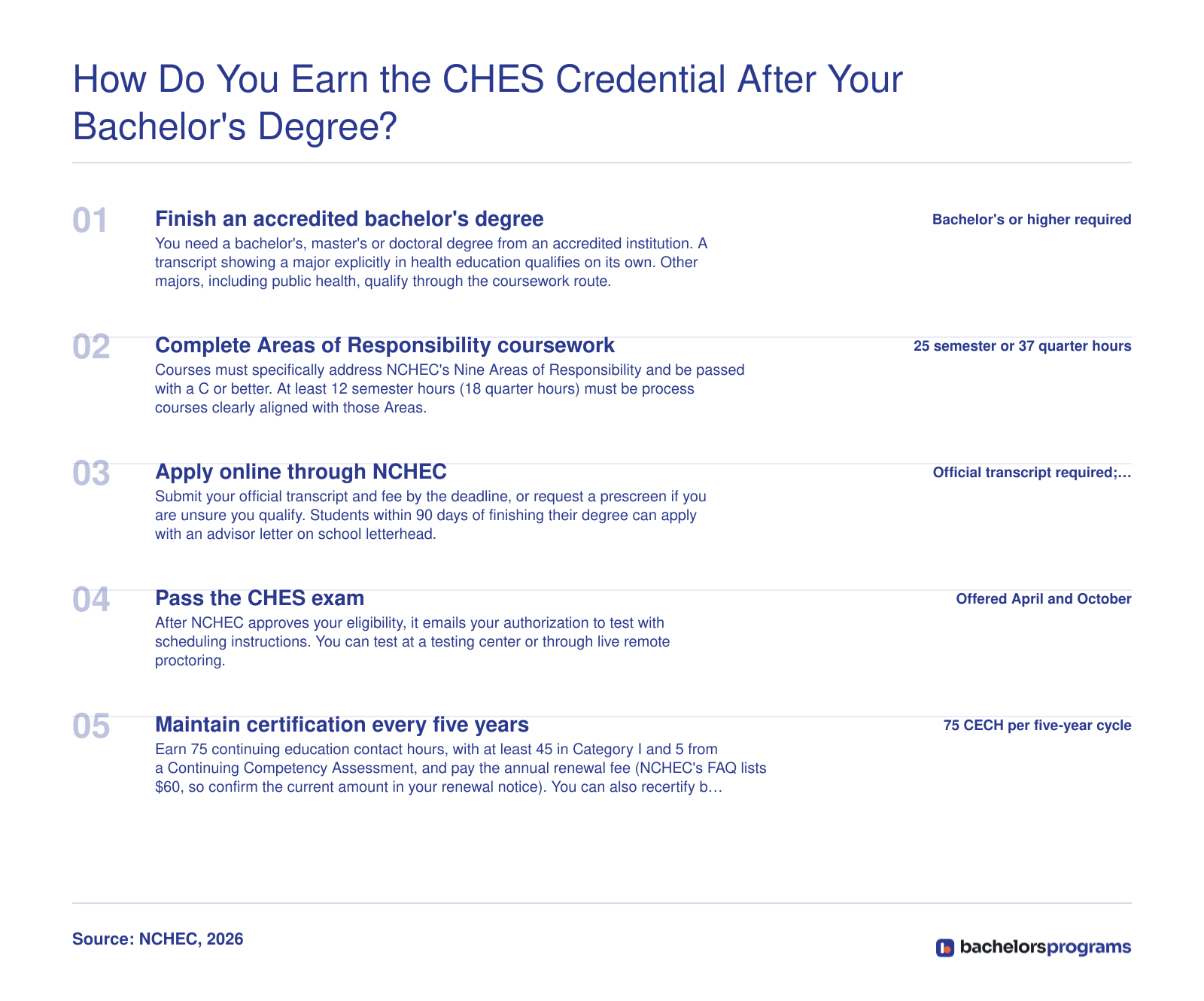
How Do You Earn the CHES Credential After Your Bachelor's Degree?
The Certified Health Education Specialist (CHES) credential, issued by the National Commission for Health Education Credentialing (NCHEC), is a common next step for public health graduates who want to work in health education. Order matters here: your coursework must line up with NCHEC's Nine Areas of Responsibility before you can sit for the exam.
CEPH Accreditation and the B.S. vs. B.A. in Public Health
Which South Carolina colleges have a CEPH-accredited bachelor's in public health? According to the Council on Education for Public Health (CEPH) directory, the University of South Carolina, Clemson University and College of Charleston hold accreditation tied to their undergraduate programs.1
Where Accreditation Applies
- University of South Carolina: The Arnold School of Public Health is the only CEPH-accredited school of public health in South Carolina. It was first accredited in 1977 and is approved through July 1, 2032.1 The university lists both its B.A. and B.S. in Public Health as accredited within Arnold.
- College of Charleston: Its Public Health Program earned accreditation in April 2023, valid through July 1, 2031.2 Coverage extends to both the B.S. and the B.A.
- Clemson University: CEPH lists a B.S. in Health Sciences as an accredited bachelor's-level program, valid through July 1, 2029.1
What It Means for You
CEPH accreditation signals that a program meets national standards for curriculum, faculty and student outcomes.1 It does not guarantee admission to graduate school or a particular job. Most entry-level public health roles do not require a degree from an accredited program, so an unaccredited bachelor's at another school on this list can still be a solid choice.
B.S. or B.A.?
A B.S. generally carries a heavier science and math load, such as biology, chemistry and statistics. It suits students aiming for epidemiology, health professions or lab-adjacent work. A B.A. leans toward social sciences, policy and communication, fitting students drawn to health education or community programs. College of Charleston's B.A., for example, offers concentrations in Maternal and Child Health or Global Health.
How to Verify
Search the CEPH accredited programs directory by state. Confirm the program's exact name, degree level and valid-through date before you apply.
How We Ranked These South Carolina Public Health Schools
The ranking weighs bachelor's degree programs in public health at South Carolina-based schools using federal data and each school's own published admissions information. The aim is a list a student can act on, not a prestige score.
Data sources
Federal figures come from IPEDS and the College Scorecard, which supplies both institution-level and program-level data. Admissions details such as GPA expectations, test policy, and transfer credit were read from each school's admissions pages.
What we weighed
- Net price: What students pay after grants and scholarships.
- Graduation rate: How many students finish.
- Selectivity: How competitive admission is.
- Delivery format: Campus, hybrid, or online.
- Program-level outcomes: Earnings and related results for the specific field of study, where published.
Limits to keep in mind
Neither figure describes the public health major alone: both graduation rate and net price cover the whole institution. Scorecard earnings reflect the latest published year, so they may trail current pay. Where a program has no published program-level figures, the school is judged on the remaining factors.
The list includes only ranked bachelor's programs at South Carolina-based schools, on campus and online. Graduate programs and schools based in other states are left out, even when they enroll South Carolina residents online.
Bachelor's in Public Health in South Carolina: Common Questions
These answers cover the questions students ask most about earning a bachelor's degree in public health in South Carolina. Figures reflect the most recent information available in 2026 and may change, so confirm details with each school.
What are the best public health schools in South Carolina?
Is there a CEPH-accredited public health school in South Carolina?
Can you get a bachelor's degree in public health online in South Carolina?
How much does a public health degree cost in South Carolina?
What do public health graduates earn in South Carolina?
Compare Public Health programs on the data that matters
Explore more Healthcare majors or browse every field of study.
All Healthcare programs Browse every field of study