Best Online Health Education Degree Programs
Compare 40+ accredited online Health Education programs, with net price after aid, graduation rates, earnings and debt from IPEDS and the U.S. College Scorecard.

The University of Florida's online health education track ends with a 12-credit internship, a reminder that fully online does not mean hands-off. The schools ranked here award it most often as a Bachelor of Science (B.S.) in Health Education, and each program can be finished from home; hybrid formats are excluded.
Without relocating, the real tests are net price (from $6,541 a year at Florida), CHES exam eligibility and field placement, which differs widely by school and often sets a working student's timeline.
Key Points
- Net price starts at $6,541 a year at the University of Florida.
- Expect about 120 credits, or roughly four years of full-time study.
- Confirm CHES exam eligibility and internship hours with each school.
Our Ranking of the Best 100% Online Health Education Bachelor's Programs
Every program in this ranking can be completed fully online, with no requirement to relocate or sit in a campus classroom. Several of these schools also teach the same curriculum on campus, but each online pathway stands on its own for students balancing work, family or a current health care job.
University of Florida
#1Gainesville, FL · ~$7,000/yr (est.)
Best for: Community health promotion career starters
The University of Florida anchors this ranking with a 120-credit health education degree that carries two concentrations and a 15-credit internship, and online students earn the same degree as campus students. UF graduates about 91% of its students, one of the strongest completion rates in the country, and the program is built around CHES exam eligibility. Prerequisites for the online pathway include anatomy or physiology with a lab, biology, college algebra, statistics and psychology.
- 120 total credit hours
- CHES exam eligibility after graduation
- Focus on illness and disease prevention in community groups
- Behavioral interventions that deliver health information
- Career paths in CDC, NIH and voluntary health organizations
- HIV/AIDS counseling certificate available
- Median earnings of $47,572 one year after finishing
- 15-credit health education internship required
- Prerequisite coursework for medicine, dentistry and pharmacy
- Prepares for graduate study in public health and epidemiology
- Health and Wellness Coaching certificate available
- Combination degree options available
- Specialization coursework in junior and senior years
Brigham Young University-Idaho
#2Rexburg, ID · ~$8,000/yr (est.)
Best for: Cost-conscious students entering public health
Brigham Young University-Idaho is a private university in Rexburg with a low published tuition and a public health department that leans on service and community outreach. The health education and promotion degree covers epidemiology, health policy, program planning and evaluation, with team projects modeled on real public health work. The school publishes a four-year example class plan, so applicants can see the full sequence before they enroll.
- Coursework in epidemiology, health policy and environmental health
- Program planning, evaluation and health communication
- Team projects modeled on real public health work
- Published four-year example class plan
- AI integrated into major coursework
- Careers as health education specialists and community health workers
University of North Carolina at Greensboro
#3Greensboro, NC · $11,000/yr (est. net price)
Best for: Transfer students holding an associate degree
UNC Greensboro built its online public health education degree for students who already hold a college credential: applicants need a prior associate or bachelor's degree, and full-time students start in the fall of junior year and finish in two years. Classes are fully online with no relocation, and part-time sequences are available. OnlineU ranked it second among the most affordable online public health degrees for 2026.
- Fully online, no campus relocation
- Two-year junior and senior sequence starting in fall
- Full-time and part-time course options
- Prior A.A., A.S., B.A. or B.S. required
- Minimum 2.5 GPA; transfer courses need a C or higher
- Prerequisites include anatomy, physiology and college algebra
- OnlineU ranked it #2 for most affordable online public health (2026)
University of Arizona
#4Tucson, AZ · ~$17,000/yr (est.)
The University of Arizona is a large public research university whose public health school offers an accredited wellness and health promotion degree with a health education emphasis. Students complete a practicum and field work alongside coursework in program planning, and graduates can sit for the Certified Health Education Specialist exam. The school graduates about 68% of its students.
- 6 units of practicum plus 3 units of field work
- Prepares students for the CHES exam
- Online emphasis: HPS 350, HPS/GHI 302 or PHP 308, plus 9 units
- Fourth-semester language proficiency required
- Emphasis must be declared before practicum
- Careers in public health government and worksite wellness
William Carey University
#5Hattiesburg, MS · ~$14,000/yr (est.)
William Carey University is a private institution in Hattiesburg, Mississippi, and its health, physical education and recreation degree is a deliberately non-licensure path. Instead of K-12 teaching credentials, it points toward community recreation, corporate wellness and athletic administration roles such as wellness consultant or program manager. Courses run through Canvas, and face-to-face options exist for students who prefer them.
- 125 credit hours, 54 in health and recreation
- Non-licensure path: no teacher licensure
- Delivered online through Canvas
- Prepares for corporate wellness and athletic administration
- Roles such as wellness consultant and program manager
- Face-to-face options available
Andrews University
#6Berrien Springs, MI · $10,000 – $15,000/yr (est.)
Andrews University is a private Michigan university whose public health degree carries a health promotion and health education concentration with a strong science and disease prevention core. Students take coursework in community health, health communication and behavior change, plus program planning and leadership, and the degree is designed to feed into an MPH. The school graduates about 72% of its students.
- 120 semester hours; minimum 2.85 overall GPA
- 2.75 GPA required in didactic and science courses
- No grade below C- in prerequisite and cognate courses
- Coursework in community health, disease prevention and health communication
- Prepares students for the CHES exam
- Foundation for an MPH
- Andrews Partnership Scholarship available
Fort Hays State University
#7Hays, KS · ~$13,000/yr (est.)
Fort Hays State University is a public Kansas university with a long distance-education track record, and its health studies degree is built for students who already hold an allied health credential. Up to 45 credits can transfer from that credential, and the 120-credit degree leaves room for electives alongside a public health core and a capstone or internship. It is one of the more flexible, lower-cost entries on this list.
- 120 credits: 34 general education, 34 core, 54 electives
- Up to 45 credits from an allied health credential
- Capstone or internship required
- 45 upper-division credit hours required
- Core covers epidemiology, environmental and global health
- Prepares students for public health graduate study
University of New Mexico
#8Albuquerque, NM · ~$15,000/yr (est.)
The University of New Mexico delivers its community health education degree entirely online in 8-week segments and accepts applications on a rolling basis, so students can start without waiting for a fall term. Coursework centers on planning, implementing and evaluating prevention programs for multicultural populations. Graduates are eligible for the CHES exam in every state, though the credential is voluntary.
- 120 credit hours in 8-week segments
- Rolling admissions with year-round applications
- CHES exam eligibility in all states
- Community prevention program planning and evaluation
- Health promotion in multicultural, multilevel contexts
- Scholarship resources available
Indiana University-Southeast
#9New Albany, IN · $5,000 – $10,000/yr (est.)
Indiana University-Southeast offers a 100% online applied health science degree with a community health educator track, and it accepts an associate degree or at least 30 credit hours toward the bachelor's. The track adds three 6-credit courses in community health assessment, education and promotion, plus program planning and evaluation. Credit for prior learning covers military service, non-credit training and volunteer work, and students from ten Kentucky counties pay in-state tuition.
- 100% online, 120 credit hours
- Minimum 3.0 cumulative GPA
- Three 6-credit courses in community health assessment and promotion
- Qualifies graduates for the CHES examination
- Accepts an associate degree or 30+ credit hours
- Credit for prior learning: military, training, volunteer work
- In-state tuition for students from ten Kentucky counties
University of Alabama at Birmingham
#10Birmingham, AL · $19,000/yr (est. net price)
The University of Alabama at Birmingham sits on a large academic health center, and its community health and human services degree includes a capstone applied project in a pre-professional setting. The health promotion and education concentration is built around CHES competencies and national health education standards. The school graduates about 64% of its students.
- Capstone applied project in a pre-professional setting
- Curriculum aligned to CHES competencies and national standards
- Prepares students for the NCHEC CHES exam
- Two concentration options
- Training in program planning, implementation and evaluation
Cost & outcomes by school
Federal data for the highest-earning Health Education programs, independent of the ranking above. Earnings are this field's bachelor's graduates four years after completing where the Scorecard reports them, else the school's undergraduate median.
| School | Net price / yr | Grad rate | Earnings | Debt | Grads/yr | Format |
|---|---|---|---|---|---|---|
| University of Florida FL | $6,541 | 91% | $68,605 | $15,454 | 200 | Online or campus |
| University of Florida FL | $4,815 | 85% | $68,605 | $15,454 | 22 | Online or campus |
| University of Arizona AZ | $16,674 | 68% | $66,937 | $21,000 | 157 | Online or campus |
| George Mason University VA | $17,915 | 68% | $65,358 | $20,500 | 170 | Hybrid |
Sources: U.S. Department of Education. Net price, graduation rate, earnings and debt: College Scorecard (earnings and debt for this field's bachelor's graduates where reported, else school-wide); graduates: IPEDS. A dash means no figure is reported.
Cost, debt & payoff
Median earnings of this field's bachelor's graduates (4 yrs after completing, else the school's undergraduate median) vs. their median federal loan debt · U.S. College Scorecard
Across these programs the median graduate earns about $52,021 and finishes with roughly $22,500 in debt — a ratio that clears a common rule of thumb (keep debt below first-year salary). Net price and debt vary widely school to school, so check the per-school figures in the table above before you shortlist.
What You Study in an Online Bachelor's Degree in Health Education
What classes do you actually take in an online health education bachelor's degree?
Core coursework in a bachelor's degree in health education usually covers program planning and evaluation, health behavior theory, health communication, community needs assessment and epidemiology basics.1 SOPHE's standards organize that preparation across nine competency areas, including assessment, planning, implementation, evaluation and research, advocacy, communication, leadership, management and ethics.2 SOPHE defines health education as the population-health specialty built on teaching, communication, behavior change and community empowerment.3 Health promotion is the broader practice of planning and evaluating interventions; public health is broader still, covering surveillance, policy and population-level action.
Graduates work as health education specialists, community health workers, wellness coordinators, patient educators and prevention specialists, often in nonprofits, hospitals, clinics, schools and government agencies.4 Several programs here offer concentrations in community health, school health or health promotion. School health tracks add teacher-education coursework and student teaching, and they require a background check.5
Accreditation and CHES Eligibility: What to Verify Before You Apply
Check these points before you apply so your degree supports financial aid, credit transfer and eligibility for the Certified Health Education Specialist (CHES) exam.
- Institutional accreditationConfirm the school holds institutional (regional) accreditation from an accreditor recognized by the U.S. Department of Education. This is the baseline for federal aid and credit transfer. NCHEC also requires a degree from an accredited institution.
- Programmatic accreditationSome standalone public health baccalaureate programs are CEPH-accredited, and some undergraduate health education programs hold SABPAC approval. Either is a plus, but NCHEC does not require them for CHES eligibility, and many quality programs carry neither.
- CHES exam eligibilityNCHEC requires at least a bachelor's degree. You also need either a transcript showing a health education major or 25 semester (37 quarter) hours tied to the Areas of Responsibility, with grades of C or better. NCHEC's 2026 eligibility rules cite Nine Areas, though its FAQ still lists eight.
- Curriculum mappingAsk admissions whether the courses are mapped to the CHES Areas of Responsibility, and request a course-to-competency crosswalk. The crosswalk shows whether you'll meet the required 25-hour mix, which includes at least 12 semester hours of process courses.
- Online deliveryNCHEC's criteria cover degree level, institutional accreditation and coursework, not delivery format. An accredited online degree should therefore qualify on the same academic basis. NCHEC doesn't address online degrees directly, so confirm this with the program.
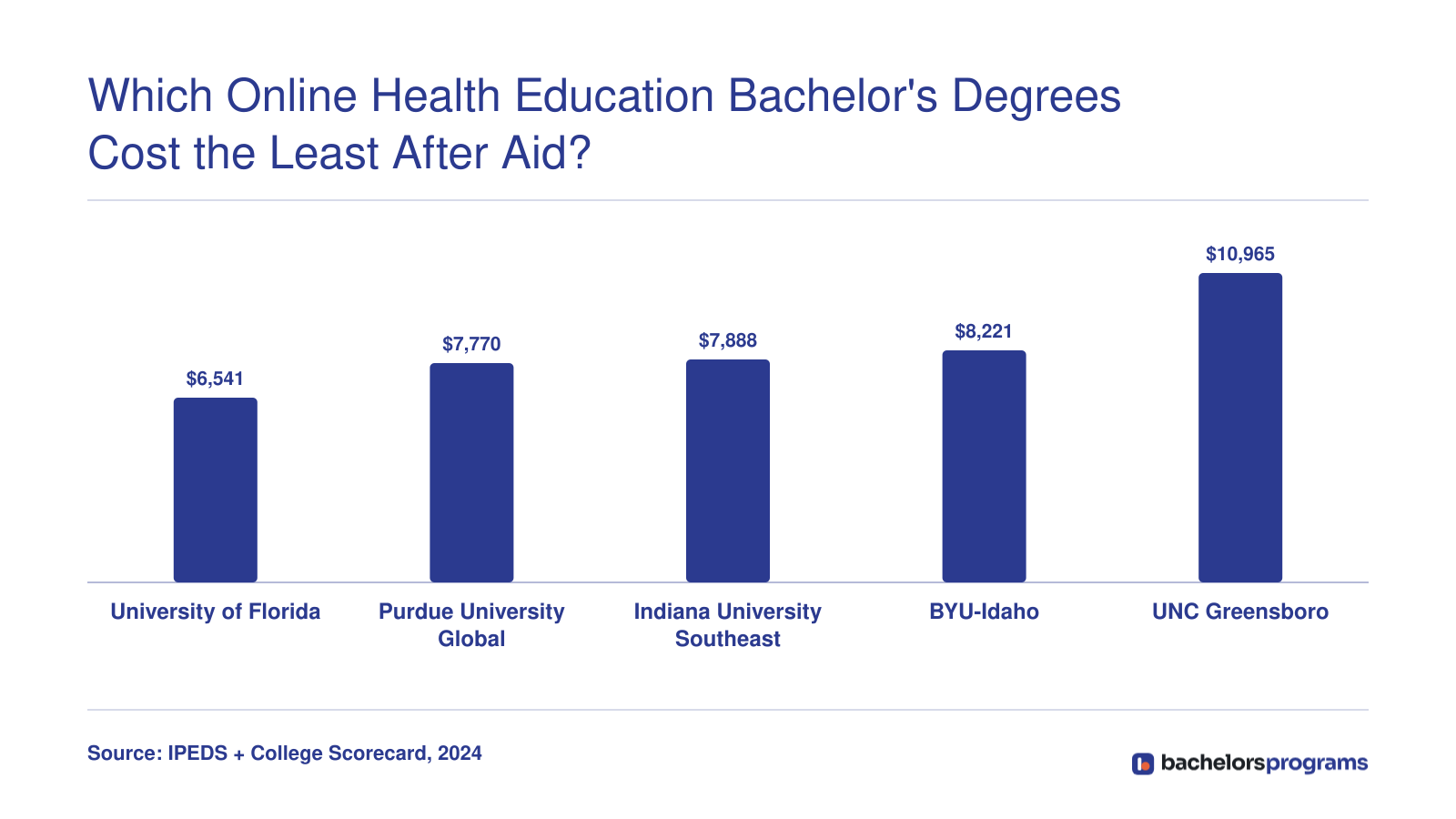
Which Online Health Education Bachelor's Degrees Cost the Least After Aid?
Average net price after grants starts at $6,541 a year at the University of Florida and tops out at $10,965 at UNC Greensboro among the most affordable fully online options here. These are institution-wide averages for aided students, so treat them as approximate, not a quote for every student. Public universities hold most of the low end, while private BYU-Idaho pairs $4,800 tuition with an $8,221 average net price; program-level median federal debt at completion is $11,675 at BYU-Idaho, $13,650 at Florida and $25,500 at UNC Greensboro.
Related Articles
How Long an Online Health Education Degree Takes
Faster is possible, but only if you bring credits or study full-time. The standard answer is about 120 credits and roughly four years of full-time study for first-time students. Transfer students with an associate degree can often finish in about two years. Purdue Global counts 180 quarter credits instead, with completion in 24 to 48 months depending on what prior credit is accepted.
Term format matters too. Several schools here run 7-week terms (William Paterson, American International College) or 8-week terms (Benedictine, Touro, Oklahoma), against 15 to 16 weeks for a traditional semester. Shorter terms and year-round starts, six per year at Touro and American International College, let you finish more courses each year.
Transfer credit limits decide how much time you can actually save. Touro, American International College, and Cincinnati accept up to 90 credits. William Paterson states no limit but requires 30 credits in residence.1 Oklahoma's 24 to 36 month track is built for transfer students with at least 24 college credits.2 Treat any accelerated claim as conditional on transfer credit or a full course load.
Do Online Health Education Programs Require Internships?
Do you have to complete an internship in an online health education degree? Usually, yes. Most programs end with a capstone, an internship, or a practicum, and the hours vary widely by school.
Fully online programs typically have you complete fieldwork near home. Texas Woman's University requires 350+ hours and expects students to secure their own site.5 The University of Georgia asks for 300+ hours (6 credits, final semester at the earliest), also student-arranged, and paid placements are rare.2 Arizona lists 250 contact hours3, while Eastern Washington requires 18 hours per 6-week session with approval one session ahead.4 Houston requires 160 hours at an approved site and includes class meetings.1 Florida varies by track: 240 or 480 hours for Health Studies.6
Some programs also require synchronous sessions, and campus visit rules aren't documented for every school here, so ask.
Because the internship usually comes near the end, it can be hard to fit around a full-time job. Before enrolling, ask each program what placement support it offers, whether your current employer can count, and whether any meetings are mandatory.
What Health Education Specialists Earn
Here is what the occupation pays nationally, so you can weigh tuition against likely earnings.
Health Education programs by state
Compare Health Education programs on the data that matters
Explore more Healthcare majors or browse every field of study.
All Healthcare programs Browse every field of study