Best Public Health Schools in Texas
Compare 32 accredited Public Health programs in Texas, with net price after aid, graduation rates, earnings and debt from IPEDS and the U.S. College Scorecard.
Health education specialists earned a national median of $64,070 in May 2025, and the Bureau of Labor Statistics projects the occupation to reach about 74,400 jobs by 2035. A bachelor's degree in public health is the standard entry credential in Texas, usually awarded as the Bachelor of Science (B.S.) in Public Health.
The decision turns on three things: cost, accreditation and format. In-state public tuition and private tuition sit far apart, and a CEPH-accredited program is not the same thing as a CEPH-accredited university. For county health departments and hospital systems hiring in Texas, coursework and internship hours tend to carry more weight than the name on the diploma.
Key Points
- At most ranked Texas schools, the public health B.S. isn't fully online.
- School-level CEPH accreditation doesn't always mean CEPH reviewed the bachelor's degree.
- Health education specialists earned a $64,070 national median in May 2025.
Best Bachelor's in Public Health Schools in Texas: Our Ranked List
These ten Texas schools anchor our ranked list of bachelor's programs in public health, running from flagship research universities to urban commuter campuses and border institutions. Every entry below is a school where you can actually enroll in an undergraduate public health degree, and each note focuses on what makes that program and campus distinct for someone choosing where to study.
The University of Texas at Austin
#1Austin, TX · ~$20,000/yr (est.)
Best for: Future physicians wanting a science-heavy foundation
The Austin flagship pairs a large research university's resources with a science-forward B.S. in Public Health that is one of the state's most established undergraduate pathways into the field. Students pick between a standard track, an honors route through the Dean's Scholars Program, and an advanced track that stacks the bachelor's with a Master of Public Health. Sitting alongside Dell Medical School and the LBJ School of Public Affairs gives students unusual exposure to clinical, policy, and community health work on one campus.
- Three tracks: standard, Honors via Dean's Scholars, and an accelerated BS plus MPH path
- 120 total credit hours with a 2.0 GPA minimum
- Prerequisite courses required before upper-division public health work
- Capstone is a senior seminar or an integrative inquiry project
- Training across all five core public health areas
- Graduate certificate in public health available during the senior year
Texas A&M University-College Station
#2College Station, TX · ~$21,000/yr (est.)
Best for: Community health organizers focused on prevention
This College Station land-grant university built its B.S. in Public Health around health promotion and disease prevention rather than one-on-one clinical care. The degree is offered at both Bryan-College Station and McAllen, and coursework trains students to assess population needs, design interventions, and manage community health programs. Graduates typically move into public health agencies, hospitals, nonprofits, and government, or continue into graduate health professions programs.
- Offered at both Bryan-College Station and McAllen
- Built around health promotion and disease prevention
- Coursework in assessing needs, planning programs, and designing interventions
- Prepares for roles in health agencies, hospitals, nonprofits, and government
- Common springboard to graduate health professions programs
The University of Texas at Dallas
#3Richardson, TX · $18,000/yr (est. net price)
Best for: Aspiring health policy analysts
This Richardson research university takes a deliberately different angle: its public health degree is a Bachelor of Arts housed in the School of Economic, Political and Policy Sciences. The curriculum blends sociology, economics, and policy analysis, which suits students who want to run programs or shape health policy rather than work at a lab bench. Core work in epidemiology, health policy, and research methods builds the analytical and evaluation skills that government, nonprofit, and business employers look for.
- Bachelor of Arts housed in the School of Economic, Political and Policy Sciences
- 120 credit hours
- Blends sociology, economics, and health policy
- Core courses in epidemiology, health policy, and research methods
- Built for future public health managers in government, nonprofits, and business
- Emphasizes analysis, program evaluation, and policy implementation
Texas A & M International University
#4Laredo, TX · $3,600/yr (est. net price)
A public university in Laredo, where the B.S. in Public Health focuses on preventing disease and promoting physical, mental, and social well-being across a border region. The program requires supervised placements with public and private community agencies, along with CPR certification and a criminal background check, so students graduate with documented field experience. Smaller cohorts mean closer faculty contact, and the curriculum is designed to stand on its own for entry-level work or lead into graduate study.
- Requires a criminal background check and CPR certification
- Hands-on placements with public and private community agencies
- Covers epidemiological principles and systems thinking
- Emphasizes ethical advocacy and communication across diverse audiences
- Prepares students for community health, health education, and policy roles
The University of Texas at San Antonio
#5San Antonio, TX · $9,000 – $22,000/yr (est.)
San Antonio's large urban public university splits its public health bachelor's into Health Sciences and Health Promotion concentrations, letting students lean toward science or toward community programming. A senior-year internship is built into the degree, and graduates are prepared to sit for the Certified Health Education Specialist exam. The program sits close to the region's public health agencies for practice placements, and a 4+1 arrangement with UTHealth Houston School of Public Health adds a graduate certificate and an MPH in one additional year.
- Two concentrations: Health Sciences and Health Promotion
- Health Sciences adds science coursework such as genetics or microbiology
- Health Promotion covers mental health, nutrition, and physical activity
- Senior-year internship supported by a dedicated internship director
- Prepares students to sit for the Certified Health Education Specialist exam
- No extra admission requirements beyond the university's general requirements
- 4+1 path with UTHealth Houston adds a graduate certificate and an MPH
- Bold Promise covers tuition and fees for eligible students
University of North Texas
#6Denton, TX · $11,000 – $21,000/yr (est.)
A large public university in Denton whose B.S. in Public Health is a broad generalist degree covering epidemiology, biostatistics, environmental health, health policy, and program management. Students complete a capstone and steer electives toward areas such as health communication, emergency management, or mapping health data, with minors like addiction studies or psychology available. The department leans on community-engaged learning and internships, and the degree works equally as a route into graduate study or into clinical professional programs.
- Capstone required for graduation
- Core includes epidemiology, biostatistics, environmental health, and policy
- Electives in health communication, emergency management, and GIS in health
- Minors available in addiction studies or psychology
- Broad generalist focus rather than a single track
- Student organizations such as Active Minds
The University of Texas at El Paso
#7El Paso, TX · $5,000 – $10,000/yr (est.)
This El Paso public university offers a CEPH-accredited B.S. in Public Health, a designation that signals the curriculum meets national standards for public health education. The program centers on health promotion and education, training students to plan, implement, evaluate, and coordinate programs in agencies, schools, businesses, and nonprofits. A general concentration lets students explore the breadth of the field before specializing, and the border setting gives classroom material an immediate real-world context.
- CEPH accredited
- Two concentration options, including a general track
- Focus on health promotion and education careers
- Students learn to plan, implement, and evaluate health programs
- Prepares graduates for health educator and coordinator roles
The University of Texas at Arlington
#8Arlington, TX · ~$14,000/yr (est.)
A large public university in the Dallas-Fort Worth Metroplex with a B.S. in Public Health that leaves more than 20 hours of electives open, so students can build real depth in epidemiology, biostatistics, health policy, or community education. A culminating internship places students inside an actual public health setting, and coursework mixes experiential, service, and team-based learning. The metroplex location supports practice placements across research, advocacy, healthcare administration, and emergency management.
- More than 20 hours of open electives for tailoring the degree
- Culminating internship in a public health setting
- Elective depth in epidemiology, biostatistics, health policy, or community education
- Experiential, service, and team-based learning
- Maverick Advantage Distinction available
University of North Texas at Dallas
#9Dallas, TX · ~$6,000/yr (est.)
A public university in south Dallas that frames its B.S. in Public Health as an interdisciplinary launchpad for health professions, including pharmacy, dentistry, physician assistant, and medical careers. Students can take the UNT Health Science Center public health certificate and double-count up to 15 credits toward both the bachelor's and the graduate credential. Those who meet the coursework and GPA requirements may carry certificate credits into the UNTHSC Master of Public Health, though admission to that program is not guaranteed.
- Up to 15 credits double-count toward a UNT Health Science Center public health certificate
- Certificate courses with a B or better can transfer into the UNTHSC MPH
- Certificate eligibility requires 72 undergraduate credit hours and a 3.2 cumulative GPA
- B or better in PBHL 4310 Epidemiology required
- Program liaison approval required for the certificate pathway
- Geared toward pharmacy, dentistry, physician assistant, and medical careers
Texas State University
#10San Marcos, TX · ~$17,000/yr (est.)
A public university in San Marcos offering a B.S. in Public Health with unusually wide specialization, from obesity and diabetes prevention to epidemiology, mental health, substance abuse prevention, and maternal and child health. Internships and a program honor society round out the experience, and the curriculum maps to two national credentials, the Certified Health Education Specialist and Certified Wellness Practitioner exams. Graduates join health promotion teams at agencies, nonprofits, industry, and clinical settings, or continue into graduate study.
- Eight concentration options, from epidemiology to maternal, child, and adolescent health
- Other specializations include mental health, substance abuse prevention, and worksite wellness
- Prepares students for the CHES and Certified Wellness Practitioner exams
- Internships in public health settings
- Program honor society for public health students
- Coursework covers health disparities, social marketing, and behavior science
Cost & outcomes by school
Federal data for the highest-earning Public Health programs, independent of the ranking above. Earnings are this field's bachelor's graduates four years after completing where the Scorecard reports them, else the school's undergraduate median.
| School | Net price / yr | Grad rate | Earnings | Debt | Grads/yr | Format |
|---|---|---|---|---|---|---|
| West Coast University-Texas TX | $53,020 | 31% | $102,672 | $32,946 | 5 | Online |
| The University of Texas at Dallas TX | $18,267 | 76% | $68,227 | $18,000 | 2 | Campus |
| Texas A&M University-College Station TX | $21,315 | 84% | $66,732 | $16,500 | 252 | Campus |
| Baylor University TX | $41,104 | 80% | $65,793 | $22,495 | 36 | Campus |
| The University of Texas at Arlington TX | $13,951 | 54% | $63,199 | $19,292 | 200 | Hybrid |
| University of Houston TX | $14,276 | 65% | $62,377 | $18,194 | — | Campus |
| The University of Texas at Austin TX | $19,857 | 89% | $61,390 | $20,500 | 391 | Campus |
| Austin College TX | $21,107 | 67% | $61,296 | $20,500 | 15 | Campus |
| Concordia University Texas TX | $23,131 | 45% | $60,883 | $21,852 | 1 | Campus |
| University of North Texas TX | $15,649 | 61% | $57,010 | $19,250 | 111 | Campus |
| St. Mary's University TX | $21,145 | 59% | $56,955 | $25,563 | — | Campus |
| Texas Woman's University TX | $11,963 | 49% | $56,544 | $19,218 | 1 | Campus |
Sources: U.S. Department of Education. Net price, graduation rate, earnings and debt: College Scorecard (earnings and debt for this field's bachelor's graduates where reported, else school-wide); graduates: IPEDS. A dash means no figure is reported.
Cost, debt & payoff
Median earnings of this field's bachelor's graduates (4 yrs after completing, else the school's undergraduate median) vs. their median federal loan debt · U.S. College Scorecard
Across these programs the median graduate earns about $54,338 and finishes with roughly $22,174 in debt — a ratio that clears a common rule of thumb (keep debt below first-year salary). Net price and debt vary widely school to school, so check the per-school figures in the table above before you shortlist.
Most Affordable Bachelor's in Public Health Programs in Texas
These Texas schools offer a bachelor's degree in public health at the lowest average net price, the amount students pay after grants and scholarships, based on 2024 IPEDS and College Scorecard data from the U.S. Department of Education. Texas A & M International University leads at $3,637 per year. Lamar University, which appears in our directory, is the only fully online option in this table. Tuition and debt figures are school-wide, not specific to the public health program.
| School | City | Format | In-State Tuition & Fees | Out-of-State Tuition & Fees | Average Net Price | Median Debt at Graduation (School-Wide) |
|---|---|---|---|---|---|---|
| Texas A & M International University | Laredo | Campus | $7,894 | $19,454 | $3,637 | $15,000 |
| University of North Texas at Dallas | Dallas | Campus | $9,595 | $21,894 | $6,420 | $18,606 |
| Lamar University | Beaumont | Online | $8,905 | $18,745 | $9,366 | $21,250 |
| The University of Texas at El Paso | El Paso | Campus | $9,744 | $25,502 | $9,403 | $18,000 |
| The University of Texas at San Antonio | San Antonio | Campus | $9,011 | $22,051 | $10,836 | $20,500 |
Which Texas Bachelor's in Public Health Programs Are CEPH Accredited?
A CEPH-accredited school and a bachelor's degree CEPH has actually reviewed are not always the same thing, and the difference matters when you compare Texas options.
What Undergraduate Accreditation Means
The Council on Education for Public Health (CEPH) is the national accreditor for public health education.1 Accreditation signals that a curriculum meets professional standards, which employers and later graduate or professional programs often look for. CEPH accredits schools, programs, and standalone baccalaureate programs, of which there are 31 nationally.2 Bachelor's degrees inside an accredited school of public health are part of that school's review. A public health program only submits its undergraduate degree if it chooses to.
Status at the Ranked Schools
The CEPH accredited programs list shows these ranked schools as accredited:
- Texas A&M University-College Station: School of Public Health, accredited since 6/2/2001, through 12/31/2033.
- The University of Texas at Austin: Public Health Program, accredited since 5/18/2023, through 7/1/2031.
- Baylor University: Public Health Program, accredited since 9/21/2013, through 12/31/2033.
The University of Texas at San Antonio and Texas State University do not show an established CEPH accreditation for their undergraduate public health degrees. For every other school on this list, we could not verify CEPH status.
The list also does not tell us whether the UT Austin and Baylor accreditations cover the bachelor's degree specifically. Ask each admissions office whether the B.S. itself was included in the CEPH review before you rely on it. A program without CEPH status can still prepare you well for entry-level work, so check the curriculum and outcomes too.
Online and Hybrid Bachelor's in Public Health Options at Texas Schools
Can you complete a bachelor's degree in public health entirely online at a Texas university?
At most of the schools ranked here, the answer is no. UT Austin, UT Dallas, Texas A&M International, UT San Antonio, UNT, UTEP and UNT Dallas all list their public health B.S. as a campus program, while Texas State runs its B.S. in Public Health online. UT Arlington lays out the route most clearly: an Accelerated Online B.S. in Public Health that requires at least 24 transfer credit hours before enrollment.2 Its traditional on-campus route is hybrid, blending in-person and online classes.1
Format Can Differ by Campus
Texas A&M offers its BSPH at College Station and at the Higher Education Center at McAllen. The university says classes are available on both campuses and online, but it does not publish a separate fully online BSPH track, and the exact mix of online and in-person coursework is not specified. Texas A&M-San Antonio confirms a BSPH but does not state whether delivery is campus-based, hybrid or online, so confirm the format with an advisor before applying.3
Who Benefits From Online or Hybrid Study
- Working adults: UT Arlington's accelerated online route is built for students who need a flexible schedule, though the 24-credit transfer requirement means it is not a first-semester option.
- Transfer students: A hybrid program can let you keep working while you finish prerequisites, but check which courses still require campus attendance.
- Rural students: If you live far from Arlington, College Station or San Marcos, an online or hybrid route can cut travel and relocation costs, provided the program confirms remote delivery for your courses.
- Students with fieldwork: Some programs include internships or service learning; ask whether those hours can be completed near home or must be on campus.
Admission Requirements for Texas Bachelor's in Public Health Programs
The schools that are hardest to get into are not always the ones that spell out their rules most clearly. Admission to a bachelor's degree in public health in Texas runs from highly selective to nearly open, and published policy details vary just as widely.
How Selective Are the Schools?
The University of Texas at Austin admits about 27 percent of applicants. Texas A & M International University admits roughly 44 percent, and Texas A&M University-College Station about 57 percent. UT Dallas sits near 65 percent, and the University of North Texas near 72 percent. The most open campuses include UT Arlington (about 80 percent), UNT at Dallas (about 84 percent), UT San Antonio (about 87 percent), and Texas State University (about 89 percent). UT El Paso admits nearly every applicant.
GPA, Test Policy, and Transfer Credit
Most schools do not publish a program-specific admission GPA. Sam Houston State University lists a 2.75 GPA2, but that applies to continuing B.S. students, and we found no separate entry GPA. Texas A&M directs applicants to ApplyTexas. Its Broad Street figures (1300 SAT, 30 ACT, top 10% of class) should not be read as the rule for every applicant.
Texas State is the clearest on transfers for its online B.S.:
- Credit limit: Up to 72 semester hours from accredited junior or community colleges1; transfers above that should consult an adviser.
- Transfer GPA: 2.0 with 14 or fewer credits, 2.5 with 15 to 29, and 2.25 with 30 or more.
- Test policy: SAT/ACT scores are not required for students in the top 75 percent of their class.
- Deadlines: September 24, 2026 for Fall 2 and January 4, 2027 for Spring 1, with documents due a week later.
UT Austin's Public Health Advanced option requires 9 graduate hours from the UTHealth Houston Austin campus before the B.S. We found no published GPA, test, transfer, or deadline policy for Baylor University or most other schools here, so confirm those directly.
Practical Tips
- Check the school's admissions page for current deadlines, since some programs require paperwork by a separate date.
- Ask an adviser how your community college credits will apply before you enroll.
- Apply early to the more selective campuses, and keep a less selective option in play.
Related Articles
Cost of a Bachelor's Degree in Public Health in Texas
Three numbers decide what a Texas public health bachelor's degree costs: the published tuition, what a typical student actually pays after grants and scholarships, and what graduates borrow. At the public schools ranked here, published in-state tuition runs from roughly $7,900 to $14,600 a year, and average net price after aid from about $3,600 to $19,900. Net price is an institution-wide average across all undergraduates, not a figure for public health majors, so use it as a rough guide rather than a quote.
What the Aid Picture Shows
School-wide context helps you judge affordability. Among the schools ranked here, the share of undergraduates receiving Pell Grants ranges from about 57 percent to 88 percent, and median debt among graduates who borrowed falls between roughly $15,000 and $21,000. A high Pell share usually signals that a campus enrolls many students with financial need and, often, that it directs aid accordingly. Private Texas colleges generally post higher sticker prices than public ones, but their aid packages can narrow the gap, so get a personalized estimate before ruling one out.
Texas Aid for In-State Students
- TEXAS Grant: A need-based state grant for Texas residents attending participating public colleges, applied toward tuition and fees. File the FAFSA by the state priority deadline.
- Texas Public Educational Grant (TPEG): A campus-administered need-based grant. Award amounts and deadlines vary by school, so ask the financial aid office directly.
- Hazlewood Act: A tuition exemption at Texas public colleges for eligible veterans, spouses, and dependent children, subject to residency and documentation rules.
One Way to Lower the Bill
Start at a Texas community college and confirm in writing that the B.S. program will accept your credits, then ask about transfer-specific scholarships. Arriving with core courses finished can cut the total you pay at university rates.
Public Health Careers and Credentials for Texas B.S. Graduates
Health education specialists earned a national median of $64,070 in May 2025, according to the Bureau of Labor Statistics, and the occupation employed about 70,400 people, with employment projected to reach 74,400 by 2035.1 A Texas-specific median for this occupation was not available in the material reviewed, so the national figure works as a benchmark, not a Texas wage.
Entry-Level Roles a B.S. Opens Up
A Bachelor of Science in Public Health from a program such as those at The University of Texas at Austin, Texas A&M University-College Station or the University of Houston typically leads to roles like these:
- Health education specialist: Designs and delivers programs that help communities adopt healthier behaviors, often at health departments, nonprofits, hospitals, and employers.
- Community health worker: Connects residents to care and services. Entry requirements vary by employer, and BLS wage figures for health education specialists should not be read as community health worker pay.
- Program or research support: Coordinates data collection, grants, and outreach for public health programs, including support roles on epidemiology teams.
Epidemiologists are a step beyond entry level. BLS reports a national median of $87,220 (May 2025) and projects 19% growth from 2025 to 2035, about 2,400 jobs.2 The typical entry requirement is a master's degree,3 so a bachelor's graduate would usually start in a support role.
CHES Certification and Texas Licensure
The main credential for bachelor's graduates is Certified Health Education Specialist (CHES), offered through the National Commission for Health Education Credentialing (NCHEC). Eligibility generally requires a degree in health education or a related major, or a degree plus a set amount of health-education coursework (commonly 25 semester credits). Confirm current credit rules with NCHEC before planning your course load.
Texas does not appear to have a general license for public health work, so most employers look at your degree, internships, and optional certification instead. Confirm requirements with the specific employer, since clinical and some regulated roles carry their own rules.
Further Study
Some graduates continue to graduate school, especially for epidemiology and other advanced roles, but many start working right after the bachelor's degree.
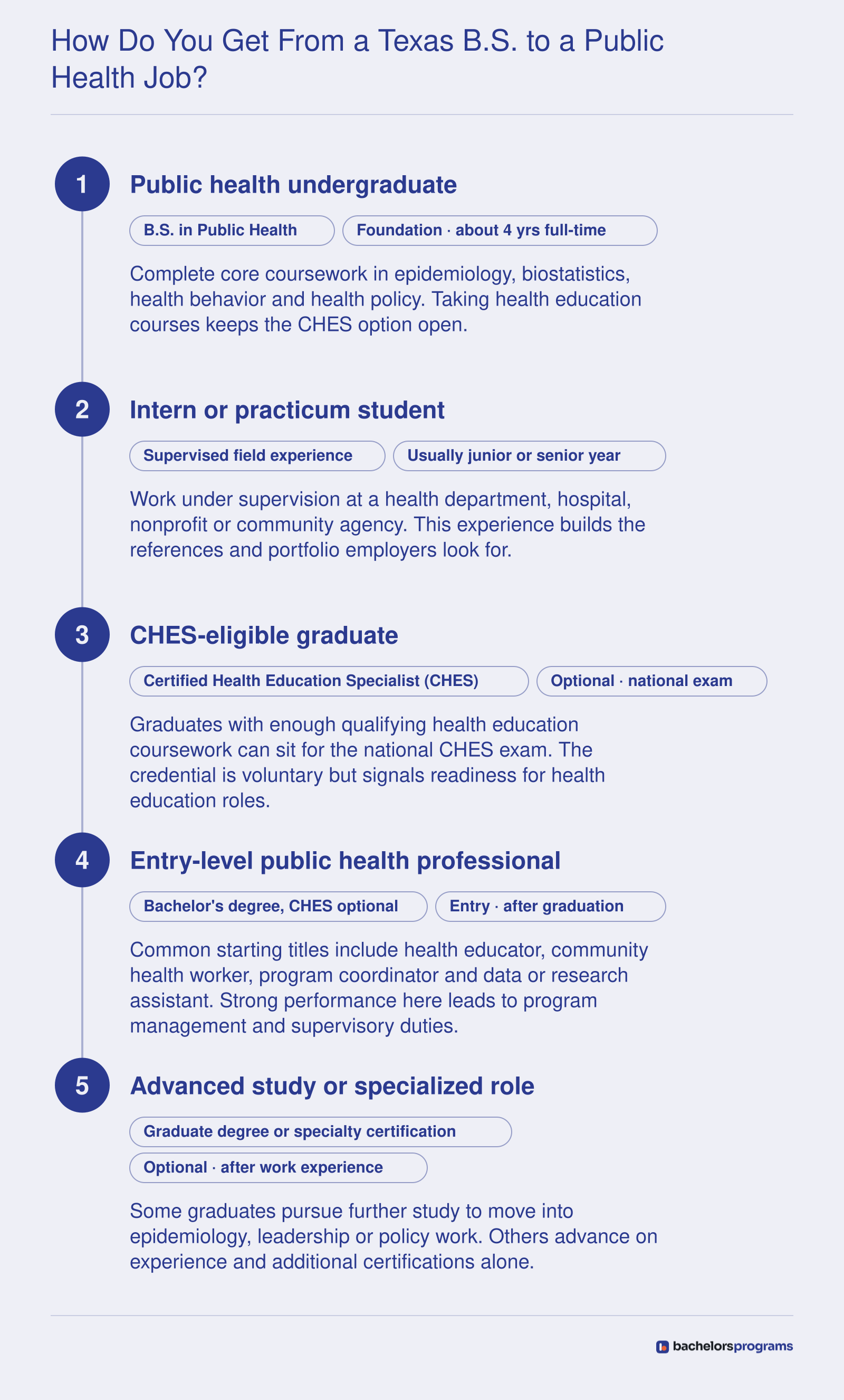
How Do You Get From a Texas B.S. to a Public Health Job?
Most Texas public health graduates follow a similar route from classroom to career. The ladder below shows the typical order, from finishing the Bachelor of Science in Public Health to an optional move into advanced study.
Texas Public Health Bachelor's Degree FAQs
These answers cover the questions Texas students ask most about a bachelor's degree in public health. Program details can change, so confirm current terms on each school's own pages.
What is the best public health school in Texas?
Can you get a bachelor's degree in public health online in Texas?
What can you do with a bachelor's degree in public health?
Do you need a license to work in public health in Texas?
Compare Public Health programs on the data that matters
Explore more Healthcare majors or browse every field of study.
All Healthcare programs Browse every field of study