Best International Relations Degree Programs
Compare 180+ accredited International Relations programs, with net price after aid, graduation rates, earnings and debt from IPEDS and the U.S. College Scorecard.

The international relations major has turned quantitative: econometrics, causal inference and advanced language training now sit alongside diplomatic history.
Most programs award the Bachelor of Arts (B.A.) in International Relations, and prices vary enormously. Stanford lists $65,910 in tuition and fees but reports an average net price of $13,807; Brigham Young charges $6,688. Median earnings five years out run from roughly $67,000 to $128,687.
Admission rates at the most selective programs sit below 15 percent. For most applicants the practical question is whether a public university's in-state price and its internship pipeline into federal agencies or NGOs justify an out-of-state premium.
Key Points
- Stanford IR graduates earn a median $128,687 five years after finishing.
- Stanford's $65,910 sticker price drops to a $13,807 average net price.
- International relations and international affairs share one federal code, CIP 45.0901.
Best Bachelor's Degree in International Relations Schools Ranked
These ten schools lead our ranking of bachelor's degree programs in international relations, drawn from a pool that spans every format: fully campus based, fully online, and blended. Each card summarizes what the program actually requires, and the quick-compare table at the end lines up location, format, average net price after aid and the institution's overall graduation rate. Price and graduation figures describe the whole institution rather than the international relations program alone.
Stanford University
#1Stanford, CA · $10,000 – $15,000/yr (est.)
Best for: Aspiring diplomats wanting a required quarter abroad
Stanford's international relations major is interdisciplinary and tightly structured: 75 units split across a core in international politics, comparative governance, American foreign policy and economics, plus a skills course and a capstone. Students choose primary and secondary pathways from eleven options, and every major spends at least one quarter abroad while building second-year college proficiency in a foreign language. Capstone choices run from a policy practicum to a 70 to 100 page honors thesis open to students holding a 3.5 GPA.
- 75 units: 30 core, 40 specialization, 5 capstone
- Eleven pathways include International Security and International History
- At least one quarter of study abroad required
- Foreign language to second-year college proficiency
- Capstone options include policy practicum and creative project
- Honors thesis of 70 to 100 pages requires a 3.5 GPA
- Writing in the Major requirement
- Prepares for law, policy, business and journalism study
University of Chicago
#2Chicago, IL · ~$15,000/yr (est.)
Best for: Accelerated learners eyeing a joint BA/MA
The University of Chicago lists international relations as a joint BA/MA degree and professional option rather than a stand-alone major, so undergraduates enter an accelerated track administered through The College. It sits alongside other joint offerings such as computational social science, humanities and Middle Eastern studies. Entry is through standard College admissions, and the track suits readers who want a broad liberal arts core paired with early graduate coursework.
- Joint BA/MA degree and professional option
- Administered through The College
- Listed with other accelerated BA/MA tracks
- Entry through standard College admissions
Georgia Institute of Technology
#3Atlanta, GA · ~$12,000/yr (est.)
Best for: Security-focused students wanting a technology angle
Georgia Tech's international affairs degree sits in the Sam Nunn School and is built as a 122-credit Bachelor of Science, with upper-division work in technology and ethics, security and diplomacy, comparative politics, and international political economy. Majors take 12 credits in a single modern language and can add the International Plan, which requires 26 weeks of study, research or internship abroad across two terms. A five-year BS/MS option opens after 45 credit hours for students holding a 3.5 GPA in Ivan Allen College courses.
- 122 credits in the Sam Nunn School of International Affairs
- Four substantive areas including security and diplomacy
- 12 credits of 3000- and 4000-level INTA electives
- 12 credits in a single modern language
- International Plan requires 26 weeks abroad across two terms
- One-credit discovery practicum and pro-seminar
- BS/MS option after 45 credit hours with a 3.5 GPA
- Minimum grade of C in core INTA courses
Yale University
#4New Haven, CT · ~$24,000/yr (est.)
Yale awards its undergraduate international relations degree as a bachelor's in global affairs, with international relations as one of six concentrations. The 14-course major blends economics, political science and history, requires an L4 language course, and finishes with a capstone or senior essay presented to an external partner such as a government agency or nonprofit. No prerequisites are needed to declare, and up to four study-abroad credits count toward the major.
- 14 courses required, with international relations as one concentration
- Eight introductory courses in economics, political science and history
- GLBL 2122 and GLBL 3101 are required
- L4 modern language course required
- Capstone, senior essay seminar or senior essay course
- Capstone presented to an external partner such as a government agency
- Up to four study-abroad credits count toward the major
- No prerequisites to declare the major
University of California-San Diego
#5La Jolla, CA · $10,000 – $15,000/yr (est.)
UC San Diego houses international relations inside the Department of Political Science, where the B.A. requires five upper-division IR courses spanning foreign policy and security, political economy and IR theory, plus seven more political science electives. Every course for the major must be taken for a letter grade, and the department publishes a fillable checklist so students and advisors can track progress together. Coursework covers war and peace, global economics and climate, which suits readers drawn to the research side of the field.
- Five upper-division IR courses plus seven political science electives
- One course from foreign policy and national security
- One course from political economy and IR theory
- POLI 12 plus two of POLI 10, 11 or 13 in lower division
- All major courses taken for a letter grade
- Fillable PDF checklist reviewed with an undergraduate advisor
- Covers war and peace, global economics and climate
University of Georgia
#6Athens, GA · ~$14,000/yr (est.)
The University of Georgia's international affairs B.A. is a 120-credit degree in the School of Public and International Affairs, with 30 credits in the major split between international relations and comparative politics coursework. Students need foreign language competency through the fourth term and must satisfy an experiential learning requirement through study abroad, an internship or a research-intensive course. Any enrolled student can declare the major without a special application, which makes it an unusually accessible route into a large public research university's policy school.
- 120 credits, with 30 in the major beyond INTL 1100
- Core of INTL 3200 and INTL 3300
- At least two topical courses each in IR and comparative politics
- Foreign language competency through the fourth term
- Experiential learning via study abroad, internship or research course
- No special application to declare the major
- 45 of the final 60 credits must be taken at UGA
- Up to 6 transfer hours may apply to the major
Pomona College
#7Claremont, CA · ~$19,000/yr (est.)
Pomona College runs international relations as a small liberal arts major with an unusually heavy research requirement: qualitative and quantitative methods before senior year, a two-semester thesis, and competitive grants for thesis fieldwork. Majors need third-year proficiency in one foreign language, or second-year proficiency in two, and at least one semester abroad. Courses from the other Claremont Colleges count, and the intermediate seminar is limited to majors.
- Two-semester senior thesis: fall seminar, spring thesis
- Qualitative and quantitative methods completed before senior year
- Third-year proficiency in one language or second-year in two
- At least one semester of study abroad required
- Intermediate seminar restricted to majors, offered every semester
- Competitive research grants for thesis fieldwork
- Courses from other Claremont Colleges accepted
- Two advanced international electives required
University of California-Davis
#8Davis, CA · $10,000 – $15,000/yr (est.)
UC Davis structures international relations as an 80-unit B.A. with four tracks: world trade and development, peace and security, global environment and health, and peoples and nationalities. Students add 24 to 30 units of a second language and a 16-unit area studies requirement spanning five world regions, and up to five courses taken abroad apply to the degree. Internships through the UC Washington Center are one way students build experience before graduation.
- 80 units minimum, beginning with political science and economics
- Four tracks: world trade, peace and security, environment, peoples
- 24 to 30 units of a second modern language
- Track IV requires at least one quarter abroad
- 16-unit area studies requirement across five regions
- Up to five courses taken abroad count toward the major
- Internships through the UC Washington Center
University of Maryland-College Park
#9College Park, MD · $16,000/yr (est. net price)
The University of Maryland offers international relations as both a B.A. and a B.S. track in the Department of Government and Politics, and the concentration is recorded on the transcript. The B.A. pairs core government courses with economics and foreign language work, while the B.S. adds data science and empirical research benchmarks for students aiming at quantitative policy work. Students can switch tracks, and both routes feed law school, master's programs, government and nonprofits.
- B.A. pairs GVPT200, GVPT280 or 282 and GVPT241 with GVPT201
- Concentration recorded on the transcript
- B.A. requires ECON200 and an intermediate foreign language course
- B.S. adds GVPT320 and stresses data science and empirical research
- Prerequisites: GVPT200 and GVPT280/282 for the B.A.
- Students may switch between tracks
Brigham Young University
#10Provo, UT · $15,000 – $20,000/yr (est.)
Brigham Young University's international relations B.A. runs 61 to 87 credit hours and pairs comparative government, international politics, economics and geography with calculus or political inquiry and statistics or econometrics. Students pick from eight specialization tracks covering international politics, political economy, and the politics and history of Asia, Latin America, the Middle East, Europe and Africa. A capstone, senior seminar or research project closes the major, and IR majors cannot add minors in economics, political science or international strategy and diplomacy.
- 61 to 87 credit hours
- Eight tracks including International Politics and Political Economy
- Regional tracks for Asia, Latin America, Middle East, Europe, Africa
- Calculus 1 and statistics or econometrics required
- Modern foreign language proficiency required
- Capstone, senior seminar or research project
- No minors in Economics, Political Science or International Strategy
Cost & outcomes by school
Federal data for the highest-earning International Relations programs, independent of the ranking above. Earnings are this field's bachelor's graduates four years after completing where the Scorecard reports them, else the school's undergraduate median.
| School | Net price / yr | Grad rate | Earnings | Debt | Grads/yr | Format |
|---|---|---|---|---|---|---|
| Carnegie Mellon University PA | $31,944 | 94% | $114,862 | $21,750 | 16 | Campus |
| Yale University CT | $23,777 | 96% | $100,533 | $12,975 | 81 | Campus |
| Claremont McKenna College CA | $28,849 | 91% | $96,520 | $13,500 | 39 | Campus |
| University of Chicago IL | $14,860 | 96% | $91,885 | $15,000 | 34 | Campus |
| Lafayette College PA | $34,433 | 88% | $91,410 | $16,620 | 24 | Campus |
| Stanford University CA | $13,807 | 92% | $91,075 | $12,000 | 82 | Campus |
| William & Mary VA | $19,096 | 89% | $91,065 | $20,500 | 97 | Campus |
| Bucknell University PA | $40,766 | 86% | $90,393 | $27,000 | 17 | Campus |
| University of Pennsylvania PA | $28,699 | 97% | $87,439 | $10,470 | 40 | Campus |
| Saint Joseph's University - Philadelphia PA | $29,689 | 79% | $86,881 | $25,500 | 5 | Campus |
| University of California-San Diego CA | $12,470 | 86% | $84,943 | $15,500 | 17 | Campus |
| University of Southern California CA | $32,740 | 92% | $84,866 | $13,247 | 138 | Campus |
Sources: U.S. Department of Education. Net price, graduation rate, earnings and debt: College Scorecard (earnings and debt for this field's bachelor's graduates where reported, else school-wide); graduates: IPEDS. A dash means no figure is reported.
Cost, debt & payoff
Median earnings of this field's bachelor's graduates (4 yrs after completing, else the school's undergraduate median) vs. their median federal loan debt · U.S. College Scorecard
Across these programs the median graduate earns about $61,333 and finishes with roughly $23,000 in debt — a ratio that clears a common rule of thumb (keep debt below first-year salary). Net price and debt vary widely school to school, so check the per-school figures in the table above before you shortlist.
How We Ranked These International Relations Schools
A graduation rate describes a whole university; an earnings figure for international relations graduates describes the major. Reading those two as if they were the same number is the most common mistake prospective students make when they compare programs.
The Federal Data Behind These Rankings
The figures come from federal sources: College Scorecard records for institutions and for individual fields of study, plus IPEDS data on completions, net price, graduation rates and retention rates. When a school does not report a figure, it is left out rather than estimated.
Institution-Wide vs. Program-Level
- Institution-wide: graduation rate, average net price and earnings 10 years after entry. These describe the campus as a whole, not the international relations major.
- Program-level: earnings after completing the IR program and median debt for graduates in that field. These follow the major itself, which is why a strong campus rate can still sit above a weaker program.
Accreditation: One Standard, No IR-Specific Body
Institutional accreditation from an agency recognized by the U.S. Department of Education or by CHEA is the standard for a bachelor's degree in international relations.1 No programmatic accreditor specific to undergraduate IR exists, and NASPAA accredits master's-level public affairs, public administration and public policy programs, not bachelor's degrees.1 The Department of Education does not accredit schools or programs itself; it recognizes the agencies that do2, and accreditation signals peer-reviewed quality assurance rather than government endorsement.
Verify It Yourself
Search DAPIP by institution name, campus or location, then confirm the agency, status and dates listed. Cross-check the CHEA directory. DAPIP holds reported, unaudited information, so treat it as a verification step rather than a guarantee; a missing entry is not conclusive proof either way.
Cost, Net Price, and Financial Aid for International Relations Majors
Sticker price and net price are two different numbers. Net price is what a school's students actually pay, on average, after grant aid and scholarships are subtracted from tuition, fees, room, and board. It is an institution-wide average, not a quote for you, and the number to compare when you weigh a public university against a private college.
Public, Private, and What Aid Actually Does
Public universities post lower published tuition, especially for in-state students, but strong private colleges often land closer than families expect once aid is applied. Use each school's average net price as a starting filter, then run its own net price calculator with your family's real finances. Two schools with a $20,000 gap in published tuition can end up within a few thousand dollars of each other after aid.
Who Enrolls Pell Grant Recipients
Pell Grant share is a useful access signal: it tells you what proportion of a school's undergraduates come from lower-income households and receive federal need-based grants. A higher share usually means the campus has built the advising, support services, and aid packaging that first-generation and lower-income students need. A low share isn't disqualifying, but ask how need-based aid is funded before you commit.
Scholarships Worth Applying For
- Benjamin A. Gilman International Scholarship: supports Federal Pell Grant recipients studying abroad, with awards up to several thousand dollars toward program costs.
- Boren Scholarships: fund undergraduates studying languages and regions critical to U.S. national security, and carry a federal service commitment after graduation.
- Critical Language Scholarship: a fully funded summer intensive language program abroad for U.S. undergraduates in languages the government prioritizes.
- Rangel and Pickering programs: competitive fellowship pathways into the Foreign Service and international affairs, with stipends, internships, and service obligations.
One Practical Check
Ask whether a semester abroad bills at home-campus tuition. If it does, your financial aid usually travels with you, which can make an overseas term far cheaper than a program with separate overseas fees.
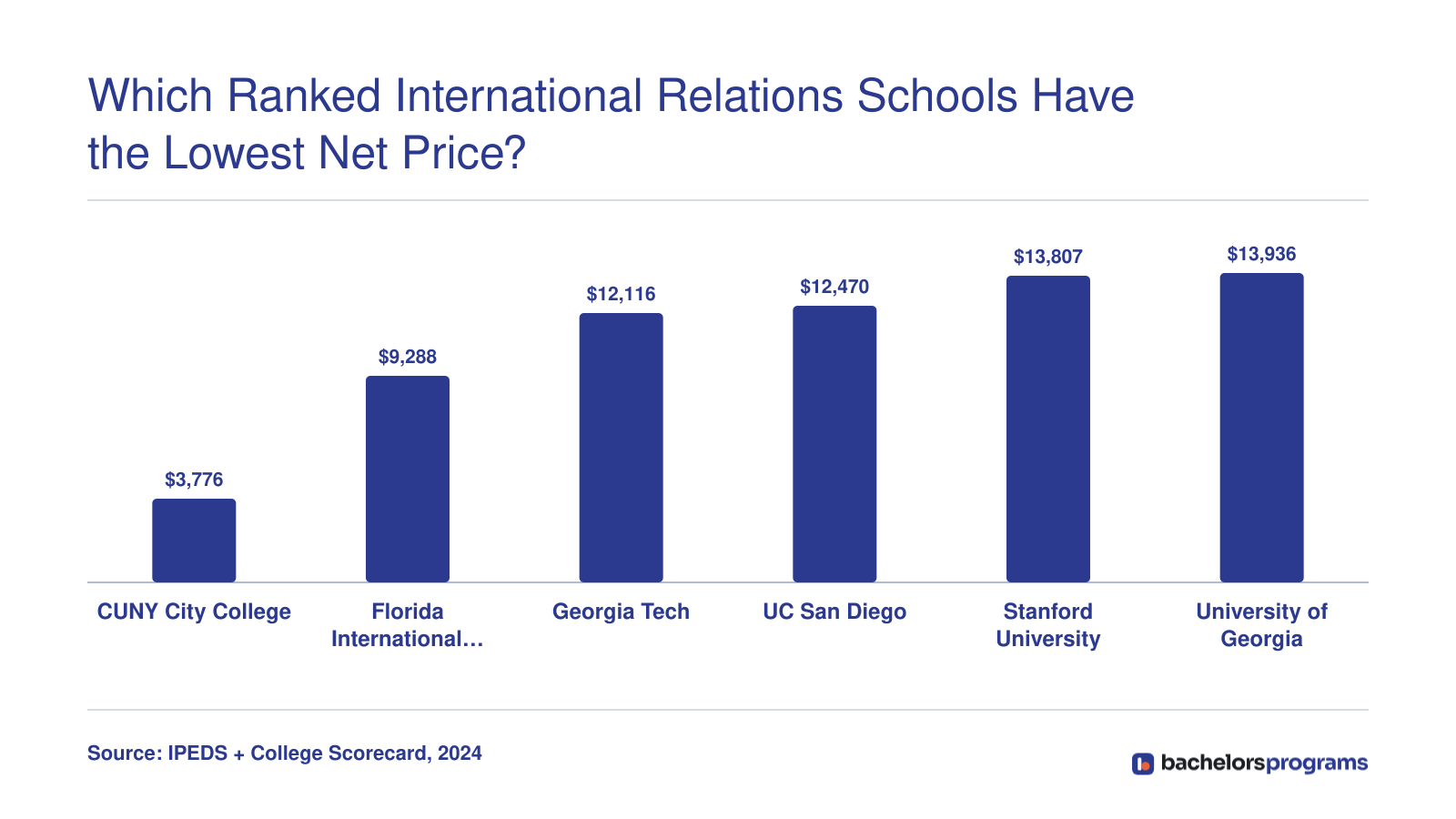
Which Ranked International Relations Schools Have the Lowest Net Price?
These figures show institution-wide average net price after grants and scholarships, not sticker price. Stanford, for example, lists $65,910 in tuition and fees, yet its average net price is $13,807. Among the lowest-cost schools ranked here, net price runs from $3,776 at CUNY City College to $13,936 at the University of Georgia, a gap of $10,160 a year, and your own aid package may land well above or below these averages.
Earnings, Debt, and Return on Investment by School
Which international relations programs pay graduates the most, and is the debt manageable? Stanford University leads the list: its bachelor's completers report median earnings of $128,687 five years after finishing. The University of Chicago follows at $98,430 over the same window. Claremont McKenna College reports $96,520, measured four years after completion, so read that figure on its own shorter clock.
Earnings Further Down the List
Brigham Young University completers report $94,047 five years out, and the University of Pennsylvania reports $92,024. The University of Southern California ($87,675), Colgate University ($86,420), William & Mary ($81,921), Georgetown University ($80,731) and Tufts University ($80,548) all use the five-year window. Treat every figure as a median for that school's own IR graduates, not a guarantee for any one student.
Debt and Monthly Payments
Debt tells you how much of that paycheck you keep. Median federal debt at completion and the median monthly payment on a 10-year plan, where reported:
- Penn: $10,470 in debt, about $111 a month.
- USC: $13,247 in debt, about $140 a month.
- Tufts: $16,250 in debt, about $172 a month.
- Georgetown: $17,500 in debt, about $186 a month.
- William & Mary: $20,500 in debt, about $217 a month.
Penn pairs a $92,024 five-year median with the lowest monthly payment in that group, which makes for a favorable balance.
Employment and Return on Investment
Stanford reports about 96% of IR completers employed one year after finishing. William & Mary reports about 94%, Tufts about 94%, Georgetown about 93%, and Penn and USC about 90% each.
For a broader return-on-investment check, the ratio of an institution's 10-year earnings to its median debt is a rough proxy. It describes the whole school, not the IR major. Stanford's ratio is about 10.3, Claremont McKenna's about 7.8 and William & Mary's about 4.0. Use it to compare schools loosely, then lean on the program-level earnings and monthly payments above when budgeting.
Related Articles
International Relations vs. International Affairs, Political Science, and Public Policy
NCES files International Relations and International Affairs under the same federal code, CIP 45.0901,1 while Political Science and Government sits in a neighboring code, 45.1001. So a school's choice of label tells you less than its curriculum does. Four checks, run in order, will separate them.
Step 1: Start with BLS and O*NET
Open the Occupational Outlook Handbook at BLS.gov and look up political scientists, policy analysts, and related roles. Then search O*NET for international affairs specialist titles. BLS often does not separate international relations from international affairs or public policy, so expect overlapping occupations rather than one clean career path per major.
Step 2: Compare programs directly
On each school's website and on College Scorecard, check:
- Department name: International relations, international affairs, political science, or public policy.
- Curriculum: Required theory, regional, language, methods, and economics courses.
- Faculty and employers: Faculty specialties, internship placements, and employer lists.
- Outcomes: Completion data and median earnings by field, where College Scorecard reports them.
Step 3: Consult professional associations
Check APSA for political science, ISA for international studies, NASPAA for public affairs and administration, and APPAM for public policy. Look for definitions, career resources, member surveys, job boards, competency frameworks, and salary reports. Employer associations in fields you want, such as government contracting, nonprofits, or trade, can show what hiring managers value.
Step 4: Verify before you decide
Triangulate four sources: BLS and O*NET data, school and College Scorecard information, association reports, and current job postings. Treat any claim about employer perception skeptically unless it names a study or survey. If public comparisons are missing, email the department or career center and ask for recent graduate outcomes, employer names, and internship placement rates.
Questions to Ask Yourself
Are you aiming for security or intelligence work that will require a clearance, and does the program offer a security concentration and Washington, D.C. access?
Can you afford a semester abroad, or will the program help fund it if language immersion is expected?
Would a political science major with an international relations concentration keep more doors open than a standalone B.A. in International Relations?
Is staying an extra year for a 4+1 master's at the same school a better deal than applying elsewhere later?
International Relations programs by state
International Relations Degree FAQ
These answers cover the questions prospective majors ask most often. Costs and earnings vary by school, so check each program's own figures before you apply.
Is a bachelor's degree in international relations worth it?
How much does an international relations degree cost?
Can you join the Foreign Service with only a bachelor's degree in international relations?
Do you need to be fluent in a second language to major in international relations?
Compare International Relations programs on the data that matters
Explore more Liberal Arts & Humanities majors or browse every field of study.
All Liberal Arts & Humanities programs Browse every field of study