Best Online International Relations Degree Programs
Compare 16 accredited online International Relations programs, with net price after aid, graduation rates, earnings and debt from IPEDS and the U.S. College Scorecard.

Diplomacy now runs on encrypted video calls, and the degree that trains for it still assumes a seminar room. Most are Bachelor of Arts degrees of about 120 credits, and a growing share of the coursework can be finished without leaving a job or a military posting. Every program ranked here runs 100% online; hybrid formats were excluded, so no campus residency is required. What separates these programs is cost and credit policy, not geography.
Key Points
- Most online international relations bachelor's programs require 120 credits, about four years.
- Between 47% and 87% of undergraduates at these schools receive Pell Grants.
- The highest international relations salaries typically require a graduate degree.
The 10 Best 100% Online International Relations Bachelor's Programs
Every program below is a bachelor's degree in international relations or a closely related global field built for fully online delivery, with no required campus residency for online students and hybrid formats left off the list. Entries are ordered by a mixed quality composite rather than any single measure, and where a school's 100% online status could not be confirmed from its own materials, the card says so. The net price on each card is the institution-wide average after aid, and the graduation rate is the school's overall graduation rate, not a program rate.
Florida International University
#1Miami, FL · ~$9,000/yr (est.)
Best for: Florida transfers seeking fully online coursework
Florida International University delivers its international relations bachelor's through the Steven J. Green School of International and Public Affairs. The curriculum is interdisciplinary, pairing international relations theory with economics and history, and it is aimed at foreign service, trade, and law pathways. Florida associate degree graduates enter as juniors under the state articulation agreement.
- 120-credit, four-year program in the Green School of International and Public Affairs
- Interdisciplinary coursework in international relations theory, institutions and processes
- Prepares students for foreign service, international trade and international law
- Also designed as preparation for graduate study
- Florida associate degree holders enter as juniors under state articulation
American Public University System
#2Charles Town, WV · $5,000 – $10,000/yr (est.)
Best for: Military learners balancing service and coursework
American Public University System, which includes American Military University, is built entirely around distance education and prices tuition per credit rather than by residency. The international relations degree carries five concentrations, monthly start dates, and room for up to 90 transfer credits. Military and working-adult students are the core audience.
- 120 credits, including 18 semester hours of major-required coursework
- Five 24-credit concentrations, from Middle Eastern Studies to Peacekeeping
- $360 per credit, with a $250 per-credit military rate
- Monthly starts in 8- and 16-week course sessions
- Up to 90 transfer credits accepted
- Senior seminar capstone taken after 106 credit hours
- No application fee and no entrance exams
Old Dominion University
#3Norfolk, VA · $13,000 – $34,000/yr (est.)
Old Dominion University lets students major in international affairs and global politics through either a Bachelor of Arts or a Bachelor of Science, so language-heavy and data-heavy plans both work. Online students enroll through ODUGlobal. Active-duty service members pay a reduced per-credit rate, and Virginia residents pay far less than non-residents.
- B.A. and B.S. tracks share 36 credit hours in political science
- B.A. adds foreign language through the intermediate level
- B.S. builds quantitative and data analysis skills
- Online option available through ODUGlobal
- Active-duty military tuition rate offered
- $281 per credit for Virginia residents, $972 for non-residents
- Emphasis area: international relations and comparative politics
Commonwealth University of Pennsylvania
#4Bloomsburg, PA · ~$16,000/yr (est.)
Commonwealth University of Pennsylvania offers an international affairs concentration inside its political science major at the Bloomsburg, Lock Haven, and Mansfield campuses. The concentration requires an internship, study abroad experience, or thesis, and classes run 15 to 40 students. Available materials describe face-to-face, online, and hybrid delivery but do not confirm the full major can be finished 100% online.
- Concentration in international affairs within the political science major
- Courses include US Foreign Policy and Global Issues
- Requires an internship, study abroad experience, or thesis
- Classes of 15 to 40 students
- Delivered face-to-face, online, or hybrid across three campuses
- 3+3 law agreements with Pitt, Duquesne and Widener
- Internships available in Washington D.C. and Harrisburg
Central Michigan University
#5Mount Pleasant, MI · $18,000/yr (est. net price)
Central Michigan University awards international relations as either a Bachelor of Arts or a Bachelor of Science on a 33-credit major, and students can study on campus or online. The department runs UN simulation delegations, study abroad across seven countries, and Boren Scholarship support. Graduates have worked with UN operations in South Sudan and at the U.S. Embassy in Abu Dhabi.
- 33 credit hours in the major
- Offered on campus or online
- Coursework on human rights, climate change and global security
- Students compete in UN simulations against international peers
- Study abroad in seven countries, including Japan, South Africa and Chile
- Boren Scholarship and Fellowship support
- Rolling admissions with December 1 scholarship priority
Arizona State University
#6Scottsdale, AZ
Arizona State University offers the international relations bachelor's through ASU Online, with three elective tracks and a required second-language sequence. A career requirement can be met by an internship, a career development course, or the Washington DC Apprenticeship, and online students take ASU 101-LA, an online orientation course. ASU runs multiple online enrollment sessions each year.
- 120 credits, with at least 45 upper-division hours
- Three elective tracks, including Intelligence, Diplomacy and Security
- 16 credits of a second language at the intermediate level
- Career requirement met by internship, career course, or DC apprenticeship
- Online students take ASU 101-LA, an online orientation course
- C minimum required in major coursework
- Multiple enrollment sessions each year for online students
University of Baltimore
#7Baltimore, MD · $10,000 – $24,000/yr (est.)
The University of Baltimore teaches international relations inside a policy, politics, and international affairs degree in its School of Public and International Affairs. Classes mix live Zoom sessions with asynchronous Canvas work, and an accelerated bachelor's-to-master's option double counts up to nine graduate credits. The university cautions that courses outside the major may not be online.
- 120 credits combining public policy, political theory and international relations
- Live Zoom sessions plus asynchronous Canvas coursework
- Some courses outside the major may not be online
- Transfer students need 30 college credits and a 2.0 GPA
- $35 application fee with rolling admissions
- Accelerated bachelor's-to-master's option double counts 9 graduate credits
- Law School Early Entry option available
Regent University
#8Virginia Beach, VA · ~$20,000/yr (est.)
Regent University offers international relations as a concentration inside its Bachelor of Arts in Government, taught from a Christian worldview. The degree runs online or on campus with four concentration options, and coursework covers terrorism, poverty, and human trafficking. Online students pay a flat per-credit rate and can start in January 2027.
- 120+ credit hours, online or on campus
- Online tuition is $415 per credit full time, $470 part time
- Next session begins January 11, 2027
- Coursework covers terrorism, poverty and human trafficking
- Taught from a Christian worldview
- Military benefits, financial aid and scholarships accepted
Bellevue University
#9Bellevue, NE · ~$18,000/yr (est.)
Bellevue University houses international relations as a sub-specialization inside its intelligence and security studies degree rather than as a standalone major. Students add two international relations electives to a security-studies core, and online classes are asynchronous. The degree is non-licensure and points toward homeland security, military, and law enforcement work.
- 127 credits: general education, 36 major credits and 54 electives
- Choose two international relations courses within the sub-specialization
- Asynchronous online classes with 24/7 tech support
- $459 per credit, $250 per credit for military students
- Kirkpatrick Signature Series required
- Non-licensure degree program
- Regional focus on Eurasia, Latin America and the Middle East
Pennsylvania State University
#10University Park, PA · ~$20,000/yr (est.)
Penn State World Campus delivers the university's international politics bachelor's at a distance, and the school describes the coursework as 100% online. Students choose from three concentrations and complete 123 credits. Entry to the major requires third-semester classification, so most students apply after finishing prerequisite coursework.
- 123 credits through Penn State World Campus
- Three concentrations, including International Relations and National Security Studies
- International Relations option requires 30 credits
- Entrance requires third-semester classification and a 2.00 GPA
- C or better required in all major courses
- Graduates have worked at the CIA, UN, UNICEF and the Red Cross
- Prepares students for law school and graduate study
Cost & outcomes by school
Federal data for the highest-earning International Relations programs, independent of the ranking above. Earnings are this field's bachelor's graduates four years after completing where the Scorecard reports them, else the school's undergraduate median.
| School | Net price / yr | Grad rate | Earnings | Debt | Grads/yr | Format |
|---|---|---|---|---|---|---|
| Pennsylvania State University PA | $32,875 | 86% | $71,001 | $24,375 | 97 | Online or campus |
| American Public University System WV | $9,597 | 57% | $65,510 | $14,947 | — | Online |
| Florida International University FL | $9,288 | 74% | $64,399 | $17,662 | 193 | Online or campus |
| Arizona State University AZ | $14,967 | 68% | $62,668 | $19,500 | 1 | Online or campus |
Sources: U.S. Department of Education. Net price, graduation rate, earnings and debt: College Scorecard (earnings and debt for this field's bachelor's graduates where reported, else school-wide); graduates: IPEDS. A dash means no figure is reported.
Cost, debt & payoff
Median earnings of this field's bachelor's graduates (4 yrs after completing, else the school's undergraduate median) vs. their median federal loan debt · U.S. College Scorecard
Across these programs the median graduate earns about $61,333 and finishes with roughly $23,000 in debt — a ratio that clears a common rule of thumb (keep debt below first-year salary). Net price and debt vary widely school to school, so check the per-school figures in the table above before you shortlist.
How We Ranked Online International Relations Programs
A campus program can coast on reputation; an online one has to prove it works at a distance. That is why hybrid programs are excluded here: any required travel or short residency undercuts the schedule that working adults and military students actually keep. A program must be entirely online to make the list.
The composite rests on four plain measures:
- Graduation rate: how many enrolled students finish their credential.
- Net price after aid: what a typical student actually pays once grants and scholarships are counted.
- Retention: how many first-year students come back for a second year.
- Earnings and debt: College Scorecard figures, used only where the government publishes them.
Two caveats matter. Graduation rate and net price are institution-wide, not program-specific. Program-level earnings appear only where enough graduates exist to report them reliably.
What a Bachelor's Degree in International Relations Covers Online
A bachelor's degree in international relations is a social science degree that studies how countries, international organizations, and non-state actors interact: trade, conflict, diplomacy, human rights, and development. Most online programs require 120 credits, about four years at a full-time pace. Arizona State and Florida International both set 120 credits; Penn State's international politics B.A. requires a minimum of 123. Transfer credit shortens that considerably, and some students with an associate degree or heavy prior credit finish in two to three years.
Coursework and concentrations
Expect a core built on comparative politics, international political economy, foreign policy, and research methods, then a concentration such as diplomacy, security studies, development, or human rights.
Language, internships, and format
Language requirements vary by program, so confirm the rule at each school. Penn State requires proficiency through the 12th-credit level in one language beyond English, though an exam can reduce or eliminate those credits1; ASU asks for two years of the same language at the high school level for admission. ASU also requires a global experience, internship, or professional development course, with placements at home, in Washington, D.C., or abroad, plus hundreds of global education options.
Asynchronous coursework suits working students; synchronous sessions suit those who want live discussion.
Related Articles
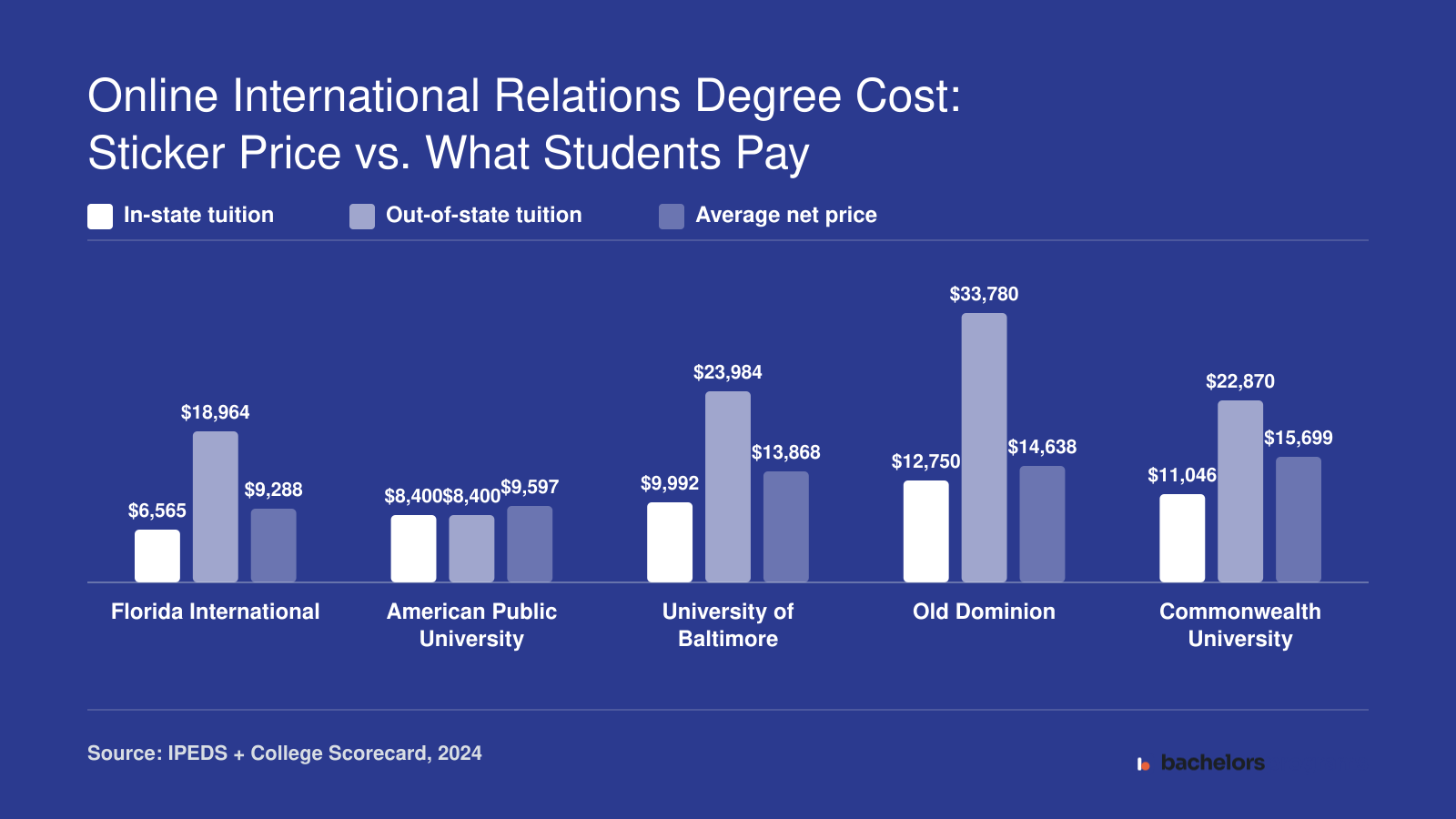
Online International Relations Degree Cost: Sticker Price vs. What Students Pay
Net price is each school's institution-wide average cost after grants and scholarships, not a quote for this degree, and 47% to 87% of undergraduates at these schools receive need-based Pell Grants. Out-of-state tuition may not apply to online students: American Public University System charges $8,400 regardless of residency, and some public universities set a flat online rate, so confirm your rate with the school before comparing. Military students can lower costs further, since Tuition Assistance pays up to $250 per credit and $4,500 per fiscal year (APUS offers a matching $250-per-credit military rate, and Old Dominion offers an active-duty rate), while the Post-9/11 GI Bill covers full in-state tuition at public schools and Yellow Ribbon adds funds only at participating institutions.
Accreditation, Transfer Credit, and Admissions
An accredited program that accepts generous transfer credit and admits most applicants is a different proposition from one that caps transfer hours and screens closely. The first is usually the safer bet.
Accreditation
Regional accreditation is the gatekeeper for federal student aid, credit transfer, and graduate admission. Arizona State, American Military University, and Methodist University each publish their regional accreditor (the Higher Learning Commission for the first two2, SACSCOC for Methodist1). Verify any other program through the U.S. Department of Education's DAPIP database or CHEA's directory before you apply.
Transfer Credit and Admission
Published maximums vary widely. Methodist accepts up to 93 transfer credits1; AMU up to 902; UTSA caps community college work at 66 credits and requires 30 credits in residence3. A published maximum never guarantees every credit applies to the major. Admission is rarely the hurdle: Florida International admits roughly 55% of applicants and Arizona State about 67%. ASU and Methodist both list international applicants as eligible, though Methodist asks non-native English speakers for a TOEFL of 61 iBT1. Fully online study does not qualify for an F-1 visa.
Career Outcomes and Earnings for International Relations Graduates
The top salaries in this field go to people with graduate degrees, while bachelor's graduates start lower. Knowing that gap helps you judge the payoff.
Program-level figures show the starting picture. Graduates of Penn State's International Politics B.A. earned a median of $71,001 four years after finishing. American Public University System graduates in International Relations and Global Security earned $65,510 at the same point, and Central Michigan graduates earned $61,331. Median debt was $24,375 at Penn State (about $258 a month), $14,947 at American Public University System ($158 a month), and $26,750 at Central Michigan ($284 a month).
Bureau of Labor Statistics data adds context. Political scientists earned a median of $142,080 in May 2025, but those roles typically require a master's degree. BLS projects a 2% decline for 2025-2035, with about 400 openings a year. Bachelor's holders more often enter related occupations:
- Market research analysts: $78,760 median, 7% projected growth.
- Public relations specialists: $74,750 median, 2% projected growth.1
Common employers include:
- Federal agencies and the Foreign Service
- Nonprofits and NGOs
- Defense contractors
- Companies with international operations
International Relations programs by state
Online International Relations Degree FAQs
How long does it take to earn an online international relations degree?
Is an online international relations degree worth it?
Can you get an international relations degree online for free or nearly free?
Do you need an international relations degree to join the U.S. Foreign Service?
Compare International Relations programs on the data that matters
Explore more Liberal Arts & Humanities majors or browse every field of study.
All Liberal Arts & Humanities programs Browse every field of study