Best Native American Studies Degree Programs
Compare 70+ accredited Native American Studies programs, with net price after aid, graduation rates, earnings and debt from IPEDS and the U.S. College Scorecard.

What does a bachelor's degree in Native American Studies actually cost? Across the schools on this list, average net price runs from $6,541 a year to $25,184, and the low end belongs to a public flagship in Florida, not a small private college. The spread rarely tracks sticker price. It tracks how heavily a state subsidizes its own residents, and whether the major sits in a free-standing Native studies department or a concentration inside a larger ethnic studies program. That structural choice decides your course requirements, your faculty, and how much of the degree you can shape around one community.
Key Points
- Net prices run from $6,541 (University of Florida) to $25,184 (Brown).
- Top-ranked programs are campus-based, while online options exist at other universities.
- Graduates often move into social and community service management roles.
Best Schools for a Bachelor's Degree in Native American Studies
Ten universities below offer a bachelor's degree in Native American studies, and each one structures the field differently: a free-standing department, a named concentration inside American studies or ethnic studies, or a comparative program that pairs Native studies with other ethnic studies work. Every card lists city and state, format, average net price after aid, institution-wide graduation rate, and admission rate so you can compare them side by side. All ten programs here are campus-based, and each entry describes what the curriculum actually requires.
University of Florida
#1Gainesville, FL · ~$7,000/yr (est.)
Best for: In-state students seeking a broad public research campus
The University of Florida runs one of the largest public research operations in the country in Gainesville, and its American Indian and Indigenous Studies program is a stand-alone major rather than a track buried inside another department. Coursework crosses anthropology, religion, Latin American studies, and history, and the program grew out of a student-led 500 Nations initiative. The school graduates 91% of students, and about two-thirds of undergraduates receive Pell Grants, which makes it an unusually accessible flagship for this field.
- Interdisciplinary major crossing anthropology, religion, and history
- Also offered as a minor, with a master's degree option
- Focus on Indigenous peoples of the Western Hemisphere
- Examines political, social, and religious structures from Indigenous perspectives
- Program started through a student-led 500 Nations initiative
- Prepares students for graduate study in the field
- Routes to American Indian education and community service careers
University of North Carolina at Chapel Hill
#2Chapel Hill, NC · ~$12,000/yr (est.)
Best for: Students wanting federal Indian law coursework
The University of North Carolina at Chapel Hill places its Native studies work inside the American Studies department, so students graduate with a B.A. in American Studies and a named American Indian and Indigenous Studies concentration on the transcript. The 27-credit sequence opens with a foundational course on the cultures and histories of Native North America and runs through federal Indian law, Indigenous literatures, and archaeology. The school graduates 91% of students, and just over half of undergraduates receive Pell Grants.
- 27 credit hours across nine courses
- Begins with AMST/HIST 110 on Native North American cultures and histories
- Eight electives, at least four numbered 200 or higher
- 2.0 GPA required overall and in the major core
- Two-semester honors thesis option for seniors
- Approved internships and selected study abroad earn credit
- Julia Preston Brumley Travel Scholarship funds study abroad
- At least half the major core must be taken at UNC-Chapel Hill
University of Chicago
#3Chicago, IL · ~$15,000/yr (est.)
Best for: Interdisciplinary humanities students exploring race and ethnicity
The University of Chicago folds Native American Studies into Comparative Race and Ethnic Studies, a Bachelor of Arts major with five specializations and a matching minor. Students complete the comparative core and then concentrate in Native American Studies, which puts the field in conversation with African American, Latina/o, Asian American, and Africa-focused scholarship. The school graduates 96% of students.
- Native American Studies is one of five specializations in the major
- Other tracks include African American Studies and Asian American Studies
- Also available as a minor
- Comparative core pairs race and ethnic studies across groups
Stanford University
#4Stanford, CA · $10,000 – $15,000/yr (est.)
Stanford offers a full Bachelor of Arts in Native American Studies through its Interdepartmental Program in Comparative Studies in Race and Ethnicity, and the major draws on courses from more than 17 departments. A Community-Engaged Learning requirement and an optional honors thesis push students into research and community work, and the university's Special Languages Program supports study of Diné, Lakota, Nahuatl, Quechua, and other Indigenous languages. The school graduates 92% of students.
- 60 units in the major, inside a 180-unit university minimum
- Core curriculum plus two comparative courses and a methodology course
- Methodology courses carry 3 to 5 units and a letter grade
- Up to 8 units may come from related ethnic studies departments
- Up to 5 units of Native language study may count toward the major
- Community-Engaged Learning met by a Cardinal Course or fellowship
- Writing in the Major capstone taken in person in the final autumn
- Optional honors requires a 3.7 major GPA and 3.5 overall
University of California-Berkeley
#5Berkeley, CA · ~$13,000/yr (est.)
UC Berkeley's Native American Studies B.A. sits in the Department of Ethnic Studies and covers the history, cultures, and contemporary situations of Native peoples in the United States, along with the legal and social institutions that shape Native life. Students can pursue field work and community-directed study, and the honors track adds a six-unit research project supervised by the department. The school graduates 93% of students, and about seven in ten undergraduates receive Pell Grants.
- B.A. housed in the Department of Ethnic Studies
- Covers Native American history, culture, and contemporary situations
- Examines legal and social institutions affecting Native American life
- Field work and community-directed study available
- Honors track requires a 3.5 GPA overall and in the major
- Honors project is 6 units across NATAMST H195A and H195B
- Honors admission approved by the Ethnic Studies Department Honors Committee
University of California-Los Angeles
#6Los Angeles, CA · $13,000/yr (est. net price)
UCLA awards a Bachelor of Arts in American Indian Studies, listed in the 2026 General Catalog, and the program is anchored by the campus American Indian Studies Center. The center is adding a Native American and Indigenous Student Success Center that will offer academic support, peer mentoring, cultural programming, and wellness resources for Native students. The school graduates 93% of students, and roughly seven in ten undergraduates receive Pell Grants.
- Bachelor of Arts in American Indian Studies, listed in the 2026 General Catalog
- Anchored by the campus American Indian Studies Center
- Native American and Indigenous Student Success Center in development
- Success center offers academic support, peer mentoring, and wellness resources
- Center grew from work by Native students, faculty, and staff
- Ties to the Native American and Pacific Islander Bruins Rising Initiative
Columbia University in the City of New York
#7New York, NY · ~$22,000/yr (est.)
Columbia University's Ethnicity and Race Studies major carries a Native American Studies and Indigenous Studies specialization, delivered through the Center for the Study of Ethnicity and Race in New York. The 27-point major pairs three required core courses with electives in the specialization, and language study beyond the intermediate level is encouraged even though it is not required. The school graduates 96% of students.
- 27 points minimum in the major
- Core courses include Introduction to Comparative Ethnic Studies
- Second core: Colonization/Decolonization or Race and Racisms
- Third core course: Modes of Inquiry, four points
- Five areas of specialization, including Native American Studies/Indigenous Studies
- Five electives outside honors, including one writing-intensive seminar
- Honors students complete four electives instead of five
- Language study beyond the intermediate level recommended, not required
University of California-Davis
#8Davis, CA · $10,000 – $15,000/yr (est.)
UC Davis runs a free-standing Native American Studies department in the College of Letters and Science, and it also offers master's and doctoral work in the field. Undergraduates choose a plan for North America, Meso-America, or South America, and the degree builds in experiential learning plus a quarter or more of study away from campus. The school graduates 86% of students, and about seven in ten undergraduates receive Pell Grants.
- Three plans: North America, Meso-America, or South America
- 48 to 68 total units, with a 48-unit minimum
- Includes 20 upper division units and 4 units of language
- 4 units of hemispheric perspectives plus 4 to 12 experiential learning units
- One to three quarters of study away or near a reservation
- Off-campus study can supply 12 to 20 of the 28 emphasis units
- Supervised internships connect to the annual UC Davis Powwow
- Covers indigenous cultures of North, Central, and South America
University of Washington-Seattle Campus
#9Seattle, WA · ~$14,000/yr (est.)
The University of Washington's Department of American Indian Studies awards a Bachelor of Arts and works closely with Native communities around Seattle. Students can join research collaborations and internships, and the department's Center for American Indian and Indigenous Studies hosts programming on sovereignty and wellness. About 500 Native students attend the university, and the school graduates 85% of students.
- Bachelor of Arts from the Department of American Indian Studies
- Decolonized, community-based, global perspective on Native history and culture
- Research collaborations and internships with the local Native community
- Center for American Indian and Indigenous Studies hosts sovereignty and wellness work
- Minors in American Indian Studies and Oceania and Pacific Islander Studies
- About 500 Native students attend the university
- Listed roles: policy analyst, community organizer, legislative aide, attorney
Brown University
#10Providence, RI · $25,000 – $30,000/yr (est.)
Brown University offers an A.B. in Critical Native American and Indigenous Studies as an interdisciplinary concentration inside the Department of American Studies. The concentration spans four breadth areas and extends beyond U.S. borders to the Americas and Oceania, closing with a capstone. The school graduates 96% of students.
- Interdisciplinary concentration inside the Department of American Studies
- Four breadth areas include Creative Expressions and Systems of Knowledge and Belief
- Foundational and capstone courses required
- Scope extends beyond U.S. borders to the Americas and Oceania
- Covers decolonial practice, sovereignty, land dispossession, and environmental justice
- Faculty work includes the Stolen Relations digital humanities project
Cost & outcomes by school
Federal data for the highest-earning Native American Studies programs, independent of the ranking above. Earnings are this field's bachelor's graduates four years after completing where the Scorecard reports them, else the school's undergraduate median.
| School | Net price / yr | Grad rate | Earnings | Debt | Grads/yr | Format |
|---|---|---|---|---|---|---|
| Dartmouth College NH | $29,519 | 96% | $97,434 | $15,157 | 26 | Campus |
| Brown University RI | $25,184 | 96% | $93,487 | $11,428 | 15 | Campus |
| University of Chicago IL | $14,860 | 96% | $91,885 | $15,000 | 22 | Campus |
| Colgate University NY | $28,786 | 91% | $85,139 | $15,000 | 7 | Campus |
| Boston University MA | $24,402 | 89% | $83,238 | $23,250 | 8 | Campus |
| Saint Mary's College of California CA | $30,378 | 70% | $78,812 | $23,691 | 3 | Campus |
| Vassar College NY | $39,343 | 91% | $71,366 | $18,625 | 8 | Campus |
| University at Buffalo NY | $20,995 | 75% | $70,814 | $15,750 | 6 | Campus |
| University of Colorado Boulder CO | $25,346 | 74% | $69,738 | $19,500 | 34 | Campus |
| Whitman College WA | $33,313 | 81% | $67,589 | $18,437 | 7 | Campus |
| University of California-Berkeley CA | $13,481 | 93% | $67,291 | $15,076 | 114 | Campus |
| University of Utah UT | $16,200 | 65% | $67,170 | $19,000 | 29 | Campus |
Sources: U.S. Department of Education. Net price, graduation rate, earnings and debt: College Scorecard (earnings and debt for this field's bachelor's graduates where reported, else school-wide); graduates: IPEDS. A dash means no figure is reported.
Cost, debt & payoff
Median earnings of this field's bachelor's graduates (4 yrs after completing, else the school's undergraduate median) vs. their median federal loan debt · U.S. College Scorecard
Across these programs the median graduate earns about $54,186 and finishes with roughly $19,500 in debt — a ratio that clears a common rule of thumb (keep debt below first-year salary). Net price and debt vary widely school to school, so check the per-school figures in the table above before you shortlist.
How We Ranked These Native American Studies Schools
Average net price ranges from $6,541 at the University of Florida to $25,184 at Brown University, so cost carried the most weight in the order. Net price reflects what a student actually pays once grants and scholarships are applied, a better guide than the published sticker price.
What We Looked At
The schools offer a bachelor's-level Native American, American Indian, or Indigenous Studies program, and all delivery formats were eligible. Four inputs shaped the order:
- Affordability: Average net price, using the figure for each school's public or private sector.
- Graduation and retention: How many students finish their degree, and how many come back for a second year.
- Earnings and debt: Program-level figures from College Scorecard, where they are published.
- Delivery format: Whether the program is on campus, online, or hybrid.
Where the Numbers Fall Short
The graduation and retention figures cover the entire institution, not the Native American Studies major. A school with a 96% graduation rate is not necessarily graduating 96% of its majors.
A few small programs, including Brown's and Chicago's, publish no earnings or debt figures at all. We left those figures blank rather than estimate them. Net price is also an average. What you actually pay hinges on family income, residency, and any tribal or institutional aid you qualify for.
What the Ranking Cannot Measure
The data cannot capture the presence of Indigenous faculty, the strength of ties to tribal nations, or whether a program teaches from Indigenous perspectives. For many students those factors matter as much as cost or earnings. Use the ranking to build a shortlist, then compare programs on those points with the checklist below.
Can You Earn a Native American Studies Degree Online?
Mostly no, at least among the top-ranked schools. Nearly every school in the ranking above lists its bachelor's program as campus-based, though Arizona State, which appears in the ranking, also runs a fully online version. Other online options do exist, but they sit at universities outside this list.
Online and Hybrid Bachelor's Options
Three programs are clearly described as online in 2026:
- Arizona State University: The Bachelor of Science in American Indian Studies is a 120-credit degree delivered entirely through ASU Online, with multiple start dates each year.
- East Central University (Oklahoma): The Bachelor of Arts in Native American Studies is also 120 credits and fully online. Courses run in 8-week terms, and the school estimates two to four years to finish. It includes a real-world internship and partnerships with the Choctaw and Chickasaw nations.
- University of New Mexico: The online Bachelor of Arts in Native American Studies centers on a Leadership and Building Native Nations concentration. Courses meet in an accelerated 8-week format. It is built for transfer students with an associate degree or roughly 60 to 70 transferable credits.
South Dakota State University also appears in a distance-learning listing for its Bachelor of Arts in American Indian & Indigenous Studies. Confirm the current format with the school before you plan around it. Portland State offers only its minor online,1 and the University of North Dakota's program is on campus.2
Why Most Programs Stay Place-Based
The field depends on relationships that are hard to replicate on a screen. Community-engaged coursework puts students in local Native communities. Language instruction works best with fluent speakers, who are often community members rather than faculty. Tribal internships and fieldwork add to the on-the-ground requirements. Stanford, for instance, builds community-engaged learning into its major, and UC Davis counts off-campus study toward the degree.
A Practical Tip for Online Seekers
Before you apply, ask admissions two questions. Does the degree require any on-site residency, internship hours, or fieldwork? Are any language or capstone courses taught live at set times? The published program pages for the online options above do not settle these points, so get the answers in writing. They affect your schedule and your total cost.
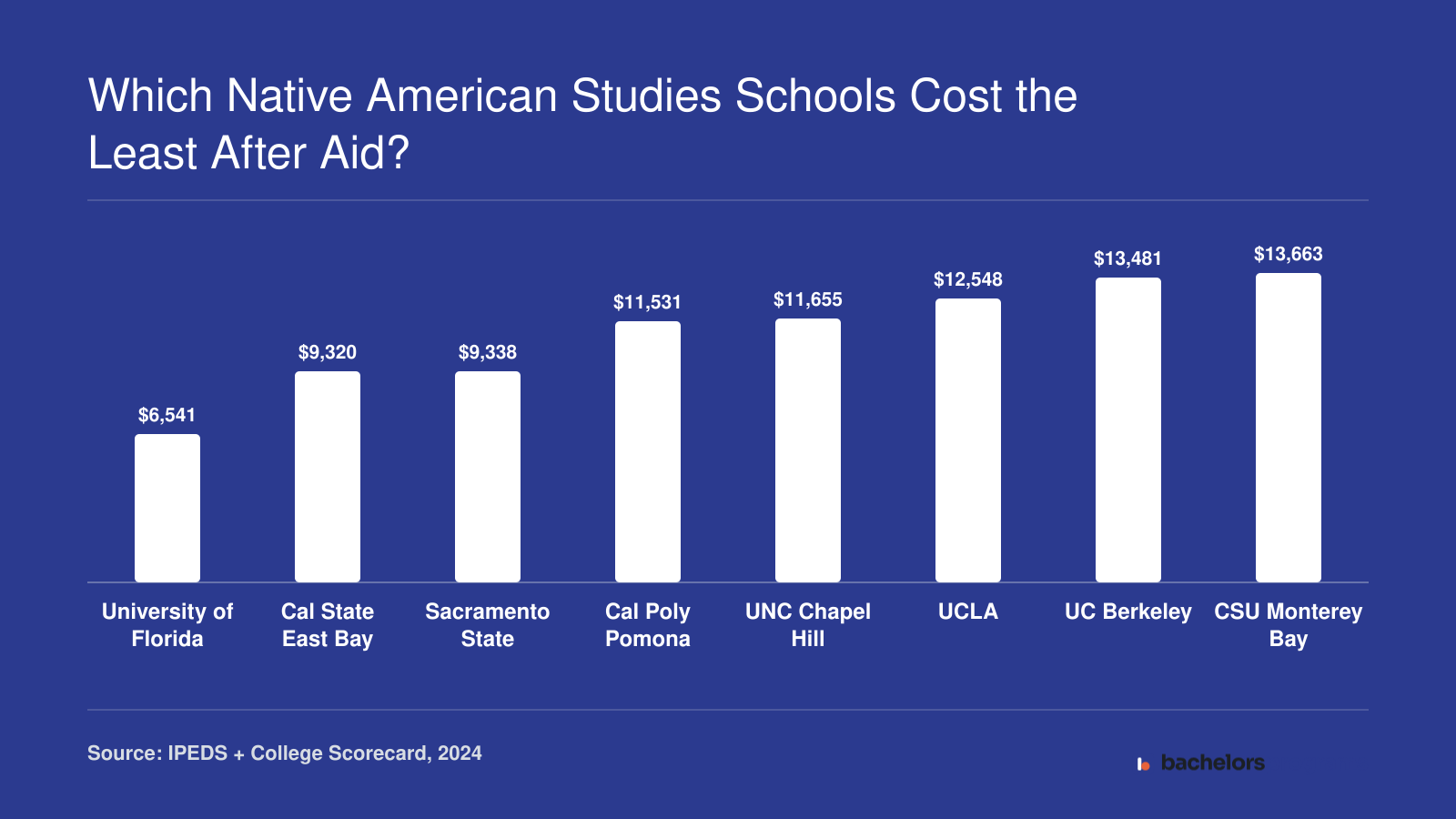
Which Native American Studies Schools Cost the Least After Aid?
Every school in this chart is a public university, which is why net prices stay between $6,541 and $13,663 a year. Private colleges usually start from a much higher sticker price, so even generous grants often leave their net price above what public schools charge in-state students. Net price is an institution-wide average of what students actually pay after grants and scholarships, not the published tuition and not a figure specific to the Native American studies major.
Native American Studies Degree Cost, Tribal Tuition Waivers, and Financial Aid
Sticker price tells you little about what a Native American studies degree actually costs, because the public universities that offer these programs discount heavily for the students they enroll.
Published Tuition Versus What Students Pay
At California State University-Sacramento, in-state tuition and fees run $8,018 against $20,618 for out-of-state students, yet the average net price after grant aid lands at $9,338. University of California-Davis publishes $16,774 in-state and $50,974 out-of-state, but averages $14,741 net. University of Florida shows the widest gap of all: $6,381 in-state, $28,659 out-of-state, and an average net price of $6,541. Out-of-state figures rarely reflect what students in these programs are billed once aid is applied.
Pell enrollment signals how many lower-income students a campus serves. Sacramento State enrolls the largest Pell share among the schools here at roughly 81 percent, followed by UC Riverside near 79 percent and Cal Poly Pomona around 78 percent. Even the most selective options, UCLA and UC Berkeley, sit near 70 percent.
Tribal Tuition Waivers and Grants
The University of Arizona's Arizona Native Scholars Grant covers tuition, mandatory fees, and the college fee for up to eight consecutive semesters.1 Eligibility requires Arizona residency, pursuit of a first bachelor's degree, and verified enrollment in one of 22 federally recognized Arizona tribes with reservation land in the state.1 Arizona also offers the Nancy Benjamin Kwoh Scholarship for full-time American Indian Studies majors with at least a 2.0 GPA and demonstrated need.1
National Scholarships for Native Students
- American Indian College Fund: Open to members or descendants of federally or state-recognized tribes with a 2.00 GPA and full-time enrollment. Awards typically run from $2,000 to $3,000.2 Applications open February 1 with a May 31 priority deadline.3
- Cobell Scholarship: Up to $5,000 for new recipients and $8,000 for returning recipients in 2026-2027, covering tuition, fees, textbooks, and living expenses at public and private nonprofit schools. No minimum GPA, though 3.25 is competitive. The cycle opens December 15 and closes March 31.
File the FAFSA regardless, and contact your tribe's higher education office directly, as many nations administer their own grants on separate deadlines.
Related Articles
What Graduates Earn: Program Outcomes by School
These figures come from the U.S. Department of Education's College Scorecard, which groups each school's Native American studies graduates with its other ethnic, cultural, and gender studies bachelor's graduates. At every school below, median federal debt stays under half of median earnings, and estimated 10-year payments run from $133 a month at the University of Washington to $241 at the University of Florida, while the University of Florida and UC Riverside carry the heaviest debt relative to pay and UCLA and UW-Seattle pair top earnings with some of the lightest borrowing. These programs graduate small classes, so a handful of students can swing the medians, and Cal State East Bay and Columbia report earnings only four years after finishing rather than five, so read those rows with care.
| School | Location | Median Earnings | Earnings Window | Median Federal Debt | 10-Year Monthly Payment |
|---|---|---|---|---|---|
| University of California-Los Angeles | Los Angeles, CA | $61,195 | Five years after finishing | $14,820 | $157 |
| University of California-Berkeley | Berkeley, CA | $60,614 | Five years after finishing | $15,076 | $160 |
| University of Washington-Seattle Campus | Seattle, WA | $57,840 | Five years after finishing | $12,551 | $133 |
| California State University-East Bay | Hayward, CA | $57,145 | Four years after finishing | $13,884 | $147 |
| University of California-Davis | Davis, CA | $56,498 | Five years after finishing | $14,000 | $148 |
| Columbia University in the City of New York | New York, NY | $55,472 | Four years after finishing | $19,500 | $207 |
| California State Polytechnic University-Pomona | Pomona, CA | $53,756 | Five years after finishing | $14,936 | $158 |
| University of California-Riverside | Riverside, CA | $53,291 | Five years after finishing | $22,305 | $236 |
| California State University-Sacramento | Sacramento, CA | $52,252 | Five years after finishing | $15,000 | $159 |
| University of Florida | Gainesville, FL | $52,141 | Five years after finishing | $22,692 | $241 |
A Common Career Path for Native American Studies Majors
Many Native American Studies graduates move into community-focused leadership roles, and social and community service management is one of the most common paths.
How to Choose a Native American Studies Program
Use this checklist to compare schools on the factors that shape your degree, your connection to Native communities, and what you will actually pay.
- AccreditationNative American Studies has no separate programmatic accreditor, so the school's institutional accreditation is what matters. Confirm that a U.S. Department of Education-recognized accreditor has approved the school for bachelor's degrees. Tribal colleges meet the same standard. According to AIHEC's 2026 directory, 35 of 37 tribal colleges and universities are accredited, mainly by the Higher Learning Commission or the Northwest Commission on Colleges and Universities, and two are still developing.
- Indigenous facultyCheck faculty pages to see how many core instructors are Native scholars and whether they teach required courses.
- Tribal partnerships and internshipsAsk whether the department has formal agreements with tribal nations that lead to internships, research, or community-based projects.
- Language accessFind out which Indigenous languages are taught and for how many semesters. A one-year sequence and a multi-year path build very different skills.
- Native student supportLook for a dedicated Native student center, culturally focused housing, or peer and faculty mentoring.
- Location and formatWeigh how close the campus is to your home community. Also consider whether an online option would let you stay near family and tribal obligations.
- Cost after waiversEstimate the net price after tribal tuition waivers, tribal scholarships, and federal aid apply, because eligibility rules vary by school and state.
Native American Studies programs by state
Native American Studies Degree FAQs
How long does it take to earn a bachelor's degree in Native American Studies?
What is the best school for Native American Studies?
Do you have to be Native American to major in Native American Studies?
Can a Native American Studies degree prepare you for law school or a tribal law career?
Compare Native American Studies programs on the data that matters
Explore more Liberal Arts & Humanities majors or browse every field of study.
All Liberal Arts & Humanities programs Browse every field of study