Best Natural Resources Degree Programs
Compare 480+ accredited Natural Resources programs at 410+ colleges, with net price after aid, graduation rates, earnings and debt from IPEDS and the U.S. College Scorecard.

Which natural resources programs actually pay off after graduation? Net price at the schools ranked here runs from about $6,500 to nearly $24,000 a year, a spread that changes what four years cost.
A bachelor's degree in natural resources, usually a B.S., trains the people who manage forests, wildlife, water, and public lands. Every program ranked here is campus-based, and most require a capstone, senior project, or practicum. Online options exist but handle fieldwork differently.
Fieldwork and federal hiring rules pull against each other: agencies screen applicants on specific course counts, so the transcript matters as much as the diploma.
Key Points
- UC Berkeley's natural resources graduates post the highest program-level earnings here.
- Foresters earned a $76,400 median in May 2025; conservation scientists, $73,010.
- UNC-Chapel Hill runs about $8,994 in state versus $41,203 out of state.
Top 10 Schools for a Bachelor's Degree in Natural Resources
The ten programs below share a few traits: every one is a campus-based bachelor's degree, and most require a capstone, senior project or practicum before graduation. What they cover varies widely, from conservation biology and forestry to water management, GIS and environmental policy. Each card shows the average net price after aid, the institution-wide graduation rate and the program details that set these schools apart for natural resources study.
University of California-Los Angeles
#1Los Angeles, CA · $13,000/yr (est. net price)
Best for: Conservation biology hopefuls wanting field stations
UCLA's environmental science degree sits inside one of the country's most selective public universities and draws on six campus departments plus two field stations in the Santa Monica Mountains and the White Mountains. Concentrations are printed on the diploma, and a yearlong senior practicum puts student teams to work with nonprofits, agencies and businesses. The university reports that about 80% of graduates enter environmental professions, and the median graduate of the program earned $31,944 one year after finishing.
- Conservation Biology concentration is printed on the diploma
- Yearlong senior practicum with nonprofits, agencies and businesses
- Field stations at Stunt Ranch and the White Mountain Research Center
- Colloquium lectures and symposiums earn academic credit
- Seven concentration options across six partner departments
- About 80% of graduates enter environmental professions
Georgia Institute of Technology
#2Atlanta, GA · ~$12,000/yr (est.)
Best for: Research-minded students with strong science backgrounds
Georgia Tech pairs a small, science-heavy environmental science degree with the research capacity of a major engineering university. The major is jointly run by the School of Earth and Atmospheric Sciences and the School of Biological Sciences, and every student completes a capstone research project. Students who want to keep going can use an accelerated BS/MS route in Earth and atmospheric sciences.
- Jointly offered by Earth and Atmospheric Sciences and Biological Sciences
- Capstone research project required of every student
- Upper-level electives build a focused career pathway
- Accelerated BS/MS option through Earth and Atmospheric Sciences
- Faculty expertise in climate science, marine science and environmental policy
University of North Carolina at Chapel Hill
#3Chapel Hill, NC · ~$12,000/yr (est.)
Best for: Field-course learners who want coastal sites
UNC-Chapel Hill runs environmental studies through a cross-department program with permanent field sites in the North Carolina mountains, on the Outer Banks and at the coast, plus study abroad in Thailand and the Galapagos. Students build a skills base in GIS, remote sensing or statistics before choosing a concentration, and an honors thesis is available. The median graduate of the program earned $33,976 one year after finishing.
- Four concentrations plus a separate Sustainability Track
- Skills coursework in GIS, remote sensing or statistics
- Field sites in the NC mountains, at the coast and on the Outer Banks
- Honors research and thesis through ENEC 693H and 694H
- Dual bachelor's to master's in as few as five years
- Capstone course in ENEC 698 required
Yale University
#4New Haven, CT · ~$24,000/yr (est.)
Yale's environmental studies major spans the humanities, social sciences and natural sciences and awards either a B.A. or a B.S. depending on how deep a student goes in quantitative and lab work. The B.S. ends in a two-term senior research project, while the B.A. ends in a one-term essay. Nine concentrations, including a design-your-own option, let students aim at conservation, policy or sustainability work.
- Sustainability and Natural Resources concentration runs six courses
- B.S. track ends in a two-term senior research project
- B.A. track ends in a one-term senior essay
- Nine concentration options, including a design-your-own path
- Summer Environmental Fellowship open to majors
- Declare the major by junior year
University of California-San Diego
#5La Jolla, CA · $10,000 – $15,000/yr (est.)
UC San Diego's environmental systems degree is built for students who want the science side of natural resources, with lower-division prerequisites in biology, chemistry, physics, math and economics before upper-division work. The Ecology, Behavior, and Evolution track awards the B.S. and finishes with a three-quarter senior internship project and seminar. A separate environmental policy track leads to a B.A. for students aiming at regulation and planning.
- Ecology, Behavior, and Evolution track awards the B.S.
- Three-quarter Senior Internship Project and Seminar
- Five upper-division electives, at least one with a lab
- Environmental Policy track leads to a B.A. instead
- Prerequisites in biology, chemistry, physics, math and economics
University of Florida
#6Gainesville, FL · ~$7,000/yr (est.)
The University of Florida houses natural resource conservation inside its forestry school, and the degree is organized around nine required content areas plus a large block of advisor-approved upper-division credits. Students finish a capstone, pass a five-part competency exam and use a summer for professional work experience. The major is also taught at the university's Milton research and education center in the Panhandle, and the median graduate earned $34,454 one year after finishing.
- 120 credits across nine core content areas
- Capstone course in Natural Resource Conservation required
- Curriculum plan approved before 70 credits
- Five-part forest resources and conservation competency exam
- Also taught at the West Florida Research and Education Center in Milton
- Summer reserved for professional work experience
University of California-Berkeley
#7Berkeley, CA · ~$13,000/yr (est.)
Berkeley's Rausser College of Natural Resources gives undergraduates unusual room to shape the degree: a self-designed conservation and resource studies major sits alongside a forestry program with wildlife biology, fire science and GIS emphases. Honors students with a 3.6 GPA or higher can take on a faculty-sponsored research project. The college sits inside one of the strongest public research universities in the country, with coursework reaching into environmental justice, policy and ecological restoration.
- Self-designed interdisciplinary major in the Rausser College of Natural Resources
- Honors research project open to students with a 3.6 GPA or higher
- Topics include ecological restoration, environmental justice and global policy
- Declare by the end of the fourth semester
University of California-Berkeley
#8Berkeley, CA · ~$13,000/yr (est.)
Berkeley's Rausser College of Natural Resources gives undergraduates unusual room to shape the degree: a self-designed conservation and resource studies major sits alongside a forestry program with wildlife biology, fire science and GIS emphases. Honors students with a 3.6 GPA or higher can take on a faculty-sponsored research project. The college sits inside one of the strongest public research universities in the country, with coursework reaching into environmental justice, policy and ecological restoration.
- Forestry concentration with emphases in wildlife biology and fire science
- Emphases also include remote sensing and GIS
- Prepares students for the Registered Professional Forester exam
- Honors program for students with a 3.6 GPA or higher
University of California-Berkeley
#9Berkeley, CA · ~$13,000/yr (est.)
Berkeley's Rausser College of Natural Resources gives undergraduates unusual room to shape the degree: a self-designed conservation and resource studies major sits alongside a forestry program with wildlife biology, fire science and GIS emphases. Honors students with a 3.6 GPA or higher can take on a faculty-sponsored research project. The college sits inside one of the strongest public research universities in the country, with coursework reaching into environmental justice, policy and ecological restoration.
- Natural Resource Management concentration can be self-designed
- Concentrate in water management, ecology or climate
- Emphasis available in remote sensing and GIS
- Faculty-sponsored individual research project through honors
Pomona College
#10Claremont, CA · ~$19,000/yr (est.)
Pomona's environmental analysis major runs across the five Claremont Colleges, so students can draw on faculty and courses from Pomona, Claremont McKenna, Harvey Mudd, Scripps and Pitzer. Two tracks, environmental science and environment and society, lead to a client-based senior seminar and a thesis. Small classes and a liberal arts setting suit students who want conservation, law or policy work grounded in research and writing.
- Tracks in environmental science or environment and society
- Joint major across the five Claremont Colleges
- Senior seminar teams build a solution for a real client
- Thesis required for graduation
- Coursework in GIS mapping and spatial analysis
- More than 60 core and affiliated faculty teach in the major
University of Michigan
#11Ann Arbor, MI · $18,000 – $61,000/yr (est.)
Michigan's Program in the Environment is jointly run by the College of Literature, Science, and the Arts and the School for Environment and Sustainability, so undergraduates study ecology alongside policy, history and environmental justice. Students can major or minor, and an accelerated master's option adds a sustainability graduate degree in a fifth or sixth year. Field-based and project-based courses do much of the teaching.
- Jointly managed by LSA and the School for Environment and Sustainability
- Field-based and project-based learning across three disciplines
- Accelerated master's with SEAS in the fifth or sixth year
- Major or minor available
- Coursework includes environmental justice and environmental history
University of Virginia
#12Charlottesville, VA · $22,000/yr (est. net price)
UVA's environmental sciences degree offers an environmental and biological conservation specialization taught with the biology department, plus field experience at Mountain Lake Biological Station, Blandy Experimental Farm or the coastal research center. Students can meet the field requirement through a course, a field station term or an internship with a conservation agency, and an optional thesis is available. The B.A. path suits students aiming at conservation biology, land management or environmental law.
- Environmental and Biological Conservation specialization, run with Biology
- Capstone: The Theory and Practice of Biodiversity Conservation
- Field experience at Mountain Lake, Blandy Farm or the coastal center
- Field requirement can be met with a conservation agency internship
- Optional thesis program for interested students
- 30 graded major credits with a 2.000 GPA required
Cost & outcomes by school
Federal data for the highest-earning Natural Resources programs, independent of the ranking above. Earnings are this field's bachelor's graduates four years after completing where the Scorecard reports them, else the school's undergraduate median.
| School | Net price / yr | Grad rate | Earnings | Debt | Grads/yr | Format |
|---|---|---|---|---|---|---|
| Georgia Institute of Technology GA | $12,116 | 94% | $102,772 | $21,672 | 11 | Campus |
| Yale University CT | $23,777 | 96% | $100,533 | $12,975 | 50 | Campus |
| SUNY Maritime College NY | $22,367 | 64% | $95,951 | $23,250 | 20 | Campus |
| Washington and Lee University VA | $23,781 | 94% | $94,810 | $19,500 | 15 | Campus |
| Brown University RI | $25,184 | 96% | $93,487 | $11,428 | 60 | Campus |
| California Polytechnic State University-San Luis Obispo CA | $16,665 | 86% | $90,768 | $18,500 | — | Campus |
| Washington University in St Louis MO | $21,786 | 94% | $86,182 | $17,500 | 41 | Campus |
| Missouri University of Science and Technology MO | $16,298 | 64% | $82,957 | $23,250 | 9 | Campus |
| Boston College MA | $41,704 | 91% | $82,861 | $17,200 | 40 | Campus |
| Davidson College NC | $17,379 | 91% | $81,400 | $18,688 | 24 | Campus |
| University of Southern California CA | $32,740 | 92% | $78,731 | $9,125 | 58 | Campus |
| University of California-Berkeley CA | $13,481 | 93% | $78,624 | $12,817 | 368 | Campus |
Sources: U.S. Department of Education. Net price, graduation rate, earnings and debt: College Scorecard (earnings and debt for this field's bachelor's graduates where reported, else school-wide); graduates: IPEDS. A dash means no figure is reported.
Cost, debt & payoff
Median earnings of this field's bachelor's graduates (4 yrs after completing, else the school's undergraduate median) vs. their median federal loan debt · U.S. College Scorecard
Across these programs the median graduate earns about $53,406 and finishes with roughly $21,500 in debt — a ratio that clears a common rule of thumb (keep debt below first-year salary). Net price and debt vary widely school to school, so check the per-school figures in the table above before you shortlist.
How We Ranked Natural Resources Degree Programs
The earnings and debt figures behind every ranking here come from the U.S. Department of Education's College Scorecard: the order rests on outcomes, not reputation. Many competing lists never explain their inputs. Here are ours.
The Five Inputs
- Cost: Average net price after grants and scholarships, not sticker tuition.
- Outcomes: Program-level earnings and debt for natural resources graduates, drawn from College Scorecard.
- Completion: Institution-wide graduation and retention rates, a signal of whether students finish.
- Selectivity: Admission rate, which hints at how competitive entry is.
- Format flexibility: Whether a school offers online or hybrid options alongside campus study.
Only bachelor's-level programs were eligible. Every school ranked here was evaluated on the same data snapshot, so no school got a newer or friendlier set of numbers.
What the Numbers Can't Tell You
Graduation and retention rates describe the whole institution, not the natural resources major alone. Net price averages out across students, so your own bill depends on your aid package. Treat it as a starting estimate, not a quote. Some programs have no published program-level earnings, and in those cases we weighed the remaining inputs rather than guess.
Why It Matters
A reputation can coast for decades. Earnings, debt, and completion show what actually happened to recent students. Use the rankings to build a shortlist, then confirm details with each school's financial aid office.
Natural Resources Degree Cost, Debt, and Return on Investment
Similar natural resources programs diverge most on cost. At the public flagships on this list, the in-state and out-of-state gap is steep: UNC-Chapel Hill runs about $8,994 in state against $41,203 out of state, and the University of Virginia about $21,803 against $59,512.
Net Price, Public and Private
What students actually pay after aid is the fairer comparison. Net price at the public schools on this list falls between roughly $9,800 and $21,600. USC and Duke, the private options here, come in near $32,740 and $29,612. A public seat can cost a third of the private ticket before a single scholarship.
Debt in Monthly Terms
Program-level debt for graduates is modest by bachelor's standards: $9,125 at USC, $12,000 at UNC-Chapel Hill, $12,817 at UC Berkeley, and $15,000 at UC Davis. Repaid on a standard 10-year schedule, those balances work out to roughly $97 to $159 a month.
Where Low Debt Meets Strong Earnings
The strongest combinations pair light borrowing with solid early pay. USC graduates carry $9,125 in median debt and earn $78,731 four years after graduation. Duke reports $11,875 against $73,435 at the same four-year mark, and UC Berkeley $12,817 against $78,624.
The practical takeaway: an in-state public seat is usually the best value in this field. North Carolina and California residents can finish with debt near $12,000 and four-year earnings of $65,000 to $79,000, without paying private tuition.
Top Program-Level Earnings Among Ranked Schools
UC Berkeley's natural resources graduates post the highest program-level earnings of any school ranked here.
Three Natural Resources Programs With the Strongest Return on Investment
These schools post the highest earnings-to-debt ratios in our data, based on U.S. Department of Education figures from IPEDS and the College Scorecard. The ratio divides each institution's median earnings 10 years after entry by its median graduate debt. It is a school-wide measure covering all graduates, not a guarantee of what a natural resources major will earn or owe.
| School | Location | Program | Average Net Price (per year) | Median Debt at Graduation | Median Earnings 10 Years After Entry | Earnings-to-Debt Ratio | Why Its Value Stands Out |
|---|---|---|---|---|---|---|---|
| Brown University | Providence, RI | Environmental Sciences and Studies (Conservation and Natural Systems) | $25,184 | $11,428 | $93,487 | 8.2 to 1 | Brown pairs the lowest median debt here with paid internships through partner organizations, the Voss Fellowship for juniors and seniors, and multi-semester undergraduate research. |
| Yale University | New Haven, CT | Environmental Studies (Sustainability and Natural Resources) | $23,777 | $12,975 | $100,533 | 7.7 to 1 | Yale has the lowest net price and the highest institution-wide earnings in this group, with nine concentration options, a required thesis, and a Summer Environmental Fellowship. |
| Duke University | Durham, NC | Marine Science & Conservation | $29,612 | $13,000 | $97,800 | 7.5 to 1 | Duke keeps median debt near $13,000 while offering electives at the Duke Marine Lab in Beaufort and travel courses in Australia, Mexico, and Panama for hands-on conservation work. |
Online vs. Campus Natural Resources Degrees: How Fieldwork Works
Online natural resources programs move fieldwork out of a shared classroom and into internships, local placements, and instructor-led field study. Campus programs build field trips and field schools into the curriculum. The examples below come from Oregon State University and Colorado State University Online.
| Factor | Online B.S. programs | On-campus programs |
|---|---|---|
| Fieldwork delivery | Internships can be completed in the student's area or elsewhere. Students may join instructor-led field study tied to research projects (Oregon State Ecampus). | Required field trips and fieldwork, plus a Forestry Field School covering surveys, silviculture, cruising, recreation, disturbance, logging-site, and mill visits (Oregon State). |
| Internship requirement | Oregon State's online Natural Resources major accepts up to 6 internship, project, or study-abroad credits toward Specialty Option requirements. | Oregon State forestry-related majors require six months of satisfactory paid, internship, or volunteer work experience related to the major. |
| Internship course format | Oregon State NR 410 carries 1 to 6 credits per enrollment, up to 12 total. Colorado State Online NRRT 487 carries 4 to 9 credits and requires NR 377 Pre-Internship. | Oregon State FES 410 is a supervised professional experience worth 1 to 16 credits, repeatable up to 16. |
| Residency or field camp | Oregon State requires at least 45 of the last 75 credits at Oregon State, online or on campus. Colorado State Online's Natural Resource Tourism B.S. is listed as an online degree. | Credits count the same way. Field school and field trips are part of the forestry coursework. |
| Scheduling flexibility | Students choose placement location and timing. Colorado State's NRRT 487 is listed for Spring, Summer, and Fall 2026. | Field activities follow the program calendar and are arranged by the school. |
| Access to field sites and equipment | Hands-on work happens at the placement site or through instructor-led research field study. | Faculty-arranged site visits, mill tours, and field school sessions put students in the field with classmates. |
| Best fit | Working adults and career changers who can arrange a local placement around a job. | First-time students who want regular group field labs and a built-in field school. |
Related Articles
Median Pay for Conservation Scientists and Foresters
A bachelor's degree in natural resources leads directly into this federal occupation group. Foresters earned a May 2025 median of $76,400, and conservation scientists earned $73,010.
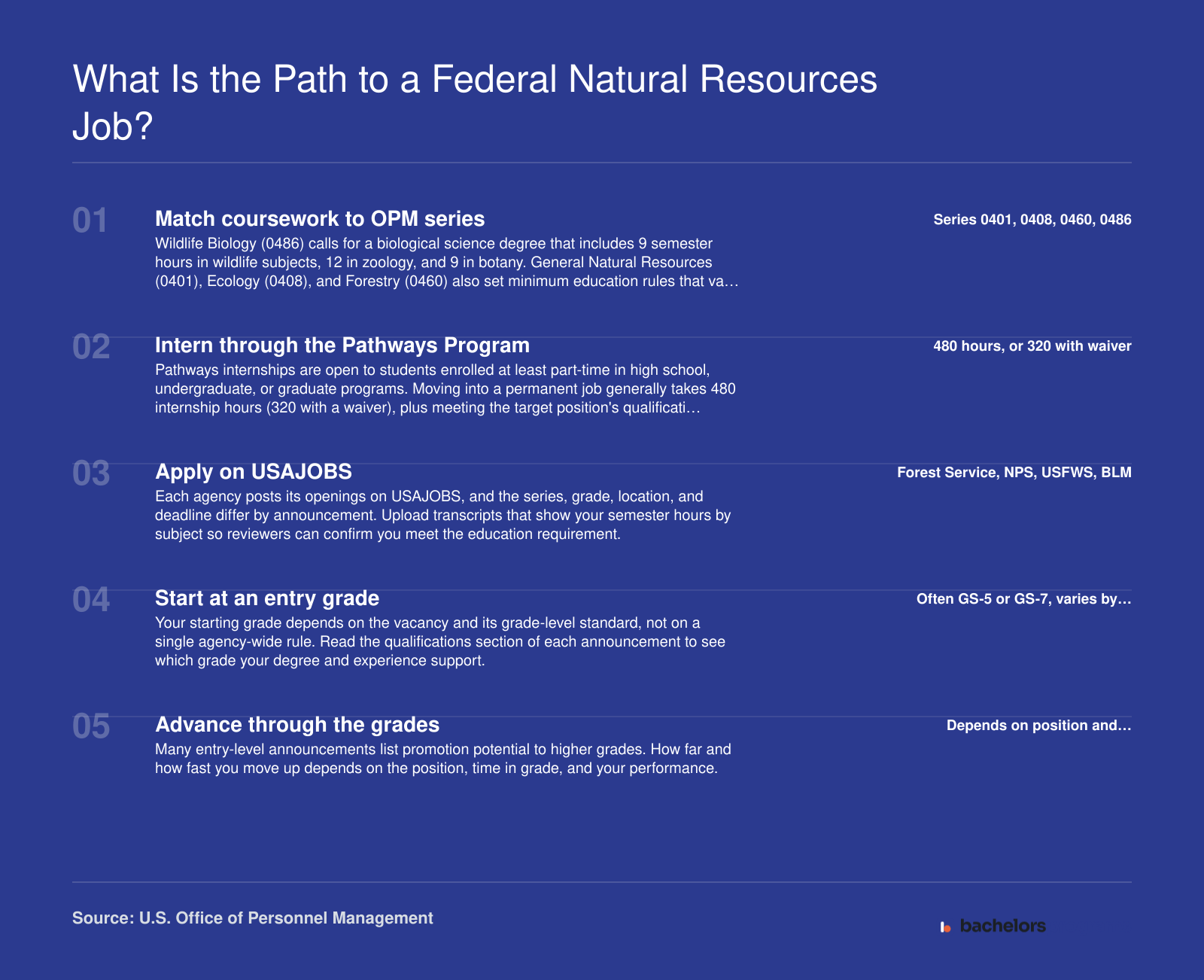
What Is the Path to a Federal Natural Resources Job?
Federal natural resources jobs at the U.S. Forest Service, National Park Service, U.S. Fish and Wildlife Service, and Bureau of Land Management rely on qualification standards from the U.S. Office of Personnel Management (OPM). Your transcript is your proof of qualification. Hiring staff count semester hours by subject, so the courses you choose in your bachelor's program can decide which job series you qualify for.
Natural Resources programs by state
Natural Resources Degree FAQs
These answers cover the questions prospective students ask most about a bachelor's degree in natural resources. Figures come from third-party rankings and school pages, so treat them as guides for comparison rather than guarantees.
What is the best college for natural resources and conservation?
Are there online bachelor's degrees in natural resources?
How much do natural resources graduates earn?
Is a natural resources degree the same as an environmental science degree?
Compare Natural Resources programs on the data that matters
Explore more Science & Engineering majors or browse every field of study.
All Science & Engineering programs Browse every field of study