Best Online Child Development Degree Programs
Compare 40+ accredited online Child Development programs, with net price after aid, graduation rates, earnings and debt from IPEDS and the U.S. College Scorecard.

A bachelor's degree in child development, most often a Bachelor of Arts (B.A.) in Child Development, can be earned entirely online, but the programs differ sharply in price and in what they lead to. Net prices run from roughly $8,500 to $24,300 a year, and most of these degrees do not carry a teaching license.
Every program here is fully online and at the bachelor's level, with no hybrid formats or graduate study.
Pay depends more on the role than on the school: childcare and preschool jobs still pay modestly.
Key Points
- Most online child development bachelor's programs don't lead to teacher licensure.
- May 2025 BLS medians: preschool teachers $38,140, childcare workers $34,980.
- California State University-East Bay posts the top program-level earnings among ranked schools.
Top 10 Fully Online Child Development Degree Programs
Every program below can be completed fully online, with no campus visits, hybrid attendance, or in-person components required at any point. They appear in the order of a composite quality score built from completion, cost, and outcome measures. Cards note institution-wide graduation rates and, where the field reports them, median earnings four years after finishing and median debt at graduation.
California State University-East Bay
#1Hayward, CA · $8,000 – $20,000/yr (est.)
Best for: Students undecided between several concentrations
California State University, East Bay runs its Human Development bachelor's degree with a Childhood Development concentration plus four sibling tracks, and the upper-division major can be finished entirely online. The 120-unit degree closes with a senior research seminar capstone, and a minor in Human Development is available. Institution-wide, 48 percent of students graduate, and median earnings in this field ran about $57,900 four years after finishing, with median debt near $16,500.
- Five concentrations, including early childhood and adolescent development
- 120 units total, with 53 to 55 in the major
- Fully online degree-completion pathway available
- Four-unit senior research seminar capstone
- Minor in Human Development offered
Charter Oak State College
#2New Britain, CT · $15,000 – $20,000/yr (est.)
Best for: Working adults with prior college credit
Charter Oak State College delivers its Child Studies bachelor's degree entirely online in eight-week terms with six start dates a year. The 42-credit major requires no practicum, and prior learning and community college credit can be applied toward the degree. Connecticut community college graduates may finish at the community college rate, and about 67 percent of the college's students graduate institution-wide.
- 42 credits in the major delivered in 8-week terms
- Six start dates per year
- No practicum required
- Credit for prior learning accepted
- Non-certification degree with separate teacher certification pathways
- Connecticut community college graduates may finish at the community college rate
University of Michigan-Dearborn
#3Dearborn, MI · ~$9,000/yr (est.)
Best for: Family-services career changers
The University of Michigan-Dearborn awards a Bachelor of Arts in Children and Families that pairs child development and psychology with family dynamics and social policy. Students gain field experience at a NAEYC-accredited early childhood center on campus or at partner agencies such as family advocacy and community action organizations. The degree does not lead to teacher certification, so it suits readers heading toward Head Start, child care administration, advocacy, or graduate study, and the institution-wide graduation rate is 58 percent.
- Field experience at a NAEYC-accredited early childhood center
- Coursework in child development, family dynamics and social policy
- Does not lead to teacher certification
- Rolling admissions throughout the year
- Go Blue Guarantee covers tuition for qualifying in-state students
University of Arkansas
#4Fayetteville, AR · ~$18,000/yr (est.)
The University of Arkansas offers a Bachelor of Science in Human Environmental Science in Human Development and Family Sciences with a Child Life concentration that adds 17 hours of health-care-focused coursework. The 120-hour, eight-semester plan covers life span development, family relations, and public policy advocacy for children and families. Institution-wide, 71 percent of students graduate, and median earnings in this field were about $46,300 four years after finishing, with median debt near $21,500.
- Child Life concentration adds 17 credit hours
- 120 credit hours across an eight-semester plan
- Internship of at least 150 hours
- Minors in Child Services and Human Development and Family Sciences
- Coursework in play, child guidance, and infant and toddler development
Auburn University
#5Auburn, AL · $13,000 – $35,000/yr (est.)
Auburn University's Human Development and Family Science degree carries an Early Child Development concentration and finishes with a 12-credit internship. The 120-credit program covers infant and toddler development, child guidance with a lab, and learning experiences for young children. Institution-wide, 82 percent of students graduate, and median earnings in this field ran about $46,200 four years after finishing, with median debt near $21,000.
- 12-credit senior internship in early child development
- 120 credit hours
- Child guidance course includes a lab
- Professional electives can count toward a minor
- Infant and toddler development coursework
Mississippi State University
#6Mississippi State, MS · ~$18,000/yr (est.)
Mississippi State University's Bachelor of Science in Human Development and Family Science concentrates in child development and accepts up to 62 transfer hours from accredited community colleges. The 124-credit degree includes 59 hours in the concentration plus an internship supervised by a licensed teacher, and it is accredited by the American Association of Family and Consumer Sciences. Institution-wide, 67 percent of students graduate, and median earnings in this field were about $41,400 four years after finishing, with median debt near $22,100.
- $452 per credit hour plus a $25 support fee per credit
- Up to 62 transfer hours from an accredited community college
- 124 credits: 36 general education, 29 core, 59 concentration
- Accredited by the American Association of Family and Consumer Sciences
- Prepares students for Praxis II Education of Young Children
- Internship supervised by a licensed teacher
Texas Woman's University
#7Denton, TX · ~$12,000/yr (est.)
Texas Woman's University awards a Bachelor of Science in Child Development with four tracks, including a Child Life emphasis endorsed by the Association of Child Life Professionals, the only such undergraduate program in Texas. An online completion option lets transfer students finish the degree remotely. Institution-wide, 49 percent of students graduate, and median earnings in this field ran about $49,200 four years after finishing, with median debt near $19,200.
- Child Life emphasis endorsed by the Association of Child Life Professionals
- Four tracks, including pre-occupational therapy and pre-physical therapy
- Online completion option for transfer students
- Meets National Council on Family Relations standards for provisional CFLE
- Prepares for early intervention and parent education roles
Oklahoma State University
#8Stillwater, OK · ~$17,000/yr (est.)
Oklahoma State University's Bachelor of Science in Early Child Care and Development requires 120 credit hours, 45 of them upper-division, and pairs curriculum courses for ages birth to 8 with a practicum and a six-credit capstone. Admission calls for a 2.5 GPA both overall and in the major. Institution-wide, 68 percent of students graduate, and median earnings in this field were about $50,600 four years after finishing, with median debt near $20,500.
- 120 credit hours, 45 of them upper-division
- 2.5 GPA required overall and in the major
- Practicum II plus a six-credit senior capstone
- Curriculum courses for ages birth to 8
- Administration and supervision coursework for early childhood settings
University of Alabama in Huntsville
#9Huntsville, AL · $19,000/yr (est. net price)
The University of Alabama in Huntsville offers a Bachelor of Science in Child, Family, and Community Development with a Leadership in Early Learning and Family Relations concentration aimed at roles outside the traditional classroom. Coursework covers child development, family relationships, community resources, and program administration, with hands-on experience in community settings. The institution-wide graduation rate is 64 percent.
- Leadership in Early Learning and Family Relations concentration
- Prepares for nonprofit, advocacy and youth development roles
- Coursework in program administration and community resources
- Community-based field experience
- Designed for careers outside traditional classroom teaching
West Virginia University
#10Morgantown, WV · ~$16,000/yr (est.)
West Virginia University's Bachelor of Science in Child Development and Family Studies covers birth through age eight, including atypical development, and requires 51 major hours inside a 120-credit degree. Field experiences, internships, and a capstone round out the program, and a 15-credit minor is required unless a second major is declared. Institution-wide, 65 percent of students graduate, and median earnings in this field were about $48,900 four years after finishing, with median debt near $22,500.
- 51 major credit hours inside a 120-credit degree
- Covers birth through age eight, including atypical development
- Field experiences, internships and a capstone
- Fall, spring and summer admission terms
- 15-credit minor required unless a second major is declared
Cost & outcomes by school
Federal data for the highest-earning Child Development programs, independent of the ranking above. Earnings are this field's bachelor's graduates four years after completing where the Scorecard reports them, else the school's undergraduate median.
| School | Net price / yr | Grad rate | Earnings | Debt | Grads/yr | Format |
|---|---|---|---|---|---|---|
| Charter Oak State College CT | $15,815 | 67% | $64,209 | $18,683 | 54 | Online |
| University of Alabama in Huntsville AL | $18,796 | 64% | $61,767 | $20,705 | 4 | Online or campus |
| University of Michigan-Dearborn MI | $9,492 | 58% | $59,649 | $22,500 | 8 | Online |
| California State University-East Bay CA | $9,320 | 48% | $57,898 | $17,516 | 259 | Online or campus |
| Fresno Pacific University CA | $13,630 | 50% | $51,756 | $23,000 | 81 | Online or campus |
| Oklahoma State University OK | $17,447 | 68% | $50,583 | $21,515 | 79 | Online |
| University of Arkansas AR | $18,209 | 71% | $46,268 | $21,500 | 79 | Online or campus |
| Auburn University AL | $24,323 | 82% | $46,242 | $21,500 | 113 | Online or campus |
| Jacksonville State University AL | $14,279 | 55% | $45,235 | $22,189 | — | Online or campus |
| Delta State University MS | $13,540 | 48% | $41,991 | $20,390 | — | Online |
Sources: U.S. Department of Education. Net price, graduation rate, earnings and debt: College Scorecard (earnings and debt for this field's bachelor's graduates where reported, else school-wide); graduates: IPEDS. A dash means no figure is reported.
Cost, debt & payoff
Median earnings of this field's bachelor's graduates (4 yrs after completing, else the school's undergraduate median) vs. their median federal loan debt · U.S. College Scorecard
Across these programs the median graduate earns about $47,626 and finishes with roughly $22,500 in debt — a ratio that clears a common rule of thumb (keep debt below first-year salary). Net price and debt vary widely school to school, so check the per-school figures in the table above before you shortlist.
How We Ranked These 100% Online Programs
Convenience is easy to find in online education. Evidence that a program works for students is harder to come by. Delivery came first: a program had to be completable fully online, so we excluded hybrid options that required campus attendance. Each school also needed institutional accreditation. From there, we compared public College Scorecard figures: net price, graduation rate, and program-level earnings and debt.
Many student-vote rankings never publish how they weight their inputs. Ours draws on public federal data that you can check yourself.
Two caveats apply. Graduation rates cover the whole institution, not just the child development major. Net price is an average after grant aid; your own bill will not match it.
What a Bachelor's Degree in Child Development Costs Online
These are the lowest-cost fully online options in our data, ranked by average annual net price (what students pay after grants and scholarships), with four-year totals estimated by multiplying that average by four. Treat the estimates as a rough guide, not a guaranteed bill: your actual cost depends on residency, aid, fees, and how many credits you still need. Transfer credits are the biggest lever for lowering that total, so request an official transfer evaluation before you enroll.
| School | Program | Average Annual Net Price | Estimated Four-Year Total (at Average Net Price) | Median Program Debt | Total Credits |
|---|---|---|---|---|---|
| Southeastern Oklahoma State University | B.S., Early Intervention & Child Development | $8,039 | $32,156 | $16,045 | 104 |
| California State University-East Bay | Human Development, B.A. (Childhood Development concentration) | $9,320 | $37,280 | $17,516 | 120 |
| University of Michigan-Dearborn | Children and Families, B.A. | $9,492 | $37,968 | N/A | N/A |
Does a Child Development Degree Lead to Teacher Certification?
A child development degree and an early childhood education degree can look interchangeable on a program page. The difference shows up at the state licensing office.
Most online child development bachelor's programs are non-licensure. They prepare graduates for preschool, Head Start, childcare administration, and family-services roles, but not, by themselves, for a public school teaching license. Early childhood education programs are more often licensure tracks: SUNY Empire State's online B.S. maps to New York's B-2 Initial Certification1, and Kansas State's prepares graduates to apply for the Kansas Early Childhood Unified B-K license.2 Family studies leans toward human services.
Other routes into the field
Other routes include a licensure-track early childhood education bachelor's, a post-baccalaureate or alternative certification program, and state early childhood or director credentials, which are separate from a teaching license. The CDA Credential from the Council for Professional Recognition is separate too; coursework can support the required training hours but does not award it.
Before enrolling, read the program's professional licensure disclosure and confirm it covers your state, the age or grade range, and the field experience required. Kansas State notes that licensure transfer elsewhere may require additional tests.2
Related Articles
Transfer Credits, Degree Completion, and Field Experience
Prior college credits can shorten an online child development degree, but how much depends on the pathway.
Freshman-entry programs generally run about 120 credits, or roughly four years. Degree-completion programs are built for students with an associate degree or prior credits and often take about two years. San Diego State's online B.S. is degree-completion and expects at least 60 transferable credits. Campbellsville and the University of New Hampshire accept up to 90 transfer credits1, and Liberty allows up to 75% of the degree to transfer. Nova Southeastern approves 9 credits for CDA holders toward the major. Ask each school whether courses run in accelerated terms, such as 7 or 8 weeks.
"Fully online" does not always mean no site visits. Purdue Global requires 5 field-experience hours in an early-childhood setting2. Campbellsville requires 200 hours of fieldwork3, and Cincinnati's licensure-track program includes 150 hours of preschool student teaching and a 140-hour infant-toddler practicum4. Liberty's field experience is optional. San Diego State's applied components run about 4 hours a week, and employed students can typically use their workplace.
Before applying, ask how placements are approved, who arranges them, and whether your current job can count.
What Can You Do With an Online Child Development Degree?
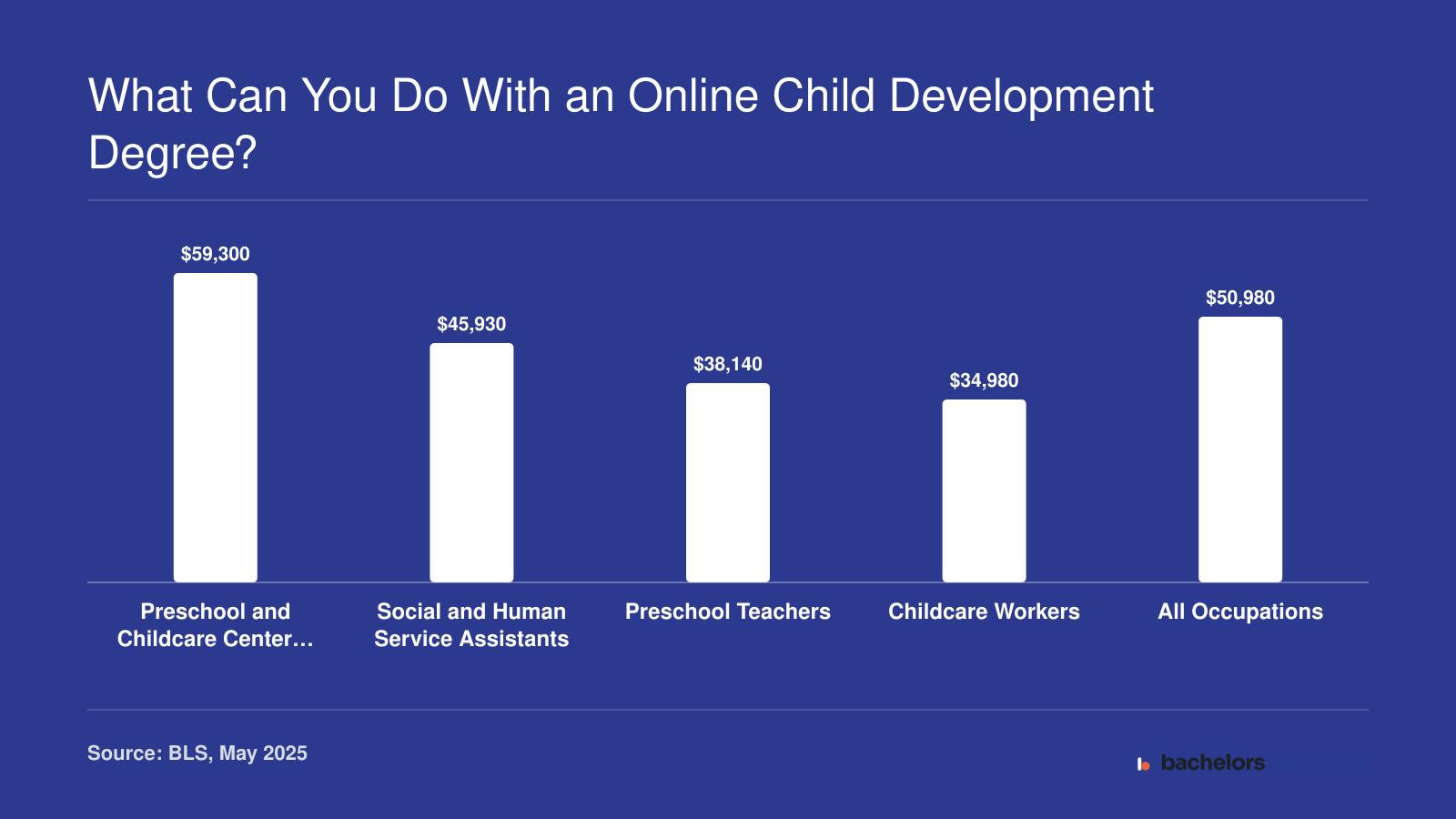
A bachelor's degree in child development leads to roles in childcare, early education, and family services, but pay varies widely by role. Entry roles pay modestly: May 2025 BLS medians put childcare workers at $34,980 and preschool teachers at $38,140, both below the $50,980 median for all occupations. Social and human service assistants earn a $45,930 median and are projected to grow 7% from 2025 to 2035. Preschool and childcare center directors earn the most at $59,300, though these roles typically require prior experience plus state-specific qualifications.
Top Program-Level Earnings Among Ranked Schools
California State University-East Bay posts the highest program-level earnings among the schools ranked here.
Accreditation and What to Verify Before You Apply
Use this checklist to confirm an online child development program is legitimate and fits your goals before you submit an application.
- Institutional accreditationConfirm the college holds accreditation from an accreditor recognized by the U.S. Department of Education or CHEA, with scope that covers distance education.
- Programmatic accreditationNAEYC higher education accreditation and CAEP mainly apply to early childhood and educator-prep programs, and many child development degrees have neither. Check NAEYC's directory for the specific program, not just the school.
- State authorization and licensure disclosureVerify the school is authorized to enroll online students in your state, and read its professional licensure disclosure if you want a state credential.
- Practicum, transfer, and credit rulesAsk how practicum placements work where you live, how many transfer credits count, and the total credits required to graduate.
Child Development programs by state
Frequently Asked Questions
Quick answers to common questions about online bachelor's degrees in child development, from format and timing to CDA credit.
Can you get a child development degree online?
How long does it take to get a bachelor's degree in child development online?
What is the difference between child development and early childhood education degrees?
Can I earn a CDA credential and a bachelor's degree at the same time, or does a CDA transfer as credit?
Compare Child Development programs on the data that matters
Explore more Education & Teaching majors or browse every field of study.
All Education & Teaching programs Browse every field of study