Best Criminal Justice Schools in Vermont
Compare 3 accredited Criminal Justice programs in Vermont, with net price after aid, graduation rates, earnings and debt from IPEDS and the U.S. College Scorecard.

In Vermont, earning a degree and earning a badge are separate tasks. Full-scope Level III certification from the Vermont Criminal Justice Council currently requires a 17-week residential academy at the Vermont Police Academy, on top of any bachelor's degree in criminal justice a recruit brings.
The Bachelor of Science (B.S.) in Criminal Justice is the common credential, though Vermont State University awards a B.A. Norwich University, Vermont State and Champlain College differ on net price, graduation rates, program earnings, online access and the Vermont careers they feed.
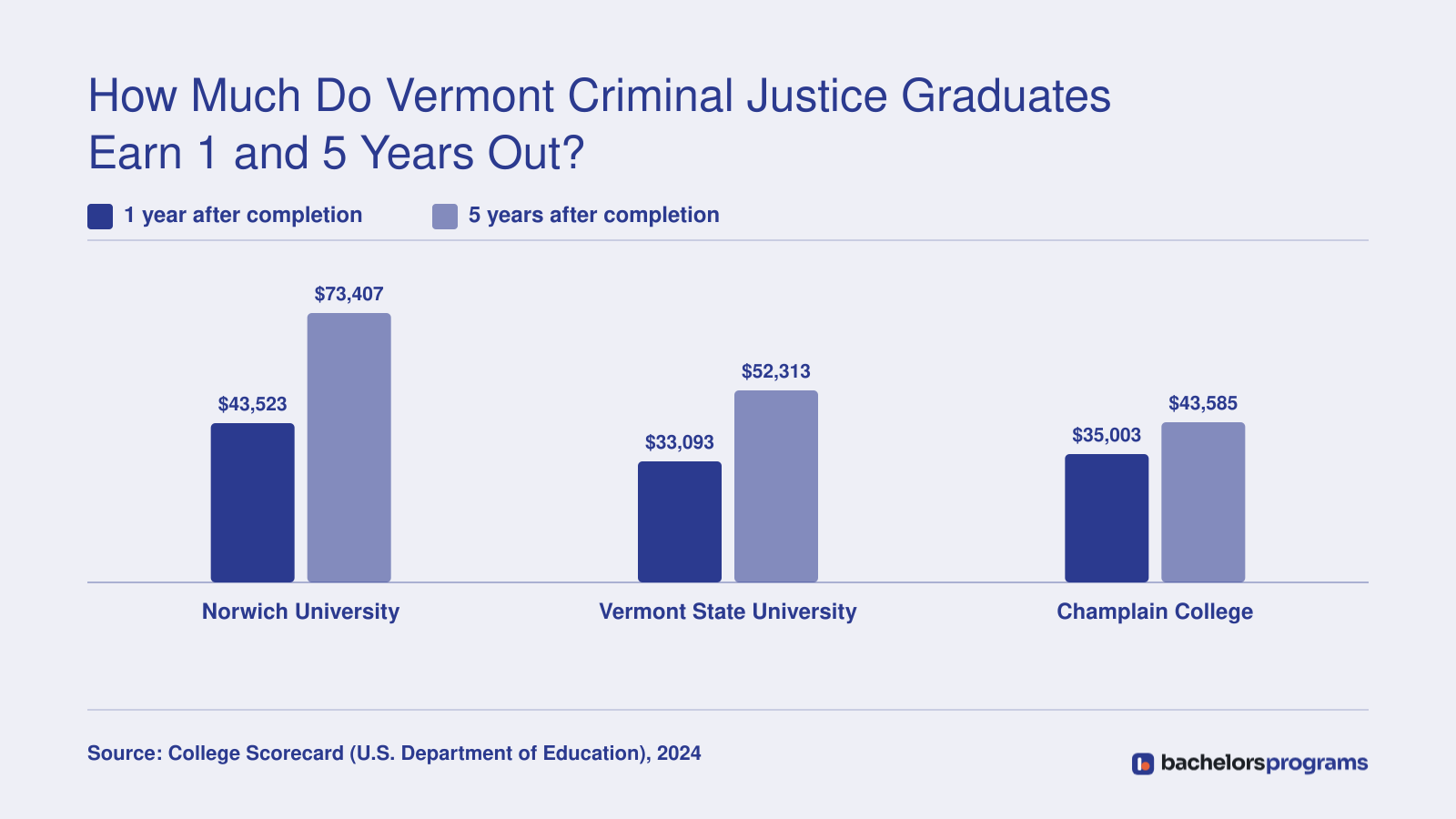
Norwich graduates earned a median $43,523 one year out and $73,407 at five years, so first-year pay understates where the degree can lead.
Key Points
- Norwich University graduates earned a median $73,407 five years out.
- Only Vermont State University lists an online criminal justice bachelor's route.
- Vermont's Level III officer certification requires a 17-week residential academy.
Best Schools for a Bachelor's Degree in Criminal Justice in Vermont
Vermont offers three bachelor's programs in criminal justice, and they differ sharply in format, price and how much of the degree happens outside the classroom. One is a private military college with a research-heavy, career-directed curriculum; one is the public university that also runs the degree fully online; one is a Burlington college built around fieldwork and a police academy senior option. Net prices below are sector-level averages after aid, not a personal quote, and graduation rates describe each institution as a whole rather than the criminal justice major alone.
Norwich University
#1Northfield, VT · $22,000/yr (est. net price)
Best for: Future federal agents and intelligence analysts
Norwich University runs its criminal justice program on the Northfield campus, and it is the most analytically directed of the three Vermont options: coursework moves from criminal law and procedure through policing, courts and corrections into research methods and statistics, the groundwork for crime analysis and intelligence work. Students can add a concentration in Emergency Management or Victim Services, and minors in criminology, cybercrime and computer forensics, or pre-law. A staged CSI Experience with alumni mentors and agency visits to Washington, D.C., and Boston add applied exposure, and an accelerated pathway lets strong students begin graduate work in public administration. Schools offering this program graduate 60% of their students, and average net price after aid is $22,257, a sector-level figure rather than an exact quote.
- On-campus program in Northfield, Vermont
- Optional concentrations in Emergency Management or Victim Services
- Minors in criminology, cybercrime and computer forensics, and pre-law
- CSI Experience staged investigation with alumni mentors
- Washington, D.C., and Boston agency visits
- Coursework in criminal law, procedure, policing, courts and corrections
- Research Methods and Elementary Statistics build analytical skills
- Accelerated Master's in Public Administration pathway
Vermont State University
#2Randolph, VT · $15,000 – $20,000/yr (est.)
Best for: Working adults needing a fully online degree
Vermont State University is the public option and the only one of the three that can be completed entirely online, with the criminal justice B.A. also taught at the Castleton and Lyndon campuses. Core coursework covers law enforcement, corrections, courts, criminology and ethics, and students choose between a Restorative Justice concentration and a self-designed set of electives; a senior capstone or thesis, an internship, and courtroom and ride-along hours are built into the degree. Restorative justice students have worked with community justice centers around the state, and internships are available with the Vermont Criminal Justice Training Council. Schools offering this program graduate 47% of their students, and average net price after aid is $18,212.
- Fully online option, plus Castleton and Lyndon campuses
- Concentration in Restorative Justice
- Criminology concentration not offered for the 2026-27 year
- Senior Seminar and Capstone or Senior Thesis
- Built-in internship with courtroom and ride-along hours
- Internships with the Vermont Criminal Justice Training Council
- Start dates in August, October, January, March and May
- Eligible Vermonters in designated Good Neighbor counties pay resident rates
Champlain College
#3Burlington, VT · ~$36,000/yr (est.)
Best for: Hands-on learners wanting police academy credit
Champlain College's criminology and criminal justice major sits in its School of Social Innovation on the Burlington campus and starts criminal justice coursework in the first semester rather than after a general-education year. A field experience requiring 24 hours per week, plus internships with police departments and prosecutors, anchors the degree in practice, and students can work with incarcerated people through the Prison Law Initiative or take digital investigation courses shared with the Digital Forensics program. Seniors may complete a 15-week Vermont Police Academy program and earn 15 credits toward the degree. Schools offering this program graduate 65% of their students, and average net price after aid is $35,860.
- Criminal justice courses begin in the first semester
- Field experience requires 24 hours per week of fieldwork
- Senior option: 15-week Vermont Police Academy for 15 credits
- Prison Law Initiative work with inmates
- Digital investigation courses shared with the Digital Forensics program
- Internships with police departments and prosecutors
- Curriculum includes criminal law, social justice and oppression
- 90 credits required before the field experience course
Cost & outcomes by school
Federal data for the highest-earning Criminal Justice programs, independent of the ranking above. Earnings are this field's bachelor's graduates four years after completing where the Scorecard reports them, else the school's undergraduate median.
| School | Net price / yr | Grad rate | Earnings | Debt | Grads/yr | Format |
|---|---|---|---|---|---|---|
| Norwich University VT | $22,257 | 60% | $70,075 | $26,000 | 81 | Campus |
| Vermont State University VT | $18,212 | 47% | $55,465 | $15,000 | 20 | Online or campus |
| Champlain College VT | $35,860 | 65% | $48,349 | $25,000 | 7 | Campus |
Sources: U.S. Department of Education. Net price, graduation rate, earnings and debt: College Scorecard (earnings and debt for this field's bachelor's graduates where reported, else school-wide); graduates: IPEDS. A dash means no figure is reported.
Cost, debt & payoff
Median earnings of this field's bachelor's graduates (4 yrs after completing, else the school's undergraduate median) vs. their median federal loan debt · U.S. College Scorecard
Across these programs the median graduate earns about $55,465 and finishes with roughly $25,000 in debt — a ratio that clears a common rule of thumb (keep debt below first-year salary). Net price and debt vary widely school to school, so check the per-school figures in the table above before you shortlist.
How We Ranked Vermont Criminal Justice Schools
Institution-wide figures describe a whole college, while program-level figures describe a single major. Both kinds of figures shape these rankings. College Scorecard supplies the institution- and program-level data; internal program records confirm what each school offers in criminal justice and how it delivers the degree.
What We Weighed
- Net price: what students typically pay once grants and scholarships are counted, not the published sticker price.
- Graduation rate: the share of students who finish a bachelor's degree at the school.
- Program earnings: what graduates of the specific program earn after leaving.
- Debt: typical borrowing among students who complete the program.
- Format: campus, online, or hybrid delivery.
Limits to Keep in Mind
Both measures describe the entire college. They reflect every undergraduate at the school, not only criminal justice majors, so read them as a guide to the college rather than the major. Scorecard earnings are medians, so half of graduates earn more and half earn less; the figure alone says nothing about the spread. Small programs can also produce figures that shift from year to year.
Only Vermont-based bachelor's programs are included, both on campus and online. An online program counts only when the school itself is based in Vermont.
Online and Hybrid Criminal Justice Bachelor's Options at Vermont Schools
Classes can be fully online, a mix of remote and in-person, or entirely on campus. Among the Vermont schools here, only Vermont State University lists an online route for its criminal justice bachelor's degree.
Vermont State University
Vermont State's Criminal Justice B.A. is listed as both online and in-person, with in-person sites in Castleton and Lyndon. The university also describes an "In-Person Plus" style that combines in-person and remote delivery. Remote courses may have scheduled meeting times or no fixed class time, so ask which applies before you register.
The program page names no mandatory residency requirement. It does caution that some online programs may require in-person meetings, residency, or fieldwork, so confirm with an advisor. The program also lists courtroom and ride-along hours, which are hands-on by nature.
Two concentrations are listed:
- Restorative Justice: Offered online and at Lyndon. Its listed Fall 1 start was Aug. 24, 2026, so ask admissions for the next start date.
- Criminology: Delivered in-person and remote, but not offered in the 2026-27 academic year.
Norwich University and Champlain College
Our program data lists Norwich University (Criminal Justice) and Champlain College (Criminology & Criminal Justice) as campus-based programs, in Northfield and Burlington. Don't assume an online or hybrid track at either school. We could not confirm one from official program pages, so check directly with each admissions office if you need remote study.
Which Format Fits You
- Working adults: Vermont State's online option offers the most flexibility, though you should confirm any meeting times.
- Traditional students: Norwich and Champlain offer a full on-campus experience, and Vermont State's Castleton and Lyndon sites do too.
- Career changers: Vermont State's online and In-Person Plus formats let you study around a current job.
Admission Requirements for Vermont Criminal Justice Bachelor's Programs
Champlain College publishes the most detailed transfer path, with guaranteed admission for qualifying associate degree graduates of Vermont's community college, while Vermont State University points transfer students toward flexible degree-completion pathways built for associate degree holders. Neither school lists a minimum GPA or an SAT/ACT policy on its criminal justice program page, so confirm both with each admissions office before you apply. Norwich University applicants should also verify GPA, testing, and transfer credit rules directly with that school.
| School | GPA Expectation | Test Policy | Transfer Credit Policy |
|---|---|---|---|
| Vermont State University (Criminal Justice, B.A.) | No policy published | No policy published | Offers flexible degree-completion pathways for students who hold an associate degree from Vermont's community college. No transfer credit policy specific to criminal justice is published. |
| Champlain College (Criminology & Criminal Justice, B.S.) | No policy published for first-year applicants. Transfer applicants from the community college pathway need at least a 2.0 GPA. | No policy published | Guaranteed admission for community college graduates in criminology and criminal justice who finish a qualifying associate degree with at least 60 credits and a 2.0 GPA. A block of 33 to 36 general education credits transfers together, and other credits transfer one to one when they apply. Only courses graded C or higher transfer. Up to 75 credit hours may count toward an on-campus bachelor's degree, and at least 45 credits must be completed at Champlain. |
Questions to Ask Yourself
Do you need an online or hybrid format, or can you commit to a campus in Vermont?
How many of your associate-level credits will a school actually accept?
Do you want a law enforcement focus or a broader criminology or restorative justice track?
Related Articles
How Much Do Vermont Criminal Justice Graduates Earn 1 and 5 Years Out?
College Scorecard reports median earnings for graduates of each school's criminal justice bachelor's program at 1 year and 5 years after completion. Norwich University graduates earned a median $43,523 at 1 year and $73,407 at 5 years, a gain of about 68.7%. Vermont State University graduates rose from $33,093 at 1 year to $52,313 at 5 years (about 58.1%), and Champlain College graduates went from $35,003 at 1 year to $43,585 at 5 years (about 24.5%). Champlain's figures come from a small graduating class.
Vermont Law Enforcement Officer Certification at a Glance
Compare Criminal Justice programs on the data that matters
Explore more Criminal Justice & Law majors or browse every field of study.
All Criminal Justice & Law programs Browse every field of study