Best Astronomy & Space Studies Degree Programs
Compare 120+ accredited Astronomy & Space Studies programs, with net price after aid, graduation rates, earnings and debt from IPEDS and the U.S. College Scorecard.
A bachelor's degree in astronomy and space studies looks straightforward until the price tag appears. Among the schools ranked here, what students actually pay runs from $6,128 at Princeton University to $23,777 at Yale University, nearly a fourfold gap for a major that feeds the same small pool of observatory, NASA-contractor, and graduate-school slots.
Astronomy and astrophysics keep the physics load heavy; space studies trades some of that for planetary science and policy coursework. Graduate committees and employers read those transcripts differently.
Telescope time and observing labs still tie most programs to a campus, and early pay tracks research experience more closely than the diploma itself.
Key Points
- Princeton's average net price is $6,128 despite $62,688 sticker tuition and fees.
- Among ranked schools, UC Berkeley astrophysics graduates earn the most early on.
- No separate accreditor reviews astronomy bachelor's programs, so check institutional accreditation.
Best Schools for a Bachelor's Degree in Astronomy and Space Studies
The best astronomy and space studies degree programs below span every format we track, and all ten ranked here deliver the major on campus, because observing labs and telescope time are difficult to reproduce online. None of these ten options is fully online, so working adults and transfer students who need remote delivery should check the additional programs listed later in this article. Each card gives the program, location, net price after aid, admission rate, and the share of students the school graduates.
Princeton University
#1Princeton, NJ · ~$6,000/yr (est.)
Best for: Thesis-driven researchers headed to graduate school
Princeton's Department of Astrophysical Sciences runs a small, research-first major built around independent work: every student completes a junior research project and a year-long senior thesis defended orally. Majors draw on campus and remote telescopes plus data from the Hubble and James Webb space telescopes, and there are no fixed tracks, so coursework is planned individually with the director of undergraduate studies. The school graduates 98% of students, and admission is among the most selective in the country.
- Eight upper-level departmental courses after prerequisites
- At least four astrophysics courses at the 300 or 400 level
- At least three physics courses plus one additional STEM course
- Prerequisites include MAT 103-202 and PHY 103/105, 104/106, 207
- Junior independent research project required
- Year-long senior thesis (AST 498-499) with oral defense
- Research uses Hubble, James Webb, and Sloan Digital Sky Survey data
- No tracks; plan coursework with the director of undergraduate studies
University of Florida
#2Gainesville, FL · ~$7,000/yr (est.)
Best for: Florida residents keeping tuition and fees down
The University of Florida offers a 120-credit Bachelor of Arts in Astronomy inside a large public research university, with foundation work in calculus and calculus-based physics before the upper-level astronomy sequence. Students reach the Gran Telescopio Canarias and the HiPerGator-2 supercomputer, and the degree is deliberately flexible enough for business, law, health professions, science writing, and teaching paths. The school graduates 91% of students.
- 120 total credits, 41 in the major (20 foundation, 21 major)
- Foundation work in Calculus 1-3 and Physics with Calculus
- Astronomy and Astrophysics 1 and 2 plus Techniques of Observational Astronomy 1
- Minimum grade of C in every course; 2.5 critical-tracking GPA
- 15 astronomy credits must be completed in UF residence
- Access to the Gran Telescopio Canarias
- HiPerGator-2 supercomputer available for computation
- Prepares for business, law, health professions, and teaching
California Institute of Technology
#3Pasadena, CA · ~$16,000/yr (est.)
Best for: Hands-on instrument builders aiming at JPL careers
Caltech grants a Bachelor of Science in Astrophysics from its Division of Physics, Mathematics and Astronomy, and undergraduates move through a demanding core before specialized astrophysics courses, observational astronomy, and instrumentation labs. Research placements with faculty and graduate students open up after the first year, more than 20 astronomy faculty work in the division, and the campus partners with NASA's Jet Propulsion Laboratory. The school graduates 94% of students.
- Caltech core curriculum completed before astrophysics specialization
- Observational astronomy and instrumentation lab work
- Research projects with faculty available after the first year
- Over 20 astronomy faculty and more than 50 physics professors
- Partnership with NASA's Jet Propulsion Laboratory
- Astrophysics minor open to students in other majors
- Science and engineering electives outside the division required
Massachusetts Institute of Technology
#4Cambridge, MA · ~$20,000/yr (est.)
MIT's Bachelor of Science in Earth, Atmospheric, and Planetary Sciences lets students choose among four concentrations, including Planetary Science + Astronomy, which covers solar system dynamics, planetary atmospheres, and the search for water and organic molecules. The degree requires 180 to 198 units beyond the General Institute Requirements, includes lab and field subjects and a thesis, and first-year students choose a department at the end of the spring term. The school graduates 96% of students.
- Planetary Science + Astronomy concentration among four options
- 180 to 198 units beyond the General Institute Requirements
- Concentration covers solar system dynamics and planetary atmospheres
- Lab and field subjects plus a thesis required
- First-years choose a department at the end of spring term
- Undergraduate Research Opportunities Program with faculty
- Double major option available
University of Chicago
#5Chicago, IL · ~$15,000/yr (est.)
The University of Chicago awards both a Bachelor of Arts and a Bachelor of Science in Astrophysics through its Department of Astronomy and Astrophysics, with coursework that runs from nuclear physics to cosmological scales. Students take computational methods and statistical data analysis alongside experimental and observational technique courses, and they join faculty-led research projects. The school graduates 96% of students.
- Separate BA and BS options in astrophysics
- Coursework from nuclear physics to cosmological scales
- Computational methods and statistical data analysis courses
- Experimental and observational technique training
- Faculty-led research projects for undergraduates
University of California-Berkeley
#6Berkeley, CA · ~$13,000/yr (est.)
UC Berkeley's Department of Astronomy offers a Bachelor of Arts in Astrophysics designed for graduate study or for technical careers in data science, teaching, and the tech industry, and students declare after finishing lower-division requirements. Program graduates report median earnings of $54,746 one year after finishing and $90,943 four years after finishing. The school graduates 93% of students.
- Declare after completing all lower-division requirements
- 2.0 GPA minimum in prerequisites and upper-division major courses
- Major courses must be taken for a letter grade
- Astrophysics minor offered by the department
- Prepares for graduate study or technical industry roles
University of Washington-Seattle Campus
#7Seattle, WA · ~$14,000/yr (est.)
The University of Washington's Seattle campus awards a Bachelor of Science in Astronomy that runs 87 to 91 credits, pairing a full physics and mathematics sequence with upper-level astronomy coursework. A summer observing course uses the department's 30-inch telescope at Manastash Ridge Observatory, and students also work with Kitt Peak, Cerro Tololo, and Very Large Array data. The school graduates 85% of students, and the department admits twice a year.
- 87 to 91 credits, four-year program
- ASTR 300, 322, 323 plus one of ASTR 321 or 324
- Nine graded 400-level astronomy credits required
- Physics sequence PHYS 121-123, 224-227, 321, 322, 334
- 21 to 25 math credits; 2.0 cumulative GPA in physics
- Summer observing course uses a 30-inch telescope at Manastash Ridge
- Two admission cycles: April 5 for autumn, October 5 for spring
University of Michigan
#8Ann Arbor, MI · $18,000 – $61,000/yr (est.)
Michigan's Department of Astronomy runs two majors and two minors: a physics-intensive Astronomy and Astrophysics major aimed at doctoral study, and an Interdisciplinary Astronomy major meant to sit alongside a primary degree. The lighter minor covers stellar and planetary astrophysics, galactic and extragalactic astrophysics, and cosmology, and general-interest courses serve students from other majors. The school graduates 93% of students.
- Physics-intensive route for students targeting an astronomy PhD
- Second major option: Interdisciplinary Astronomy
- Minors in Astronomy and Astrophysics and in Interdisciplinary Astronomy
- Interdisciplinary minor covers stellar, galactic, and cosmology topics
- General-interest astronomy courses open to other majors
- Consult an undergraduate advisor as soon as you consider the major
Harvard University
#9Cambridge, MA · $15,000 – $20,000/yr (est.)
Harvard College awards an A.B. in Astrophysics that builds from a foundation in modern physics to a general account of the known contents of the universe. Coursework is split between observational and theoretical offerings, and the department also arranges joint concentrations with other fields. The school graduates 98% of students.
- Bachelor of Arts conferred by Harvard College
- Observational and theoretical courses offered
- Built on a foundation of modern physics
- Joint concentrations available with other departments
Yale University
#10New Haven, CT · ~$24,000/yr (est.)
Yale's Department of Astronomy offers two routes, a Bachelor of Arts in Astronomy and a Bachelor of Science in Astrophysics, differing in how much physics and mathematics they require. The B.A. suits science policy or science journalism, the B.S. suits graduate study in astronomy or physics, and both include a senior essay or research project. The school graduates 96% of students.
- B.A. requires 10 courses beyond prerequisites
- B.S. requires 12 courses beyond prerequisites
- B.A. includes a senior essay or independent research project
- B.S. includes a two-term senior project
- Core courses include ASTR 2100 or 2200, 2550, and 3100
- B.S. adds ASTR 3200 and three physics courses above 4000
- B.A. suits science policy or science journalism
- B.S. suits graduate study in astronomy or physics
Cost & outcomes by school
Federal data for the highest-earning Astronomy & Space Studies programs, independent of the ranking above. Earnings are this field's bachelor's graduates four years after completing where the Scorecard reports them, else the school's undergraduate median.
| School | Net price / yr | Grad rate | Earnings | Debt | Grads/yr | Format |
|---|---|---|---|---|---|---|
| Massachusetts Institute of Technology MA | $20,111 | 96% | $143,372 | $14,768 | — | Campus |
| California Institute of Technology CA | $16,075 | 94% | $128,566 | — | 10 | Campus |
| University of Pennsylvania PA | $28,699 | 97% | $111,371 | $15,715 | — | Campus |
| Princeton University NJ | $6,128 | 98% | $110,066 | $10,320 | 10 | Campus |
| Lehigh University PA | $36,931 | 88% | $105,584 | $21,960 | 5 | Campus |
| Cornell University NY | $28,690 | 95% | $104,043 | $14,000 | 9 | Campus |
| Georgia Institute of Technology GA | $12,116 | 94% | $102,772 | $21,672 | — | Campus |
| Columbia University in the City of New York NY | $21,590 | 96% | $102,491 | $21,500 | 17 | Campus |
| Harvard University MA | $19,066 | 98% | $101,817 | $14,000 | 21 | Campus |
| Yale University CT | $23,777 | 96% | $100,533 | $12,975 | 12 | Campus |
| Dartmouth College NH | $29,519 | 96% | $97,434 | $17,500 | 5 | Campus |
| Brown University RI | $25,184 | 96% | $93,487 | $11,428 | — | Campus |
Sources: U.S. Department of Education. Net price, graduation rate, earnings and debt: College Scorecard (earnings and debt for this field's bachelor's graduates where reported, else school-wide); graduates: IPEDS. A dash means no figure is reported.
Cost, debt & payoff
Median earnings of this field's bachelor's graduates (4 yrs after completing, else the school's undergraduate median) vs. their median federal loan debt · U.S. College Scorecard
Across these programs the median graduate earns about $64,395 and finishes with roughly $20,500 in debt — a ratio that clears a common rule of thumb (keep debt below first-year salary). Net price and debt vary widely school to school, so check the per-school figures in the table above before you shortlist.
How We Ranked These Astronomy and Space Studies Schools
Choosing between a well-known name and a school you can actually afford is the tradeoff most astronomy applicants face, so our ranking leans on what students pay and what they get back, not on reputation alone.
What We Looked At
- Average net price: What families pay after grants and scholarships are applied.
- College Scorecard outcomes: Program-level earnings and debt, where the federal government publishes them.
- Graduation and retention rates for the whole institution: Signs of whether students finish and stay.
- Program completions: How many students earn the degree each year.
- Delivery format: On campus, online, or hybrid.
Why Net Price Beats Sticker Tuition
Published tuition is a starting point that few students pay in full. Net price is a better basis for comparison, but it is a sector-level average for each school, not a personal quote. What you actually pay hinges on your aid package, residency, and household income, so run the net price calculator on each school's site before you decide.
Limits You Should Know About
Graduation rates and 10-year earnings describe the whole institution, not the astronomy or space studies program alone. A few programs are too small to have their own program-level earnings published. In those cases we relied on the other measures and did not guess.
Scope
We ranked bachelor's-level programs only. Online, hybrid, and on-campus programs were all eligible, so format shaped the comparison without limiting who could appear.
Astronomy vs. Astrophysics vs. Space Studies: Which Degree Fits You?
Astronomy and astrophysics are physics-heavy research tracks, while space studies is broader and more interdisciplinary, blending policy, exploration, planetary science, and space operations. Course names and requirements vary by school, so treat the comparison below as typical patterns and check each catalog before you apply.
| Factor | Astronomy | Astrophysics | Space Studies |
|---|---|---|---|
| Core focus | Solar system, stars, galaxies, and cosmology, often with observational work | Theory and modeling of black holes, neutron stars, and the Big Bang | Science, technology, and policy of space exploration |
| Calculus and advanced math | Calculus, differential equations, linear algebra, vector analysis, Fourier series, and integral transforms in upper-level physics | Same toolkit, with heavier use in complex mathematical models | Often lighter at the bachelor's level; differential equations appear as a prerequisite for advanced orbital mechanics |
| Physics core | Intro astrophysics covers celestial mechanics, relativity, optics, stellar evolution, and compact objects | Same foundation, usually followed by more theory-based upper-level courses | Physics is one part of a mixed curriculum, and depth varies widely by program |
| Programming and data | Data analysis, numerical simulation, and computer interfacing; Python is a common tool | Simulation and parallel computing play a larger role | Data analysis, programming, remote sensing, image processing, and systems engineering |
| Typical careers | Astronomer, scientific research and development, federal government, and university roles | Theoretical research, modeling, and simulation work | Aerospace industry, research, and space-related government roles |
| Graduate school | Research careers generally require a master's or Ph.D. | Research careers generally require a master's or Ph.D. | Feeds into graduate space studies; UND's M.S. accepts a bachelor's degree plus 3 credits in statistics, algebra, calculus, or computer science |
| Best fit | Grad-school-bound researcher who enjoys observation and lab work | Student strong in math who wants theoretical research | Career changer, online learner, or aerospace and policy-minded student |
How Much Does an Astronomy or Space Studies Degree Cost?
Sticker tuition overstates what most students pay: Princeton University lists $62,688 in tuition and fees, yet its average net price after grants is $6,128, slightly below the University of Florida's $6,541 and about half of UC San Diego's $12,470, so a well-funded private school can cost less than a public one once aid is applied. Pell share, the portion of undergraduates receiving federal Pell Grants, signals whether lower-income students actually enroll and receive aid, and each school below reports a share above 66 percent in 2024 IPEDS and College Scorecard data. Median debt and the 10-year monthly payment are not reported for these astronomy programs, so the debt column shows school-wide medians as context only, ranging from $10,320 at Princeton to $15,500 at UC San Diego.
| School | Sector | Format | Average Net Price | In-State Tuition & Fees | Out-of-State Tuition & Fees | Pell Share | School-Wide Median Federal Debt (context only) |
|---|---|---|---|---|---|---|---|
| Princeton University (Princeton, NJ) | Private nonprofit | Campus | $6,128 | $62,688 | $62,688 | 81.4% | $10,320 |
| University of Florida (Gainesville, FL) | Public | Campus | $6,541 | $6,381 | $28,659 | 66.7% | $15,000 |
| University of California-San Diego (La Jolla, CA) | Public | Campus | $12,470 | $16,758 | $50,958 | 72.0% | $15,500 |
Related Articles
Online vs. Campus Astronomy Programs: Labs, Telescopes, and In-Person Requirements
Can you complete astronomy lab and telescope requirements without ever setting foot on campus? Often yes, but the answer depends on how a program delivers its observing work.
How Online Programs Handle Labs and Observing
Fully online astronomy and space studies bachelor's degrees typically replace the brick-and-mortar lab with a mix of workarounds:
- At-home lab kits: physics and astronomy courses may ship equipment or rely on household materials for optics and measurement exercises.
- Remote and robotic telescopes: students log in to a telescope and queue observing requests, then download the images.
- Virtual observing software: planetarium and sky-simulation tools stand in for some naked-eye and telescopic sessions.
- Short residencies or field sessions: some programs require a brief on-site visit for hands-on instrument work.
American Public University is the clearest example among the schools on this list. Its online Bachelor of Science in Space Studies labels physics and astronomy courses "with Lab," and each carries 4 semester hours. The astronomy concentration, 15 semester hours, prepares students for observatories, planetariums, and science centers, and the university says these students gain experience with its 24-inch robotic telescope. Arizona State University delivers its Bachelor of Science in Astronomical and Planetary Sciences entirely online, though published details on how students complete labs and observing are thinner.
What You Give Up Off Campus
Campus programs put you at the instrument. Princeton astrophysics majors use on-campus and remote telescopes. The University of Washington offers a summer observing course built around a 30-inch telescope. Caltech runs observational astronomy and instrumentation labs alongside a NASA Jet Propulsion Laboratory partnership. Those faculty-led research groups are hard to replicate at a distance.
Questions to Ask Admissions
Ask whether lab credits appear on the transcript as lab science, since physics and astronomy graduate committees check for that. Confirm what equipment you must buy or borrow, whether telescope time is guaranteed in required courses, and whether any in-person session is mandatory. If graduate school is the goal, ask how online lab grades and research experience are documented in applications.
Accreditation and What to Look for in an Astronomy Program
No separate accrediting body reviews astronomy or physics bachelor's programs in the U.S., so judge a program by its school's accreditation and by department-level quality signals. Use this checklist before you apply.
- Institutional accreditationConfirm the college holds accreditation from a regional or national accreditor recognized by the U.S. Department of Education or CHEA. This is the accreditation that matters for an astronomy degree. ABET does not accredit standard physics or astronomy bachelor's programs. It covers applied science, computing, engineering and engineering technology.
- An active physics or astronomy departmentLook for research-active faculty and a visible undergraduate community, such as a Society of Physics Students chapter or student involvement with the American Physical Society or American Astronomical Society. These are useful signals of engagement, but none of them are accreditation.
- The program's CIP codeAsk which federal classification code the school reports for the major. Astrophysics (40.0202) and Astronomy and Astrophysics, Other (40.0299) are among the relevant codes. STEM coding can affect international students and some scholarships, but verify eligibility for your specific purpose.
- Hands-on research accessAsk whether undergraduates get observatory time, telescope use or access to research instruments, and how early in the degree that starts.
- Transfer and math placement policiesGet the transfer-credit rules and calculus placement requirements in writing. Math sequencing can determine whether you finish in four years.
Top Early-Career Earnings Among Ranked Programs
Among the schools ranked here, UC Berkeley's astrophysics graduates post the strongest early-career pay.
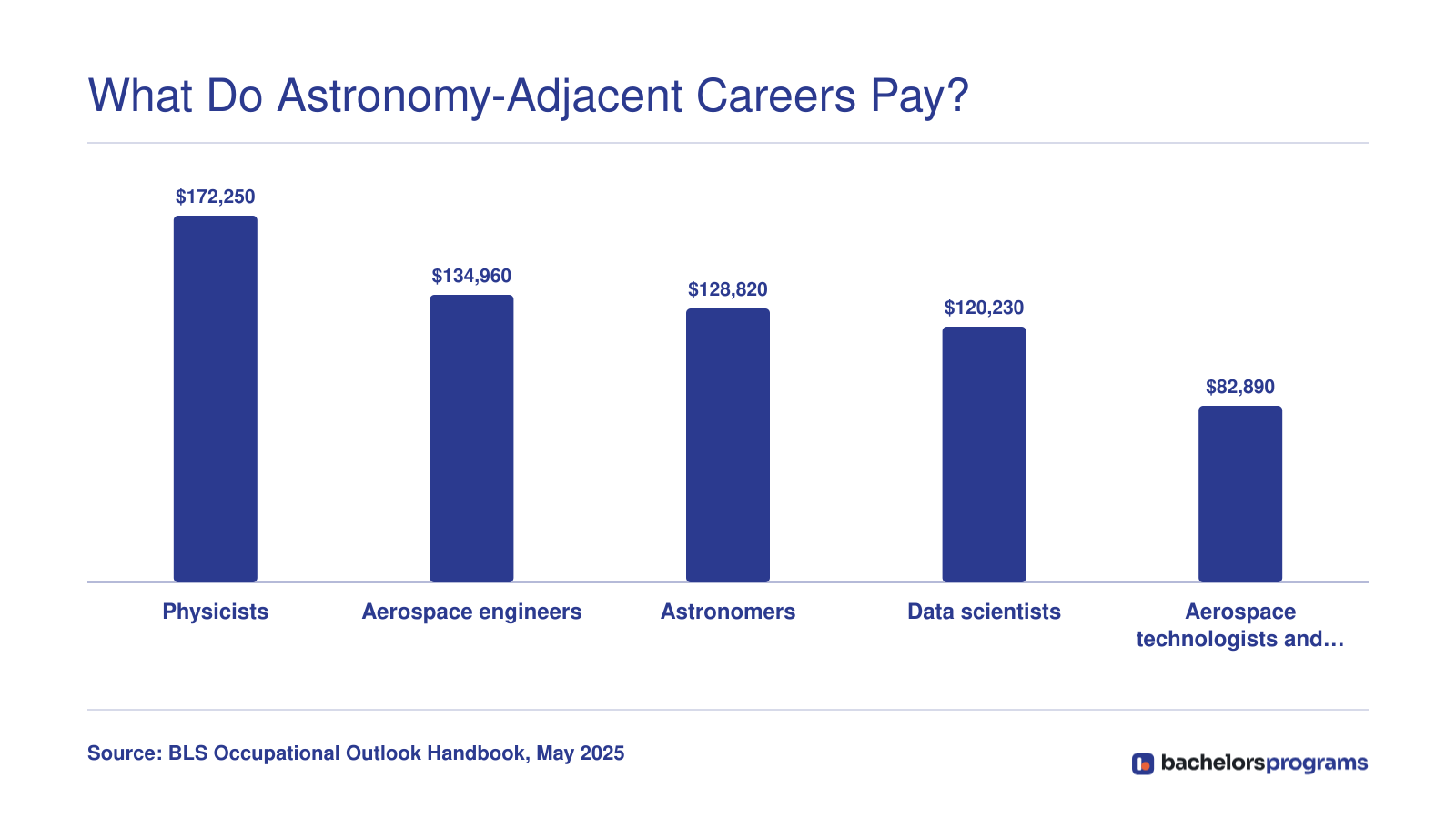
What Do Astronomy-Adjacent Careers Pay?
Physicist and astronomer pay reflects a workforce made up mostly of PhD holders, so read those bars as long-term targets rather than starting salaries. Data science and aerospace technician roles are more realistic entry points for bachelor's grads, and aerospace engineering is open to those who add engineering coursework, though pay varies by employer and region. BLS projects 2025-2035 growth of 35% for data scientists, 12% for aerospace engineering and operations technologists and technicians, 8% for aerospace engineers, and 7% for physicists and astronomers combined.
Astronomy & Space Studies programs by state
Astronomy and Space Studies Degree FAQs
These answers cover the practical questions students ask before committing to a bachelor's degree in astronomy and space studies. Requirements vary by school, so confirm details with the program you are considering.
Can you get an astronomy degree online?
How long does a bachelor's in astronomy take, and can transfer credits shorten it?
Can a space studies graduate get into an astrophysics or physics PhD program?
Do I need to be strong in calculus before starting an astronomy major?
Compare Astronomy & Space Studies programs on the data that matters
Explore more Science & Engineering majors or browse every field of study.
All Science & Engineering programs Browse every field of study