Best Online Chemistry Degree Programs
Compare 16 accredited online Chemistry programs, with net price after aid, graduation rates, earnings and debt from IPEDS and the U.S. College Scorecard.

Yes, you can earn a bachelor's degree in chemistry online; schools award it as a Bachelor of Science (B.S.) or a Bachelor of Arts (B.A.) in Chemistry. The harder question is lab work. Chemistry is a bench science, and programs answer the lab requirement differently, through home kits, virtual simulations, or short campus residencies.
The programs ranked on this page are fully online and undergraduate; graduate chemistry study carries different accreditation and lab expectations.
A lab course finished at a kitchen table is not the same credential as one finished at a fume hood, and some graduate programs and employers treat them differently.
Key Points
- Indiana University-Southeast is the most affordable pick, at $7,888 average net price.
- Fully online programs handle lab work through home kits and virtual simulations.
- For pharmacy school, Chapman rejects online labs, while St. John Fisher accepts them.
Best Fully Online Bachelor's Degree in Chemistry Programs for 2027
The list below collects online bachelor's degree in chemistry programs, and hybrid or campus-only options were filtered out before ranking. The pool is genuinely small, so this roster runs six schools rather than a padded ten, ordered by a blend of quality signals instead of any single measure. How each program handles laboratory work is the detail worth checking first, and a later section walks through home kits, virtual labs, and proctored exams.
University of West Florida
#1Pensacola, FL · $5,000 – $10,000/yr (est.)
Best for: Research-minded students starting labs as freshmen
At the University of West Florida, undergraduates can join a research group as early as their freshman year, and the department backs that up with more than 25 paid on-campus summer research positions plus over $25,000 in scholarships awarded annually. Students publish in peer-reviewed journals and present at local, regional, and national conferences. The B.S. specializations are approved by the American Chemical Society and require two calculus-based physics courses plus biochemistry with lab, while the B.A. bends the same coursework toward business, forensic science, pre-medical, pre-dental, pre-law, and environmental fields.
- American Chemical Society approved B.S. specializations
- Tracks: Chemistry; Chemistry/Biochemistry
- Honors research track inside the chemistry specialization
- Undergraduates can join research groups as freshmen
- More than 25 paid on-campus summer research positions
- $25,000+ in scholarships awarded each year
- Two calculus-based physics courses for ACS certification
- B.A. path applies chemistry to business, forensics, and pre-law
Athens State University
#2Athens, AL
Best for: Working adults transferring in prior credits
Athens State is a degree-completion, transfer-only university, so students arrive with prior college credit and typically finish in about two years depending on how many credits they bring and how many courses they take per semester. The chemistry major stresses laboratory practice: instrument use, sample preparation, experimental design, chemical measurement, and quantitative problem solving. A chemistry minor is available for students majoring elsewhere, and the department points graduates toward roles such as chemist, lab technician, industrial hygienist, safety manager, and science teacher, or toward graduate and professional school.
- Degree-completion format for students with prior credit
- About two years to finish, depending on transfer credit
- Lab work in instrumentation, sample prep, and analysis
- Chemistry minor also offered
- Prepares students for graduate or professional school
- Career paths include chemist, lab technician, and science teacher
Indiana University-Southeast
#3New Albany, IN · $5,000 – $10,000/yr (est.)
Best for: Small-class learners aiming at graduate school
Indiana University Southeast awards the chemistry major through its Bachelor of Science in Physical Sciences, a 120-credit degree built on analytical, organic, and inorganic chemistry with a 2.0 cumulative GPA minimum. Undergraduates work in modern labs, conduct research, and share results at conferences, and class sizes stay small enough for individual attention. Graduates receive an ACS certificate at graduation, and the major prepares students for graduate research in chemical science or for further study in chemical engineering and medical fields. Students from ten Kentucky counties qualify for in-state tuition under a reciprocity program.
- 120 credit hours with a 2.0 cumulative GPA minimum
- Core coursework in analytical, organic, and inorganic chemistry
- ACS certificate awarded at graduation
- Undergraduate research in modern labs, presented at conferences
- Small class sizes and Chemistry Club membership
- Students from ten Kentucky counties pay in-state tuition
- Prepares students for graduate study in chemical science or engineering
Metropolitan State University
#4Saint Paul, MN · ~$17,000/yr (est.)
Metropolitan State University keeps its chemistry major compact: 64 credits total, 25 of them upper division, with an 18-credit elective block students can shape toward a specialty. Core work runs through organic chemistry, quantitative analysis, physical chemistry, and a calculus-based physics sequence, and students must finish General Chemistry I and II before declaring. Undergraduates use instrumentation of the kind found in industry and can earn internship credit at a rate of one credit per 40 hours worked. Recent graduates report median earnings of about $63,580 four years after completion, with median debt of about $29,646.
- 64-credit major, including 25 upper division credits
- 18 elective credits split across three categories
- Calculus-based physics sequence required
- Industry-grade instrumentation in campus labs
- Internship credit: 1 credit per 40 hours worked
- Finish General Chemistry I and II before declaring the major
- Pathways into research, analytical, and product chemistry
Wilmington University
#5New Castle, DE · ~$16,000/yr (est.)
Wilmington University structures its chemistry degree as 29 courses totaling 120 credits, with rolling starts every eight weeks and admission guaranteed to most programs without standardized test scores. The core spans physical, analytical and instrumental, organic, inorganic, and biochemistry alongside physics, data science, and mathematics. Cooperative learning and mentored research give students work experience or a runway into graduate study. Graduates move into chemical manufacturing, pharmaceutical and biotechnology companies, forensic science and crime labs, environmental and waste management, and government agencies.
- 120 credit hours across 29 courses
- Core spans physical, analytical, organic, inorganic, and biochemistry
- Supporting work in physics, data science, and mathematics
- No entrance exam and no standardized test scores
- Rolling starts every eight weeks
- Cooperative learning and mentored research
- Prepares students for graduate-level study
Howard Payne University
#6Brownwood, TX · ~$24,000/yr (est.)
Howard Payne University keeps chemistry classes small and pairs lecture sequences with laboratory work, so students spend real time at the bench rather than only in a lecture hall. The B.S. in Chemistry - Standard is a 120-hour, four-year degree, and the same department offers biochemistry and forensic science variants plus a 22-24 hour chemistry minor. Students get personal advising and faculty mentorship and can present at the department's yearly Summer Research Symposium. Graduates head into laboratory technician roles or fields such as toxicology, forensic science, physician assistant studies, and veterinary medicine, or continue into graduate and professional programs.
- 120 credit hours on a four-year plan
- Two concentration options within the department
- Laboratory work paired with classroom instruction
- Chemistry minor of 22-24 credit hours
- Yearly Summer Research Symposium for student projects
- Personal advising and faculty mentorship in small classes
- Sister tracks in biochemistry and forensic science
None of the ranked Chemistry programs match the online lens yet. The full ranking is at the link above.
Cost, debt & payoff
Median earnings of this field's bachelor's graduates (4 yrs after completing, else the school's undergraduate median) vs. their median federal loan debt · U.S. College Scorecard
Across these programs the median graduate earns about $57,514 and finishes with roughly $23,250 in debt — a ratio that clears a common rule of thumb (keep debt below first-year salary). Net price and debt vary widely school to school, so check the per-school figures in the table above before you shortlist.
How We Ranked Online Chemistry Programs
The same bar applied to every program before scoring.
What Counted as Eligible
Only bachelor's-level chemistry programs delivered fully online were eligible. Hybrid formats and degrees that require any campus attendance were set aside, since the point is a degree an adult can finish without relocating. Each program also had to be offered by an accredited institution.
How the Order Was Set
Schools were ordered by a composite quality score, not a single measure such as sticker price. Each was weighed on three plain questions: what will it cost (average net price after aid), how often do students finish (graduation and retention rates), and what do graduates earn and owe (program-level earnings and debt where published). Holding cost, completion, and outcomes in one score keeps a cheap program with weak completion from outranking a stronger one.
Where the Numbers Came From
Figures come from the U.S. Department of Education's College Scorecard, both at the institution level and at the program level by CIP code, plus tuition and fees reported through IPEDS. The Scorecard snapshot used here reflects the most recent release available in 2026.
What the Score Cannot Tell You
The graduation rate covers the whole school, not the chemistry major, and the net price shown averages aid across students, so your own offer will differ. Small programs sometimes have no published earnings at all, so those cells stay blank rather than being estimated.
How Online Chemistry Labs Work: Home Kits, Virtual Labs, and Proctored Exams
Louisiana State University at Alexandria's online B.S. in Chemistry (Industry Professional concentration) delivers its required labs through three one-week, on-campus intensives, three weeks in total. That is one honest answer to "how do online chemistry labs work?": the lectures move online, and some of the bench work stays in person.
The Main Lab Formats
- Home lab kits: Supplies are shipped to you for experiments at home. Science Interactive offers hands-on kits, and eScience or Hands-On Labs kits work the same way.
- Virtual labs: Simulations let you run procedures and analyze data on screen.
- Remote instruments: Some programs let you operate real equipment over the internet.
- Campus intensives: Short residencies, often in summer, concentrate the hands-on work into one or two weeks.
What the Schools Here Require
LSUA says it does not require ongoing campus attendance, but the lab component still means three trips (CHEM 2002, CHEM 3361 and CHEM 3362), either during the semester or in prescheduled summer residencies. Arizona State University's online B.A. in Chemistry is mixed. Many labs are online, but the organic chemistry and biochemistry labs are in person, described as two-week summer labs.
So are there fully online chemistry degrees with no campus visits? Among the programs where we could confirm lab details, no. Oregon State Ecampus offers a fully online lab course, CH 140, which is useful for transfer credit, but that is one course rather than a complete bachelor's. Metropolitan State University and Wilmington University both list fully online options. Ask their admissions offices, before you apply, which lab format they use and whether any visit is required.
How Work Is Proctored
The usual tools are online proctoring services that monitor exams by webcam, and video-recorded lab work submitted alongside written reports. Each school sets its own rules, so ask which one applies and whether any exams must be taken at an approved testing center.
The Upper-Division Trade-Off
Introductory labs translate to home kits and simulations fairly well. Upper-division labs such as instrumental analysis and physical chemistry depend on equipment that cannot be mailed to your house. That is why ASU holds its organic and biochemistry labs in person and LSUA concentrates its labs into residencies. Before enrolling, ask exactly how a program handles those advanced labs, and whether a simulation will satisfy graduate schools or employers who expect hands-on instrument experience.
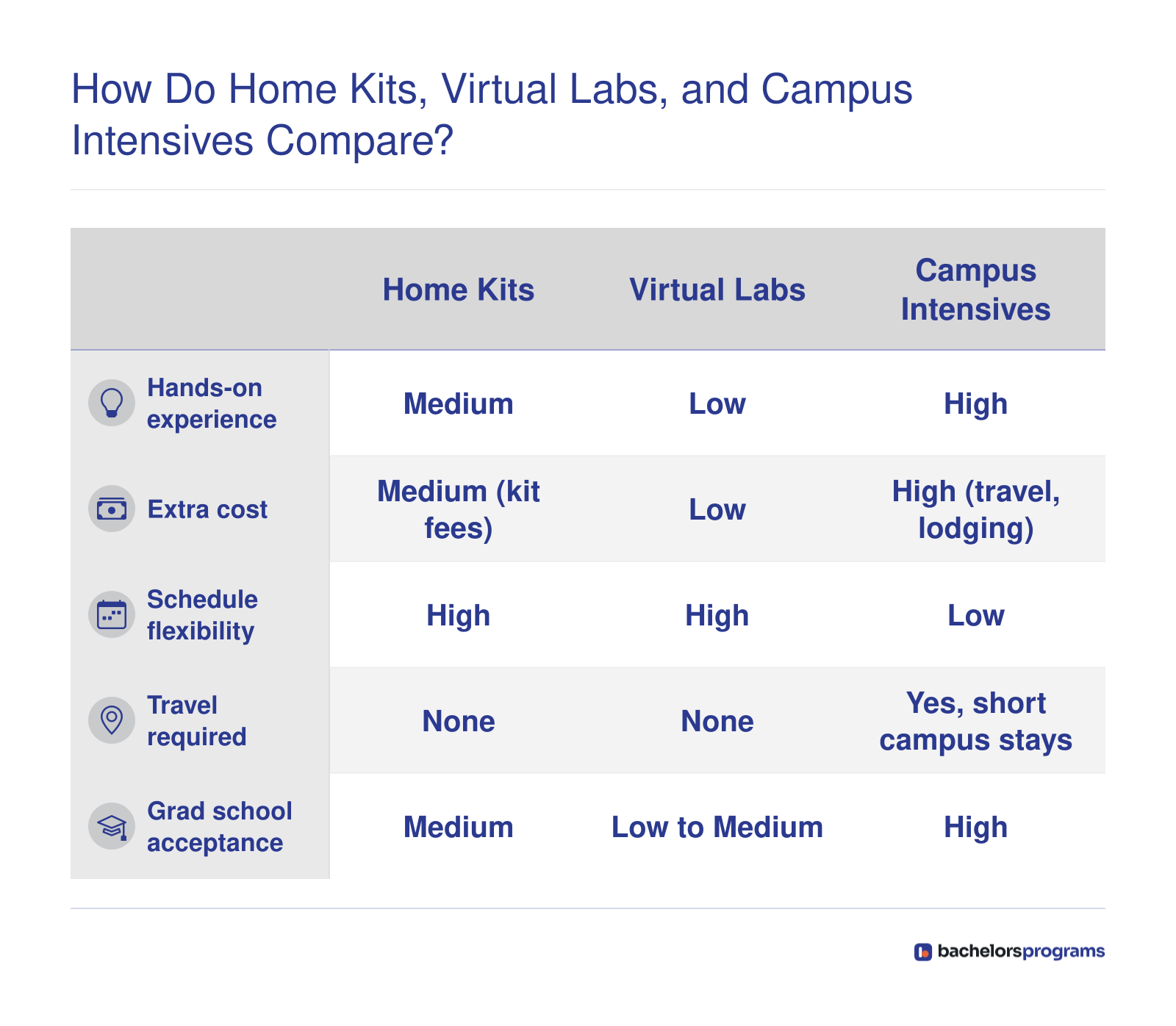
How Do Home Kits, Virtual Labs, and Campus Intensives Compare?
Online chemistry programs deliver lab work in three main ways, and each trades flexibility against hands-on practice differently. The fully online programs ranked here rely on home kits and virtual labs, so you can finish lab requirements without traveling to campus.
What an Online Chemistry Degree Costs: Net Price, Tuition, and Debt
Average net price at the schools ranked here runs from $7,888 to $23,627 a year. Indiana University-Southeast ($7,888) and the University of West Florida ($9,364) are the most affordable options, followed by Wilmington University ($15,644). Net price does not include program charges such as per-credit online rates or lab fees: Wilmington lists $1,317 for a 3-credit course, and home lab kits for online chemistry courses at schools such as West Texas A&M University and Cochise College cost $150 to $285 per course. Wilmington, Metropolitan State, and Howard Payne charge the same tuition regardless of residency, so their out-of-state figure is not an added surcharge, and the debt column covers all of each school's graduates, not chemistry majors alone.
| School | In-State Tuition and Fees | Out-of-State Tuition and Fees | Average Net Price | Pell Grant Share | Median Federal Debt (Institution-Wide) |
|---|---|---|---|---|---|
| Indiana University-Southeast | $8,424 | $22,811 | $7,888 | 66% | $19,684 |
| University of West Florida | $6,360 | $19,241 | $9,364 | 68% | $16,624 |
| Wilmington University | $12,630 | $12,630 | $15,644 | 70% | $20,000 |
| Metropolitan State University | $9,840 | $9,840 | $16,863 | 68% | $17,100 |
| Howard Payne University | $34,982 | $34,982 | $23,627 | 58% | $26,793 |
Accreditation, ACS Approval, and Graduate School Readiness
St. John Fisher University accepts online science prerequisites with labs from regionally accredited colleges.[[CITE:890583]] Chapman University does not accept online lab courses at all, with human anatomy as the lone exception.[[CITE:890585]] Both read the same pharmacy applicant pool, and the distance between those two policies explains why accreditation and lab format deserve a check before you enroll.
## Institutional Accreditation Is the Floor
Institutional accreditation, the category once called regional accreditation, is what makes a degree usable. It qualifies the program for federal financial aid, keeps credits transferable, and satisfies the "accredited institution" language written into most graduate admissions policies. St. John Fisher and UNC Eshelman specify regionally accredited coursework; Chapman requires coursework from accredited institutions. Every school here holds institutional accreditation; the U.S. Department of Education's database lists the exact accreditor for any institution, and checking it takes about a minute for a program you are seriously considering.
## ACS Approval Is a Separate Badge
The American Chemical Society approves specific degree tracks, not whole colleges. An ACS-approved bachelor's degree in chemistry usually means a defined slate of chemistry courses plus substantial in-person laboratory hours, which is difficult to deliver fully online. Of the programs here, University of West Florida lists ACS accreditation among its highlights, and Indiana University Southeast notes an ACS certificate at graduation. Other entries, including Metropolitan State University and Wilmington University, describe fully online chemistry options without claiming ACS status. Confirm with the department directly, since approval is reviewed on a cycle.
## What Graduate Schools Actually Say
There is no national rule. AAMC states plainly that each medical school sets its own requirements[[CITE:890588]], and [[LINK:2|the 2026 MSAR]] shows the split: some schools accept online labs verified through AMCAS, some limit online coursework to the Spring 2020 through Fall 2021 window, some cap online prerequisite lectures and require labs in person, and some will not consider an [[LINK:1|online bachelor's degree]]. Pharmacy programs vary just as widely. UNC Eshelman requires prior approval for online labs[[CITE:890587]], Kansas permits online science prerequisites with labs but flags lab courses under two credits[[CITE:890584]], and UT Austin lists General Chemistry I and II with labs without saying whether online versions qualify.[[CITE:890586]]
## The Practical Takeaway
If you are pre-health, build your target-school list first and ask each admissions office in writing whether a specific online chemistry lab will count. Get the answer before you register, not after.
Related Articles
B.S. vs. B.A. in Chemistry, and How Biochemistry Compares
Choosing between a B.S. and a B.A. in chemistry is a tradeoff between depth and flexibility: the B.S. packs in more required science, while the B.A. leaves room to pair chemistry with another field. Requirements vary by school, so check each catalog, but the general pattern holds.
How the Two Degrees Compare
- Math and physics: A B.S. typically requires calculus beyond the first course plus a full year of calculus-based physics. A B.A. often asks for less of both.
- Upper-division chemistry: The B.S. usually carries more advanced credits, such as physical chemistry, instrumental analysis, and inorganic chemistry. The B.A. requires fewer.
- Lab intensity: Expect more lab hours, and often a research or capstone component, in the B.S.
- Career or grad path: The B.S. suits lab-based chemist roles and later advanced study. The B.A. fits teaching, science writing, policy, or business, especially alongside a second major.
- Pre-med or pre-pharmacy: Either can cover prerequisites if you add the required biology courses. The B.A. leaves more elective room for them, while the B.S. gives a deeper chemistry foundation. Confirm requirements with the schools you plan to apply to.
Where Biochemistry Fits
Biochemistry shares general and organic chemistry with the chemistry major but trades some physical chemistry for molecular biology and biochemistry courses. The Bureau of Labor Statistics notes that chemists may work in interdisciplinary biochemistry, so the occupations overlap heavily.1
Be careful with the pay numbers. Chemists earned a national median of $91,240 in 2025, with a bachelor's degree as the typical entry credential.1 Biochemists and biophysicists had a median of $127,410, but their typical entry education is a doctoral or professional degree, so that figure does not describe bachelor's graduates.2 Clinical laboratory technologists, who typically need a bachelor's in medical technology or a life science such as chemistry, had a median of $62,930.3 No reliable national data compares B.S. and B.A. pay or employer preference.
Why Search Results Mix Degree Types
Schools label specializations differently. Common concentrations include analytical, industrial, medicinal, and chemistry education, and some programs fold them into a general chemistry degree. Online search results also mix in biochemistry, chemical engineering, and associate degrees. Check the exact degree title and concentration before you compare programs.
Questions to Ask Yourself
Are you headed to pharmacy, medical, or Ph.D. programs?
Do you want a lab bench job in quality control or manufacturing?
Are you planning to teach high school chemistry?
What You Can Do With a Chemistry Degree: Careers and Earnings
A bachelor's degree in chemistry splits graduates into two broad camps: bench scientists who design and run experiments, and technicians who support them. The Bureau of Labor Statistics tracks these separately, and the pay gap between them is real.
Common Roles and Job Outlook
Graduates most often land as chemists, chemical technicians, quality control analysts, lab managers, regulatory specialists, or (with a teaching credential) high school science teachers. The federal numbers:
- Chemists: Median pay of $91,240 a year as of 2025,1 with about 84,900 people employed as of 2024.2 Employment of chemists and materials scientists is projected to grow 7 percent from 2025 to 2035.1 Chemical manufacturing employs roughly 28 percent of them; federal government chemists post a much higher median of $137,720, while testing laboratories sit at $66,140.
- Chemical technicians: Median pay of $60,390 in 2025, with employment near 60,000 and projected growth of 5 percent from 2025 to 2035.3 Chemical manufacturing again leads at about 30 percent of jobs; testing labs pay a median of $49,050.
The lesson for job hunting is blunt: industry matters as much as job title. A federal lab and a contract testing lab can differ by tens of thousands of dollars for similar work.
What Graduates of These Programs Actually Earn
Federal earnings data for individual chemistry programs is thin, since small graduating cohorts get suppressed. Where it is published, it is useful. Chemistry graduates of Metropolitan State University reported median earnings of $63,580 four years after finishing, against median program debt of about $29,646. That works out to a debt load roughly half of one year's pay, which is a manageable ratio by federal standards and comfortably inside what most repayment calculators flag as sustainable.
Use that frame on any program you consider: compare the median debt a program's graduates carry to the starting pay you can realistically expect in your target industry. A degree that leaves you owing less than a year's salary gives you room to take a lower-paying research or government role early, then move up.
National Median Pay for Chemists
Federal wage data shows what a bachelor's degree in chemistry can lead to in the U.S. job market.
Chemistry programs by state
Compare Chemistry programs on the data that matters
Explore more Science & Engineering majors or browse every field of study.
All Science & Engineering programs Browse every field of study