Best Physiology Degree Programs
Compare 130+ accredited Physiology programs, with net price after aid, graduation rates, earnings and debt from IPEDS and the U.S. College Scorecard.

A physiology major housed in a kinesiology department and one folded into a biology core can share a name and teach very different course sequences. The most common credential is the Bachelor of Arts (B.A.) in Physiology, though plenty of schools award a B.S. or label the major human physiology or exercise physiology.
Most students choose a physiology major for the pre-health prerequisites and later discover where a bachelor's degree alone can take them: exercise physiology, clinical research, lab science. Average net price after aid across the programs ranked here runs from roughly $6,500 to $29,600. That spread, not the major's name, separates a workable four years from a costly one.
Key Points
- Annual tuition at the ranked schools spans roughly $6,400 to $70,000-plus.
- Medical schools prefer no major, making physiology a sound pre-med path.
- Exercise physiologists earned a median $59,460 in May 2025, BLS reports.
The 10 Best Schools for a Bachelor's Degree in Physiology
All 10 programs on this list are campus-based, six of the ten are public universities, and their tuition ranges from roughly $6,400 a year in state at one end to more than $70,000 at the other. They sit in eight states, with three University of California campuses in the mix, and nearly all of them place physiology inside a larger biology, kinesiology or integrative biology department rather than running it as a stand-alone major. What they share is a lab component and a pre-health orientation, with medicine, physical therapy and biomedical research named again and again as intended destinations.
University of Florida
#1Gainesville, FL · ~$7,000/yr (est.)
Best for: Pre-med students seeking internship-heavy training
The University of Florida runs one of the country's largest applied physiology programs, and the major sits inside a health and human performance college with working ties to the university's medical, veterinary, engineering and health professions schools. In-state students pay about $6,400 a year in tuition and fees against roughly $28,700 out of state, the school admits 24% of applicants, and its graduation rate is 91%. The program reports a 46% medical school admission rate and 47% acceptance to physical therapy programs, and graduates working full time earn a median of $73,679 four years after finishing, with median debt of $16,888.
- 12 credit hours of internship as a capstone
- Program reports 46% medical school admission rate
- Program reports 47% acceptance to physical therapy programs
- No separate major application; students transition after prerequisites
- Change-of-major applicants need 75% of tracking courses and 27 gen-ed hours
- Coursework spans anatomy, physiology, biomechanics and motor behavior
- Core classes offered in both fall and spring terms
Rice University
#2Houston, TX · ~$13,000/yr (est.)
Best for: Aspiring physical therapists wanting a research capstone
Rice University is a private research university in Houston with a 6-to-1 student-faculty ratio and a kinesiology department that offers both a Bachelor of Arts and a Bachelor of Science. Tuition and fees run about $64,100 a year, the school admits 8% of applicants, and its graduation rate is 95%.
- Offered as both a Bachelor of Arts and a Bachelor of Science
- BS adds biology, chemistry and physics plus advanced kinesiology electives
- Capstone research experience required for the BS
- Coursework includes human anatomy lab, human physiology and biomechanics
- STEM-designated major
- Rice-UTMB Physical Therapy Scholars Program gives majors preference
- Supervised research and sports medicine internships for upperclassmen
- No graduate program in the department
University of California-Los Angeles
#3Los Angeles, CA · $13,000/yr (est. net price)
Best for: Aspiring researchers drawn to anatomy labs
UCLA is a public research university whose physiological science major is one of the larger programs of its kind, awarding bachelor's degrees through the Department of Integrative Biology and Physiology. In-state tuition and fees are about $15,200 against roughly $49,400 out of state, the campus admits 9% of applicants, and its graduation rate is 93%. Students train in a dedicated human anatomy laboratory with faculty who include eight UCLA Distinguished Teaching Award recipients, and graduates working full time report median earnings of $57,139 four years after finishing, with median debt of $17,049.
- Dedicated human anatomy laboratory for majors
- Coursework runs from molecules and cells to organs and whole-body systems
- Draws on neuroscience, molecular biology, cellular mechanisms and pathology
- Faculty include eight UCLA Distinguished Teaching Award recipients
- Program covers how gene disruptions lead to disease
- Prepares graduates for medicine, healthcare and biomedical research
Brown University
#4Providence, RI · $25,000 – $30,000/yr (est.)
Brown University is an Ivy League school in Providence where undergraduates design a concentration instead of declaring a fixed major, and biology is one of the most flexible routes through the curriculum. Tuition and fees are about $71,400 a year, the school admits 5% of applicants, and its graduation rate is 96%. The physiology and biotechnology track threads through courses such as cell physiology and biophysics, tissue engineering and physiological pharmacology, and every Sc.B. student completes a two-semester research requirement.
- Physiology and Biotechnology is one of seven thematic tracks
- Three-course track includes Cell Physiology and Biophysics
- At least three courses must carry a lab or fieldwork component
- Sc.B. requires seven prerequisites plus fourteen biology courses
- Two-semester research requirement for Sc.B. students
- Honors requires a thesis and presentation based on a research project
- Directed research counts toward concentration credit
Duke University
#5Durham, NC · ~$30,000/yr (est.)
Duke University is a private research university in Durham with a 5-to-1 student-faculty ratio and 12 separate concentrations inside its biology major. Tuition and fees run about $68,800 a year, the school admits 6% of applicants, and its graduation rate is 97%. The anatomy, physiology and biomechanics concentration appears as a notation on the official transcript, requires a 400-level capstone and two full lab courses beyond the introductory sequence, and students heading to graduate school are pushed toward an extended multi-semester research project.
- At least four courses from an approved APB course list
- One of the four must be a 400-level capstone
- Two full lab courses at the 200 level or above
- Major requires at least 10 courses including three biology area courses
- Concentration appears as a notation on the official transcript
- Extended multi-semester research encouraged for graduate school
- Up to two approved alternate electives may count
University of Washington-Seattle Campus
#6Seattle, WA · ~$14,000/yr (est.)
The University of Washington's Seattle campus is a large public research university with medical, nursing, pharmacy and public health schools on and around campus, which makes it a natural fit for students pointed at health professions. In-state students pay about $13,000 in tuition and fees and out-of-state students about $43,200, the school admits 39% of applicants, and its graduation rate is 85%. Physiology is an option inside the BS in Biology with 31 credits of advanced physiology coursework, and graduates working full time earn a median of $60,004 four years after finishing, with median debt of $17,493.
- Physiology option inside the BS in Biology
- At least 31 credits of advanced physiology electives
- Two advanced physiology courses and one physiology lab required
- 90 total credits including BIOL 180, 200 and 220 with a 2.0 minimum
- 2.5 minimum GPA in supporting courses for admission to the option
- Two laboratory courses required beyond the introductory labs
- Departmental honors needs a 3.3 UW GPA and 3.4 major GPA
University of California-Davis
#7Davis, CA · $10,000 – $15,000/yr (est.)
UC Davis is a public research university in California's Central Valley with a large College of Biological Sciences and one of the country's better-known veterinary medicine schools. In-state tuition and fees are about $16,800 against roughly $51,000 out of state, the school admits 42% of applicants, and its graduation rate is 86%. Physiology is one of three tracks inside the neurobiology, physiology and behavior major, it requires a systemic physiology laboratory plus four depth electives, and students can propose a custom track with an advisor. Graduates working full time earn a median of $66,461 four years after finishing, with median debt of $14,598.
- Physiology is one of three tracks in the NPB major
- 97 units minimum for the degree
- Track electives include Human Gross Anatomy and Exercise Physiology
- NPB 101L Systemic Physiology Laboratory is required
- At least four depth electives, two upper-division NPB or EXB
- Custom track possible with approval from a biology advisor
- Prepares students for medicine, veterinary, dental, pharmacy or nursing study
Brigham Young University
#8Provo, UT · $15,000 – $20,000/yr (est.)
Brigham Young University is a church-affiliated private university in Provo that charges unusually low tuition for an independent institution, which shows up sharply in its price. Tuition and fees are about $6,700 a year for everyone, the school admits 68% of applicants, and its graduation rate is 81%. The cell biology and physiology BS keeps the degree tight at about 62.5 credit hours, requires a capstone and three hours of experiential learning, and graduates working full time earn a median of $68,321 four years after finishing with median debt of $13,000.
- 62.5 minimum credit hours
- Eight major core courses plus eight chemistry and physics courses
- Three hours of experiential learning: research, internship, teaching and more
- Capstone course required from eight options
- Six hours of electives required
- Learning outcomes include scientific writing and laboratory techniques
- Emphasizes analysis of scientific literature
University of California-Irvine
#9Irvine, CA · $14,000/yr (est. net price)
UC Irvine is a public research university in Orange County with a large biological sciences division and a medical school on campus. In-state tuition and fees are about $15,700 against roughly $49,900 out of state, the school admits 29% of applicants, and its graduation rate is 87%. The physiology and exercise science BS is catalogued alongside the biological sciences focus area and repeated under both health and medicine and pre-med groupings, which makes the pre-health intent of the degree easy to see from the start.
- Grouped with health and medicine majors in the catalogue
- Also grouped with pre-med majors
- Listed under the biological sciences focus area
- Awards a Bachelor of Science degree
Purdue University
#10West Lafayette, IN · ~$15,000/yr (est.)
Purdue University is a large public land-grant university in West Lafayette with a strong science and engineering identity and a College of Science that houses the neurobiology and physiology major. In-state tuition and fees are about $10,000 against roughly $28,800 out of state, the school admits 50% of applicants, and its graduation rate is 83%. The BS combines physiology with neurobiology and points students toward medicine, clinical research, veterinary medicine, neuroscience and biotechnology, and transfer applicants need a 3.0 GPA plus at least a C+ in the equivalent biology, chemistry and calculus courses.
- Combines physiology with neurobiology in the College of Science
- Transfer applicants need a 3.0 GPA and C+ in key science courses
- Recommended high school prep includes four years of math and English
- Prepares students for medicine, research, veterinary and biotech careers
- On-campus program at the West Lafayette campus
- Three years of high school lab science recommended
Cost & outcomes by school
Federal data for the highest-earning Physiology programs, independent of the ranking above. Earnings are this field's bachelor's graduates four years after completing where the Scorecard reports them, else the school's undergraduate median.
| School | Net price / yr | Grad rate | Earnings | Debt | Grads/yr | Format |
|---|---|---|---|---|---|---|
| University of Dayton OH | $29,533 | 80% | $109,604 | $23,250 | — | Campus |
| Cornell University NY | $28,690 | 95% | $104,043 | $14,000 | — | Campus |
| Boston College MA | $41,704 | 91% | $103,937 | $19,000 | — | Campus |
| Duke University NC | $29,612 | 97% | $97,800 | $13,000 | — | Campus |
| Brown University RI | $25,184 | 96% | $93,487 | $11,428 | — | Campus |
| University of Southern California CA | $32,740 | 92% | $92,498 | $18,000 | — | Campus |
| California Polytechnic State University-San Luis Obispo CA | $16,665 | 86% | $90,768 | $18,500 | — | Campus |
| Rice University TX | $13,370 | 95% | $89,718 | $11,000 | 52 | Campus |
| Saint Joseph's University - Philadelphia PA | $29,689 | 79% | $86,881 | $25,500 | — | Campus |
| Drexel University PA | $38,509 | 78% | $84,648 | $25,325 | — | Campus |
| University of Maryland-College Park MD | $15,678 | 89% | $82,860 | $19,000 | — | Campus |
| University of California-Irvine CA | $14,251 | 87% | $80,735 | $15,000 | 14 | Campus |
Sources: U.S. Department of Education. Net price, graduation rate, earnings and debt: College Scorecard (earnings and debt for this field's bachelor's graduates where reported, else school-wide); graduates: IPEDS. A dash means no figure is reported.
Cost, debt & payoff
Median earnings of this field's bachelor's graduates (4 yrs after completing, else the school's undergraduate median) vs. their median federal loan debt · U.S. College Scorecard
Across these programs the median graduate earns about $60,765 and finishes with roughly $21,187 in debt — a ratio that clears a common rule of thumb (keep debt below first-year salary). Net price and debt vary widely school to school, so check the per-school figures in the table above before you shortlist.
How We Ranked Physiology Bachelor's Programs
Physiology sits in many different academic homes, from biology departments to kinesiology schools, so a program's name alone tells you little. The ranking covers only bachelor's-level physiology programs: majors, options, and concentrations housed in biology, integrative biology, and exercise science departments. Campus, online, and hybrid formats were all eligible.
What We Measured
- Affordability: Published in-state and out-of-state tuition, plus average net price after grants and scholarships. Net price shows what families typically pay, which often differs sharply from the sticker price.
- Program-level outcomes: Median earnings after completion and median federal debt for physiology graduates, drawn from the U.S. Department of Education's College Scorecard. Comparing the two shows whether a program's payoff justifies its borrowing.
- Program size: The number of physiology degrees a school awards. Larger programs tend to offer more lab sections and research openings, while smaller ones may offer closer faculty contact.
- Selectivity: Admission rate, which helps you gauge how competitive getting in will be.
- Student success: Graduation and retention rates. Strong retention suggests students get the support they need to push through demanding gateway courses like organic chemistry and physics.
Where the Data Falls Short
Some of these figures describe the whole university, not the physiology major. Graduation rate, retention rate, and net price are institution-wide, so a school's physiology students may perform better or worse than its overall averages.
Program-level earnings and debt also have gaps. College Scorecard does not publish them for every program, usually because a graduating group is too small to report. When those figures were unavailable, we did not estimate them.
How to Use This Ranking
Treat the list as a starting point. Before applying, compare each program's prerequisites, research requirements, and pre-health advising, since those details shape your path to medical, PA, or PT school as much as any number here.
Physiology vs. Exercise Physiology vs. Human Physiology Degrees
At many schools, "human physiology" is simply another name for general physiology, so check the course list rather than the title. Exercise science programs can be accredited by CAAHEP (the Commission on Accreditation of Allied Health Education Programs, through its CoAES committee), and that accreditation matters for ACSM certification. Rule of thumb: pick general or human physiology for med, PA, or research paths, and exercise physiology for fitness, rehab, and clinical exercise roles.
| Factor | General Physiology | Exercise Physiology | Human Physiology |
|---|---|---|---|
| Typical degree title | B.A. or B.S. in Physiology, depending on the school | B.S. in Exercise Science, Exercise Physiology, or Kinesiology (ACSM lists all three as qualifying fields) | B.S. or B.A. in Human Physiology, often the same program as general physiology |
| Core focus | How organ systems function in the body, from cells to whole organisms | How the body responds to exercise, plus testing, prescription, and conditioning | Same systems-level focus as general physiology, sometimes with a stronger human health angle |
| Lab and science load | Typically heavy: biology, chemistry, and physics, often with upper-level lab work | Typically moderate: anatomy and physiology, biomechanics, and applied labs such as exercise testing | Typically heavy and similar to general physiology; confirm on the course list |
| Best-fit goal | Pre-med, PA, other health professions, and research | Fitness, rehab, and clinical exercise roles | Pre-med, PA, other health professions, and research |
| Programmatic accreditation | CAAHEP/CoAES accreditation applies to Exercise Science programs, so a physiology degree is not the qualifying program type | CAAHEP accreditation is available for Exercise Science programs and becomes an ACSM requirement for graduates on or after August 15, 2027 (a formally initiated process also counts) | Same as general physiology: not identified as the qualifying accredited program type |
| ACSM-EP eligibility | Not eligible by title; ACSM has no petition process for non-exercise-science degrees | Eligible with at least 21 semester hours of exercise science coursework, a stand-alone exercise physiology course of 3 or more credits, and current CPR/AED certification | Not eligible by title; the same ACSM coursework rules apply |
| ACSM-CEP eligibility | Not listed by title; must meet the equivalent-major coursework and experience rules | Bachelor's in Exercise Science or Exercise Physiology plus 1,200 hours of clinical experience (a master's pathway requires 600 hours) | Not listed by title; must meet the equivalent-major coursework and experience rules |
Cheapest and Best-Value Physiology Programs
Costs below are average net price after grants and scholarships, based on 2024 IPEDS and College Scorecard data from the U.S. Department of Education, with published in-state and out-of-state tuition shown separately for comparison. Texas A&M University-Central Texas posts the lowest net price at $1,300, though it does not report program-level debt. UCLA's net price is nearly double the University of Florida's, yet graduates of the two programs carry almost identical median debt ($16,900 vs. $16,776, or about $179 and $178 a month over 10 years), so the cheapest sticker price is not automatically the best value. All of these schools are public, and that advantage depends on residency: out-of-state tuition reaches $17,154 at A&M-Central Texas, $28,659 at Florida and $49,403 at UCLA. Average net price is only an approximation, so run each school's net price calculator with your own family's finances before you commit to a shortlist.
| School | Location | Sector | Program | Average Net Price (After Aid) | In-State Tuition and Fees | Out-of-State Tuition and Fees | Program Median Debt | Est. Monthly Payment (10-Year) |
|---|---|---|---|---|---|---|---|---|
| Texas A&M University-Central Texas | Killeen, TX | Public | B.S. in Exercise Physiology and Human Performance | $1,300 | $7,363 | $17,154 | N/A | N/A |
| University of Florida | Gainesville, FL | Public | Applied Physiology & Kinesiology | $6,541 | $6,381 | $28,659 | $16,776 | $178 |
| University of California-Los Angeles | Los Angeles, CA | Public | Physiological Science | $12,548 | $15,203 | $49,403 | $16,900 | $179 |
Related Articles
Is a Physiology Degree Good for Medical School?
A physiology degree is a sound route to medical school: it builds the science foundation admissions committees expect, and the major itself does not count against you. Medical schools do not prefer any particular major.
What the AAMC Data Shows
AAMC data for 2024-2025 shows biological sciences majors made up the largest group of MD matriculants by far, at 13,420.1 Physical sciences (2,121), social sciences (2,040), and humanities (785) were much smaller groups.1 Physiology is generally reported within the biological sciences category. AAMC has also noted that more than half of applicants over the prior five years reported a biological sciences major.3
Those are enrollment counts, not acceptance rates, so they show who gets in rather than who is favored. Mean scores among matriculants were close across groups. Biological sciences majors averaged a 511.6 MCAT and a 3.79 total GPA.1 Physical sciences majors averaged 513.6 and 3.78, and humanities majors 513.3 and 3.79.1 For acceptance rates by major group and the overall rate, check the latest AAMC FACTS tables directly.
What Matters More Than Your Major
GPA, MCAT performance, clinical experience, and finished prerequisites carry the weight. A physiology major with a 3.8 and meaningful patient-facing hours beats a higher-profile major with weaker numbers.
Prerequisites: What Physiology Covers and What You Add
AAMC guidance says students will likely complete one year of biology, one year of English, and two years of chemistry through organic chemistry.2 Individual schools set their own lists, so confirm each one. Commonly required or recommended courses include:
- Biology: Usually built into the physiology curriculum.
- General chemistry: Often required for the major.
- Organic chemistry and biochemistry: Sometimes required, sometimes an elective you must add.
- Physics: Frequently not part of the core, so plan to add it.
- English: Usually satisfied through general education, but verify the count.
- Statistics: Often a major requirement, though some programs leave it optional.
An Honest Caveat
B.A. programs in physiology often leave more room for electives and fewer required lab sciences than B.S. tracks. That flexibility helps if you want a minor or a semester abroad, but you may need to spend it on extra chemistry or physics courses to cover every prerequisite. Map the major's requirements against your target schools' lists before your sophomore year.
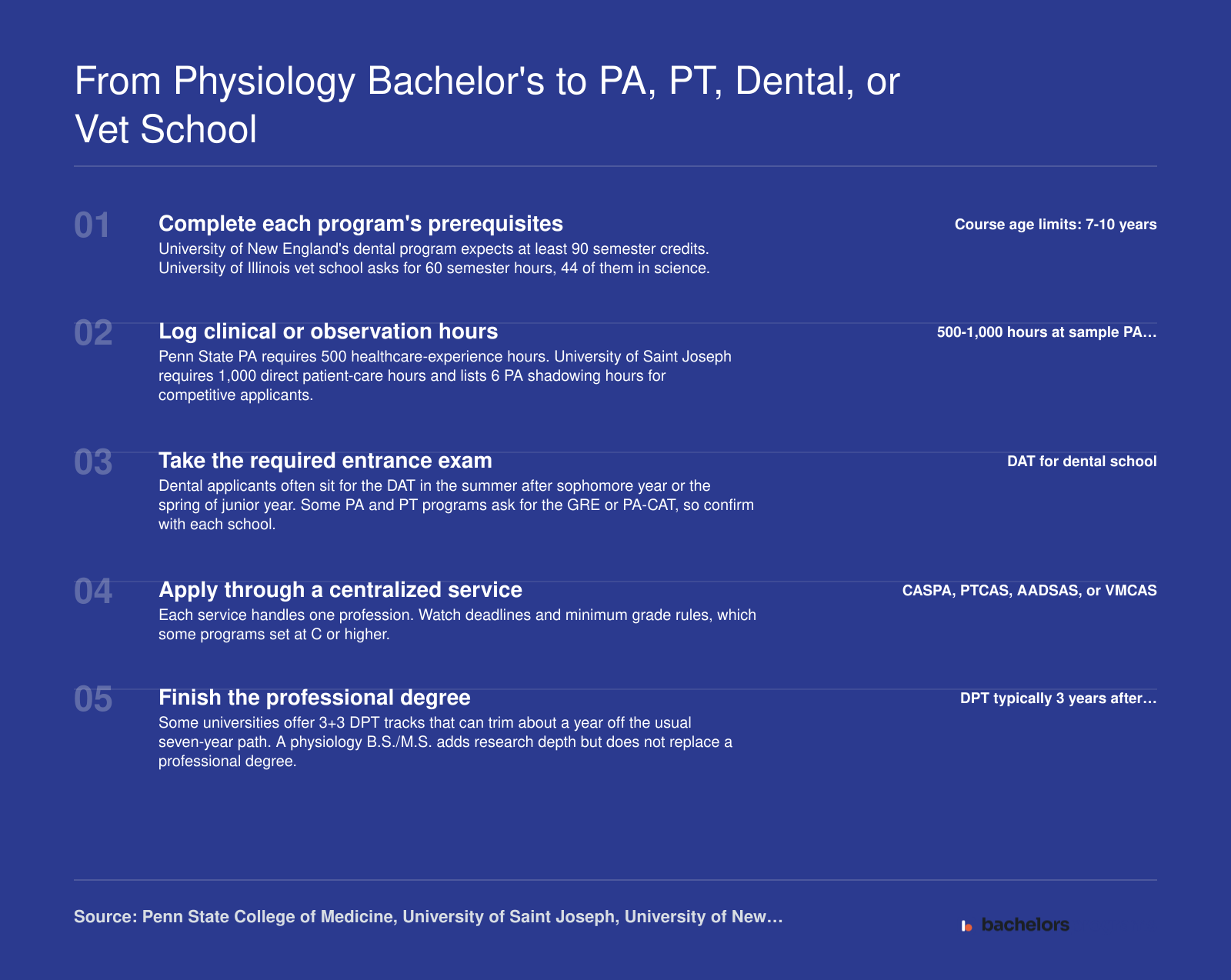
From Physiology Bachelor's to PA, PT, Dental, or Vet School
A bachelor's degree in physiology is generally accepted by PA, physical therapy, dental, and veterinary programs, but each school sets its own requirements. The figures below come from individual programs and vary widely, so treat them as examples rather than national rules.
What Can You Do With a Physiology Degree? Jobs and Salaries
Exercise physiologists earned a median annual wage of $59,460 in May 2025, and the Bureau of Labor Statistics projects 13% job growth for the occupation between 2025 and 2035.1 That is the highest projection among the roles listed below, and exercise physiology is only one of several paths a physiology degree supports.
Five Roles and What They Pay
- Exercise physiologists: $59,460 median annual wage in May 2025; 13% projected growth, 2025 to 2035.1
- Clinical laboratory technologists and technicians: $62,930; 3% projected growth.2
- Biological technicians: $57,510; 7% projected growth.3
- Health education specialists: $64,070; 6% projected growth.4
- Sales representatives in technical and scientific products: $104,920; 1% projected growth.5 This is a subset of wholesale and manufacturing sales representatives, an occupation projected to show no overall growth (0%) across the same decade.
These are national BLS figures for the occupations themselves, with wages as of May 2025 and projections through 2035. They describe what a job pays, not what a particular major earns.
What Physiology Graduates Actually Earned
Federal College Scorecard program-level data answers the second question. For graduates of the physiology programs at the schools ranked here, median earnings five years after graduation range from $69,140 to $77,228. The time window matters: five years out captures graduates who went straight to work and largely excludes anyone still in medical school or a doctoral program. These are program-level figures for physiology graduates specifically, not institution-wide earnings for an entire university.
The Launchpad Effect
Many physiology majors use the degree as a stepping stone into medical, dental, physician assistant, physical therapy, or veterinary school. Early-career earnings therefore understate long-run pay for that group, since a student who starts medical school at 23 may not draw a clinical salary until 30 or later. Graduates who do go straight to work often land as laboratory technologists, research assistants, or clinical coordinators, roles that cluster in the high $50,000s to mid $60,000s nationally. Technical and scientific sales pays roughly double the median of the other occupations listed, and it rewards the same grounding in human physiology that lab and clinical work does.
The two sets answer different questions, so read them side by side: BLS shows what the occupation pays, and program-level federal data shows what recent physiology graduates took home.
Top Bachelor's-Level Paycheck for Physiology Grads
Clinical laboratory work is one of the best-paying roles a physiology graduate can pursue with a bachelor's degree.
Physiology programs by state
Compare Physiology programs on the data that matters
Explore more Science & Engineering majors or browse every field of study.
All Science & Engineering programs Browse every field of study