Best Elementary Education Degree Programs in Vermont
Compare 5 accredited Elementary Education programs in Vermont, with net price after aid, graduation rates, earnings and debt from IPEDS and the U.S. College Scorecard.

Public or private, on campus or fully online: Vermont's route to a K-6 classroom splits along that line. The entry credential is a bachelor's degree in elementary education, a B.S., B.S.Ed. or B.A. depending on the school, and every route ends at the same gate: the Vermont Agency of Education's K-6 endorsement.
Sticker price does not track the credential. Annual tuition at these Vermont colleges runs from $11,952 at Vermont State University to $67,600 at Middlebury College, yet the student teaching semester and licensure portfolio look much alike.
Vermont State University also offers the degree online; the others are campus-based.
Key Points
- Vermont State University offers its elementary education bachelor's fully online.
- University of Vermont and Saint Michael's College set a 3.0 GPA bar.
- Saint Michael's graduates earn a $54,308 median four years after finishing.
Best Bachelor's Degree in Elementary Education Programs in Vermont
Five Vermont colleges award a bachelor's degree in elementary education that leads to a K-6 teaching license, and they differ sharply in size, structure and setting. Two are small private liberal arts colleges, one is a residential university with a military heritage, one is the public flagship, and one is the public system with a fully online route. The entries below put the most established, licensure-ready programs first.
Middlebury College
#1Middlebury, VT · $30,000 – $35,000/yr (est.)
Best for: Liberal arts students adding K-6 licensure
Middlebury is a private liberal arts college in Middlebury, Vermont, with an eight-to-one student-faculty ratio and a graduation rate above 90 percent. Elementary licensure runs through the Education Studies department as a double major: students pair a major in another discipline with education coursework and a fall-only Professional Semester of full-time student teaching in a local school. Because the cohort is small, admission to the Professional Semester is by application, and completing it does not by itself guarantee a Vermont license.
- Pairs a major in another discipline with education studies coursework
- Leads to Vermont initial educator licensure for grades K-6
- Fall-only Professional Semester, taken by application and approval
- Four-credit full-time student teaching with a master teacher and supervisor
- Methods courses in literacy, social studies, science, math and the arts
- Vermont Licensure Portfolio and state exams such as Praxis required
- Fulfills both SCI and DED distribution requirements
University of Vermont
#2Burlington, VT · $19,000 – $46,000/yr (est.)
Best for: Future teachers seeking early classroom fieldwork
The University of Vermont is the state's public flagship in Burlington and prepares elementary teachers through the College of Education and Social Services. The B.S.Ed. uses partner schools for at least four community-based field experiences before a full-semester senior internship, and students can add a special education endorsement or enter through a CCV 2+2 transfer route. The college reports that 98 percent of its graduates were employed or continuing their education six months after graduation.
- 120-credit bachelor's program focused on grades K-6
- Fieldwork starts in year one, with at least four community-based placements
- Full-semester teaching internship in the senior year
- Dual licensure in special education available as an add-on
- CCV 2+2 transfer pathway for community college graduates
- Teacher education programs are nationally accredited
- Study abroad options in Costa Rica, France and New Zealand
- 98% of education graduates employed or continuing study within six months
Norwich University
#3Northfield, VT · $22,000/yr (est. net price)
Best for: Residential students wanting a subject-area concentration
Norwich University in Northfield is a private residential campus with a long military tradition and a sizable civilian student body. Its Bachelor of Science in Education with an Elementary Education major compresses the degree into 94 credits over four years, with a 30-credit academic concentration and 12 credits of student teaching. Licensure candidates must clear a 3.0 GPA plus Praxis Core and content tests before student teaching, and a non-licensure track exists for students who do not want a Vermont license.
- 94 credits across four years and eight semesters
- 12 credits of student teaching in ED 425
- Choose the Elementary Education (licensure) or non-licensure track
- 30-credit concentration in language arts, the sciences or social studies
- 3.0 GPA in Education and overall required for student teaching
- Praxis Core and Praxis II content tests required before student teaching
- Licensure candidates build a portfolio
- Meets Vermont Agency of Education standards
Saint Michael's College
#4Colchester, VT · $25,000 – $30,000/yr (est.)
Saint Michael's College is a private Catholic liberal arts college in Colchester, just outside Burlington, with a graduation rate near 73 percent and a ten-to-one student-faculty ratio. Its B.A. in Elementary Education is built so that finishing the major also finishes the coursework Vermont licensure requires, and two extra courses add an early childhood endorsement. The education faculty frame the program around creativity, curiosity, collaboration and social justice, and a published sample degree map helps students plan all four years.
- Completing the major also completes the courses for licensure
- Two additional courses add an early childhood education endorsement
- Sample degree map published for four-year planning
- Emphasis on creativity, curiosity, collaboration and social justice
Vermont State University
#5Randolph, VT · $15,000 – $20,000/yr (est.)
Vermont State University is the state's public system, formed from the merger of the Castleton, Johnson, Lyndon and Vermont Technical campuses, and it offers the most flexible route on this list. Elementary candidates can study on campus at Castleton or Johnson or complete the same curriculum fully online, and they graduate with endorsements in both elementary education (K-6) and special education (K-8). A teacher apprenticeship pathway lets current Vermont school employees earn the degree while working, and the program is accredited by the Vermont Agency of Education.
- Dual endorsements: elementary education K-6 and special education K-8
- On campus at Castleton or Johnson, or fully online
- Two practicums plus a 15-week full-time student teaching placement
- $462 per credit in state, $402 per credit online
- Liberal Arts and Sciences concentration spans math, world history, biology and visual art
- Teacher apprenticeship pathway for current Vermont school employees
- Accredited by the Vermont Agency of Education
- Fall and spring start terms; open to F-1 international students
Cost & outcomes by school
Federal data for the highest-earning Elementary Education programs, independent of the ranking above. Earnings are this field's bachelor's graduates four years after completing where the Scorecard reports them, else the school's undergraduate median.
| School | Net price / yr | Grad rate | Earnings | Debt | Grads/yr | Format |
|---|---|---|---|---|---|---|
| Middlebury College VT | $31,483 | 91% | $76,310 | $13,857 | 6 | Campus |
| Norwich University VT | $22,257 | 60% | $65,575 | $25,000 | — | Campus |
| Saint Michael's College VT | $25,239 | 73% | $54,308 | $27,000 | 13 | Campus |
| University of Vermont VT | $19,343 | 79% | $48,111 | $20,500 | 78 | Campus |
| Vermont State University VT | $18,212 | 47% | $42,859 | $15,000 | 39 | Online or campus |
Sources: U.S. Department of Education. Net price, graduation rate, earnings and debt: College Scorecard (earnings and debt for this field's bachelor's graduates where reported, else school-wide); graduates: IPEDS. A dash means no figure is reported.
Cost, debt & payoff
Median earnings of this field's bachelor's graduates (4 yrs after completing, else the school's undergraduate median) vs. their median federal loan debt · U.S. College Scorecard
Across these programs the median graduate earns about $54,308 and finishes with roughly $20,500 in debt — a ratio that clears a common rule of thumb (keep debt below first-year salary). Net price and debt vary widely school to school, so check the per-school figures in the table above before you shortlist.
How We Ranked Vermont Elementary Education Programs
Choosing an elementary education program in Vermont comes down to trade-offs, not a single obvious winner. The five ranked schools, Middlebury College, the University of Vermont, Norwich University, Saint Michael's College and Vermont State University, differ in size, price and structure.
What we looked at
Only bachelor's programs in Vermont were considered, whether delivered on campus or online by a Vermont-based school. Four questions shaped the order:
- Cost and net price: What a student pays after grants and scholarships matters more than the sticker rate.
- Outcomes: Graduation rates and what graduates earn and borrow.
- Delivery format: Whether the program runs on campus, online or in a mix.
- Fit with Vermont licensure: Whether the program leads toward a Vermont K-6 license, and whether it adds an endorsement such as special education.
Read the numbers with care
Graduation rate is measured for the whole institution, not for the education major alone. Net price is a sector-level average, so it is not a quote for any one student. Your own aid package, residency and household income can move the real figure a long way, so treat both as starting points and confirm with each school's financial aid office.
So, what is the best program?
The honest answer is that it depends. A student watching cost may lean toward a public option such as Vermont State University or the University of Vermont. Someone who wants a second endorsement should compare programs like Vermont State's elementary with special education degree. A student who wants a liberal arts major alongside licensure might look at Middlebury's double major. Match the program to your budget, schedule and endorsement goals.
Online and Hybrid Elementary Education Options at Vermont Schools
Vermont State University offers the elementary education bachelor's degree entirely online, and its online students follow the same curriculum as the in-person cohorts at Castleton and Johnson. In short, you can earn a bachelor's degree in elementary education online in Vermont, though the in-person route at Castleton and Johnson mixes face-to-face and remote delivery.
Online, Hybrid, and Campus Formats
Vermont State University's program is enrolling for 2026-27, with a fall start on August 24, 2026 and a spring start on January 19, 2027. It is the one fully online option here, and it carries a dual endorsement: Elementary Education for grades K-6 and Special Education for grades K-8. Its Castleton and Johnson sections are hybrid in practice, combining in-person and remote instruction. The university also lists an online apprenticeship pathway for school staff who already work in classrooms. Middlebury College, the University of Vermont, Norwich University, and Saint Michael's College list campus-based elementary education programs. Middlebury's route is a double major in education studies with elementary licensure, not a stand-alone education major, so plan for two sets of requirements. Saint Michael's also lists an early childhood endorsement alongside its elementary major.
Student Teaching Is Always In Person
No online format removes the classroom requirement. Vermont State University students complete two practicums plus a 15-week full-time student teaching placement. The University of Vermont builds in four community-based field experiences and a full-semester teaching internship; Middlebury requires a four-credit full-time student teaching semester in a local school, and its professional semester runs in the fall only.
If you live outside Vermont and study online, start the placement conversation in your first year. Confirm the school site, the supervising teacher, and how many weeks you must be on site, then budget for travel or a temporary move. Ask the program whether it can place you near your home district or whether you must come to Vermont.
Admissions Requirements: GPA, Test Policy and Prerequisites by School
Admission to a bachelor's degree in elementary education in Vermont usually has two checkpoints: getting into the college, then getting into the teacher education program. At the University of Vermont and Saint Michael's College, the program checkpoint includes a 3.0 GPA, and Vermont requires most licensure candidates to take Praxis Core and Praxis II, although UVM notes that qualifying grades or SAT/ACT scores can lead to a Praxis Core waiver. The University of Vermont is not test-optional for first-year applicants, so plan on submitting SAT or ACT scores there, and confirm current requirements for Middlebury College and Norwich University directly with each admissions office.
| School | Minimum GPA | Test Policy | Program Prerequisites | Source Note |
|---|---|---|---|---|
| University of Vermont | No first-year minimum published; 3.0 overall average for admission to the education program | SAT/ACT required for first-year applicants (2026-27 catalog) | High school: 4 years English, 3 years college-prep math (Algebra I, Algebra II, geometry), 3 years social science, 2 years of the same foreign language, 2 years science including a lab. Education program: strong academic performance, faculty recommendations, and passing Praxis I or an approved Vermont alternative; Praxis Core may be waived based on qualifying math and English grades or SAT/ACT scores, as determined by the Vermont Agency of Education | High school course pattern comes from an older UVM catalog; GPA, testing and education program details come from the 2026-27 catalog and UVM transfer planning materials |
| Saint Michael's College | 3.0 cumulative GPA and 3.0 major GPA (licensure concentration) | No policy published | Completed bachelor's degree with a liberal arts or science major or equivalent under Vermont Licensing Rules, an entrance interview, and experience working with children | Published requirements describe the post-baccalaureate elementary licensure route; first-year requirements for the Bachelor of Arts in Elementary Education were not listed in available sources |
| Vermont State University | No policy published | No policy published | No policy published | Program page lists the Education: Elementary with Special Education B.A.; contact admissions for 2026-27 entry criteria |
Related Articles
Elementary-Only vs. Dual Endorsement: Which Vermont Path Fits You?
A standard bachelor's degree in elementary education leads to the K-6 endorsement. Adding special education widens the grade range and the roles you can hold. Vermont's own numbers show why that matters: elementary teaching positions fell between 2020 and 2025, while special education positions grew.
| Factor | Elementary-only (K-6) | Elementary plus special education |
|---|---|---|
| Endorsement coverage | Elementary Education endorsement (code 1-00) authorizes service in grades K-6 | Adds the Special Educator endorsement (code 8-82), which authorizes grades K-8. A Vermont license can carry more than one endorsement. |
| Added coursework | Elementary methods and core content courses | Extra special education coursework on top of the elementary core. Ask each program how it fits into the four years. |
| Student teaching | Placement in a general K-6 classroom | Confirm whether the placement includes a special education setting, since requirements vary by program. |
| Schools in this guide | Middlebury College (Education Studies double major with elementary licensure), University of Vermont (Elementary Education B.S.Ed.), Norwich University (Elementary Education), Saint Michael's College (B.A. in Elementary Education) | Vermont State University in Randolph (Education: Elementary with Special Education, B.A.). Ask the other schools whether they offer a special education add-on. |
| Vermont jobs and pay (2025) | 3,490 elementary teachers, except special education; $64,340 mean annual wage | 570 kindergarten and elementary special education teachers; $62,180 mean annual wage |
| Vermont staffing trend (2020 to 2025) | Elementary teachers in Grades 1-6 fell from 2,481 to 2,278 (down 203 FTE positions) | Special education teachers rose from 1,344 to 1,417 (up 72 FTE positions) |
| Endorsements issued (2024-2025) | 70 provisional and 27 emergency Elementary Education endorsements | 94 provisional Special Educator endorsements |
| Job flexibility | General classroom roles in grades K-6 | Classroom or special education roles through grade 8. About 37,100 special education teacher openings are projected nationally each year from 2025 to 2035. |
Vermont K–6 Licensure at a Glance
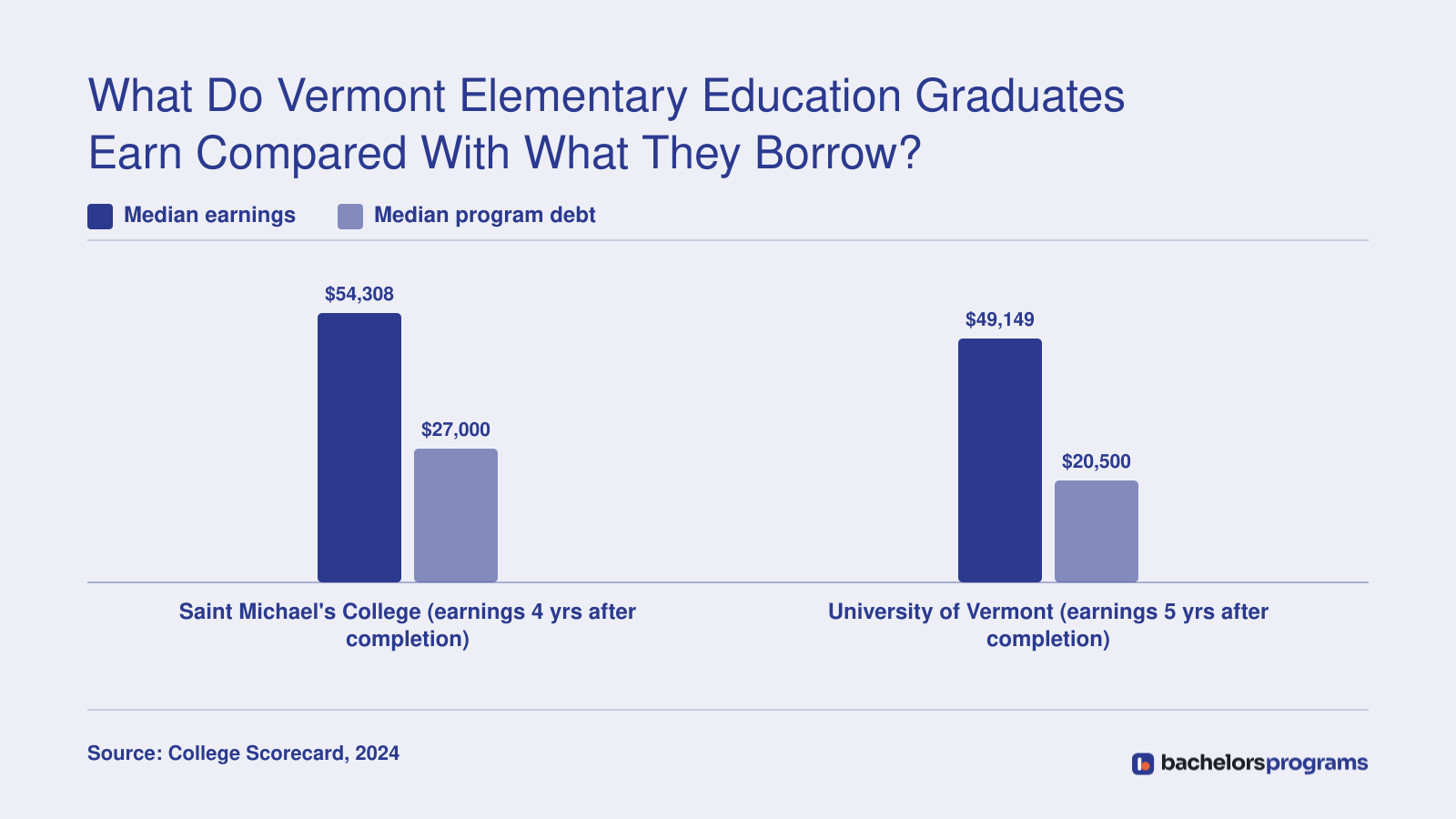
What Do Vermont Elementary Education Graduates Earn Compared With What They Borrow?
Saint Michael's College elementary education graduates earn a median of $54,308 four years after finishing, against median program debt of $27,000, while University of Vermont graduates earn a median of $49,149 five years out with $20,500 in median debt. Vermont State University's elementary and special education graduates earn a median of $42,273 five years after completion. Because the earnings windows differ, treat the gap between schools as a rough guide rather than an exact comparison.
What Vermont Elementary Teachers Earn
Vermont's most recent state-level BLS estimate puts elementary teachers' average pay at $63,520.
Compare Elementary Education programs on the data that matters
Explore more Education & Teaching majors or browse every field of study.
All Education & Teaching programs Browse every field of study