Best Public Health Schools in Vermont
Compare 3 accredited Public Health programs in Vermont, with net price after aid, graduation rates, earnings and debt from IPEDS and the U.S. College Scorecard.

Where can you earn a bachelor's degree in public health in Vermont? The options are few: the University of Vermont in Burlington, Saint Michael's College in Colchester, and Norwich University in Northfield. All three award a bachelor's degree, though the titles differ.
With so few choices, cost, format, and CEPH accreditation are what separate them. UVM charges Vermont residents $19,058 in tuition and fees and nonresidents $45,502, a gap that changes the math for out-of-state applicants. Online access and admissions standards also differ by school.
Most entry-level public health jobs require no license, so employers often weigh internships and applied coursework as heavily as the degree.
Key Points
- University of Vermont tuition runs $19,058 in-state versus $45,502 out-of-state.
- Norwich and Saint Michael's charge the same tuition regardless of residency.
- UVM is test-optional; admitted students typically hold 3.5 to 3.8 GPAs.
Best Bachelor's Degree in Public Health Programs in Vermont, Ranked
Three Vermont schools currently award a bachelor's degree in public health or a closely related B.S.: a flagship public research university in Burlington, a liberal arts college in Colchester, and a private military college in Northfield that teaches the degree entirely online. Schools offering this program have graduation rates of 60% to 79% and admit between 65% and 85% of applicants. Net price after aid for first-year students runs from roughly $19,300 to $25,200, depending on the school and on a family's financial circumstances.
University of Vermont
#1Burlington, VT · $19,000 – $46,000/yr (est.)
Best for: Vermont residents wanting a research university
The University of Vermont is the state's flagship public research university, set in Burlington on Lake Champlain, and the only school in this group whose public health bachelor's program holds CEPH accreditation. Its Public Health Sciences B.S. pairs a 40-credit public health core with biology, statistics, and social science coursework, then sends students into a capstone field placement with community partners. About 79% of undergraduates finish their degree, the strongest completion rate among the three schools here, 65% of applicants are admitted, and net price after aid averages roughly $19,300. It takes the top spot because it pairs the best completion rate in the group with the only accredited public health bachelor's in Vermont.
- CEPH-accredited Public Health Sciences B.S. with a 40-credit public health core
- 120 total credit hours; prerequisite courses required before admission
- Capstone field experience with community partners such as Rise VT and Planned Parenthood
- Supporting coursework in biology, statistics, and social and behavioral sciences
- Accelerated 3+3 pathway to the occupational therapy doctorate
- Undergraduates can join faculty research projects
- Observation and networking through UVM Medical Center connections
- Foundation for graduate study in medicine, nursing, and health policy
Saint Michael's College
#2Colchester, VT · $25,000 – $30,000/yr (est.)
Best for: Liberal arts students drawn to community health
Saint Michael's College is a private liberal arts college in Colchester, just outside Burlington, and its public health major can be taken as either a Bachelor of Arts or a Bachelor of Science. Students work across biology, sociology, political science, and health science, and undergraduates can run original research with faculty mentors or apply for Trustee Scholar summer stipends. It admits about 85% of applicants, graduates about 73%, and its net price after aid is roughly $25,200. It lands second because that completion rate sits close to UVM's even though the program is smaller and built on a flexible arts and sciences route rather than a single accredited core.
- Offered as either a Bachelor of Arts or a Bachelor of Science
- Interdisciplinary coursework in biology, sociology, political science, and health science
- Original research with faculty mentors
- Trustee Scholar summer research stipends available
- Volunteer placements with local health providers and the UVM Medical Center
- Complements the Peace Corps Prep track
- Focus on biosocial determinants of disease and health care access
- Prepares students for entry-level roles in health departments, hospitals, and nonprofits
Norwich University
#3Northfield, VT · $22,000/yr (est. net price)
Best for: Working adults needing asynchronous online classes
Norwich University, the nation's oldest private military college, sits in Northfield and delivers its Bachelor of Public Health entirely online and asynchronously. The 120-credit degree is built for working adults, veterans, and active-duty service members, with tuition of $500 per credit, $250 per credit for those on active duty, and up to 90 transfer credits accepted. About 60% of students graduate, 74% of applicants are admitted, and net price after aid is roughly $22,300. It takes third because its part-time-friendly online format serves a different reader than the two campus programs, and its completion rate trails both.
- 100% online, asynchronous courses; 120 total credit hours
- $500 per credit; $250 per credit for active-duty service members
- Transfer up to 90 credits; finish in as few as two years
- Coursework in epidemiology, biostatistics, health policy, and disaster response planning
- Capstone required; full-time and part-time enrollment options
- Optional add-on certificate in Response Planning
- Rolling admissions with no entrance exam required
- Military benefits and employer tuition reimbursement supported
Cost & outcomes by school
Federal data for the highest-earning Public Health programs, independent of the ranking above. Earnings are this field's bachelor's graduates four years after completing where the Scorecard reports them, else the school's undergraduate median.
| School | Net price / yr | Grad rate | Earnings | Debt | Grads/yr | Format |
|---|---|---|---|---|---|---|
| Norwich University VT | $22,257 | 60% | $65,575 | $25,000 | — | Online |
| University of Vermont VT | $19,343 | 79% | $62,472 | $20,951 | 47 | Campus |
| Saint Michael's College VT | $25,239 | 73% | $61,317 | $26,922 | 10 | Campus |
Sources: U.S. Department of Education. Net price, graduation rate, earnings and debt: College Scorecard (earnings and debt for this field's bachelor's graduates where reported, else school-wide); graduates: IPEDS. A dash means no figure is reported.
Cost, debt & payoff
Median earnings of this field's bachelor's graduates (4 yrs after completing, else the school's undergraduate median) vs. their median federal loan debt · U.S. College Scorecard
Across these programs the median graduate earns about $62,472 and finishes with roughly $25,000 in debt — a ratio that clears a common rule of thumb (keep debt below first-year salary). Net price and debt vary widely school to school, so check the per-school figures in the table above before you shortlist.
How We Ranked Vermont's Bachelor's Degree in Public Health Programs
We used the most recent Scorecard release available in 2026, pairing institution-level data for each school with program-level data for its public health bachelor's degree.
The Five Ranking Factors
- Net price: The average yearly cost after grants and scholarships, which tells most families more than published tuition does.
- Graduation rate: The share of students who complete a bachelor's degree at the school, a signal of academic support and follow-through.
- Selectivity: The admission rate, treated as one indicator of the academic environment rather than a goal in itself.
- Program earnings: Median earnings for graduates of the public health program, where the Scorecard reports them.
- Debt: Median federal loan debt for program graduates, weighed against what those graduates go on to earn.
Why the List Is Short
The list includes only bachelor's programs at Vermont-based schools, delivered on campus or online. Graduate degrees, certificates, and programs at schools in other states are left out. Vermont's higher education system is small, so the University of Vermont, Saint Michael's College, and Norwich University are the Vermont-based public health bachelor's programs we could verify. They are not picks narrowed down from a long national pool.
Read the Numbers With Care
Both figures are institution-wide averages. They describe all undergraduates at a school, not public health majors specifically, so a program's own completion rate or cost can differ. Earnings and debt figures are tied to the program itself, but small graduating classes can limit how much the Scorecard reports. Treat the ranking as a starting point, then confirm current costs and outcomes directly with each school before you apply.
CEPH Accreditation and Public Health Specializations in Vermont
CEPH accreditation is the Council on Education for Public Health's review of a public health school or program against national standards. For undergraduates, it signals that the curriculum covers the field's core domains, includes applied or practical learning, and has been examined by an outside accreditor. Employers and graduate public health programs recognize the credential, and some graduate admissions offices give preference to applicants from accredited programs. CEPH separates public health programs, standalone baccalaureate programs, and schools of public health, a distinction that matters when reading accreditation lists.
UVM's CEPH Status
The University of Vermont's Public Health Program is CEPH-accredited from June 16, 2018 through December 31, 2033.1 The public health major at UVM is the B.S. in Public Health Sciences, an on-campus degree. CEPH's listing accredits the Public Health Program rather than a separately named standalone baccalaureate program, so the degree's accreditation runs through that program. UVM also holds CEPH accreditation for its B.S. in Health Sciences, from September 6, 2019 through December 31, 2027.1 Health Sciences is a related major, not a substitute for the public health degree.
Saint Michael's and Norwich
Saint Michael's College in Colchester offers a public health bachelor's program, and Norwich University in Northfield offers a Bachelor of Public Health. Neither appears on CEPH's public list of accredited programs.1 That does not mean the programs lack rigor, but it does mean their CEPH status cannot be verified from the accreditor's listing. Prospective students should ask each department directly, especially if they plan to apply to graduate public health programs that prefer or require an accredited undergraduate background.
Curriculum and Specializations
UVM's public health sciences major is the main route at the university. The curriculum is organized around public health sciences rather than a single clinical track, and applicants should ask the department for the current concentration or elective options. At Saint Michael's and Norwich, ask for the current course sequence and any named specialization, since those details change and are best confirmed with an advisor. Across Vermont, students also use closely related majors such as health sciences as an alternative or complement to public health.
Admissions for Vermont Public Health Bachelor's Programs
The University of Vermont publishes the most detailed admissions picture for a bachelor's degree in public health: a test-optional policy, a Fall 2026 admitted-student GPA range of 3.5 to 3.8, and a recommended 2.8 average for transfer applicants. UVM also requires at least 120 credits and a final major GPA of 2.3 or higher to complete the Public Health Sciences B.S. Applicants to Saint Michael's College and Norwich University should confirm GPA, testing, and transfer rules directly with each school's admissions office before applying.
| School | GPA Expectation | Test Policy | Transfer Credit Policy |
|---|---|---|---|
| University of Vermont (Public Health Sciences B.S.) | 3.5 to 3.8 is the typical admitted-student range for Fall 2026, not a stated minimum; a final major GPA of at least 2.3 is required to graduate | Test-optional; applicants may self-report ACT or SAT scores, applicants without scores are not disadvantaged and remain eligible for merit scholarships, and enrollees who self-reported must submit official scores | Credit accepted for comparable courses from regionally accredited, degree-granting institutions; grades below C earn no credit; a 2.8 average is recommended to be competitive, not a minimum |
| Saint Michael's College (Public Health) | No GPA expectation published | No testing policy published | No transfer credit policy published |
Online and Hybrid Bachelor's Options at Vermont Schools
Vermont's best-known online public health programs sit at the graduate level, which leaves undergraduates with a smaller but real set of choices. Those graduate offerings are a separate track from the bachelor's degree.
Campus Only or Online
The three schools split cleanly by format:
- University of Vermont (Burlington): The B.S. in Public Health Sciences is delivered on campus. It includes a full-semester senior capstone with a community partner organization.
- Saint Michael's College (Colchester): The Public Health major is campus-based, with volunteer opportunities through local health providers and the UVM Medical Center.
- Norwich University (Northfield): The Bachelor of Public Health is the online option, with asynchronous classes.
None of these programs is listed as a hybrid. If you want a mix of in-person and remote study, the practical route is to pair a campus program with its own flexibility, such as the capstone or volunteer placements, and ask each admissions office what can be arranged.
How Norwich's Online Degree Works
Norwich's program totals 120 credit hours and can be taken full time or part time. The university says it can be completed in as few as two years, and it accepts up to 90 transfer credits. Admissions are rolling and no entrance exam is required. A capstone is required, so ask the program whether that component has any on-site expectations, since the published details do not say.
This format suits working adults, transfer students, and military-connected learners, who may qualify for a reduced per-credit rate. Students who want daily contact with faculty and labs will likely prefer the campus programs at UVM or Saint Michael's.
Cost of a Bachelor's Degree in Public Health in Vermont
Tuition and Net Price
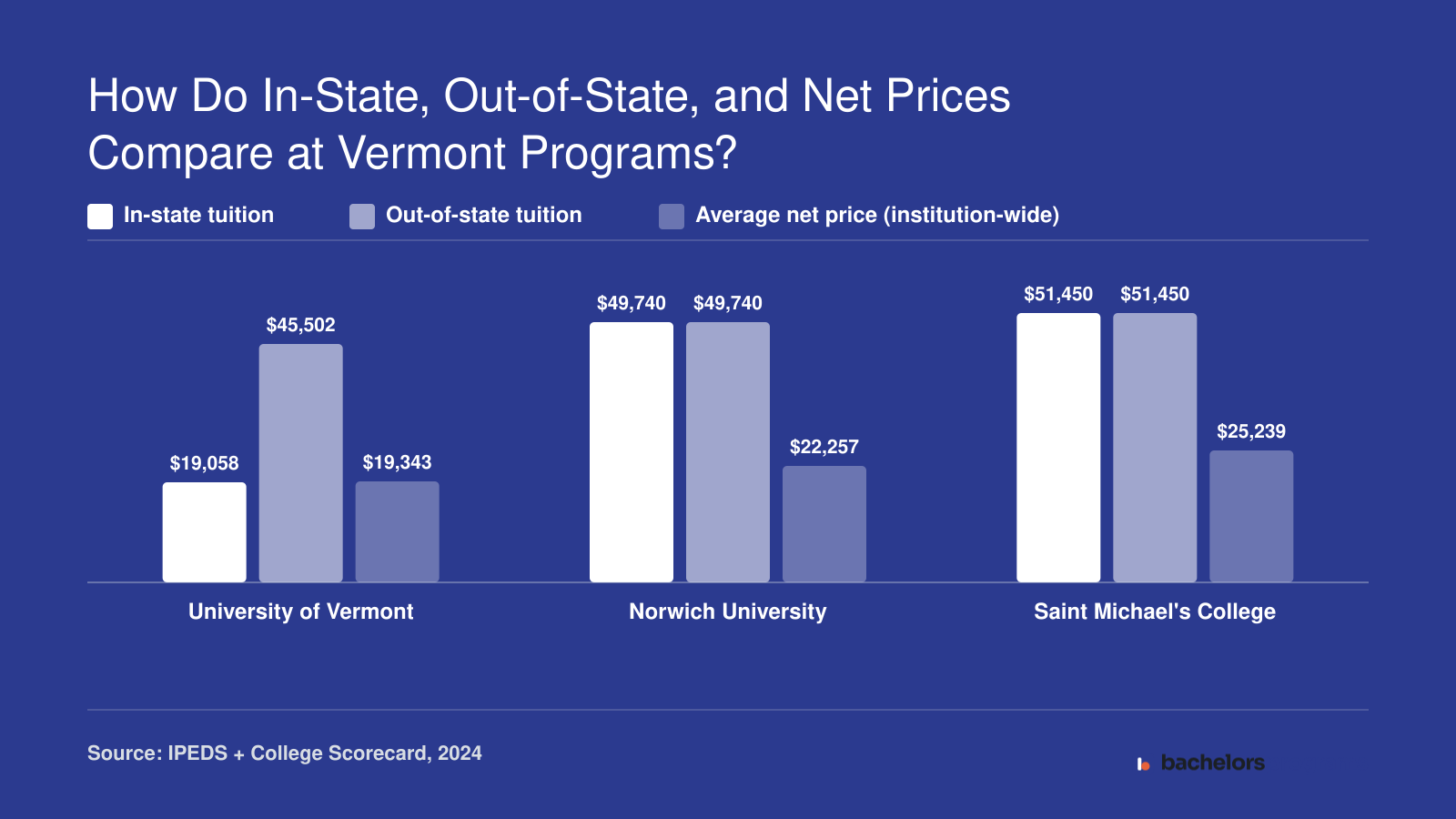
The University of Vermont is the only public option here, and the gap between residents and nonresidents is wide. Published tuition and fees for the Public Health Sciences B.S. run $19,058 for Vermont residents and $45,502 for out-of-state students. Saint Michael's College lists $51,450 for everyone, and Norwich University lists $49,740 for its Bachelor of Public Health. Norwich's online format is priced at $500 per credit, with $250 per credit for active-duty military.
Net price, the amount left after grants and scholarships, is lower at the private schools than the sticker price suggests. The averages are about $19,343 at UVM, $22,257 at Norwich, and $25,239 at Saint Michael's. Treat these as rough guides. Each is an average for a type of institution, not a quote for you, and your own figure depends on family income, residency, and the aid you receive.
Vermont State Aid
The main program is the VSAC Vermont Grant. It is need-based and requires the FAFSA.2 Applicants must be Vermont residents (generally for one year), must not already hold a bachelor's degree, and can attend full-time or part-time. The grant is portable to approved schools in or outside Vermont and covers up to 10 full-time semesters.1 Awards ranged from $1,000 to $15,350 for 2025-2026.1 Funding is first-come, first-served, and grades are not a factor. Residents who are not U.S. citizens or eligible noncitizens may qualify through the Pathways version3, and a Part-Time Grant covers degree students taking fewer than 12 credits a semester.6
VSAC also administers more than 150 scholarships for Vermont residents through one Unified Scholarship Application.4 Awards typically run $1,000 to $3,000, and some reach $5,000.1 Most require the FAFSA.5
Another option is the Rural Health Transformation Tuition Benefit.7 It is tied to a commitment to serve rural Vermont, and its maximum equals UVM's in-state tuition. Listed fields include allied health, mental health, and social work, so confirm that your program qualifies. Funding is unavailable for 2026-2027, and applications for 2027-2028 opened October 1, 2026.7
Practical Tips
- File early: Submit the FAFSA and VSAC grant application as soon as they open, since grant funds run out.
- Ask each school: Institutional aid often moves the net price more than state aid does, so compare each school's own award letter.
- Search scholarships: Fill out the Unified Scholarship Application once to be considered for many awards.
How Do In-State, Out-of-State, and Net Prices Compare at Vermont Programs?
Two cost gaps matter most at Vermont's public health schools. The first is between in-state and out-of-state tuition, and it applies only at the University of Vermont: $19,058 for Vermont residents versus $45,502 for nonresidents. Norwich University and Saint Michael's College are private and charge one rate to everyone. The second is between the published tuition price and what students actually pay after aid. At Norwich, $49,740 in tuition becomes an average net price of $22,257. At Saint Michael's, $51,450 drops to $25,239. Net price is an institution-wide average for aided students, not a figure specific to public health majors. It also includes living costs, which explains why UVM's $19,343 net price sits slightly above its in-state tuition.
Public Health Careers and Salaries in Vermont With a Bachelor's Degree
A bachelor's degree in public health leads to two broad kinds of entry-level work: program-side roles that plan and evaluate health initiatives, and community-facing roles that connect residents directly with care and services. Many graduates start in one lane and move into the other as they gain experience.
What You Can Do With a Public Health Degree in Vermont
Common job titles for bachelor's graduates include:
- Health educator: Builds workshops, campaigns, and materials on topics like nutrition, tobacco, and substance use.
- Community health worker: Helps individuals navigate insurance, appointments, and social services.
- Program coordinator: Manages grant-funded public health projects, timelines, and reporting.
- Prevention specialist: Leads outreach focused on substance use, injury, or chronic disease.
- Outreach coordinator or patient navigator: Links clinics with the communities they serve.
Titles vary by employer, so read job descriptions closely. In Vermont, likely employers include the Vermont Department of Health and its district offices, hospitals and health systems, community health centers, nonprofit human-services agencies, community action agencies, and schools and colleges. Internships completed during the degree add the practical skills these employers look for. Some senior health education positions do call for a master's degree.
What Public Health Jobs Pay
The Bureau of Labor Statistics reports a national median wage of $64,070 for health education specialists1 and $51,850 for community health workers2, both as of May 2025. BLS projects 6% job growth for health education specialists and 13% for community health workers from 2025 to 2035.3
For a Vermont benchmark, the Burlington-South Burlington metro area had about 90 health education specialist jobs in May 2024, with a mean annual wage of $67,920.4 The role is roughly 1.8 times as concentrated there as it is nationally. Treat that figure as a local snapshot from a different year than the national data, not a statewide average.
CHES Certification and Vermont Licensure
The Certified Health Education Specialist (CHES) credential is administered by the National Commission for Health Education Credentialing (NCHEC). It is voluntary, but some employers require or prefer it, particularly for health educator and program roles. The Master Certified Health Education Specialist (MCHES) is the advanced tier aimed at experienced practitioners. Review NCHEC's current eligibility rules early in your degree so you can plan coursework with the exam in mind.
Most public health roles do not require state licensure, and Vermont does not license health educators or community health workers. Clinical careers such as nursing are a separate path with their own training and licensing requirements.
Related Articles
Frequently Asked Questions About Public Health Schools in Vermont
These answers cover the most common questions about earning a bachelor's degree in public health in Vermont. Details come from the schools' own program and accreditation pages.
Does Vermont offer a bachelor's degree in public health?
Is there a public health major at UVM?
Can you study public health online at a Vermont school?
Are Vermont public health programs CEPH accredited?
What are the best public health schools in Vermont?
Compare Public Health programs on the data that matters
Explore more Healthcare majors or browse every field of study.
All Healthcare programs Browse every field of study