Best Criminal Justice Schools in Maryland
Compare 10 accredited Criminal Justice programs in Maryland, with net price after aid, graduation rates, earnings and debt from IPEDS and the U.S. College Scorecard.

A bachelor's degree in criminal justice is common preparation for court, probation, corrections and federal agency hiring, though the Maryland State Police require only a high school diploma or GED. The common version is the Bachelor of Science (B.S.) in Criminal Justice, though some schools use names such as criminal and legal studies.
Every program here is based in Maryland or delivered online by a Maryland school. Tuition is the sharpest divide: public universities such as Bowie State and Coppin State charge a fraction of what private campuses like McDaniel and Hood do, yet five-year earnings across these schools sit within roughly $8,000 of each other.
Key Points
- Five-year median earnings range from $60,453 to $68,673 across these schools.
- Stevenson University's online B.S. runs 8-week sessions at $470 per credit.
- Maryland State Police recruits must be 20 to 59 years old.
Best Bachelor's in Criminal Justice Schools in Maryland
Every entry below is a bachelor's degree in criminal justice or a closely named variant, such as criminal and legal studies or law and criminal justice, offered on campus, online or both by a Maryland institution. Each summary notes the format, the track or concentration where the school lists one, in-state tuition and the institution-wide graduation rate so you can compare like with like. Middle States Commission on Higher Education accreditation is institutional, covering every program within a school's scope; it is named below only where the records reviewed confirmed it, so check a school's accreditation page before you apply if no note appears.
Stevenson University
#1Owings Mills, MD · ~$27,000/yr (est.)
Best for: Hands-on learners wanting federal internships
Stevenson's B.S. in Criminal Justice builds a standard core (ethics, victimology, American courts, research methods) around a required 3-credit internship, with past placements at Baltimore County Police, NCIS and the U.S. Marshals Service. A 4+1 track lets students earn the bachelor's and a master's in roughly five years, and the field is also offered as a minor. Classes meet on campus in Owings Mills, in-state tuition is $37,734 and the institution-wide graduation rate is 68%.
- 4+1 bachelor's to master's option, both degrees in about five years
- Required 3-credit internship plus a separate 4-credit statistics course
- Core coursework: ethics, victimology, American courts, research methods
- Internship sites include Baltimore County Police, NCIS and U.S. Marshals
- Covers AI applications in criminal justice and how to evaluate bias in results
- Visits to correctional institutions, research showcases and conferences
- Minor in criminal justice available
University of Baltimore
#2Baltimore, MD · $10,000 – $24,000/yr (est.)
Best for: Working adults finishing a degree online
The University of Baltimore's B.S. in Criminal Justice sits in a dedicated School of Criminal Justice inside the College of Public Affairs, and students can take it on campus, fully online, or through an online completer route for the upper-level major. The 120-credit degree covers criminal justice administration, criminological theory and research design, and qualifying students may apply up to 9 graduate credits to both a bachelor's and a master's. UBalt appears in Middle States records as accredited and reaffirmed, and it is a named academic partner in the Maryland Justice Partnership, a statewide reform effort.
- 120 total credit hours, with courses on campus and online
- Fully online option plus an online completer for upper-level major courses
- Up to 9 graduate credits double-counted toward the master's
- Internship at an agency matched to your career goals
- Presumptive Admit path to the UBalt law school
- Victim Studies minor also offered
- Maryland Police Officer Scholarship open to current and future officers
McDaniel College
#3Westminster, MD · ~$22,000/yr (est.)
Best for: Liberal arts students preparing for law school
McDaniel runs criminal justice as a major and a minor inside its Sociology Department, with complementary work in sociology and psychology. Every major completes an internship; recent sites include Baltimore City Police, the Maryland State Police Forensic Lab and the State Police Fire Marshal's Office. Pre-law advising and graduate school preparation are available, and the McDaniel Commitment guarantees two experiential learning opportunities per undergraduate. Study is on campus in Westminster, in-state tuition is $52,081 and the institution-wide graduation rate is 63%.
- Major and minor both offered through the Sociology Department
- All majors complete an internship before graduating
- Internship sites: Baltimore City Police, State Police Forensic Lab, Fire Marshal
- Pre-law advising and graduate school preparation available
- Courses include Criminology and Religion and American Prisons
- McDaniel Commitment guarantees two experiential learning opportunities
University of Maryland Eastern Shore
#4Princess Anne, MD · ~$13,000/yr (est.)
University of Maryland Eastern Shore grants a B.S. in Criminal Justice on its Princess Anne campus, and it is among the lowest-priced routes on this list at $5,750 in-state tuition. The institution-wide graduation rate is 35%, so budget time for advising and support services as you plan a four-year path. Middle States records list the university as accredited and reaffirmed, with bachelor's degrees inside the accredited scope.
- Bachelor of Science in Criminal Justice
- On-campus program at the Princess Anne campus
Frostburg State University
#5Frostburg, MD · $10,000 – $26,000/yr (est.)
Frostburg awards a B.S. in Criminal and Legal Studies with two concentrations: criminal studies for law enforcement work, and legal studies for law school or court-system careers. An optional internship can place students with a district attorney's office, the courts or a law firm, and the major is often taken as a double major with political science or sociology. In-state tuition is $7,254 on the Frostburg campus and the institution-wide graduation rate is 50%.
- Two concentrations: criminal studies and legal studies
- Legal studies track prepares students for law school and court careers
- Optional internship with a district attorney's office, courts or law office
- Covers criminal law, policing, courts, corrections and ethical issues
- Often paired as a double major with political science or sociology
- Student group: Politics, Law & Society
- Alumni job titles include assistant state's attorney and police officer
Hood College
#6Frederick, MD · ~$21,000/yr (est.)
Hood College offers a B.A. in Law & Criminal Justice in Frederick with two areas of study: law, aimed at law school and legal careers, and criminal justice, covering law enforcement, the judicial process and corrections. An internship is required in the criminal justice track, and past placements include the ACLU, the Maryland State's Attorney's Office, the Public Defender's Office and the Frederick County Sheriff's Office. Students work a semester-long hypothetical Supreme Court case in a moot courtroom. Study is on campus, in-state tuition is $46,700 and the institution-wide graduation rate is 57%.
- Bachelor of Arts with law and criminal justice tracks
- Internship required for the criminal justice concentration
- Semester-long hypothetical Supreme Court case in a moot courtroom
- Internship sites include ACLU, State's Attorney and Public Defender
- Prepares students for law school and legal careers
University of Maryland Global Campus
#7Adelphi, MD · $22,000/yr (est. net price)
University of Maryland Global Campus delivers its B.S. in Criminal Justice entirely online, with 120 credits split between a 33-credit major, general education and electives, closing with a capstone. There are no prerequisites to apply and up to 90 credits can transfer, which suits working officers and career changers. Middle States accreditation was granted in 1946 and last reaffirmed on November 20, 2025, and the institution-wide graduation rate is 33%. Courses run $337 per credit for in-state students.
- Fully online; 120 credits, 33 of them in the major
- $337 per credit in state and $250 per credit for military students
- Transfer up to 90 credits; no prerequisites to apply
- Capstone required, plus Ethical Behavior in Criminal Justice
- Law-enforcement agency agreements discount out-of-state tuition up to 25%
- Up to 60 credits through the law-enforcement track, subject to admission
- No-cost digital materials and an interest-free monthly payment plan
- Pi Gamma Mu honor society chapter
Bowie State University
#8Bowie, MD · ~$19,000/yr (est.)
Bowie State's B.S. in Criminal Justice covers law, social justice, community advocacy and forensic science, with a criminalistics lab for fingerprints, firearms, documents and toxicology. Internships supply field-specific experience, students can join the Criminal Justice Club and the Alpha Phi Sigma honor society, and the Fannie Angelos Program prepares qualified students for law school. Classes meet in full-service SMART classrooms with a fully online option; in-state tuition is $9,218 and the institution-wide graduation rate is 38%. Bowie State is also an academic partner in the Maryland Justice Partnership.
- Fully online option available
- Criminalistics lab for fingerprints, firearms, documents and toxicology
- Internships earn field-specific experience
- Criminal Justice Club and Alpha Phi Sigma honor society
- Fannie Angelos Program prepares qualified students for law school
- Full-service SMART classrooms
Coppin State University
#9Baltimore, MD · $5,000 – $10,000/yr (est.)
Coppin State awards a B.S. in Criminal Justice built on a 21-credit core plus at least 18 credits of criminal justice electives, with a grade of C or better required in every major and prerequisite course. The 120-credit degree includes field service training and an internship, supported by partnerships with federal, state and local facilities around Baltimore. The department sits in the College of Behavioral and Social Sciences and hosts an Alpha Phi Sigma chapter. In-state tuition is $7,100 and the institution-wide graduation rate is 26%.
- 120 credit hours: 21-credit core plus at least 18 elective credits
- Grade of C or better required in every major and prerequisite course
- Core covers criminological thought, criminal justice and the Constitution
- Field service training and internship course required
- Partnerships with federal, state and local facilities in Baltimore
- Alpha Phi Sigma honor society chapter
Strayer University-Maryland
#10Baltimore, MD · ~$14,000/yr (est.)
Strayer's B.S. in Criminal Justice is a 40-course degree with 11-week terms, and Maryland students take it fully online. Six concentrations include digital forensics and cybersecurity, crime and criminal behavior, criminal justice administration, and probation and parole, and up to 28 classes can transfer in. Tuition is $1,555 per course plus a $65 technology fee each term. The institution holds Middle States accreditation and reports an institution-wide graduation rate of 38%.
- 40 courses of 11 weeks each, fully online for Maryland students
- $1,555 per course plus a $65 technology fee each term
- Six concentrations, including digital forensics and probation and parole
- Transfer up to 28 classes into the degree
- 67.5 credit hours in the major and 18 in the concentration
- No-cost general education courses through Sophia Learning
- $150 one-time degree conferral fee
Cost & outcomes by school
Federal data for the highest-earning Criminal Justice programs, independent of the ranking above. Earnings are this field's bachelor's graduates four years after completing where the Scorecard reports them, else the school's undergraduate median.
| School | Net price / yr | Grad rate | Earnings | Debt | Grads/yr | Format |
|---|---|---|---|---|---|---|
| University of Maryland Global Campus MD | $22,063 | 33% | $69,848 | $20,406 | 434 | Online |
| Bowie State University MD | $19,298 | 38% | $67,303 | $21,500 | 76 | Online or campus |
| University of Baltimore MD | $13,868 | 38% | $63,032 | $17,250 | 37 | Online or campus |
| Stevenson University MD | $26,505 | 69% | $61,348 | $26,425 | 36 | Online or campus |
| McDaniel College MD | $21,916 | 63% | $60,663 | $25,000 | 22 | Campus |
| Hood College MD | $20,873 | 57% | $60,022 | $25,000 | 8 | Campus |
| Coppin State University MD | $9,977 | 26% | $58,110 | $25,000 | 20 | Campus |
| Frostburg State University MD | $16,715 | 50% | $56,668 | $25,000 | 24 | Campus |
| Strayer University-Maryland MD | — | 38% | $53,916 | $41,562 | 18 | Online |
| University of Maryland Eastern Shore MD | $13,338 | 35% | $52,398 | $28,000 | 24 | Campus |
Sources: U.S. Department of Education. Net price, graduation rate, earnings and debt: College Scorecard (earnings and debt for this field's bachelor's graduates where reported, else school-wide); graduates: IPEDS. A dash means no figure is reported.
Cost, debt & payoff
Median earnings of this field's bachelor's graduates (4 yrs after completing, else the school's undergraduate median) vs. their median federal loan debt · U.S. College Scorecard
Across these programs the median graduate earns about $60,343 and finishes with roughly $25,000 in debt — a ratio that clears a common rule of thumb (keep debt below first-year salary). Net price and debt vary widely school to school, so check the per-school figures in the table above before you shortlist.
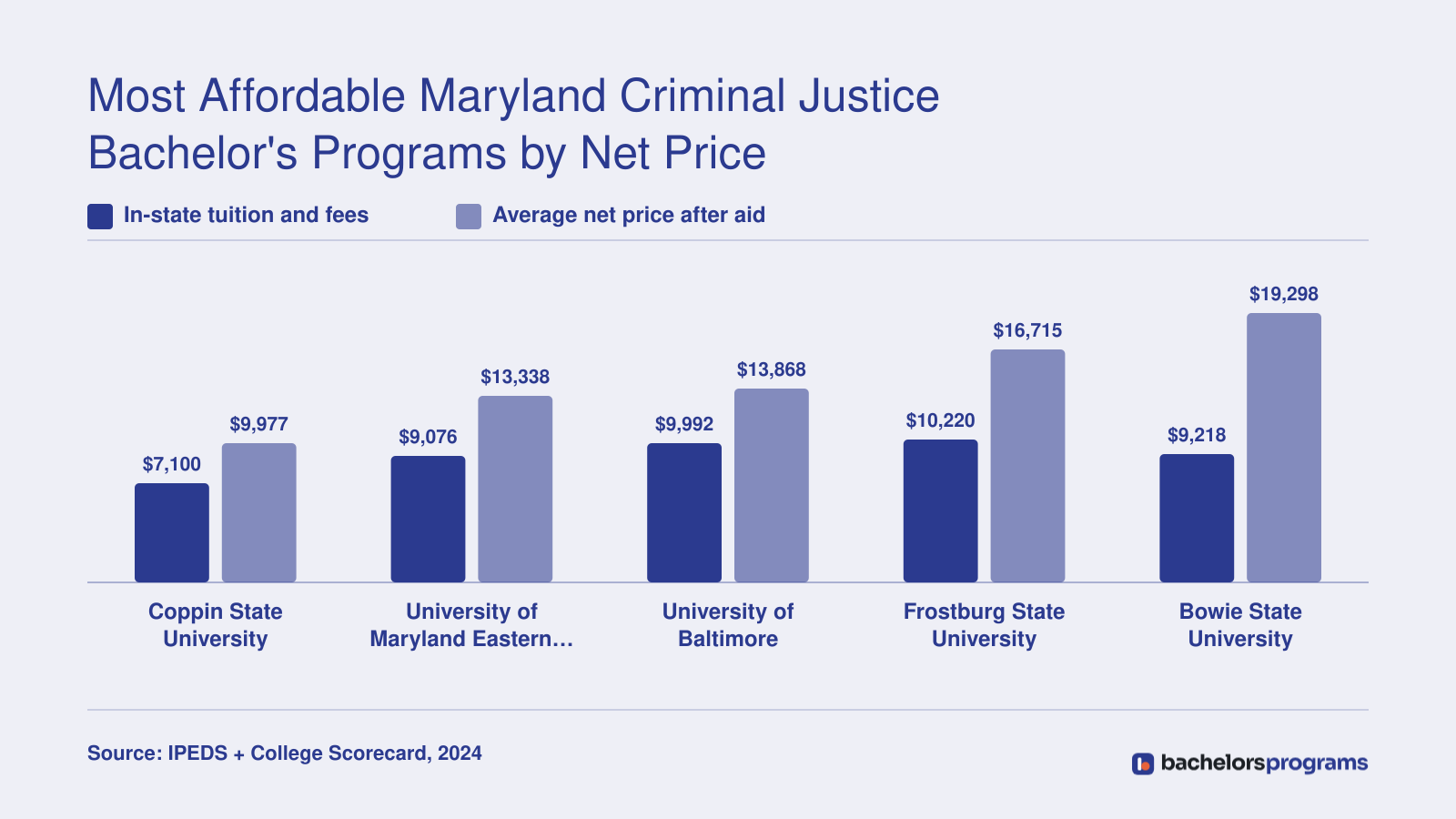
Most Affordable Maryland Criminal Justice Bachelor's Programs by Net Price
Every school in this affordability group is a public university, so each net price is the average for that sector, measured across the whole institution after grants and scholarships. It is not a quote for the criminal justice major or for your household. Net price runs higher than published in-state tuition and fees at every school shown, from about $2,900 more at Coppin State University to about $10,100 more at Bowie State University, because it also counts housing, books and living costs.
Maryland Criminal Justice Graduates With the Highest Earnings
Frostburg State University, University of Baltimore and Stevenson University fall between $60,453 and $64,259 five years out, while median debt runs from $17,250 at University of Baltimore to $26,425 at Stevenson University. These medians describe each program's past completers, not a guarantee of what any future graduate will earn.
| School | Median earnings (later window) | Median earnings (one year after finishing) | Median debt at graduation | Typical monthly payment (10-year plan) |
|---|---|---|---|---|
| University of Maryland Global Campus | $68,673 (five years after finishing) | $55,479 | $20,406 | $216 |
| Frostburg State University | $64,259 (five years after finishing) | $40,844 | $25,000 | $265 |
| University of Baltimore | $63,341 (five years after finishing) | $48,991 | $17,250 | $183 |
| Stevenson University | $60,453 (five years after finishing) | $38,745 | $26,425 | $280 |
| Hood College | $60,022 (four years after finishing) | $41,764 | $25,000 | $265 |
Online and Hybrid Bachelor's in Criminal Justice at Maryland Schools
Stevenson University delivers its Bachelor of Science in Criminal Justice entirely online in 8-week sessions at $470 per credit with no added fees, and the degree still requires 120 credits. Short sessions and a flat per-credit rate are worth comparing across Maryland schools.
Fully Online, Hybrid and Campus Formats
Several schools here run the criminal justice bachelor's fully online. Stevenson runs its program entirely online and organizes it into 8-week sessions. University of Maryland Global Campus offers its criminal justice bachelor's and a law enforcement track fully online, with courses offered year-round.1 Strayer University-Maryland also delivers its Bachelor of Science in Criminal Justice online, using 11-week courses.
Bowie State University and the University of Baltimore both list a fully online option. UBalt's is a completer route for upper-level major coursework, which fits students arriving with an associate degree. McDaniel College, Hood College, Frostburg State University, the University of Maryland Eastern Shore and Coppin State University list their criminal justice programs in campus-based formats. If you want some face-to-face instruction, ask a department which required courses actually run online before you assume a hybrid schedule is available.
Cost and Residency Rules
UMGC publishes a residency split: $337 per credit for Maryland students, $499 for out-of-state students and $250 for military students, with other fees possibly applying.1 Stevenson publishes a single $470 rate and charges no fees, so a Maryland address does not change the price. Before you budget, ask each admissions office two questions: whether the online rate matches the campus rate, and whether an out-of-state address changes it.
The Accreditation Check Is the Same
Online enrollment does not lower the bar. Students in an online criminal justice bachelor's at a Maryland school sit under the same institutional accreditation as campus students, and Maryland institutions are accredited through the Middle States Commission on Higher Education. That matters for federal aid and for hiring or licensure later.
An online-only school headquartered in another state differs mainly in oversight and fit. A Maryland-based school's online program keeps you inside the state's transfer and aid systems, and lets you use campus services if you live near Owings Mills, Adelphi or Baltimore. Confirm the accreditor on the school's own site before you apply.
Admissions for Maryland Bachelor's in Criminal Justice: GPA, Test Policy and Transfer Credit
Criminal justice admissions in Maryland follow no single standard. Each school sets its own transfer GPA, testing stance and credit limits, and some publish very little of that on the criminal justice program page. Check the admissions or transfer page before you apply, and get any verbal answer in writing.
Published GPA and Test Policies
University of Maryland Global Campus publishes specific numbers. Its 2025-2026 transfer guide for the B.S. in Criminal Justice lists a 2.0 minimum GPA.1 UMGC does not publish a test-optional or test-required statement for transfer applicants, so confirm with an admissions counselor whether SAT or ACT scores are needed.
University of Maryland Eastern Shore publishes no general minimum GPA and no test policy for the criminal justice bachelor's. Its community college agreement asks students to complete the partner program, stay in good standing and be accepted by UMES. One criminal justice course transfers as a three-credit equivalent.2 UMES publishes no maximum transfer credit figure.
University of Baltimore publishes no minimum GPA, test policy or maximum transfer credit figure for its B.S. in Criminal Justice. For Stevenson University, McDaniel College, Frostburg State University, Hood College, Bowie State University, Coppin State University and Strayer University-Maryland, ask admissions for the current transfer GPA, test policy and credit cap.
Transfer Credits and Community College Pathways
UMGC accepts up to 70 credits from two-year and community colleges and up to 90 credits from all sources combined.1 The degree requires 120 credits, including 30 in residence and 15 upper-level credits at UMGC. Its published guide for an A.A.S. in Law Enforcement shows how that associate degree feeds into the B.S. in Criminal Justice.
UMES has a criminal justice agreement with a community college partner, and the pathway depends on completing that associate program and meeting UMES admission standards.2 University of Baltimore does not publish a transfer cap for the criminal justice bachelor's.
How ARTSYS Helps
ARTSYS is Maryland's statewide articulation system. Search its Criminal Justice transfer guide to compare community college courses with four-year requirements and find recommended associate programs.3 A block-transfer guide commonly packages about 60 credits, but the 3.0 minimum shown in one guide is tied to a specific transfer pattern, not a statewide criminal justice rule.3
One Practical Tip
Finish an A.A. or A.S. before you transfer if you can. A completed associate degree usually gives you a cleaner block of credit and satisfies lower-level general education, which leaves more room for major courses and electives. Ask for a written credit evaluation before you enroll.
Related Articles
Questions to Ask Yourself
Would you qualify for Maryland need-based aid, and have you filed the FAFSA or MSAR before the deadline?
Could a community college start and a transfer cut your total cost without losing credits?
Does the earnings window in the Scorecard data match how soon you need to repay loans?
Maryland Police Officer Certification at a Glance
Maryland Criminal Justice Degree Questions, Answered
These answers cover the questions Maryland students ask most often about a bachelor's degree in criminal justice. They match the ranking, format and earnings sections above.
What is the best school for criminal justice in Maryland?
What is the difference between criminology and criminal justice?
Can you get a bachelor's degree in criminal justice online in Maryland?
How much do criminal justice majors make in Maryland?
Compare Criminal Justice programs on the data that matters
Explore more Criminal Justice & Law majors or browse every field of study.
All Criminal Justice & Law programs Browse every field of study