Best Early Childhood Education Schools in Oregon
Compare 4 accredited Early Childhood Education programs in Oregon, with net price after aid, graduation rates, earnings and debt from IPEDS and the U.S. College Scorecard.

A licensure track and a non-licensure major can carry nearly the same name. Oregon's public universities award the bachelor's degree in early childhood education under several labels. Only some of those paths lead to a Teacher Standards and Practices Commission license for public PreK through grade 3 classrooms. The Bachelor of Science (B.S.) in Early Childhood Education is the common credential, offered on campus in Corvallis and Monmouth and fully online from La Grande and Ashland.
In-state tuition at these four public universities runs roughly $11,000 to $14,400 a year before aid. The harder question is whether the program you pick qualifies you to teach where you want to work.
Key Points
- Eastern Oregon and Southern Oregon offer the clearest online bachelor's routes.
- Eastern Oregon University's online program requires a 2.5 cumulative GPA.
- Leading public PreK to grade 3 classrooms requires an Oregon TSPC license.
Best Bachelor's in Early Childhood Education Schools in Oregon: Our Ranked List
Four Oregon public universities award a bachelor's degree in early childhood education or a closely related field, and they differ sharply in how you earn it. Oregon State centers on campus study in Corvallis and Bend, Western Oregon runs hybrid and evening classes in Monmouth, and Eastern Oregon and Southern Oregon are built for students who transfer in and finish online. Institution-wide graduation rates at the four schools run from 43% to 70%.
Oregon State University
#1Corvallis, OR · $15,000 – $20,000/yr (est.)
Best for: Future leaders in Oregon early-learning systems
Oregon State University is the largest of the four and the most connected to Oregon's public early-learning system. Its degree sits in Human Development and Family Sciences, with a Child Development option on the Corvallis campus and an Early Childhood option at OSU-Cascades in Bend, both printed on the transcript. Students take 180 credits with a required core in child development, family studies and applied research, then add practicum and internship work in child development centers. The university's reach into state early-learning work is unusual for a bachelor's program: OSU runs the Oregon Parenting Education Collaborative hubs that serve every county, partners with the Oregon Department of Early Learning and Care on infant and toddler care expansion, and will host Head Start classrooms on the Bend campus.
- Child Development option on the Corvallis campus; Early Childhood option at OSU-Cascades
- Both options appear on the transcript
- 180 total credits across fall, winter and spring terms
- Core includes Infant and Child Development, Family Studies and Families and Poverty
- At least 24 elective credits beyond the core, 18 of them upper-division
- Option courses can double-count with electives
- Practicum and internship sections include the Child Development Center Internship
- Major code 447
Western Oregon University
#2Monmouth, OR · ~$17,000/yr (est.)
Best for: Licensure-seeking community college transfers
Western Oregon University awards a Bachelor of Science in Early Childhood Studies, and its distinguishing feature is a licensure path built into the degree. The EI/ECSE concentration adds six required electives and makes graduates eligible for the Oregon Teaching License for Early Intervention and Early Childhood Special Education, birth to age five, with no added time or cost. Most classes can be taken fully or partially online in hybrid, evening and intensive formats, which lets students keep working while enrolled. Western Oregon is also the transfer-friendliest school on this list, with 94% of its students arriving from community colleges, and federal data show median earnings of about $54,800 four years after finishing.
- EI/ECSE concentration adds six required electives
- Concentration qualifies graduates for the Oregon EI/ECSE license, birth to age five
- Licensure path adds no extra time or cost
- Most classes can be taken fully or partially online
- 94% of students transfer in from community colleges
- Credit granted for prior early childhood coursework
- Final three terms completed in a senior cohort
- 60 volunteer hours required
Eastern Oregon University
#3La Grande, OR · $15,000 – $20,000/yr (est.)
Best for: Rural learners needing fully online study
Eastern Oregon University offers the most flexible delivery on this list: a Bachelor of Arts, Bachelor of Science or Bachelor of Applied Science in Early Childhood Education that runs 100% online with no on-campus requirements. The major is 180 quarter credits with a 50-credit core and two field practica totaling 90 hours in settings serving children from birth through age eight. Students can transfer up to 135 credits and finish in as little as two years, and graduates land on Oregon Registry Step 10. The degree prepares students for preschool director, child care administrator and early development specialist roles, though it does not lead directly to a K-12 teaching license; federal data put median earnings near $48,900 four years after finishing.
- 100% online with no on-campus requirements
- 180 quarter credits, including 50 major core credits
- Two field practica totaling 90 hours, birth through age eight
- Transfer up to 135 credits from other institutions
- Finish in as little as two years after transfer
- Graduates place on Oregon Registry Step 10
- Does not lead directly to Oregon K-12 teacher licensure
- BAS option for students who hold an AAS degree
Southern Oregon University
#4Ashland, OR · ~$17,000/yr (est.)
Southern Oregon University runs Early Childhood Development as a degree-completion major, and it is designed around the community college route. Students take lower-division early childhood and general education courses at a community college, usually finishing an AA or AAS, then complete at least 60 upper-division credits through SOU. All upper-division early childhood courses are online only, while upper-division general education can be taken on campus in Ashland or online. A capstone internship and a professional portfolio are graduation requirements, and the program prepares graduates for preschool and Head Start teaching, administration, family advocacy and early intervention work. Federal data show median earnings of about $53,600 four years after finishing.
- Degree-completion format: lower-division work at a community college
- At least 60 upper-division credits, with ECD courses online only
- Upper-division general education available on campus or online
- Capstone internship and professional portfolio required to graduate
- Articulation agreements with Oregon and California community colleges
- Credit for prior learning available
- Coenrollment option preserves financial aid eligibility
- Prepares students for preschool, Head Start and family advocate roles
Cost & outcomes by school
Federal data for the highest-earning Early Childhood Education programs, independent of the ranking above. Earnings are this field's bachelor's graduates four years after completing where the Scorecard reports them, else the school's undergraduate median.
| School | Net price / yr | Grad rate | Earnings | Debt | Grads/yr | Format |
|---|---|---|---|---|---|---|
| Oregon State University OR | $19,604 | 70% | $64,010 | $21,221 | 60 | Campus |
| Western Oregon University OR | $17,237 | 47% | $54,761 | $22,250 | — | Hybrid |
| Southern Oregon University OR | $16,732 | 43% | $53,584 | $23,000 | 14 | Online |
| Eastern Oregon University OR | $17,148 | 43% | $48,894 | $22,375 | 53 | Online |
Sources: U.S. Department of Education. Net price, graduation rate, earnings and debt: College Scorecard (earnings and debt for this field's bachelor's graduates where reported, else school-wide); graduates: IPEDS. A dash means no figure is reported.
Cost, debt & payoff
Median earnings of this field's bachelor's graduates (4 yrs after completing, else the school's undergraduate median) vs. their median federal loan debt · U.S. College Scorecard
Across these programs the median graduate earns about $54,173 and finishes with roughly $22,313 in debt — a ratio that clears a common rule of thumb (keep debt below first-year salary). Net price and debt vary widely school to school, so check the per-school figures in the table above before you shortlist.
How We Ranked Oregon's Early Childhood Education Bachelor's Programs
The accreditation that educator preparation programs name has shifted: Oregon education colleges now list AAQEP where they once listed CAEP. That change matters when you compare programs: the letters on a program page tell you who reviewed the coursework and the clinical hours behind a bachelor's degree in early childhood education.
What the figures behind each entry describe
Two kinds of numbers sit side by side, and they answer different questions. Earnings and typical student debt are program-level: they follow graduates of the specific field of study. Institution-wide figures such as graduation rate and net price describe the whole university, not the early childhood major. A healthy overall completion rate does not guarantee a small major finishes at the same pace, so read the institutional figures as context and the program figures as the sharper signal. Delivery format (campus, online, hybrid) and accreditation round out the comparison.
Four kinds of accreditation, four different promises
- Regional (NWCCU): institution-level. Eastern Oregon University is regionally accredited by NWCCU, the body that accredits Oregon's public universities.1 Regional accreditation confirms the university meets baseline standards and nothing more specific.
- AAQEP: the national accreditor for educator preparation. Eastern Oregon University's College of Education is an AAQEP member in good standing; neither it nor the other Oregon colleges checked here list CAEP accreditation.1
- Oregon TSPC approval: the state approval that counts if you want an Oregon teaching license. TSPC publishes an approved-program inventory and notes that listed programs can be on temporary hiatus, so confirm the program is running now.
- NAEYC: accredits early childhood centers and, in Oregon, associate-degree programs. As of 2026 its higher-education list identifies no Oregon early childhood bachelor's program.2
Where verification stopped
Accreditation details were read from school and accreditor pages. Where a school publishes no program-level accreditation statement, we say so rather than infer one. Ask admissions which approvals apply to the exact degree you would enroll in.
Online and Hybrid Bachelor's Options at Oregon Schools
You can earn a bachelor's degree in early childhood education online from an Oregon-based school; Eastern Oregon University and Southern Oregon University are the clearest routes.
Fully Online, Hybrid and Campus-Only
- Eastern Oregon University: Fully online with no on-campus requirements.1 It suits rural and working-adult students who cannot relocate to La Grande.
- Southern Oregon University: Offers a fully online option. Upper-division early childhood development courses are online only, and lower-division work is typically completed at a community college.
- Western Oregon University: Hybrid. Most classes are fully or partially online, the final three terms run in a cohort, and the school says students can work full-time while enrolled.
- Oregon State University: Its early childhood options are campus-based. The Child Development option is offered only in Corvallis, and the Early Childhood option only at OSU-Cascades in Bend.5 OSU's online degree is a separate Elementary Education program, not early childhood education.
How Practicum Placements Work Online
Online students still work in real classrooms. Eastern Oregon requires 90 clinical hours across two practica: 30 hours in Practicum I and 60 in Practicum II.1 The school says these can be arranged in your local community or current workplace.2 Sites typically require a criminal background check, and you must follow Oregon Office of Child Care regulations.3
One caution: a 2026 state approval document describes a 50-mile radius from La Grande for student teaching. Eastern's program pages describe local arrangements. Ask the department which rule applies to your placement before you enroll.
Western Oregon requires 60 volunteer hours. For OSU's online Elementary Education degree, placement coordinators help arrange classroom placements in your own community, anywhere in the United States.4
Tuition for Online Students
Published rates differ sharply for residents and nonresidents. Eastern Oregon lists $11,184 in-state and $24,729 out-of-state. Oregon State lists $14,400 and $38,190. The data does not show whether online students are charged the resident rate, so confirm that with each school's bursar before comparing costs.
Admissions Requirements and Transfer Credit by School
What Eastern Oregon University Expects
Eastern Oregon University's online Early Childhood Education bachelor's program publishes the clearest admissions standards of the schools on this list. Applicants need a 2.5 cumulative GPA across all higher-education coursework in the program area.1 If you have fewer than 30 quarter college credits, EOU evaluates your high-school and college transcripts together, with minimums of 2.5 at the high-school level and 2.25 at the college level. Transfers bringing more than 30 quarter credits need a 2.25 college GPA.
You also need junior standing, or an Associate of Arts Oregon Transfer degree showing general-education completion with a 2.5 GPA. Two prerequisites, ECED 311 and ECED 312, must be finished or in progress with a C- or better. EOU's admissions pages and its program packet describe the college GPA threshold slightly differently: 2.25 in some transfer situations, 2.5 cumulative in the packet. Ask an admissions counselor which applies to your transcript before you apply.
Tests and Transcripts
No SAT or ACT scores are required for the online program.2 EOU decides on educational background and official transcripts from every accredited institution you have attended.4
EOU accepts up to 135 transfer credits, and the degree requires 180 total credits, at least 20 of which must be earned at EOU.3 An AAOT or ASOT from an Oregon community college satisfies general-education distribution requirements, subject to advisor review. Students holding an Associate of Applied Science in Early Childhood Education can enter EOU's Bachelor of Applied Science pathway, which requires 45 general-education credits. That pathway is separate from the B.A./B.S. and, per EOU's admissions packet, does not prepare graduates for many master's programs, including EOU's Master of Arts in Teaching.
Statewide, the Oregon Department of Early Learning and Care notes that an Oregon Registry Step 7 or Child Development Associate credential may convert to college credit through individual colleges' prior-learning or challenge-course processes. Credit awards, requirements, and costs vary by college, commonly 9 to 15 credits at rates as low as $10 per credit.
Other Schools
For Oregon State University, Western Oregon University, and Southern Oregon University, confirm current GPA expectations, test policy, and transfer-credit limits directly with each admissions office; published program pages vary in how much of this detail they post.
Related Articles
Cost of an Early Childhood Education Bachelor's Degree in Oregon
State grants and campus aid usually bring the cost of an early childhood education bachelor's degree in Oregon well below the published tuition figure.
Sticker Price vs. Net Price
Among the schools ranked here, in-state tuition runs from $11,076 a year at Eastern Oregon University to $14,400 at Oregon State University, with Western Oregon University at $11,879 and Southern Oregon University at $12,762. The figure that matters more is net price, the average students pay after grant aid: $16,732 at Southern Oregon, $17,148 at Eastern Oregon, $17,237 at Western Oregon and $19,604 at Oregon State. Those are institution-wide averages across every major, so use them as a planning estimate rather than a quote for an early childhood major. They also sit above tuition because they fold in housing, books and fees.
Eastern Oregon and Western Oregon hold the lowest tuition; Southern Oregon posts the lowest net price after aid.
Oregon Aid That Cuts the Bill
- Oregon Opportunity Grant: For 2026-27, awards at four-year schools range from $1,800 to $8,352 for Oregon residents with no prior bachelor's degree. The state's published FAFSA or ORSAA cutoff for that year was May 15, 2026, and awards go out by application date until funds are exhausted.
- Oregon Promise: $2,280 to $4,716 for full-time, full-year study, but only at Oregon community colleges, covering up to 12 credits a term and capping at 90 attempted credits. Class of 2026 applicants with a Student Aid Index below $27,000 qualified, with a June 1, 2026 application deadline.
- Oregon Early Childhood Education Scholarship: for students in approved early childhood programs enrolled at least six credits a term who file the FAFSA or ORSAA and accept all aid offered, for up to four years of full-time study.
One Practical Move
File the FAFSA or ORSAA as early as you can. Oregon aid is processed by application date, so an early file is the cheapest move available to you.
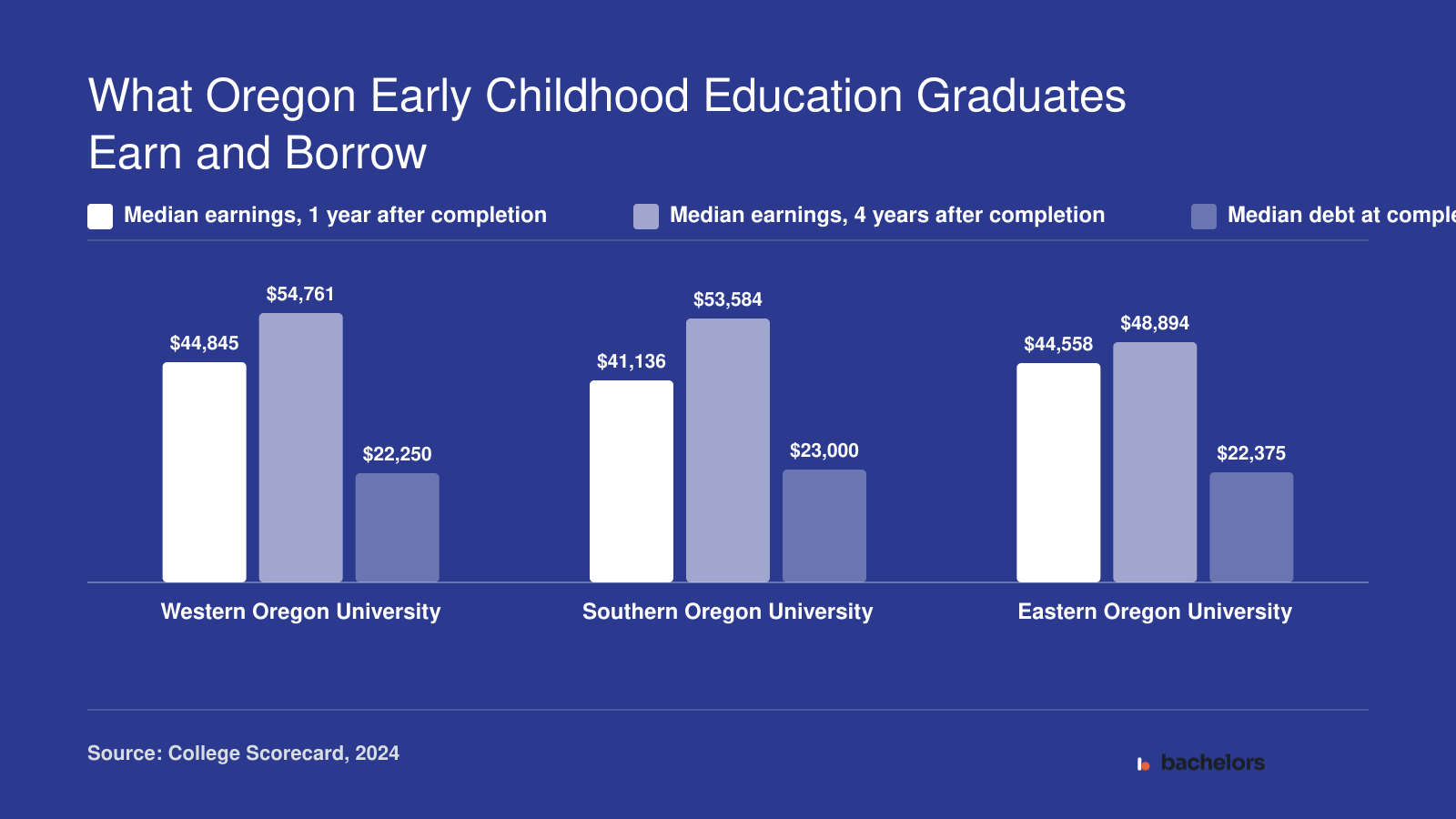
What Oregon Early Childhood Education Graduates Earn and Borrow
The chart compares program-level median earnings for bachelor's graduates in early childhood education one year and four years after completion with median debt at completion. Oregon State University does not report program-level earnings or debt for this field, so it is left off the chart. At Western Oregon, Southern Oregon and Eastern Oregon, median debt of $22,250-$23,000 sits well below first-year median earnings of $41,136-$44,845, and earnings four years out exceed twice that debt.
Do You Need a Teaching License for Early Childhood Education in Oregon?
A teaching license from the Oregon Teacher Standards and Practices Commission (TSPC) lets you lead a classroom in a public school. For public PreK through grade 3 teaching, you need one. For most childcare, preschool and Head Start roles, you do not.
Licensure-Track vs. Non-Licensure Paths
A bachelor's degree alone does not authorize public school teaching. You must complete a TSPC-approved educator preparation program and then earn the license. Oregon has no single PreK-3 license title, so the license and endorsement depend on the grade span you want to teach.
- Licensure-track B.S.: Built to lead to a TSPC license. Choose it if you want to teach in a public school classroom.
- Non-licensure B.S.: Prepares you for childcare, preschool, Head Start, family services or program leadership. Choose it if your goal is outside the public school system.
What Other Roles Expect
Licensed childcare centers need a facility license, but individual preschool teachers there generally do not hold teaching licenses. The state's childcare qualification options include Oregon Registry steps and coursework, or an associate degree in early childhood education or a related field, so a bachelor's is not required for every teacher.
Head Start preschool teachers are typically expected to hold a bachelor's degree in early childhood education or a related field, with an associate degree plus equivalent coursework as an alternative.1 Infant and toddler teachers generally need a Child Development Associate (CDA) credential or comparable training.1 Preschool Promise accepts a bachelor's, an associate degree plus training, or a CDA or Registry Step 8.1 Directors are often preferred to hold a bachelor's in early childhood education, business or a related field, though this is a preference rather than a universal rule. Early intervention and early childhood special education teachers follow a separate path with their own license and endorsement.
Check Before You Enroll
TSPC approval attaches to a specific program, not to a degree title. Confirm that the exact program appears in the Oregon Licensure Program Inventory before you enroll. Out-of-state and online programs are not approved Oregon preparation programs. Oregon State University, Western Oregon University, Eastern Oregon University and Southern Oregon University each use different program names, so ask each school directly whether its track leads to licensure.
Early Childhood Education Careers in Oregon: Settings and Demand
A certificate-level aide and a bachelor's-prepared lead teacher can work in the same building, but they rarely hold the same job, the same pay, or the same ceiling.
Where the Work Happens
Oregon's early childhood employers fall into a few broad settings:
- Public schools: district-run pre-K and kindergarten classrooms, where teaching slots usually call for a license.
- Private preschools and childcare centers: the largest share of openings, spanning assistant, lead and floater roles.
- Head Start and Early Head Start: federally funded programs where many teaching positions favor or require a bachelor's in early childhood education or a related field.
- Program administration: center director, education coordinator, curriculum coach and family services roles.
Demand in Oregon
The Oregon Employment Department lists preschool teachers among its Occupations in Demand for 2026.1 State figures put employment at about 7,020 preschool teachers in 2024, with roughly 938 openings a year as teachers retire, move up, or leave the field. The median annual wage for Oregon preschool teachers was $40,414 in 20251, a little above the national median of $38,140 reported for May 2025.2
Directors and Pay Progression
Pay climbs with responsibility. Nationally, preschool and childcare center directors earned a median of $59,300 in May 2025.3 The national outlook for directors is flat to slightly negative over 2025-2035 as birth rates and childcare costs press on enrollment, though turnover still generates about 5,200 openings a year.3 Oregon does not publish separate director projections, so treat the national trend as a rough guide rather than a state forecast.
That pay gap is where the degree matters. A bachelor's in early childhood education is the usual entry point for lead teaching in Head Start, for licensed public pre-K roles, and for director or coordinator positions that combine classroom experience with budgeting, staff supervision and family engagement. Associate and certificate holders more often start as assistants or aides and move up with experience. Programs such as Western Oregon University's Early Childhood Studies and Eastern Oregon University's Early Childhood Education are built around that four-year path.
Oregon Preschool Teacher Wage
This is what preschool teachers across Oregon earn at the midpoint, regardless of where or whether they earned a bachelor's degree.
Questions to Ask Yourself
Do you want to teach in a public school, or work in preschool, Head Start or childcare administration?
Can you attend on campus, or do you need an online or hybrid program?
Are you starting with community-college credits that need to transfer?
Compare Early Childhood Education programs on the data that matters
Explore more Education & Teaching majors or browse every field of study.
All Education & Teaching programs Browse every field of study