Best architecture Degree Programs
Compare 110+ accredited architecture programs at 90+ colleges, with net price after aid, graduation rates, earnings and debt from IPEDS and the U.S. College Scorecard.

A bachelor's degree in architecture is an undergraduate program in design studio, building technology, and architectural history. Most programs award a Bachelor of Science (B.S.) in architecture, though some schools offer a five-year professional B.Arch instead.
Cost spreads widely among the top schools. Average annual net price after aid runs from $6,128 at Princeton to $23,777 at Yale. Those are institution-wide figures, so studio fees and equipment come on top.
Several well-known programs here are pre-professional and not NAAB accredited. That distinction, more than prestige, determines how long licensure will take.
Key Points
- A NAAB-accredited B.Arch meets the education requirement for architect licensure.
- A B.S. in architecture is pre-professional; licensure usually requires an M.Arch.
- Architects earned a median $99,280 per year as of May 2025.
Best Architecture Schools for a Bachelor's Degree: Our Top 10
This list ranks bachelor's-level architecture programs on cost, completion, and graduate outcomes, weighing net price after aid and on-time graduation most heavily. Every school below offers an undergraduate route into architecture, though only some hold a NAAB-accredited Bachelor of Architecture; the rest award a pre-professional B.S., B.A., or B.Des. that typically leads to a Master of Architecture for licensure.
Princeton University
#1Princeton, NJ · ~$6,000/yr (est.)
Best for: Liberal arts minded design thinkers
Princeton's School of Architecture sits inside one of the country's most selective liberal arts universities, and undergraduates enter through a four-year A.B. with a concentration in architecture rather than a separate professional school. The program is deliberately preprofessional: students apply to Princeton as a whole, then choose from dozens of concentrations, and studio work is framed within a broad humanities education. Small cohorts and a very high completion rate make it a strong fit for students who want architecture thinking without a five-year studio lock-in.
- Four-year A.B. with a concentration in architecture
- Preprofessional education, not an accredited professional degree
- Students apply to Princeton, then choose among 37 concentrations
- A.B. or B.S.E. degree paths available
- Over 50 minors and certificates to pair with the major
- Studio and seminar work inside a liberal arts curriculum
University of Florida
#2Gainesville, FL · ~$7,000/yr (est.)
Best for: In-state students seeking low net price
The University of Florida's School of Architecture awards a preprofessional Bachelor of Design over four years and 120 credits, built around an eight-semester design studio sequence plus history, theory, structures, and building technology. Admission to the major is limited and competitive, with students ranked at the end of semester four on GPA and faculty review of design work. Required field trips and study-abroad options in Vicenza, Asia, Mexico, and Nantucket extend the curriculum well beyond Gainesville, and the woodshop and fabrication lab support hands-on building.
- Preprofessional BDes, 120 credits over four years
- Not NAAB accredited; the two-year M.Arch is the accredited degree
- Eight-semester architectural design studio sequence
- Competitive pin-up review and selection at end of semester 4
- Maintain a 2.75 UF GPA to stay in the major
- Study abroad in Vicenza, Asia, Mexico, and Nantucket
- Required field trips paid for by students
- Woodshop and 3D fabrication lab on site
University of California-Berkeley
#3Berkeley, CA · ~$13,000/yr (est.)
Best for: California licensing track starters
Berkeley's College of Environmental Design offers a Bachelor of Arts in Architecture that balances environmental design fundamentals with three specialization areas: design and representation, technologies and building performance, and history, society, and culture. Juniors pick either a research track built around a shared faculty theme or a studio track that adds design studios each semester, ending in a final project. The degree is preprofessional and counts as foundations entry to a Master of Architecture, and it can apply toward California licensing requirements.
- Preprofessional BA and foundation for a Master of Architecture
- Three concentration areas, from design to building performance
- Junior spring choice between research track and studio track
- Studio track adds architecture courses and a studio each semester
- Research track follows a shared faculty theme to a final project
- Can apply toward California licensing requirements
- Transfer applicants need two years of lower-division coursework
- Declare a College of Environmental Design major at application
Massachusetts Institute of Technology
#4Cambridge, MA · ~$20,000/yr (est.)
MIT's Course 4 leads to a Bachelor of Science in Architecture inside a department that fields more than 100 courses a year with 55 faculty and keeps undergraduate studios near a 1:10 teacher-to-student ratio. The degree is not NAAB accredited; MIT's professional credential is the M.Arch., and undergraduates are expected to continue there or into adjacent design fields. Students meet the Institute's general requirements alongside architecture coursework, and roughly 120 of about 250 students in the department pursue an architecture or design major, minor, or concentration.
- Course 4 leads to the Bachelor of Science in Architecture
- Not NAAB accredited; MIT's professional degree is the M.Arch
- Two undergraduate majors plus four minors in the department
- General Institute Requirements sit alongside architecture courses
- Teacher-to-student ratio in undergraduate teaching rarely above 1:10
- Over 100 courses offered annually by 55 faculty
- Prepares graduates for the Master of Architecture and related fields
University of California-Los Angeles
#5Los Angeles, CA · $13,000/yr (est. net price)
UCLA lists an Architectural Studies BA among its undergraduate majors in the 2026 General Catalog, placing architecture study inside a large public research university with a broad liberal arts core. The catalog entry confirms the bachelor's-level program at the Los Angeles campus but publishes limited detail on credit totals and course sequencing, so applicants should confirm requirements directly with the department. The campus location gives students access to one of the country's densest architectural and urban design communities.
- Architectural Studies BA listed in the 2026 General Catalog
- Bachelor's-level program at the Los Angeles campus
- Catalog notes courses, requirements, and fees are subject to change
- Confirm credit totals and course sequence with the department
University of Michigan
#6Ann Arbor, MI · $18,000 – $61,000/yr (est.)
Michigan's Taubman College teaches a Bachelor of Science in Architecture on campus in Ann Arbor, built on a four-studio sequence that moves from precedent analysis to context, large buildings and urban issues, and finally the Wallenberg Studio focused on design research and humanitarian concerns. The first two years use a menu of modules so students from varied backgrounds can enter the studio sequence, and most graduates add a minor. A full-time career and professional development team supports job placement, and graduates either enter firms or continue to the professional M.Arch for licensure.
- Bachelor of Science in Architecture taught on campus in Ann Arbor
- Four themed studios from precedents to the Wallenberg Studio
- Wallenberg Studio centers design research and humanitarian concerns
- First two years use modules for students from varied backgrounds
- Digital Fabrication and Robotics Lab and Visualization Lab
- Most students graduate with a minor
- Dedicated full-time career and professional development team
- Licensure path continues through the professional M.Arch
Rice University
#7Houston, TX · ~$13,000/yr (est.)
Rice's School of Architecture offers a Bachelor of Arts with a major in architecture that requires 130 credit hours, including 17 courses and four integrated sequences in design studios, history and theory, technology, and practice. Unusually, 45 of the elective credits must fall outside the school, so the degree is built for students who want architecture embedded in a wider education. Students can also pursue a direct-entry Bachelor of Architecture route at Rice; the BA leads into that stage for those admitted.
- BA in architecture requiring 130 credit hours
- 17 courses and four sequences: studios, history, technology, practice
- 45 elective credits must come from outside the School of Architecture
- At least 11 courses at the 300 level or above
- 2.00 major GPA required; 3.00 average expected for major approval
- Transfer credit cannot satisfy major requirements
- BA leads into the Bachelor of Architecture stage for admitted students
Georgia Institute of Technology
#8Atlanta, GA · ~$12,000/yr (est.)
Georgia Tech's Bachelor of Science in Architecture requires 124 credits and pairs design studios 1 through 7 with media and modeling, construction technology, environmental systems, and structures. Incubator workshops are open to every class level, and the International Plan adds language proficiency, globally focused coursework, an international experience, and a capstone, with study abroad following the first four foundational studios. Graduates move into graduate architecture study or directly into firms, the building industry, or government service.
- Bachelor of Science in Architecture requiring 124 credit hours
- Architecture design studios 1 through 7 plus media and modeling
- Construction technology, environmental systems, and structures coursework
- Incubator workshops open to freshmen through seniors
- International Plan requires a 2.5 GPA and study abroad
- 12 free elective credits, which may be taken pass-fail
- 11-hour architecture cluster option
University of Washington-Seattle Campus
#9Seattle, WA · ~$14,000/yr (est.)
The University of Washington's College of Built Environments awards a BA in Architectural Studies over four years, approaching architecture through socio-cultural influences, urbanism, spatial reasoning, landscape, construction, and ecology. Students focus through one of three areas: History and Theory, Materials and Making, or Sustainable Development. The major is capacity-constrained with a separate departmental application, and first-year applicants can be considered for direct admission by listing it as a first-choice major.
- Four-year BA in Architectural Studies
- Three focus areas: History and Theory, Materials and Making, Sustainable Development
- Capacity-constrained major with a separate departmental application
- First-year applicants can be considered for direct admission
- Entry begins autumn or winter quarter
- Transfers need ARCH 200, 231, 350, 351, and 352
- Completing prerequisites does not guarantee admission
- Non-degree enrollment available for prerequisite coursework
Yale University
#10New Haven, CT · ~$24,000/yr (est.)
Yale College awards a BA with a major in architecture, requiring 15 course credits including three prerequisites and a senior requirement, with a choice between a Design concentration and a History, Theory, Criticism of Architecture and Urbanism concentration. Design students take a four-course core of junior studios and history surveys, spread electives across four subject areas, and finish with a senior design portfolio. The major is explicitly not an accredited professional degree, and admission runs through a Declaration of Intent in the spring of sophomore year after the prerequisite sequence.
- BA in Architecture requiring 15 course credits
- Two concentrations: Design, or History, Theory, Criticism of Architecture and Urbanism
- Design concentration includes two junior-year studios
- Seniors complete ARCH 4000 and 4001 and submit a design portfolio
- Electives spread across history, urbanism, materials, and computation
- Declaration of Intent in spring of sophomore year after prerequisites
- Not an accredited professional degree
- Required orientations cover technology, library research, and the woodshop
Cost & outcomes by school
Federal data for the highest-earning architecture programs, independent of the ranking above. Earnings are this field's bachelor's graduates four years after completing where the Scorecard reports them, else the school's undergraduate median.
| School | Net price / yr | Grad rate | Earnings | Debt | Grads/yr | Format |
|---|---|---|---|---|---|---|
| Massachusetts Institute of Technology MA | $20,111 | 96% | $143,372 | $14,768 | 11 | Campus |
| University of Pennsylvania PA | $28,699 | 97% | $111,371 | $15,715 | 26 | Campus |
| Princeton University NJ | $6,128 | 98% | $110,066 | $10,320 | 14 | Campus |
| Lehigh University PA | $36,931 | 88% | $105,584 | $21,960 | 30 | Campus |
| Cornell University NY | $28,690 | 95% | $104,043 | $14,000 | — | Campus |
| Columbia University in the City of New York NY | $21,590 | 96% | $102,491 | $21,500 | 21 | Campus |
| Yale University CT | $23,777 | 96% | $100,533 | $12,975 | 21 | Campus |
| University of Southern California CA | $32,740 | 92% | $92,498 | $18,000 | 9 | Campus |
| Rice University TX | $13,370 | 95% | $89,718 | $11,000 | 26 | Campus |
| Washington University in St Louis MO | $21,786 | 94% | $86,182 | $17,500 | 9 | Campus |
| Wellesley College MA | $25,496 | 92% | $84,803 | $10,000 | 10 | Campus |
| The Cooper Union for the Advancement of Science and Art NY | $13,269 | 81% | $83,847 | $15,000 | 25 | Campus |
Sources: U.S. Department of Education. Net price, graduation rate, earnings and debt: College Scorecard (earnings and debt for this field's bachelor's graduates where reported, else school-wide); graduates: IPEDS. A dash means no figure is reported.
Cost, debt & payoff
Median earnings of this field's bachelor's graduates (4 yrs after completing, else the school's undergraduate median) vs. their median federal loan debt · U.S. College Scorecard
Across these programs the median graduate earns about $67,122 and finishes with roughly $21,960 in debt — a ratio that clears a common rule of thumb (keep debt below first-year salary). Net price and debt vary widely school to school, so check the per-school figures in the table above before you shortlist.
How We Ranked Bachelor's Degree in Architecture Programs
A strong architecture ranking should be useful before a campus visit, not a substitute for one. We built this list to compare the financial and academic outcomes a bachelor's degree in architecture can produce, while acknowledging what an architecture education offers that numbers cannot capture.
The Measures We Used
We started with the 2024 College Scorecard and IPEDS, the federal data sources that let families compare schools on common ground. The evaluation weighs net price after aid, graduation and retention rates, completions, and the earnings and debt of architecture graduates. We also included program-level earnings and debt for architecture completers, rather than relying only on a whole-university average.
That distinction matters. Graduation rate, net price, 10-year earnings, and median debt are institution-wide figures. They describe the entire undergraduate population, not just architecture students. Program earnings and debt are narrower: they follow students who completed an architecture program, so they give a closer read on what a degree in this field may return.
Scope and Limits
The ranking covers undergraduate programs only. We included campus, online, and hybrid delivery formats rather than filtering any format out, because prospective students balance location, cost, and flexibility differently.
What the data cannot measure is just as important. Studio quality, faculty reputation, and design culture shape an architecture education, but they do not appear in federal outcome figures. Use this list to narrow the field, then visit studios, review student work, and talk with faculty before you commit.
B.Arch vs. B.S. in Architecture: Which Bachelor's Degree Fits Your Goals?
A NAAB-accredited Bachelor of Architecture (B.Arch.) is a professional degree that meets the education requirement for licensure. A Bachelor of Science (B.S.) or Bachelor of Arts in architecture is pre-professional, so students who want to be licensed usually follow it with an accredited M.Arch. The short verdict: choose the B.Arch. if you are certain you want licensure, and choose the B.S. if you want room to pivot into planning, construction, or other design fields.
| Factor | B.Arch. | B.S. in Architecture |
|---|---|---|
| Degree type | Professional undergraduate degree | Pre-professional undergraduate degree |
| NAAB accreditation | Accredited. NAAB accredits professional degrees titled B.Arch., M.Arch., and D.Arch. | Not accredited. NAAB does not accredit pre-professional degrees |
| Typical length | Five years | Usually four years for full-time students |
| Typical credit hours | 150 semester credit hours minimum, often higher | About 137 credits in one cited four-year program; totals vary by school |
| Studio intensity | Full professional studio sequence built around NAAB requirements, alongside general and optional studies | Foundation design studios and coursework, with the professional sequence completed in graduate study |
| Path to licensure | Meets the education requirement for becoming a licensed architect in all U.S. jurisdictions | Not enough on its own. Students seeking licensure must also earn a professional degree such as an M.Arch. |
| Graduate study | Not required to satisfy the education requirement | Often the pre-professional component of an M.Arch. track, which may add about 60 graduate credits |
| Career flexibility | Focused on practice. Best for students committed to architecture | Broader. Works as a base for planning, construction, or design careers, or for a later M.Arch. |
Cost, Debt and Earnings: Which Architecture Schools Offer the Best Value?
The figures below come from IPEDS and College Scorecard (2024) and describe each school as a whole, not the architecture program alone. Earnings are medians measured 10 years after entry, debt is the median for all completers, and net price is an average cost after grants and scholarships, so your own aid offer will differ. Princeton's $6,128 net price and $10,320 median debt give it a higher earnings-to-debt ratio than MIT, even though MIT reports higher 10-year earnings, and the same math often favors public universities, where a low in-state net price and light borrowing can beat a higher-earning private school once loan payments are counted.
| School | Location | Sector | Average Net Price After Aid (school-wide) | Median Debt at Completion (school-wide) | Median Earnings 10 Years After Entry (school-wide) | Earnings-to-Debt Ratio (school-wide) |
|---|---|---|---|---|---|---|
| Princeton University | Princeton, NJ | Private nonprofit | $6,128 | $10,320 | $110,066 | 10.7x |
| Massachusetts Institute of Technology | Cambridge, MA | Private nonprofit | $20,111 | $14,768 | $143,372 | 9.7x |
| Wellesley College | Wellesley, MA | Private nonprofit | $25,496 | $10,000 | $84,803 | 8.5x |
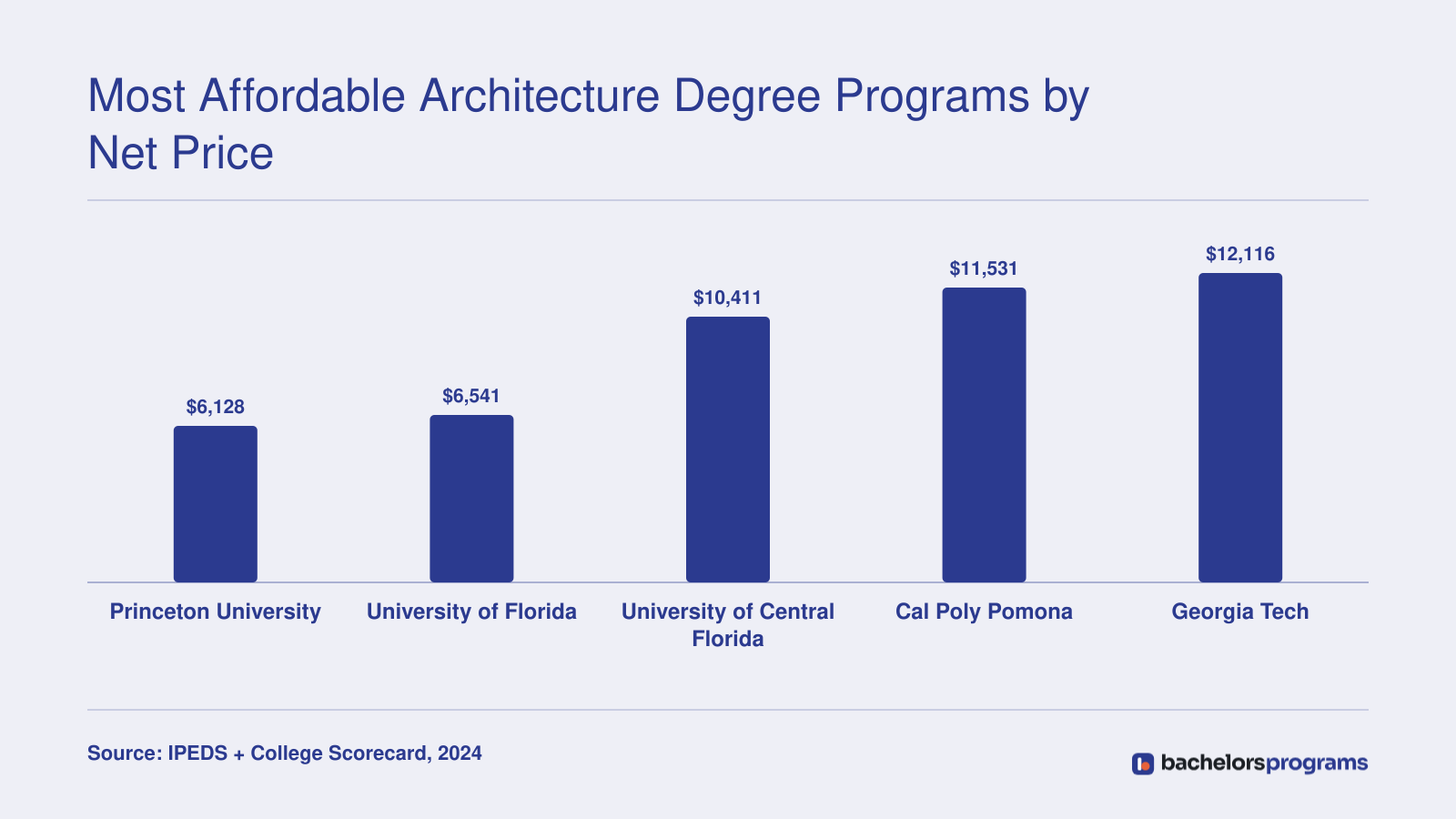
Most Affordable Architecture Degree Programs by Net Price
The chart below compares the average annual net price after grants and scholarships at the lowest-cost schools in our data. These figures are institution-wide averages for undergraduates, not architecture-specific prices, so studio fees, equipment and field trips can add to the bill. Princeton's aid pushes it to the lowest net price, but public universities in Florida, California and Georgia fill out the rest of the low-cost end. For public schools, that low price generally depends on in-state residency, so start with your home state's public options.
Related Articles
B.Arch vs. B.S. Plus M.Arch: Total Time and Cost to Licensure
The B.Arch reaches licensure sooner, while the B.S. plus M.Arch route trades that speed for flexibility. Either route requires an education from a NAAB-accredited program, then the Architectural Experience Program (AXP) and the Architect Registration Examination (ARE).1
The Two Timelines
- B.Arch route: A five-year professional bachelor's degree, followed by completion of AXP and ARE.
- B.S. plus M.Arch route: A four-year pre-professional B.S. in architecture, then a typical two-year accredited M.Arch, followed by AXP and ARE. NCARB calls this the six-year M.Arch pathway.
The two-year graduate length applies to students whose bachelor's degree is in architecture. The University of Illinois, for example, lists two years for graduates of its own B.S. or an equivalent, but 2.5 to 4 years for applicants without an architecture bachelor's.2 Length varies by school and by prior coursework.
What the Extra Year Costs
The B.S. route typically adds one more year in school than the B.Arch. That means another year of tuition and living costs, plus one fewer year of full-time earnings. Graduate tuition differs widely between schools, so check each program's current rate before you compare totals.
Shortening the Path With IPAL
NCARB's Integrated Path to Architectural Licensure (IPAL) is an optional pathway inside an accredited program, not a separate degree. Participants must be able to complete at least 75% of AXP before graduating and take all six ARE 5.0 divisions during school.3 NCARB says dedicated students can be licensed in as little as six years, and it reported 32 IPAL programs at 27 colleges in 20264. Finishing the remaining experience hours and passing every exam division still falls to the individual student. For context, 2025 licensees averaged 12.3 years to licensure overall.5
Which Route Fits You
Choose the B.Arch if you are certain about architecture and want the fastest, lowest-cost route to a license. Choose the B.S. plus M.Arch if you want to keep your options open, expect to switch schools for graduate study, or prefer to delay the professional commitment beyond your undergraduate years.
What Licensed Architects Earn
Architects nationwide earned a median of $99,280 per year, or $47.73 per hour, as of May 2025.
architecture programs by state
Architecture Degree FAQs
These answers cover the questions prospective architecture students ask most often about degree types, licensure and preparation. Requirements change, so confirm details with your state board and NCARB before you commit to a program.
Is a B.Arch better than a B.S. in architecture?
Can you become a licensed architect without a NAAB-accredited degree?
Do you need to be good at drawing or math to study architecture?
Can you switch from a B.S. to a B.Arch after starting college?
Compare architecture programs on the data that matters
Explore more Arts & Design majors or browse every field of study.
All Arts & Design programs Browse every field of study