Best Online Art History Degree Programs
Compare 15 accredited online Art History programs, with net price after aid, graduation rates, earnings and debt from IPEDS and the U.S. College Scorecard.

You can earn a bachelor's degree in art history entirely online; the usual credential is a Bachelor of Arts (B.A.) in Art History, typically 120 credit hours. So, can you get an art history degree online? Yes. Every program listed here is fully online; hybrid formats are excluded.
The tension is practical. Studio-heavy requirements, portfolio submissions, foreign language sequences and residency credits vary widely between schools, and they decide whether a program works remotely and what it costs.
Among the programs here, tuition, transfer rules and early-career earnings differ sharply, while museum and gallery jobs remain competitive and often reward internships as much as the diploma.
Key Points
- A standalone art history major differs from a smaller concentration.
- Compare average net price, not sticker tuition, to find cheaper options.
- College Scorecard earnings group art history under fine and studio arts.
Best Fully Online Art History Degree Programs for 2027
Every program below offers an online route to the bachelor's degree in art history, and each card notes where a school also teaches the same degree on campus so you can confirm the fully remote sequence with an advisor before you apply. Nine programs met our online filter for 2026, so the list is not padded to ten. Net price and graduation rate shown on each card are institution-wide figures after aid, not numbers for the art history major alone.
Utah Valley University
#1Orem, UT · $5,000 – $10,000/yr (est.)
Best for: Cost-conscious students seeking the lowest total price
Utah Valley University labels this art history degree Online-Plus, meaning most work is remote but the foreign-language sequence and 30 residency credits can push students toward transfer credit or prior-learning options. The 120-credit B.A. pairs a 51-credit discipline core with two seminars and a portfolio submission. It carries the lowest total program cost in this ranking. Ask the department which terms, if any, require a campus presence before you commit.
- 120 total credit hours
- 51-credit discipline core plus 33 upper-division art history credits
- Two art history seminars required
- Foreign language through the 2020 level required
- Portfolio submission required with a 3.0 GPA in ARTH courses
- 2.0 overall GPA minimum
- 30 residency credits at UVU
- Online course options listed in the academic plan
University of Massachusetts-Lowell
#2Lowell, MA · ~$17,000/yr (est.)
Best for: Liberal arts generalists wanting a flexible concentration
The University of Massachusetts Lowell houses art history inside its Bachelor of Liberal Arts, an interdisciplinary degree that lets students pair six art history courses with work in other fields. Three of those six must be upper-level, and the sequence runs from ancient art to the present. Published materials describe online art history coursework but do not spell out a fully online path, so confirm the remote sequence with an advisor.
- Six art history courses required within the liberal arts degree
- Three of the six must be at the 3000 or 4000 level
- Surveys run from ancient art to the present
- Covers architecture, painting, sculpture and artifacts
- Builds writing, verbal and critical judgment skills
- Pairs art history with coursework in other liberal arts fields
Georgia Southern University
#3Statesboro, GA · $15,000 – $20,000/yr (est.)
Best for: Museum and gallery career starters needing online flexibility
Georgia Southern University's Betty Foy Sanders Department of Art is NASAD-accredited and teaches the art history concentration online as well as at its Statesboro and Armstrong campuses. Concentration electives carry the ARTH prefix and cover Western and non-Western art from prehistory to the contemporary period. The department also arranges studio visits to regional museums and galleries, and art scholarships reach freshmen, transfer and continuing students.
- NASAD-accredited Betty Foy Sanders Department of Art
- Fully online option alongside Statesboro and Armstrong campuses
- Electives carry the ARTH prefix
- Coursework spans prehistory to contemporary art
- Studio visits to regional museums and galleries
- $30 application fee, waived for some applicants
- Scholarships for freshmen, transfer and continuing students
Ferris State University
#4Big Rapids, MI · ~$9,000/yr (est.)
Kendall College of Art and Design, Ferris State University's art and design college, offers the art history B.A. with an unusually heavy studio component: a 51-credit major studio block sits alongside art and design history coursework. Admission needs a 2.5 GPA but no portfolio and no test scores. Classes run in Grand Rapids, online, or in a mixed format, so the online-only route needs confirming with the college.
- NASAD-accredited Kendall College of Art and Design
- 2.5 GPA minimum; no portfolio or entrance exam required
- 51-credit major studio block
- 24 credit hours of electives
- 400-level art history seminars and historiography
- Non-western art history coursework required
- Classes in Grand Rapids, online, or mixed delivery
Bridgewater State University
#5Bridgewater, MA · $16,000/yr (est. net price)
Bridgewater State University keeps art history classes at 35 students or fewer and requires at least two studio courses alongside global art history and Euro-American surveys. Coursework draws on history and anthropology, and the department arranges field visits to museums, galleries and architectural sites in Boston, New York City and Providence. Students can enroll full time, part time or online, evening courses exist, and the Bridgewater Commitment waives tuition and mandatory fees for families earning $125,000 or less.
- NASAD-accredited Department of Art and Art History
- Classes capped at 35 students
- At least two studio courses required
- Coursework draws on history and anthropology
- Field visits to museums and galleries in Boston and New York City
- Evening courses available
- Bridgewater Commitment covers tuition for families earning $125,000 or less
Empire State University
#6Saratoga Springs, NY · ~$12,000/yr (est.)
Empire State University, part of SUNY, builds the art history concentration inside an individualized B.A., B.S. or B.P.S. in The Arts, so students shape the degree with a mentor rather than follow one fixed major. Transfer credit, individualized credit for prior learning and professional learning evaluation can all shorten the 124-credit total. Every plan must cover seven foundation areas, including historical perspectives and artistic theory, and the program was updated for the Spring 2027 term.
- 124 total credit hours
- Choose a B.A., B.S. or B.P.S. in The Arts
- Individualized degree plan built with an academic mentor
- Concentration options include art history and museum studies
- Credit for prior learning and professional learning evaluation
- Seven foundation areas required in every plan
- Updated for the Spring 2027 term
Arizona State University
#7Scottsdale, AZ
Arizona State University runs the art history concentration inside its online B.A. in Art through the Herberger Institute for Design and the Arts, the largest program in this group. First-year students enter as art exploratory majors with no portfolio review and file a declaration form at 30 credit hours. A capstone in research methods and art history writing closes the degree, and coursework ranges from prehistory through Africa, Oceania and the Americas.
- 120 total credit hours through the Herberger Institute
- No portfolio review for first-year students
- Declaration form filed at 30 credit hours
- Capstone in research methods and art history writing
- Offered online, at Tempe, and at ASU Local
- Courses include Art of Africa, Oceania, and the Americas
University of Colorado Colorado Springs
#8Colorado Springs, CO · $10,000 – $24,000/yr (est.)
The University of Colorado Colorado Springs folds art history into a B.A. in Visual and Performing Arts, with a concentration in the History of Art and Visual Culture. Students take at least 45 art history credits, 33 of them upper-division, and finish with a senior capstone. Delivery runs on campus, online or hybrid, and coursework covers Native American, Hispanic, Spanish colonial, feminist and photographic art.
- 120 total credit hours, 60 of them in the VAPA college
- 45 art history credits, 33 at the upper division
- C or better required in every major course
- Senior capstone required
- Covers Native American, Hispanic and feminist art
- On campus, online or hybrid delivery
Academy of Art University
#9San Francisco, CA · ~$41,000/yr (est.)
The Academy of Art University is a private San Francisco art school whose BFA in Art History blends 24 units of art history core with studio work and a senior thesis. Students complete a portfolio in painting, printmaking or sculpture and two European foreign language courses, and the degree is offered online. The curriculum leans further toward studio practice than a traditional B.A. in art history does, which suits students who want making and scholarship in the same program.
- 120-unit bachelor's degree
- 24 units of art history core
- Senior thesis plus a portfolio in painting, printmaking or sculpture
- Two European foreign language courses
- 36 liberal arts general education units
- C minimum in all core courses
None of the ranked Art History programs match the online lens yet. The full ranking is at the link above.
Cost, debt & payoff
Median earnings of this field's bachelor's graduates (4 yrs after completing, else the school's undergraduate median) vs. their median federal loan debt · U.S. College Scorecard
Across these programs the median graduate earns about $49,842 and finishes with roughly $22,954 in debt — a ratio that clears a common rule of thumb (keep debt below first-year salary). Net price and debt vary widely school to school, so check the per-school figures in the table above before you shortlist.
How We Ranked Fully Online Bachelor's Degree in Art History Programs
We ranked bachelor's degree programs in art history that students can complete entirely online, scoring them on delivery format and a few measurable quality signals. Here is what went into it and where it falls short.
The Fully Online Filter
Before any scoring, we removed programs that require hybrid sessions, on-campus residencies, or in-person attendance. Many competing lists skip this step and mix in programs that still need a campus visit, which can mislead students who live far from the school or work full time. Only programs you can complete from home were scored.
We also kept the scope to bachelor's-level programs. Certificates, minors with no degree attached, and graduate degrees were not considered.
What the Composite Blends
The score combines delivery format with quality signals:
- Net price after aid: what students typically pay after grants and scholarships are subtracted.
- Graduation rate: the share of students who finish at the institution.
- College Scorecard outcomes: earnings and related results, used where they are published.
Limits Worth Knowing
These figures have real gaps; treat them as guides, not guarantees.
- Graduation rates cover the whole institution, not the art history program alone.
- Net price is an average across students, not a quote. Actual costs vary with your aid package, transfer credits, and course load.
- Some programs have no published program-level earnings, so those schools are judged on the remaining signals.
Use the ranking to build a shortlist, then confirm current tuition, format, and outcomes directly with each school before you apply.
Standalone Art History Major or Concentration? What You Actually Study
Two transcripts can both say art history and still represent different degrees. A standalone bachelor's degree in art history is built around the discipline; an art history concentration is a smaller cluster of courses inside a liberal arts, humanities, or general studies bachelor's degree. The difference shows up in credit counts, required research work, and how prepared you are for graduate study or museum work.
What a Bachelor's Degree in Art History Requires
Most majors stack survey courses, period and regional courses, methods and theory, and a capstone or senior thesis. A concentration usually trims that sequence. You may still get a survey pair and a few upper-level electives, but you have less guaranteed room for non-Western art, historiography, or a sustained research project.
Credit Counts and Structure
Utah Valley's standalone B.A. lists a 51-credit discipline core, including 33 upper-division art history credits and two art history seminars. Lindenwood's standalone major includes 6 credit hours of capstone coursework, among them a research methods course and an internship worth 1 to 6 credits. Arizona State's art history concentration sits inside a 120-credit B.A. in Art and requires a capstone.1 Some majors make art history the center of the degree; a concentration asks you to build that center through electives.
Why the Distinction Matters
Graduate art history programs and museum hiring committees look for sustained upper-level coursework, a research paper or thesis, and reading knowledge of a foreign language. A concentration can be a legitimate path, but you may need to add art history courses or a language sequence before applying to graduate school. Curatorial assistant and registrar roles may accept a bachelor's degree; curator positions generally require a graduate degree. Utah Valley shows why language planning matters: it requires 16 credit hours in one language through the 2020G level, recommends German or French, and notes those language courses are not currently online. If a program lists a language requirement, treat it as part of the degree plan, not an elective.
Cheapest Online Art History Degree Options
If you are searching for the cheapest online art history degree, start with average net price, which is the school-wide average a student actually paid per year after grants and scholarships, so treat it as a benchmark rather than a guaranteed bill. At Utah Valley University, fully online students who live in the U.S. but outside Utah pay a flat $285 per credit, roughly $34,200 for a 120-credit degree before any transfer credit, while Utah residents pay the same residency-based rates as on-campus students, and UVU does not list a separate mandatory online fee; Ferris State charges the same published tuition and fees whether you live in Michigan or not. Transfer and prior-learning credit can cut these totals sharply (UVU still requires 30 credits earned at UVU, and Empire State accepts credit for prior learning), but the lowest price can come with tradeoffs: Empire State's option is an art history concentration inside a broader arts degree rather than a standalone major, and lower-cost online programs may offer fewer structured internship supports, so confirm hands-on opportunities before you enroll.
| School | Program | Format | Avg. Net Price After Aid (per year) | In-State Tuition and Fees (per year) | Out-of-State Tuition and Fees (per year) | Credits Required |
|---|---|---|---|---|---|---|
| Utah Valley University | B.A. in Art History | Online and on campus | $6,376 | $6,507 | $18,489 | 120 |
| Ferris State University | BA in Art History | Fully online option and on campus | $8,624 | $14,778 | $14,778 | N/A |
| Empire State University | The Arts (Art History concentration) | Online | $11,676 | $7,648 | $17,558 | 124 |
Related Articles
Accreditation and Admissions: What to Verify Before You Apply
Before you apply, check the points below on each school's official admissions and catalog pages.
- Institutional accreditationYes, online art history degrees can be fully accredited. Accreditation covers the whole institution, so an online bachelor's degree carries the same status as the on-campus version. Look up each school in its accreditor's directory, such as HLC, MSCHE, SACSCOC, NECHE, WSCUC or NWCCU.
- No art history-specific accreditorNo accreditor reviews art history B.A. programs specifically, so institutional accreditation is the check that matters. Some art departments, including those at Georgia Southern, Ferris State and Bridgewater State, hold NASAD accreditation. That is a plus, but it does not replace institutional accreditation.
- No associate degree neededThe UW-Milwaukee, Lindenwood and ASU program pages do not list an associate degree as a prerequisite. ASU notes that first-year students face no portfolio review. You can usually enter as a freshman or as a transfer student.
- Transfer and residency limitsLindenwood accepts up to 90 transfer credits, so you may finish with as few as 30 credits there. UW-Milwaukee requires at least 15 credits at the 300 level or above taken at UWM. Utah Valley requires 30 residency credits.
- Application basics and GPAPlan to submit a high school diploma or GED and all transcripts. Published GPA floors include 2.0 at Utah Valley (3.0 in art history courses) and 2.5 at Ferris State, which requires no entrance exam. UW-Milwaukee requires a 2.0 across major coursework, including transfer credits. Confirm each school's test-optional policy directly.
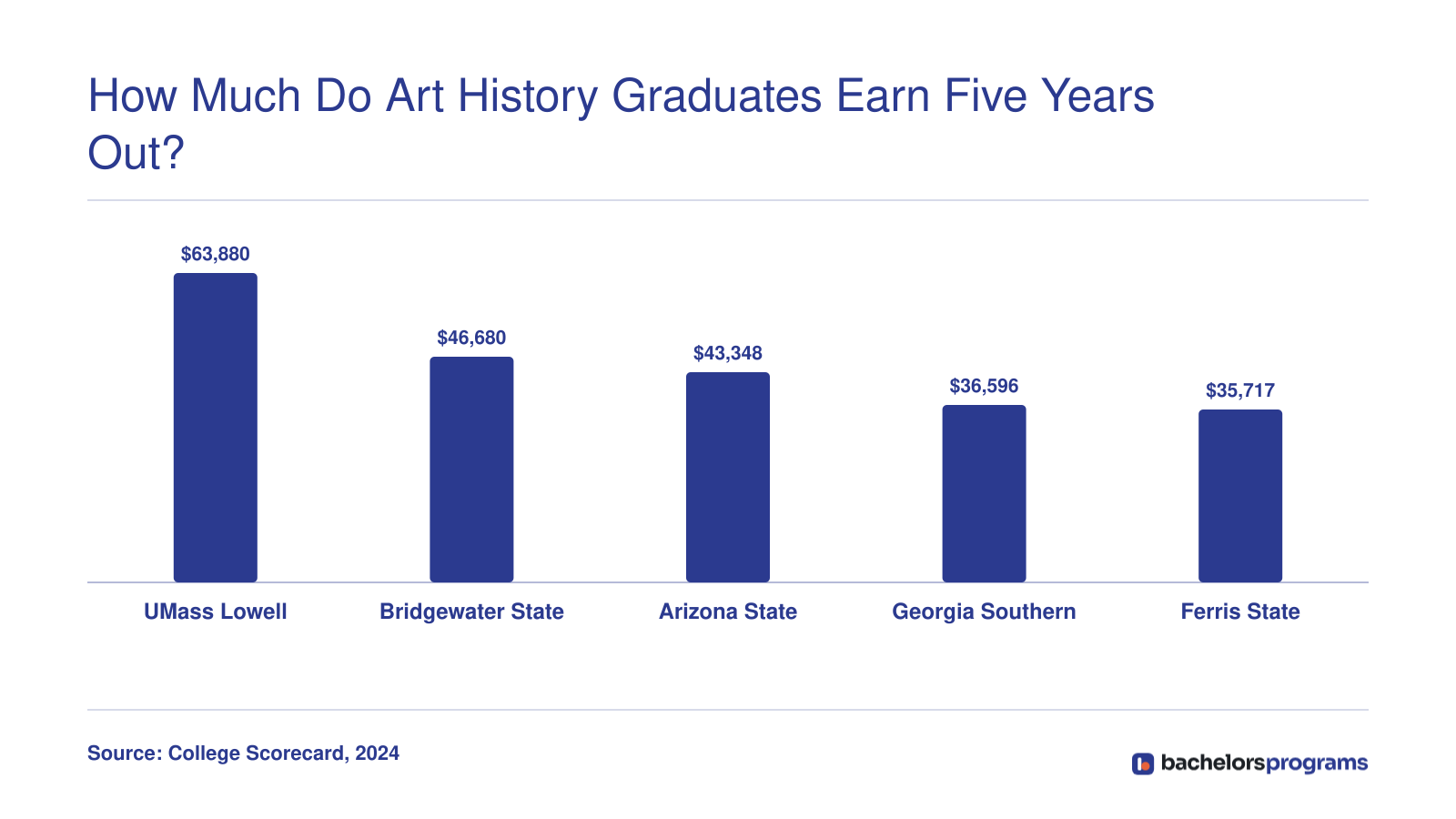
How Much Do Art History Graduates Earn Five Years Out?
The chart compares median earnings for bachelor's graduates five years after finishing, using federal College Scorecard data for each school's program. The figures cover the federal fine and studio arts category, which includes art history, so treat them as a guide to the field rather than a promise for any single major. UMass Lowell leads at $63,880, while Ferris State and Georgia Southern both fall in the mid-$30,000s.
What Museum Curators Earn
Curator roles are a common long-term goal for art history majors, and pay reflects the advanced training they require.
Questions to Ask Yourself
Can you commit to live online seminars at set times, or do you need fully asynchronous courses?
Does the program help you place an internship at a museum, gallery, or archive near your home?
How many of your existing credits will transfer, and how much time and tuition does that save?
Who teaches the upper-level art history courses, and are they tenure-track faculty or adjuncts?
What does the program cost after fees, and are there charges for online course delivery?
Art History programs by state
Online Art History Degree FAQs
These answers cover the questions prospective students ask most about earning a bachelor's degree in art history online. Details vary by school, so confirm specifics with each admissions office.
How long does it take to earn an online art history degree?
Can you get an online art history bachelor's degree without an associate degree?
Do employers and graduate schools treat an online art history degree differently from a campus degree?
Can you study art history online without seeing artworks in person?
Compare Art History programs on the data that matters
Explore more Arts & Design majors or browse every field of study.
All Arts & Design programs Browse every field of study