Best Online Fine Arts Degree Programs
Compare 21 accredited online Fine Arts programs, with net price after aid, graduation rates, earnings and debt from IPEDS and the U.S. College Scorecard.

Yes, you can complete a fine arts bachelor's degree entirely online. Every school ranked here teaches its program that way, and hybrid formats are excluded. The most common credential is the Bachelor of Science (B.S.) in Fine Arts, though the BFA remains the studio-heavy standard.
Cost is where these programs diverge. Average net price after aid, measured across each whole institution, ranges from $7,099 to $40,613, a spread that has little to do with the quality of the studio instruction.
Studio work remains the real constraint: ceramics and sculpture need home equipment, and critique happens on video.
Key Points
- SUNY Empire State's $295 per credit totals about $35,400 for 120 credits.
- Every program here runs fully online with no required campus residency.
- Most degrees take 120 credits, though Miami University lists 128.
Best Fully Online Fine Arts Degree Programs Ranked
Every program below can be completed online, and none of the program pages we reviewed lists a required campus residency, summer intensive, or in-person critique for the online route. Each card names the concentration, the city and state, the net price, this school's graduation rate, and program-level earnings where the federal data reports them.
Bridgewater State University
#1Bridgewater, MA · $16,000/yr (est. net price)
Best for: Massachusetts residents seeking affordable studio art
Bridgewater State University runs its art programs through a nationally accredited department where studio classes cap at 16 students. Majors choose among five concentrations, and the fine arts track covers painting, sculpture, and printmaking. Courses are offered in person, online, or blended, with evening sections for working students, and the program page lists no required campus residency or in-person critique. Families earning $125,000 or less pay no tuition or mandatory fees.
- Five concentrations: art education, crafts, fine arts, graphic design, photography
- Studio space for ceramics, jewelry and metals, printmaking, and book arts
- Internships at galleries and museums plus Boston gallery visits
- Classes capped at 16 students, with evening sections available
- Courses run in person, online, or blended, with no required residency
- Median pay of $29,595 one year after finishing and $45,747 after four years
Ferris State University
#2Big Rapids, MI · ~$9,000/yr (est.)
Best for: Portfolio-driven students wanting a studio-intensive BFA
Ferris State University teaches its studio arts BFA through Kendall College of Art and Design in Grand Rapids, a NASAD-accredited art school. The curriculum is studio-heavy, with 39 major studio credits and a two-course thesis sequence. Classes run on the Grand Rapids campus, online, or in a mixed format, and applicants submit a portfolio of 8 to 10 pieces rather than test scores. The program page lists no required campus residency, summer intensive, or in-person critique.
- NASAD-accredited BFA taught through Kendall College of Art and Design
- 39 major studio credits plus 24 or 27 supportive studio credits
- 12 or 15 art history credits and 12 elective credits
- Portfolio of 8 to 10 pieces with a 2.50 GPA; test scores not required
- Studio Arts Thesis I and II are part of the major sequence
- Classes held in Grand Rapids, online, or in a mixed delivery format
- Median pay of $39,165 four years after finishing
Winston-Salem State University
#3Winston-Salem, NC · $10,000 – $15,000/yr (est.)
Best for: HBCU-focused students targeting gallery and studio careers
Winston-Salem State University offers a four-year art degree through its arts center, with concentrations in studio art and computer graphics. Classes hold 12 to 15 students, and every senior shows work in the Diggs Gallery. The program runs on campus and online, and the page lists no required residency, summer intensive, or in-person critique. The university is a historically Black institution, and its own materials place the art program among the top 10 at HBCUs.
- Concentrations in Studio Art and Computer Graphics
- 15 semester hours of foundational courses plus four electives in the track
- Senior Exhibition staged at the Diggs Gallery
- Small classes of 12 to 15 students
- Internships at Diggs Gallery and at regional or national museums
- Four-year program delivered on campus and online
- Entry-level earnings reported at $30,000 to $50,000
Oral Roberts University
#4Tulsa, OK · ~$25,000/yr (est.)
Oral Roberts University offers a BFA in art with specializations in graphic design, game design and development, and studio art. More than 65% of the coursework sits in the major, and students finish with senior projects and an exhibition. Online students take live, scheduled classes through ORU Flex rather than working asynchronously, and the page lists no required campus residency or in-person critique. A portfolio is optional and can be submitted for scholarship consideration.
- Three specializations: graphic design, game design and development, studio art
- Over 65% of coursework sits inside the major
- Live, scheduled online classes through ORU Flex
- Senior projects and an exhibition cap the degree
- Optional portfolio submitted for scholarship consideration
- Internships with galleries and design studios
- Median pay of $53,632 five years after finishing
Empire State University
#5Saratoga Springs, NY · ~$12,000/yr (est.)
SUNY Empire State University is built for students who want to shape their own degree. The arts area of study awards a BA, BS, or Bachelor of Professional Studies, and each student builds a 124-credit plan with an academic mentor. Credit for prior learning, professional learning evaluation, and credit by examination all count toward the degree, and the visual arts concentration can be turned into a custom concentration. No campus residency or in-person critique is listed.
- 124 total credits across seven foundation areas
- Choose a BA, BS, or Bachelor of Professional Studies
- Individualized degree plans built with an academic mentor
- Credit for prior learning and credit by examination accepted
- Students may design their own concentration
- Median pay of $39,946 one year after finishing
University of Mount Olive
#6Mount Olive, NC · ~$19,000/yr (est.)
The University of Mount Olive blends traditional studio work in painting, drawing, and printmaking with digital graphic design. Students build a portfolio and can focus on illustration, web design, 3D design, bookmaking, or poster design. The program keeps a computer lab, a photography studio, and a fine arts studio on campus, and the program page lists no required residency, summer intensive, or in-person critique. Visual arts scholarships are awarded on portfolio or financial need.
- Combines traditional studio work with digital graphic design
- Focus areas include illustration, web design, 3D design, and bookmaking
- Computer lab, photography studio, and fine arts studio available
- Portfolio of best creative work required
- Minor in Visual Arts and Design requires 21 semester hours
- Scholarships based on portfolio or demonstrated financial need
Saint Mary-of-the-Woods College
#7Saint Mary of the Woods, IN · ~$32,000/yr (est.)
Saint Mary-of-the-Woods College awards a BA in art with a 48-credit major that mixes traditional studio methods with digital design. Students work in photography, ceramics, drawing, and painting, and pair the major with minors chosen alongside a professional advisor. The college names art director, curator, and art therapist among the roles graduates pursue, and it cites federal projections of 6% growth for craft and fine artists through 2031. The program is offered online and on campus, with no required residency or in-person critique listed.
- 48-credit art major
- Studio work in photography, digital design, drawing, painting, and ceramics
- Mix and match majors and minors with a professional advisor
- Careers named include art director, curator, and art therapist
- BLS projects 6% growth for craft and fine artists, 2021 to 2031
Le Moyne-Owen College
#8Memphis, TN · $7,000/yr (est. net price)
Le Moyne-Owen College awards a 120-credit BA in art through its Fine Arts and Humanities Division. Students pick graphic design or studio art, and the studio track covers painting, drawing, and sculpture alongside art history and theory. Courses run online or in person, and the program page lists no required residency, summer intensive, or in-person critique. The small Memphis campus reports a 10-to-1 student-faculty ratio.
- Two concentrations: Graphic Design and Studio Art
- 120 total credits for the degree
- Studio art covers painting, drawing, and sculpting methods
- Courses available online or in person
- 10-to-1 student-faculty ratio
Alabama State University
#9Montgomery, AL · $20,000 – $25,000/yr (est.)
Alabama State University has offered a visual arts degree for more than 75 years and holds NASAD accreditation for the program. Students concentrate in fine arts, graphic design, or a general art track, working in the Tullibody Fine Arts Center's studios and two Adobe-equipped computer labs. Classes run at an 8-to-1 student-faculty ratio, and student work is exhibited in the Callie Warren and Arthur Britt galleries. The program page lists no required campus residency or in-person critique.
- Concentrations in fine arts, graphic design, or general art
- NASAD-accredited program offered for more than 75 years
- 8-to-1 student-to-faculty ratio
- Two art computer labs with Adobe suite access
- Studios for painting, drawing, ceramics, sculpture, and printmaking
- Exhibitions at the Callie Warren and Arthur Britt galleries
- Coursework includes filmmaking, web design, and sequential art
Academy of Art University
#10San Francisco, CA · ~$41,000/yr (est.)
Academy of Art University in San Francisco built its BFA in fine art around portfolio production, with sophomore and senior reviews written into the 120-unit degree. Instruction covers figurative and non-figurative drawing, painting, and sculpture, and a senior workshop covers contracts, invoicing, and taxes for working artists. The BFA is available fully online, and the program page lists no required campus residency, summer intensive, or in-person critique.
- 120 units: 24 core, 39 major, 42 liberal arts, and 9 elective
- Fully online option available for the BFA
- Sophomore and senior portfolio reviews required
- Senior workshop covers contracts, invoicing, insurance, and income tax
- Minimum 2.0 GPA and a C- in all major coursework
- Median pay of $33,830 five years after finishing
None of the ranked Fine Arts programs match the online lens yet. The full ranking is at the link above.
Cost, debt & payoff
Median earnings of this field's bachelor's graduates (4 yrs after completing, else the school's undergraduate median) vs. their median federal loan debt · U.S. College Scorecard
Across these programs the median graduate earns about $46,731 and finishes with roughly $23,615 in debt — a ratio that clears a common rule of thumb (keep debt below first-year salary). Net price and debt vary widely school to school, so check the per-school figures in the table above before you shortlist.
How We Ranked Online Fine Arts Schools
Only a program delivered entirely online, with no campus residency required, earns a place here. Hybrid formats, which blend online and campus coursework, do not qualify for this list.
The Inputs
Each school is weighed on three plain measures: average net price after federal and institutional aid (an average, not a quoted tuition), the institution's overall graduation rate, and program-level earnings and typical student debt reported through College Scorecard. None of these ranks artistic quality; they describe cost and outcomes.
Accreditation, Checked Two Ways
Every school on this list holds institutional accreditation from a regional or national body.2 Some also hold specialized NASAD accreditation for art and design.2 The NASAD directory is the authoritative listing of its accredited members, flags distance-learning programs in parentheses1, and does not rank schools.3 Verify both yourself: the U.S. Department of Education database for institutional accreditation, and NASAD's accredited-institution directory for program-level recognition.
What a Bachelor's Degree in Fine Arts Online Actually Involves
In an online fine arts degree, most studio instruction happens at home, though physical media remain the dividing line. The most common online credential is the Bachelor of Fine Arts. A BFA is studio-heavy, often closer to two-thirds art coursework, while a BA leans toward liberal arts. A fine arts degree differs from graphic design, illustration, and performing arts degrees, so check the curriculum before applying.
Studio Work From Home
Drawing and painting courses typically run through video demonstrations, readings, and critique forums. Students work at home, photograph finished pieces, and submit images with written reflection for portfolio review. Ceramics, sculpture, jewelry, and metals are harder. Eastern Kentucky University lists ceramics and jewelry and metals among its studio concentrations1, while West Georgia covers hand-building, glazes, firing, carving, and casting.2 Ask whether a program requires local studio or kiln access, or substitutes a digital course for a physical one.
Budget Beyond Tuition
Published tuition rarely tells you whether supply kits or Adobe Creative Cloud licenses are included. Treat clay, canvas, tools, camera gear, and software subscriptions as separate costs, and ask each program about per-course studio fees. Lindenwood lists $495 to $525 per credit; Lindsey Wilson lists $318 for 2025-26.3 Budget a dedicated workspace and materials on top of tuition.
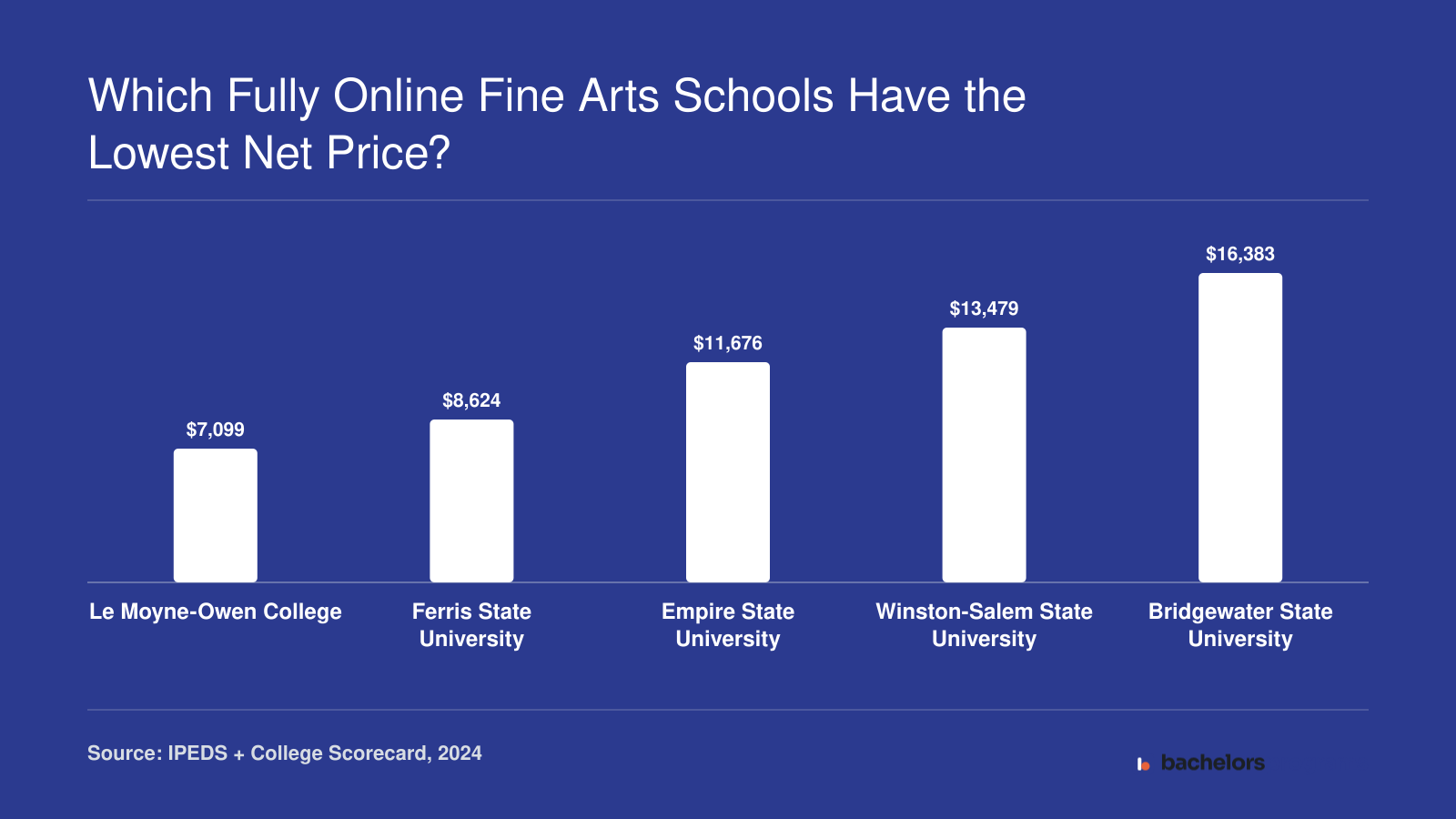
Which Fully Online Fine Arts Schools Have the Lowest Net Price?
Net price is each school's institution-wide average annual cost after grants and scholarships. It is not a quote for the fine arts program, and what you pay will vary with your family income. Le Moyne-Owen College, the only private school among these lowest-cost options, comes in lowest at $7,099, while the public universities range from $8,624 at Ferris State to $16,383 at Bridgewater State.
Total Cost, Cost per Credit, and Debt Compared
What the Full Degree Costs
Multiply per-credit online tuition by the typical 120 credits. SUNY Empire State's $295 per credit works out to about $35,400, the low end among the schools here with a published rate. Arizona State's $580 per credit (Fall 2026, lighter course loads) comes to roughly $69,600.1 Rates shift with course load, so treat these as estimates, and confirm the rate applies to studio courses.
Sticker Price vs. Net Price
Public online programs often charge one rate to everyone. Arizona State's online tuition is the same for residents and nonresidents. At Empire State, published tuition is $8,850 in-state and $10,590 out-of-state, while average net price is $11,676.
Budget for fees too. Arizona State adds a $50 or $100 technology fee depending on load.1 Asbury charges $50 per semester,2 and Norwich $150 per term.3
Debt and Aid
Median federal debt for Empire State's fine arts bachelor's graduates is $13,688, or about $145 a month over 10 years. That is the program's own figure, not the whole university's.
Federal grants and loans are available at accredited schools. Ask each school about art scholarships, military discounts, and transfer-credit savings; these vary by institution.
Related Articles
Portfolio Requirements, Transfer Credit, and How Long an Online BFA Takes
Most online fine arts bachelor's degrees run four years and about 120 credits at full-time pace, and credit transfer, not speed, is what shortens the timeline. Miami University lists 128 credits; most others sit at 120. Part-time enrollment stretches the timeline further.
Transfer credit moves the timeline
Laguna College of Art and Design accepts up to 60 transfer units, with no more than 24 in studio art.1 Manhattan School of Music enrolls students with 60 to 90 prior-learning credits and teaches in 6-week terms, so the maximum-credit entrant can finish in about a year, with two to three years typical. Vermont State University reviews the BFA portfolio before 60 credits.2
What the portfolio asks for
University of New Mexico wants 10 artworks and a 300 to 500 word artist statement.3 Miami requests 12 to 15 images plus a 3.0 GPA.4 Some programs, including UT Permian Basin, require no admission portfolio at all.5
Before enrolling, request a written transcript evaluation and a portfolio review, so you can plan from confirmed credits rather than estimates.
What Online Fine Arts Graduates Earn Early On
Among the schools ranked here, the strongest program-level earnings figure comes from a studio art bachelor's degree with live online classes.
Careers After an Online Fine Arts Degree and How to Choose Your Program
"Are online fine arts degrees worth it?" The honest answer depends on debt. If total borrowing stays low relative to what you expect to earn early in your career, the degree can pay off. Realistic paths include working studio artist, freelance and commission work, gallery and museum roles, arts administration, design-adjacent jobs, and K-12 art teaching, which requires a separate state teaching certification on top of the degree.
A Quick Decision Checklist
- Accreditation: Confirm institutional accreditation and, where offered, NASAD accreditation for the art program.
- No residency: Verify the program is fully online with no campus visits required.
- Concentration: Match the studio focus to the medium you actually work in.
- Supplies: Budget for materials, software, and shipping costs for studio work.
- Transfer credit: Maximize credits from prior coursework to shorten the degree.
Your Next Step
Compare two or three ranked schools, request information from each, and ask for a sample online studio course plus a full fee schedule. Seeing how a school runs critique and studio time online tells you more than any brochure.
Fine Arts programs by state
Compare Fine Arts programs on the data that matters
Explore more Arts & Design majors or browse every field of study.
All Arts & Design programs Browse every field of study