Best Online Graphic Design Degree Programs
Compare 50+ accredited online Graphic Design programs, with net price after aid, graduation rates, earnings and debt from IPEDS and the U.S. College Scorecard.

A bachelor's degree in graphic design is a four-year undergraduate credential built on studio work: typography, branding, layout, and increasingly UX and motion. Schools award it as a Bachelor of Fine Arts (B.F.A.), Bachelor of Science (B.S.), or Bachelor of Arts (B.A.) in Graphic Design, and only bachelor's-level study is considered here, not graduate programs.
The catch is delivery. Plenty of programs marketed as online quietly require campus visits, whether for a foundation studio, a senior portfolio review, or a residency weekend. Each of these programs is 100% online; hybrid formats were excluded.
That distinction matters because a portfolio, not a diploma, is what hiring managers review. Residency requirements are where flexibility disappears.
Key Points
- Online graphic design tuition runs roughly $302 to $955 per credit.
- Institutional accreditation outweighs NASAD membership when choosing an online program.
- Graphic designers earn a national median salary of $62,960 a year.
Top 10 Fully Online Bachelor's Degree in Graphic Design Programs
These are the ten online bachelor's degree in graphic design programs that rose to the top of our ranking, with hybrid-only offerings excluded from the list. Every entry can be completed without relocating to campus, though a few schools also let students take studio or elective courses in person when they prefer. Order reflects a mixed quality composite of cost, completion and program strength, not any single measure.
Rasmussen University-Minnesota
#1St. Cloud, MN · ~$18,000/yr (est.)
Best for: Working adults needing frequent start dates
Rasmussen University runs its design bachelor's fully online with 23 courses and eight start dates a year, aimed at working adults who want to finish quickly. The school has a graduation rate of 53%, and Adobe certification prep is built into the coursework.
- $267 per credit, about $24,030 in tuition for 90 credits
- 90 credit hours across 23 courses
- Finish in as few as 18 months with 90 transfer credits
- Eight start dates a year, including November 2026 and January 2027
- Prepares students for Adobe Certified Associate exams
- UX and UI design coursework in interactive publishing
- Median earnings of $46,610 four years after finishing
- Median debt of $35,438 among program graduates
Tulane University of Louisiana
#2New Orleans, LA · ~$40,000/yr (est.)
Best for: Transfer students with prior design coursework
Tulane University awards this degree through its School of Professional Advancement, and the school has a graduation rate of 86%. The degree can be earned entirely online, with in-person options for students who want them.
- 120 credits, with 42 in the major
- Career tracks in Graphic Design or Interactive UX/UI Design
- Motion graphics, branding and packaging coursework
- Transfer up to 60 credits, plus up to 24 for prior work experience
- Rolling admission with four start dates a year
- Test optional with no entrance exam required
Elizabeth City State University
#3Elizabeth City, NC · $5,000 – $10,000/yr (est.)
Best for: Designers adding a film and animation minor
Elizabeth City State University is a public university in northeastern North Carolina with a long-standing studio art tradition. The school has a graduation rate of 44%, and the design major pairs studio practice with annual portfolio reviews.
- Studio and theory sequence covering traditional and digital media
- Typography I and II, branding and packaging, interactive design
- Annual portfolio reviews plus a required senior exhibition
- Minors in Film and Animation or Music pair with the major
- Internships with businesses and organizations
Miami Dade College
#4Miami, FL · $2,800 – $10,000/yr (est.)
Miami Dade College awards this graphic design BFA through New World School of the Arts, a Miami arts conservatory with Art Basel and museum partnerships. The school has a graduation rate of 46%, and course formats vary by term, so confirm which sections run online.
- 129 credits: 36 lower-division, 60 upper-division, 33 general education
- Graphic Design is one of six emphasis areas in the BFA
- Coursework includes Communications Design I and II and Senior Design Studio
- International travel abroad experience built into the degree
- Exchange programs in Italy, Mexico and Spain
- Offsite client projects have included the Federal Reserve Bank and MSC Cruises
Highline College
#5Des Moines, WA · ~$10,000/yr (est.)
Highline College in Des Moines, Washington builds its applied bachelor's on top of associate degrees in art and design. The school has a graduation rate of 35%, and the two-year format suits students who already hold an AAS credential and want to finish remotely.
- Two-year degree, with full-time defined as 12 or more credits
- Four specializations, including Graphic Design and Multimedia Design
- Track covers logo design, web development, animation and advertising
- Tuition and fees run $7,849 per year
- Associate of Applied Science degrees transition into the bachelor's
Ana G. Mendez University
#6Orlando, FL · ~$20,000/yr (est.)
Ana G. Mendez University is a Hispanic-serving institution serving Florida and Puerto Rico, and its graphic design bachelor's leans on studio practice plus portfolio work. Language of instruction and delivery format depend on site availability, so confirm the sections you need before enrolling.
- 123 total credit hours
- Three graphic design studios plus two web design and graphics studios
- Packaging design and video editing courses
- Senior design project I and II plus a portfolio studio
- Entrepreneurship and design ethics coursework
- 2.00 GPA required to graduate
Millersville University of Pennsylvania
#7Millersville, PA · $11,000 – $23,000/yr (est.)
Millersville University of Pennsylvania is a public campus whose art and design department made this Bachelor of Design its newest credential. The school has a graduation rate of 58%, and coursework leans toward interactive, kinetic and web design.
- Bachelor of Design is the department's newest degree
- Focus areas include experience design, kinetic design and web design
- Basic coding included in the curriculum
- Grounded in design theory, skills, application and analysis
Ferris State University
#8Big Rapids, MI · ~$9,000/yr (est.)
Ferris State University delivers its design BFA through Kendall College of Art and Design, and the school has a graduation rate of 47%. Classes meet on campus, online or in mixed formats, so confirm the delivery pattern you need.
- Delivered through Kendall College of Art and Design
- 45 major studio credits plus 24 supportive studio credits
- Portfolio of 8 to 10 pieces and a 2.50 GPA required for admission
- Coursework in typography, branding, packaging and web design
- Median earnings of $50,658 four years after finishing
- Median debt of $27,000 among program graduates
Bemidji State University
#9Bemidji, MN · ~$15,000/yr (est.)
Bemidji State University is a public Minnesota campus whose design major is organized around six emphases. The school has a graduation rate of 48%, and the graphic design track adds wayfinding, packaging and retail design to a traditional core.
- 120 credits, with 78 in the major
- Six emphases offered within the Design major
- Wayfinding, packaging and point-of-purchase design courses
- Junior and Senior Screening reviews plus a Senior Culmination
- Median earnings of $54,642 four years after finishing
- Median debt of $27,000 among program graduates
Regent University
#10Virginia Beach, VA · ~$20,000/yr (est.)
Regent University is a private Christian university in Virginia Beach, and the school has a graduation rate of 57%. The design BFA is offered online and as a blended campus program, with a professional portfolio required at the end.
- 120 credits, with coursework in logo development and corporate branding
- Eight-week sessions, with the next term starting January 11, 2027
- Classes include 3-D Design Methods, Advanced Typography and Packaging Design
- Students build a professional design portfolio before graduating
- Online tuition of $415 per credit for full-time students
None of the ranked Graphic Design programs match the online lens yet. The full ranking is at the link above.
Cost, debt & payoff
Median earnings of this field's bachelor's graduates (4 yrs after completing, else the school's undergraduate median) vs. their median federal loan debt · U.S. College Scorecard
Across these programs the median graduate earns about $53,215 and finishes with roughly $23,900 in debt — a ratio that clears a common rule of thumb (keep debt below first-year salary). Net price and debt vary widely school to school, so check the per-school figures in the table above before you shortlist.
How We Ranked Fully Online Graphic Design Programs
A program that requires even one campus visit is not fully online, so it did not qualify for this ranking.
The Online-Only Filter
The first cut is delivery format. Every school ranked here awards a bachelor's degree in graphic design that students can complete entirely at a distance, with no residency, no on-campus studio intensives, and no required weekend visits. Hybrid programs and degrees that trade online coursework for a semester in a campus design studio were set aside, no matter how strong the art department. The credential shows up as a Bachelor of Science or a Bachelor of Arts in Graphic Design.
What the Quality Score Weighs
Affordability leads: average net price after grant and scholarship aid, not the sticker tuition. Graduation and retention rates for the entire institution come next, because they hint at whether students actually finish what they start. Where the federal College Scorecard publishes program-level earnings and typical debt for graphic design graduates, those figures join the composite. A low price on a program most students abandon is not a bargain.
Where the Numbers Fall Short
Those rates cover the whole college, not the design department. Net price averages aid across all students, so your own offer may land higher or lower depending on state grants, transfer credits, and household income.
How to Use This List
The ranking is a shortlist, not a verdict. Request each finalist's financial aid estimate, ask how community college credits apply to studio courses, and confirm the program builds the portfolio pieces you want to show employers.
Cheapest Online Graphic Design Degrees by Net Price
If you are searching for the cheapest online graphic design degree, this table pulls out the lowest-cost options by average net price after aid, based on 2024 IPEDS and College Scorecard data from the U.S. Department of Education. Treat that figure as an approximation of what an average aided student pays per year, since your actual cost will depend on your aid package, residency, and transfer credits. Miami Dade College has the lowest figure at $5,463, and Ferris State University adds NASAD accreditation at $8,624, so compare these numbers with the net price of each program in the ranking above before you let rank alone decide.
| School | Location | Delivery | Average Net Price After Aid | In-State Tuition and Fees | Out-of-State Tuition and Fees | Graduation Rate |
|---|---|---|---|---|---|---|
| Miami Dade College | Miami, FL | Online and on campus | $5,463 | $2,838 | $9,661 | 45.9% |
| Elizabeth City State University | Elizabeth City, NC | Online | $6,364 | $6,536 | $10,536 | 43.5% |
| Ferris State University | Big Rapids, MI | Online and on campus | $8,624 | $14,778 | $14,778 | 46.9% |
How Much Does an Online Graphic Design Degree Cost?
Published per-credit rates for online graphic design bachelor's programs run from roughly $302 to $955 in 2026, which puts total program tuition somewhere between about $36,240 and $114,600 before any aid. That spread is wide enough that cost should be treated as three separate numbers, not one.
Three cost views to keep separate
- Per-credit tuition: The published rate a school charges for a single credit hour. Easy to compare, but it tells you nothing about how many credits you owe.
- Total program tuition: Per-credit rate multiplied by required credits, typically around 120. Credit requirements vary more than students expect, so this number can shift by thousands even when the per-credit rate looks identical.
- Average net price: What a student pays once grant and scholarship aid is applied. This is the figure worth weighting most heavily, and it is the basis for the affordability table on this page.
What ranked programs actually charge
Arkansas State posts one of the lower rates at $292 per credit, charged flat to all U.S. residents with fees included, so there is no out-of-state penalty for online students. University of Maryland Global Campus lists $330 per credit. Southern New Hampshire University charges $354 per credit across 120 credits, which the school estimates at $42,480 for the full degree, though that figure excludes other fees. Bellevue University charges $459 per credit over 127 credits, and Savannah College of Art and Design sits at the top end at $955 per credit across 180 quarter hours. Sessions College lists $300 per credit, Boise State $395, and Lindenwood $525.
Where program-level federal data exists, median debt at completion offers a useful reality check. Graduates of the graphic design program at Bellevue University carry a median of about $29,688 in federal debt, and the comparable figure at Ferris State University is around $27,000.1 These are program-specific medians, not institution-wide averages, which makes them more useful than a campus-level number.
Can you get a graphic design degree online for free?
No. No accredited bachelor's degree is free, and free design courses on YouTube or tutorial platforms carry no credit toward a credential. What does cut the bill meaningfully: Pell Grants for eligible students, employer tuition assistance, and transfer credit. SNHU accepts up to 90 transfer credits, requiring only 30 credits in residence, which can reduce total tuition by three-quarters for students arriving with an associate degree.
The Hidden Costs: What Will Design Software Add to Your Degree?
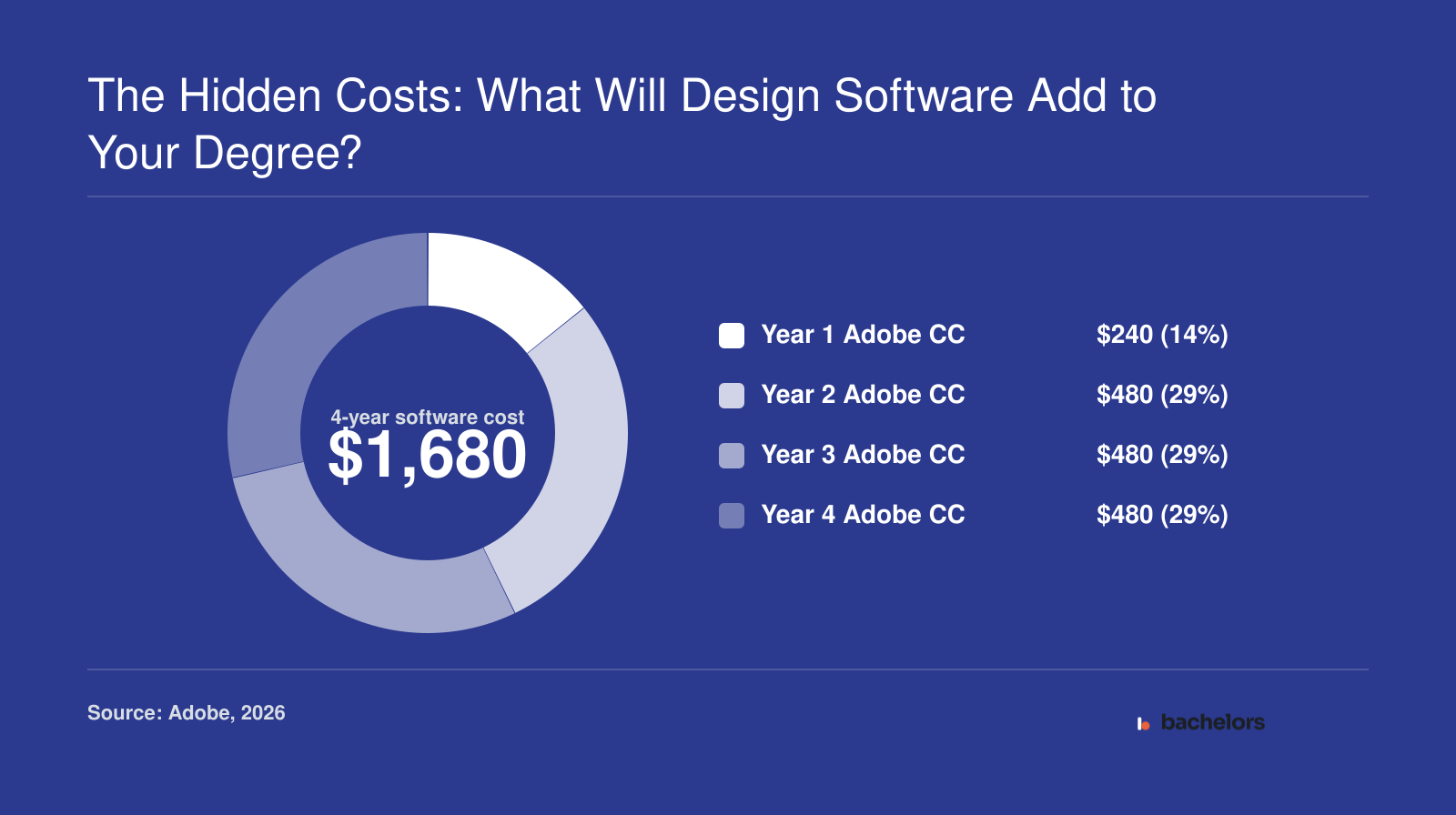
Tuition is only part of the bill. Adobe's student Creative Cloud Pro plan costs $239.88 prepaid for the first year, then renews at $479.88 per year (Adobe says this renewal price is subject to change), which adds up to roughly $1,680 over a four-year bachelor's degree. Plan separately for a design-capable laptop, a drawing tablet, and any online technology fee, and ask each program here whether software licenses are included in tuition rather than assuming they are.
Related Articles
Accreditation and NASAD: Which Online Programs Qualify?
Institutional accreditation matters far more than NASAD membership when you choose an online graphic design program. The two credentials do different jobs, and students routinely confuse them.
Institutional vs. Programmatic Accreditation
Institutional accreditation, historically called regional accreditation, covers the whole college. It comes from bodies such as SACSCOC, HLC, MSCHE, NWCCU, and NECHE.1 This is the credential that makes you eligible for federal financial aid and lets your credits transfer to other schools. Skip any program that lacks it.
NASAD, the National Association of Schools of Art and Design, is a specialized accreditor focused only on art and design.2 It is not an institutional accreditor, though it is recognized by the U.S. Department of Education.3 It reviews an institution's art and design unit, not how courses are delivered. So there is no separate category of "NASAD online programs." A school is a member or it is not.
Are There NASAD-Accredited Online Graphic Design Programs?
A few, yes. Among the schools ranked here, Ferris State University lists NASAD accreditation for its graphic design program, which offers online or mixed delivery options. The program details we have for the other schools here do not mention NASAD, so confirm each one directly rather than assuming.
Most fully online programs are institutionally accredited but not NASAD-accredited. That is usually fine. Employers hiring designers look at your portfolio, your command of tools like Adobe Creative Cloud, and your internship or freelance work. They rarely ask who accredited the art department. NASAD status can matter more if you plan to transfer into a campus-based art school or want the structured studio review that membership requires.
How to Verify Status Yourself
- Check NASAD's directory: Search the accredited institutions list on the NASAD website. Records can show the school's institutional accreditor and its approved visual arts and design programs. The search page was last updated October 30, 2026.
- Confirm the institutional accreditor: Visit the accreditor's own website, or the school's accreditation page, and look for the college by name.
- Match the credential: Make sure the listing covers the specific degree you want, not just the institution as a whole.
- Ask admissions directly: Request the accreditor names in writing if a school's site is vague.
BA vs. BS vs. BFA in Graphic Design: Which Online Degree Fits?
Most fully online options for a bachelor's degree in graphic design are a B.A. or a B.S., while the B.F.A. is more studio-intensive and less common in a fully online format. Credit splits vary by school, so treat the figures below as typical patterns and check each program's curriculum. Employers weigh your portfolio more heavily than the letters on your diploma.
| Factor | B.A. in Graphic Design | B.S. in Graphic Design | B.F.A. in Graphic Design |
|---|---|---|---|
| Share of credits in studio and design coursework | Smaller share, typically about one third to one half of the degree | Moderate share, usually a design core plus technical electives | Largest share, often about half to two thirds of the degree |
| General education load | Heaviest, with broad liberal arts requirements and sometimes a language requirement | Moderate, often weighted toward math, science, or technology courses | Lightest, since more credits go to studio work |
| Typical total credits | Usually about 120 | Usually about 120 | Usually 120 or more, depending on studio requirements |
| Technical or business emphasis | Writing, communication, and humanities alongside design | Web, digital, and production tools, sometimes with marketing or business courses | Craft, concept development, typography, and critique-based studio work |
| Best-fit career goal | Brand, marketing, and communications design roles | Web, digital interface, and production-oriented design roles | Portfolio-driven creative roles such as agency design or art direction |
| Online availability | Common as a fully online option | Common as a fully online option | Less common fully online because of the studio intensity |
| What employers and pay data show | Federal data lists a bachelor's degree in graphic design or a related field as the typical entry requirement, with a portfolio showing creativity and originality. Median pay for graphic designers was $62,960 in May 2025 and is not split by degree type. Web and digital interface designers, a related field where a bachelor's may be preferred, had a median of $104,000. | Same federal findings apply: the degree opens the door, and the portfolio decides who gets hired. | Same federal findings apply: a studio-heavy degree helps build the portfolio, but the credential letters do not change the pay data. |
What Graphic Designers Earn Nationally
Across all experience levels, graphic designers in the U.S. earned a median of $62,960 a year, with the lowest 10% earning under $39,520 and the top 10% earning more than $104,910.
Questions to Ask Yourself
Can you stay on deadline without in-person studio feedback?
Can you budget for a design-capable computer and Creative Cloud for four years?
How will you build real client or internship work into your portfolio?
Graphic Design programs by state
Compare Graphic Design programs on the data that matters
Explore more Arts & Design majors or browse every field of study.
All Arts & Design programs Browse every field of study