Best Online Web Design Degree Programs
Compare 10 accredited online Web Design programs, with net price after aid, graduation rates, earnings and debt from IPEDS and the U.S. College Scorecard.

Average annual net prices for the online programs here run from $12,135 at Clark State College to $35,860 at Champlain College, a gap of more than $23,000 a year. Anyone weighing a bachelor's degree in web design online is really asking two things: can it be earned fully online, and which schools justify what they charge? Every program ranked here is a bachelor's degree delivered 100% online; graduate study is out of scope.
Employers tend to hire on portfolio strength rather than a school's name, so a lower price does not automatically mean a weaker credential. It does mean checking accreditation and curriculum before you compare tuition.
Key Points
- Champlain College web design completers earned a median $52,260 after one year.
- Published admission policies require no portfolio or prior coding experience.
- Web and digital interface designers' median pay ($104,000) tops web developers' ($92,650).
The Best Fully Online Bachelor's Degree in Web Design Programs, Ranked
Every program on this list can be completed entirely online, from the first general education course through the final capstone, with no required campus visits. Campus-based and hybrid alternatives were not considered for these entries. Each card notes what the program requires, how long it typically takes, and who it tends to suit best.
Champlain College
#1Burlington, VT · ~$36,000/yr (est.)
Best for: Transfer students bringing prior college credit
Champlain College Online is the adult division of a Burlington, Vermont, college built around career-focused majors, and it runs its bachelor's degrees in seven-week terms rather than semesters. Web design and development students take 48 credits of professional coursework that includes front-end development and user experience design, alongside general education and open electives. The college is regionally accredited by the New England Commission of Higher Education and enrolls a largely adult, transfer-heavy population.
- 120 credits: 48 professional, 42 general education, 30 general electives
- Up to 90 transfer credits accepted; the average student brings about 40
- Seven-week terms with a maximum of three courses per term
- Two courses per term puts completion near three years and four months
- $342 per credit for 2026-27; $250 per credit for military servicemembers
- 2.5 GPA recommended for admission
- Regionally accredited by the New England Commission of Higher Education
University of Maryland Global Campus
#2Adelphi, MD · $22,000/yr (est. net price)
Best for: Working adults who need year-round start dates
University of Maryland Global Campus is a public online institution designed around adults who fit coursework around full-time work, with sessions opening throughout the year. Web and digital design students pick among three focus areas and can stack an embedded web design certificate inside the bachelor's degree. Tuition is billed per credit with distinct in-state, out-of-state, and military rates, and digital course materials replace paid textbooks.
- 120 total credit hours, 30 of them in the major
- Three focus areas: web design, digital design, or augmented and virtual reality
- Up to 90 transfer credits accepted
- Embedded 18-credit web design certificate inside the degree
- Capstone (WDDE 495) required for graduation
- No-cost digital materials replace textbooks
- Per-credit tuition with separate in-state, out-of-state, and military rates
University of Arkansas at Little Rock
#3Little Rock, AR · $17,000/yr (est. net price)
Best for: Working professionals upgrading to a design role
The University of Arkansas at Little Rock is a public metropolitan campus whose web design and development degree pulls coursework from art and design, rhetoric and writing, mass communication, information science, and information technology. A cooperative experience gives students work-based credit before graduation, and an information technology minor is built into the degree. The university also runs transfer partnerships with Arkansas community colleges that can smooth the path for students arriving with an associate degree.
- Coursework drawn from art and design, rhetoric, mass communication, and IT
- Cooperative experience capstone built into the degree
- Information technology minor embedded in the program
- Focus on mobile web design, database concepts, and digital imaging
- Prepares students for web designer, UX/UI designer, and content manager roles
- Scholarships listed for the program
Sullivan University
#4Louisville, KY · ~$26,000/yr (est.)
Sullivan University is a private institution in Louisville, Kentucky, whose College of Business and Technology runs career-focused information technology degrees with day, evening, and weekend scheduling. The web design material sits inside a broader IT curriculum, so graduates leave with networking, database, and programming coursework alongside design skills. Financial aid, scholarships, and military discounts are available to applicants who qualify.
- Web Design and Application Development is one of four IT concentrations
- 36 to 48 months to finish, depending on pace and transfer credit
- Curriculum spans user support, networking, databases, and programming
- Day, evening, and weekend classes; online and Louisville-area formats
- Transfer credits accepted; aid, scholarships, and military discounts available
- Housed in the College of Business and Technology
DeVry University-Illinois
#5Lisle, IL · $31,000/yr (est. net price)
DeVry University is a private institution that has built its reputation on career-oriented technology and business degrees, offered online and at campuses and connected classrooms around the country. The web design and development track sits inside a multimedia design and development bachelor's degree, so students study visual design and coding together rather than separately. Classes start every eight weeks and students can enroll full-time or part-time, which suits adults returning to school after time away.
- 122 credit hours; full-time and part-time enrollment available
- New classes start every eight weeks
- Coursework in HTML, CSS, JavaScript, and Adobe Creative Cloud
- Covers building websites that meet accessibility and legal standards
- Prepares students for the Adobe Certified Associate exam
- Accredited by the Higher Learning Commission
Grand Canyon University
#6Phoenix, AZ · ~$22,000/yr (est.)
Grand Canyon University is a private Christian institution in Phoenix with a large online division and a design program that runs a student design club. Online courses run in seven-week blocks with year-round starts, while the Phoenix campus follows a traditional semester calendar. Digital design students work in Adobe Creative Cloud, which they supply themselves, and can bring in a substantial block of prior college credit.
- 120 credits, 76 of them in the major
- Up to 90 transfer credits accepted
- Online courses run seven weeks; campus courses run 15 weeks
- UX/UI systems, HTML and CSS, front-end development, and content management
- Adobe Creative Cloud subscription required at student cost
- 2.8 unweighted GPA required, or 2.5 with a qualifying ACT or SAT score
- Online tuition is $490 per credit
South College
#7Knoxville, TN · $18,000/yr (est. net price)
South College is a private institution based in Knoxville, Tennessee, that runs career-focused associate, bachelor's, and graduate programs with a strong online footprint. Its web design concentration sits inside a large information technology bachelor's degree, so students take a broad core in networking, systems administration, and cybersecurity before narrowing into design. The concentration absorbs a block of general electives, so it does not add time to the overall degree.
- 181.5 total credits: 57.5 in the core and 124 in the major
- Concentration replaces 35 hours of approved general electives
- Minimum grade of C required in every major course
- Approved general electives must be at the 3000 or 4000 level
- Core covers databases, networking, Windows Server, and cybersecurity
- Cyber Security, Data Analytics, IT Management, and Networking also offered
Clark State College
#8Springfield, OH · $4,400 – $8,000/yr (est.)
Clark State College is a public community college in Springfield, Ohio, that has extended its catalog into applied bachelor's degrees, with tuition set at in-state rates. The web design and development bachelor's comes in two tracks, one built around visual design and one around development and secure coding, both closing with senior projects and a capstone. Courses run online and at the Springfield campus, and some requirements can be satisfied by proficiency exam.
- 120 semester credit hours laid out across four years
- Design track covers layout, typography, branding, UX, and accessibility
- About $24,224 in total in-state tuition and fees, textbooks excluded
- Senior Project I and II plus a capstone to finish
- Web design and development internship built into the curriculum
- Proficiency test available for some coursework
- 120 semester credit hours with the same capstone structure
- Development track covers secure coding, databases, and APIs
- About $23,910 in total in-state tuition and fees, textbooks excluded
- Prepares students for full-stack development and DevOps roles
- Online elective courses accepted toward the degree
- Basic computer skills expected at entry
Cost & outcomes by school
Federal data for the highest-earning Web Design programs, independent of the ranking above. Earnings are this field's bachelor's graduates four years after completing where the Scorecard reports them, else the school's undergraduate median.
| School | Net price / yr | Grad rate | Earnings | Debt | Grads/yr | Format |
|---|---|---|---|---|---|---|
| Champlain College VT | $35,860 | 65% | $67,795 | $27,000 | 9 | Online |
| University of Maryland Global Campus MD | $22,063 | 33% | $65,287 | $21,000 | 94 | Online |
| Walsh University OH | $20,493 | 59% | $59,764 | $27,000 | — | Hybrid |
| DeVry University-Illinois IL | $30,770 | 37% | $47,440 | $41,879 | 22 | Online or campus |
| University of Arkansas at Little Rock AR | $17,248 | 42% | $45,265 | $22,000 | 15 | Online or campus |
| Grand Canyon University AZ | $22,472 | 44% | $42,186 | $22,114 | — | Online or campus |
| Clark State College OH | $12,135 | 22% | $39,584 | $14,490 | — | Online or campus |
| Sullivan University KY | $25,532 | 71% | $38,008 | $20,000 | — | Online or campus |
| South College TN | $17,858 | 42% | $36,642 | $18,668 | — | Online |
Sources: U.S. Department of Education. Net price, graduation rate, earnings and debt: College Scorecard (earnings and debt for this field's bachelor's graduates where reported, else school-wide); graduates: IPEDS. A dash means no figure is reported.
Cost, debt & payoff
Median earnings of this field's bachelor's graduates (4 yrs after completing, else the school's undergraduate median) vs. their median federal loan debt · U.S. College Scorecard
Across these programs the median graduate earns about $53,758 and finishes with roughly $22,057 in debt — a ratio that clears a common rule of thumb (keep debt below first-year salary). Net price and debt vary widely school to school, so check the per-school figures in the table above before you shortlist.
Best Fully Online Web Design Schools at a Glance
This table lists each fully online bachelor's degree in web design in rank order, using U.S. Department of Education figures from IPEDS and the College Scorecard (2024). Net price is the average annual cost after grants and scholarships, not a tuition quote, and graduation rate covers the whole institution rather than the web design major alone. Program-level debt and first-year earnings appear only where the federal data publishes them for the specific program, and full profiles of every school follow directly below.
| Rank | School | State | Avg. Net Price per Year (after aid) | Graduation Rate (institution-wide) | Program Median Debt | Program Median Earnings (1 Year After Graduation) |
|---|---|---|---|---|---|---|
| 1 | Sullivan University | KY | $25,532 | 71% | N/A | N/A |
| 2 | University of Arkansas at Little Rock | AR | $17,248 | 42% | N/A | N/A |
| 3 | University of Maryland Global Campus | MD | $22,063 | 33% | N/A | N/A |
| 4 | Champlain College | VT | $35,860 | 65% | $27,000 | $52,260 |
| 5 | DeVry University-Illinois | IL | $30,770 | 37% | $41,879 | $32,159 |
| 6 | Grand Canyon University | AZ | $22,472 | 43% | N/A | N/A |
| 7 | South College | TN | $17,858 | 42% | N/A | N/A |
| 8 | Clark State College | OH | $12,135 | 22% | N/A | N/A |
How We Ranked Online Web Design Programs
Any school can publish a clean, modern program page; the harder question is whether the degree behind it is accredited, affordable, and built around design work rather than a repackaged IT major. The ranking below is built to reward substance over presentation.
Two filters, applied first
Only bachelor's degrees qualify. Only programs delivered 100% online qualify, so hybrid formats, required campus residencies, and summer lab intensives were set aside. A degree you cannot finish from your current zip code does not belong on a list of online programs.
What the composite measures
Each program is scored on institutional accreditation, average net price, school-wide graduation and retention rates, College Scorecard earnings and median debt for the program's field, and how deep the design coursework runs. That last factor matters more than it sounds: several degrees here are web design concentrations inside an IT or digital design major, which shifts the balance toward programming and systems courses.
Accreditation, school by school
Every institution ranked here holds institutional accreditation from a recognized regional accreditor, and several state it directly (Champlain College: NECHE; DeVry University and Grand Canyon University: HLC). NASAD accredits the institution as a whole rather than a department,1 and it expects regional accreditation alongside it.2 Most fully online programs are not NASAD members, so its absence is common rather than disqualifying.
Limits worth knowing
Graduation and retention figures describe the whole institution, not the web design major. Program-level earnings are not published for every program, and missing figures stay blank rather than being estimated.
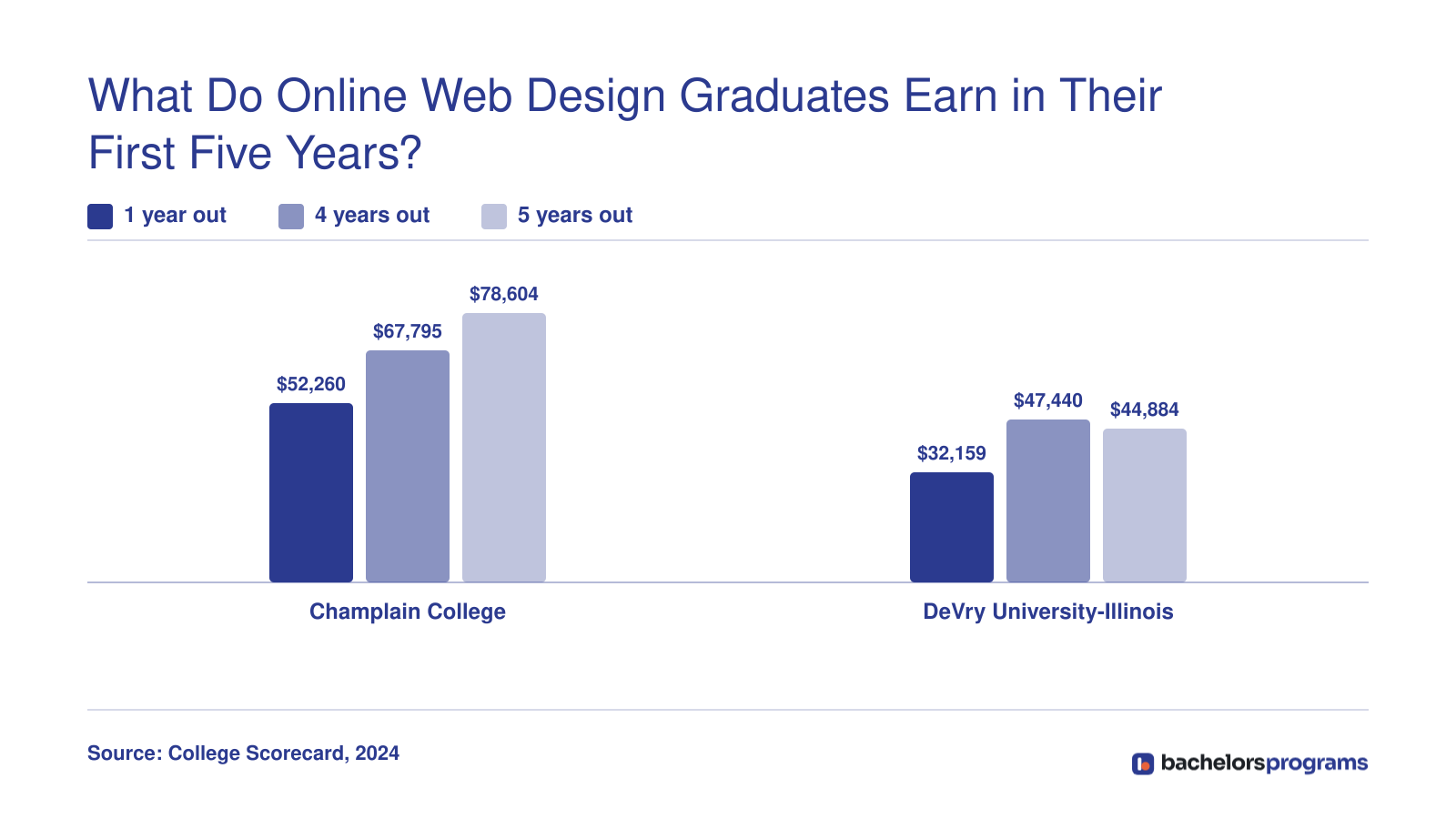
What Do Online Web Design Graduates Earn in Their First Five Years?
Web design bachelor's completers at Champlain College earned a median of $52,260 one year after finishing, compared with $32,159 at DeVry University-Illinois, a gap of roughly $20,100 that widens to about $33,700 by year five ($78,604 vs. $44,884). The chart includes only schools ranked here that publish program-level earnings, measured 1, 4 and 5 years after completion. These are College Scorecard medians for each school's own web design graduates, not occupation-wide wages, and small graduating classes can make them shift noticeably from one release to the next.
Related Articles
Web Design vs Web Development vs Digital Design Degrees
A bachelor's degree in web design centers on how a site looks and feels to use, web development centers on building it, and digital design sits closer to visual communication and media. Graphic design degrees are the nearest alternative for visually focused students, though they usually offer less web-specific coding and site-building depth. Rule of thumb: choose design if you want to decide how a site works for people, and development if you want to make it function.
| Factor | Web Design | Web Development | Digital or Graphic Design |
|---|---|---|---|
| Core focus | Site layout, usability and user experience | Building functional sites and applications | Visual communication across print, screen and interactive media |
| Typical courses | Website Design, Web Page Development (HTML5 and CSS), image editing, fonts and layout | Fundamentals of Web Development, back-end programming, database management | Visual hierarchy, UX and UI principles, responsive prototyping, a web-design course |
| Coding depth | Light to moderate: HTML5 and CSS | Deepest: HTML, CSS and JavaScript, plus SQL, NoSQL and vector databases | Light: HTML and CSS in one web-design course |
| UX and accessibility coverage | Strong: personas, wireframe storyboards, usability and accessibility for all users | Present: web standards, accessibility and usability, with less detail on UX courses | Strong: user-centered design and designing for accessibility |
| Typical first jobs | Junior web designer, UX or UI designer | Junior front-end or web developer | Graphic designer, digital media designer |
| Portfolio emphasis | Site mockups, wireframes and designed pages | Working, dynamic code projects | Branding, layout and prototype pieces |
| Where ranked programs lean | Arkansas State University's Web Design option | Bellevue University's web development and software development degrees | Bellevue University's graphic design degree; Champlain College Online's combined web design and development degree spans both |
How to Choose a Bachelor's Degree in Web Design Online
What should you verify before you enroll in an online web design program? Accreditation and transfer credit come first, because they determine whether the time and money you have already spent actually count.
Accreditation, then transfer caps
Regional accreditation is the baseline. It keeps your credits portable and your federal aid intact. After that, ask how many credits the program will accept. Champlain College Online caps transfer credit at 90 of the 120 credits required, and the average entrant arrives with about 40, leaving roughly 80 credits, or about 27 courses. A student who maxes out the cap can finish in as few as 10 courses over about five terms. UMGC also accepts up to 90 credits for 2026-2027 entrants.1 Liberty and Franklin each cap transfer at 75 percent of the degree,2 while California Baptist accepts up to 100 units.3 Ask specifically about credit for prior learning: UMGC publishes prior-learning and military pathways, and Walsh advertises credit for life and work experience, but the limits and evaluation rules differ by school.4 Confirm them in writing before you apply.
Synchronous or asynchronous delivery
Asynchronous courses suit working adults who need to study after a shift. Live, scheduled sessions suit students who want real-time critique and a studio feel. Ask how critiques and design reviews happen online, since that is where web design students learn the most.
Terms, starts and student support
Champlain runs seven-week terms, Arizona State lists 7.5-week terms, Liberty uses eight-week terms, and Franklin ranges from six to twelve weeks. California Baptist reports six entry points a year.3 Shorter terms paired with frequent starts can shorten your path, but verify the current 2026-2027 schedule against the catalog. Finally, confirm that career services, portfolio reviews and internship support extend to online students, not just to those on campus.
Can Beginners Apply? Admission Requirements for Online Web Design Programs
Yes. The schools below with published policies do not require a portfolio or prior coding or design experience for admission. Standard undergraduate requirements apply, though GPA and testing rules differ by school.
- High school diploma or GEDExpected across the programs below, along with official transcripts.
- Minimum GPARanges from no stated cutoff at UMGC and BYU-Idaho to 2.0 at Walsh, a recommended 2.5 at Champlain (with case-by-case exceptions), and 3.0 or 3.5 on some ASU pathways.
- Test scoresChamplain does not require them, UMGC lists no program-specific test policy, and Arkansas State requires the ACT or SAT from freshmen.
- Freshman automatic admissionRecent high school graduates may qualify automatically at Arkansas State with a 3.0 GPA, ACT 19+, SAT 990+ or top-20% class rank.
- PortfolioNot required at Champlain, Arkansas State, Walsh or UMGC. Check with other schools directly, since some design programs request one.
- Prior design or coding experienceNot required at those four schools. Basic computer or HTML and CSS skills can help but are not required to apply.
- Transfer studentsArkansas State asks for a 2.0 cumulative GPA with at least 13 transferable credits. Walsh requires a C- or higher in transfer coursework.
- Adult learnersWalsh admits applicants 21 or older and asks for a resume, plus transcripts if applicable.
Portfolio, Capstone and Software Requirements
Arkansas State's DIGI44793 Digital Technology and Design Portfolio is a 3-credit, 7-week capstone built around a professional portfolio presentation. Other programs finish the same way: Bellevue's GD 495 is a 4-credit portfolio capstone, and MICA's online design degree runs a two-part capstone (Research & Programming, then Project & Presentation) before a Comprehensive Portfolio course.2
Internships
Policies differ. Arkansas State offers GDES45803 Graphic Design Internship (3 credits, repeatable), and Berkeley College lists a GRD4483 Internship alongside its capstone and portfolio courses. Bellevue and MICA do not list a required internship in their program details. For UMGC, SNHU Online and South College, ask admissions about capstone and internship rules before you apply.
Software and Hardware
Adobe Creative Cloud and Figma show up across these programs. Bellevue's courses use Illustrator, InDesign, Photoshop and Figma.1 MICA adds HTML, CSS and JavaScript.2 Berkeley gives its graphic design students a full Adobe Creative Cloud license at no extra cost, and Figma is free to download. Ask every other school whether licenses are included.
Berkeley publishes the most detailed hardware list:
- Processor: Intel Core i5/i7 (8th generation or newer) or AMD Ryzen 5/7.
- Memory: 8 GB RAM minimum, 16 GB recommended.
- Storage: 128 to 256 GB SSD.
- Graphics-heavy courses: a GPU (2 GB minimum, 8 GB preferred) and a 1920 x 1080 or larger display.
- Connection: broadband internet.
Costs Beyond Tuition
Budget for a laptop that meets those specs, since a basic machine may struggle with design courses. Add Adobe subscription fees if your school does not cover them, plus portfolio hosting and a domain name. Repeating an internship course also means paying for extra credits.
Web Design Salary Snapshot
Earnings depend on whether you lean toward design or code. Web and digital interface designers earned a median of $104,000, and web developers earned a median of $92,650.
Web Design programs by state
Compare Web Design programs on the data that matters
Explore more Arts & Design majors or browse every field of study.
All Arts & Design programs Browse every field of study