Best Communications Degree Programs in Rhode Island
Compare 10 accredited Communications programs in Rhode Island at 7 colleges, with net price after aid, graduation rates, earnings and debt from IPEDS and the U.S. College Scorecard.
A communications degree in Rhode Island leads to public relations, marketing, media and advertising work, and the credential employers recognize is the Bachelor of Arts in Communications. The price of getting there splits sharply: in-state tuition and fees run $11,300 at Rhode Island College, against $37,146 for out-of-state students at the University of Rhode Island.
That gap is the real decision. Two students can leave with the same credential and a debt load that differs by five figures, and entry-level agency and media pay in Providence does not close it quickly. What separates the schools ranked here is price, admission odds, and the portfolio a student builds before graduating.
Key Points
- The University of Rhode Island ranks first, with a 73% graduation rate.
- Rhode Island College charges state residents $11,300 in tuition and fees.
- A random draw picks 25 residents for the $2,000 Paul Sherlock Access Scholarship.
Best Communications Schools in Rhode Island: Our Ranked List
The University of Rhode Island is the best communications school in Rhode Island for most students: it pairs the state's broadest Bachelor of Arts in Communication Studies, with five concentrations and an accelerated master's pathway, with a 73% graduation rate and a net price near $21,000. Bryant University and Rhode Island College follow for very different reasons, one for business-integrated communication and one for the lowest net price in the state. The seven programs below are all campus-based, and two of them look alike at first glance but are not.
University of Rhode Island
#1Kingston, RI · ~$21,000/yr (est.)
Best for: Students wanting multiple concentration paths
The University of Rhode Island in Kingston is the state's flagship and the broadest communications offering in this ranking, a B.A. in Communication Studies built around a curriculum each student plans with an advisor. Five concentrations let students steer toward public relations, media studies, organizational communication, intercultural work or science and health communication, and strong students can apply in junior year to an accelerated bachelor's-to-master's pathway that finishes both degrees in five years. The university reports a graduation rate of 73% and an average net price after aid of about $21,440, unusually low for a flagship.
- B.A. in Communication Studies with five concentration options
- Tracks: Public Communication and Persuasion, Media Studies
- Accelerated bachelor's-to-master's track completable in five years
- Accelerated applicants need 75 credits, a 3.0 overall and 3.3 major GPA
- Internships and extracurricular media work built into the curriculum
- Personalized advising and a curriculum planned around your interests
- Also covers organizational, intercultural and health communication
Bryant University
#2Smithfield, RI · ~$41,000/yr (est.)
Best for: Business-minded communication majors
Bryant University in Smithfield treats communication as a Bachelor of Science inside a business-first curriculum: every student in the college completes a business minor, so finance, management and marketing principles sit alongside the liberal arts core. Cohorts are small and advising is handled jointly by professional and departmental advisors. The university reports a graduation rate of 80%, second only to Providence College here, and an average net price after aid of about $41,219.
- Communication is a Bachelor of Science, not a B.A.
- 122 total credit hours, about 36 of them in the major
- Business minor required for every student in the college
- Business and liberal arts coursework integrated throughout
- Housed in the Communication, Media, and Sports Studies Department
- Professional and departmental academic advisors assigned to students
Rhode Island College
#3Providence, RI · $9,000/yr (est. net price)
Best for: Cost-conscious Providence-area students
Rhode Island College in Providence splits communication into two separate bachelor's degrees that are easy to confuse: a Communication B.A. with media and speech-language tracks, and a Strategic Communication B.A. built around public relations, crisis communication and persuasion. Both are campus programs with small classes and access to an on-campus multimedia production studio plus the student newspaper, TV station and radio station. The college reports a graduation rate of 48%, the lowest in this ranking, and an average net price after aid of about $9,478, by far the lowest here.
- Concentrations: Media Communication and Advertising; Speech, Language and Hearing Science
- Coursework in advertising, media ethics, social media and video production
- On-campus multimedia production studio and computer lab
- Student outlets include The Anchor newspaper, ANCHOR TV and WXIN radio
- Internships with local media outlets and marketing agencies encouraged
- Speech, Language and Hearing Science track covers ASHA prerequisites
- Focus on public relations, crisis communication and persuasion
- Coursework in social media strategy, news writing and public presentations
- Includes political and organizational communication courses
- Small classes with faculty mentorship and hands-on projects
- 40 credits of General Education requirements
- Transfer options available on the Providence campus
Salve Regina University
#4Newport, RI · ~$37,000/yr (est.)
Salve Regina University in Newport structures its B.A. in Communications as a sequenced four-year plan with foundation courses in media writing and multimedia storytelling, a required 3-credit internship and a senior capstone. Students pick four electives, at least two at the 300 level, from topics such as public relations, podcasting, social media strategies and film. The university reports a graduation rate of 77% and an average net price after aid of about $36,967.
- 120 credits total, 39 credits (13 courses) in the major
- 41 to 44 credits of core coursework plus major requirements
- Required 3-credit internship and senior seminar capstone
- Four electives, at least two at the 300 level
- Electives include public relations, podcasting, social media and film
- Four-year sequenced plan of study with Salve Compass experiential learning
Roger Williams University
#5Bristol, RI · ~$38,000/yr (est.)
Roger Williams University in Bristol frames its Communication & Media Studies major around the relationship between culture and communication, with a strong emphasis on public advocacy, community building and social justice. A 3+3 Juris Doctor pathway, an active PRSSA chapter and the Lambda Pi Eta honor society give it a professional-advocacy bent, and alumni work at ESPN, Hasbro and the Associated Press. The university reports a graduation rate of 69% and an average net price after aid of about $37,999.
- Explores the relationship between culture and communication
- Emphasis on public advocacy, community building and social justice
- 3+3 Juris Doctor pathway available
- Student organizations include PRSSA and honor society Lambda Pi Eta
- Alumni work at ESPN, Hasbro and the Associated Press
- Faculty incorporate real-world topics and diversity, equity and inclusion
Johnson & Wales University
#6Providence, RI · ~$31,000/yr (est.)
Johnson & Wales University in Providence offers a production-heavy Media & Communication B.A. built on a 120-credit, four-year plan with a required capstone and a required 6-credit internship. Students work in the Center for Media Production, which has two light-controlled studios, a soundproofed podcast studio and two editing suites, and have interned at Sony Music, iHeartMedia and the Rhode Island International Film Festival. The university reports a graduation rate of 55% and an average net price after aid of about $31,027.
- 120 credits completed over four years
- Required 6-credit internship inside applied experiential learning
- Seven major electives across media studies and media production
- Center for Media Production with two light-controlled studio spaces
- Soundproofed podcast studio and two editing suites on campus
- Internships at Sony Music, iHeartMedia and the RI International Film Festival
- Capstone plus courses in global media and media industries
- Housed in Providence's arts district; study abroad option available
Providence College
#7Providence, RI · ~$49,000/yr (est.)
Providence College runs a Communication B.A. inside a traditional liberal arts core that includes the Development of Western Civilization sequence and proficiency requirements in writing, oral communication, diversity and civic engagement. The major adds visual communication, rhetorical analysis and argumentation, communication research, an internship and a capstone, with four electives from an approved list. It is the most selective and most expensive option in this ranking: the college reports a graduation rate of 86% and an average net price after aid of about $48,523.
- 120 credits with a required internship and capstone
- Four communication electives chosen from an approved list
- Core courses in visual communication, rhetorical analysis and research
- Development of Western Civilization core sequence required
- Proficiency requirements in writing, oral communication and diversity
- Minimum 2.0 GPA required to graduate
- Ethics, philosophy, theology and fine arts in the core
Cost & outcomes by school
Federal data for the highest-earning Communications programs, independent of the ranking above. Earnings are this field's bachelor's graduates four years after completing where the Scorecard reports them, else the school's undergraduate median.
| School | Net price / yr | Grad rate | Earnings | Debt | Grads/yr | Format |
|---|---|---|---|---|---|---|
| Providence College RI | $48,523 | 86% | $87,054 | $27,000 | — | Campus |
| Salve Regina University RI | $36,967 | 77% | $72,975 | $27,000 | 14 | Campus |
| Roger Williams University RI | $37,999 | 69% | $70,575 | $26,000 | 21 | Campus |
| Bryant University RI | $41,219 | 80% | $68,518 | $27,000 | 13 | Campus |
| University of Rhode Island RI | $21,440 | 73% | $64,520 | $22,813 | 174 | Campus |
| Johnson & Wales University RI | $31,027 | 55% | $51,247 | $23,786 | 11 | Campus |
| Rhode Island College RI | $9,478 | 48% | $51,105 | $18,875 | 23 | Campus |
Sources: U.S. Department of Education. Net price, graduation rate, earnings and debt: College Scorecard (earnings and debt for this field's bachelor's graduates where reported, else school-wide); graduates: IPEDS. A dash means no figure is reported.
Cost, debt & payoff
Median earnings of this field's bachelor's graduates (4 yrs after completing, else the school's undergraduate median) vs. their median federal loan debt · U.S. College Scorecard
Across these programs the median graduate earns about $64,520 and finishes with roughly $23,300 in debt — a ratio that clears a common rule of thumb (keep debt below first-year salary). Net price and debt vary widely school to school, so check the per-school figures in the table above before you shortlist.
How We Ranked Rhode Island Bachelor's Degree in Communications Programs
Every communications program here is measured the same way, so the University of Rhode Island, Bryant University, Providence College and Rhode Island College can be compared on equal terms instead of by which viewbook is more flattering. Each program is scored on the same set of measures, and the results are read together rather than one at a time.
The Measures We Use
- Net price: what families actually pay after grants and scholarships, not the published sticker tuition.
- Graduation rate: how many first-year students finish, a rough proxy for whether a school gets people across the line.
- Program-level earnings: median pay for graduates of the field a few years after finishing.
- Debt: typical borrowing at completion.
- Completions: how many students actually finish the communications credential.
- Selectivity: admissions difficulty, included as context, not treated as a virtue in itself.
Where the Numbers Stop Short
Rhode Island has no consistent statewide methodology for ranking communications programs, so we apply one standard across every school here rather than repeat each institution's own framing. Be aware of the limits. Net price is a sector-average estimate rather than a figure calculated for a single major. Graduation rate is institution-wide and not specific to communications. Program earnings are medians drawn from College Scorecard data for graduates of the field.
How to Use the List
A program that looks strong on price can look ordinary on earnings, and the ranking is meant to surface that tension rather than hide it. Treat it as a starting point, then confirm current tuition, aid, transfer credit, and program requirements directly with each school before you apply.
Bachelor's Programs at a Glance: Side-by-Side Comparison
This table lines up each Rhode Island communications bachelor's program by cost, completion and early earnings, using 2024 figures from IPEDS and the College Scorecard (U.S. Department of Education). Rhode Island College carries the lowest average net price here at $9,478, and the University of Rhode Island charges in-state students $16,942 in tuition and fees. Among programs that report earnings, Bryant University communication graduates post the highest median pay one year out, at $45,071.
| School | Location | Type | Program | In-State Tuition & Fees | Average Net Price | Admission Rate | Graduation Rate | Median Earnings 1 Year After Graduation |
|---|---|---|---|---|---|---|---|---|
| Bryant University | Smithfield | Private | Communication (B.S.) | $52,677 | $41,219 | 65% | 80% | $45,071 |
| Providence College | Providence | Private | Communication B.A. | $63,550 | $48,523 | 51% | 86% | Not reported |
| University of Rhode Island | Kingston | Public | Communication Studies B.A. | $16,942 | $21,440 | 72% | 73% | $36,785 |
| Rhode Island College | Providence | Public | Communication BA; Strategic Communication BA | $11,300 | $9,478 | 92% | 48% | $34,357 |
| Salve Regina University | Newport | Private | Communications (B.A.) | $50,100 | $36,967 | 68% | 77% | $33,230 |
| Roger Williams University | Bristol | Private | Communication & Media Studies | $44,418 | $37,999 | 88% | 69% | $33,596 |
| Johnson & Wales University | Providence | Private | Media & Communication B.A. | $42,419 | $31,027 | 88% | 55% | $28,062 |
Online and Hybrid Communications Bachelor's Options at Rhode Island Schools
Can you earn a bachelor's degree in communications online from a Rhode Island school? Yes, but only one: the University of Rhode Island's Strategic Communication B.A. degree-completion program, delivered fully online. The other communications bachelor's programs here, including URI's own Communication Studies B.A., are campus programs.
URI's online Strategic Communication completion route
This is a completion degree, not a start-from-scratch program. Applicants need prior college coursework and at least a 2.5 GPA, then finish a 120-credit degree with 36 credits in communication and 42 credits at the upper-division level. Online tuition for 2026-2027 is $654 per credit, plus a $30 registration fee each semester and a $16 per credit technology fee; the application is free. Rates are set by academic year and can change. On transfer credit, no more than 15 credits may apply inside Communication Studies, so a student arriving with a long transcript should expect a course-by-course review of what counts toward the major.
The campus Communication Studies B.A.
URI's Communication Studies B.A. in Kingston offers five concentration options and a curriculum built around each student's goals. Rhode Island College's Communication B.A. is a full-time campus program with two concentrations, Media Communication and Advertising, and Speech, Language, and Hearing Science, and it runs a multimedia production studio plus student newspaper, TV and radio operations.1
Which format fits you
Working adults and transfer students who already hold college credits and need to keep working fit the online completion route best, because it lets them apply what they have already earned toward the major. First-time students who want internships, production labs, student media outlets and faculty available in person are usually better served by a campus program, where that access is built into the schedule.
Admissions for Communications Bachelor's Programs in Rhode Island
Communications admission in Rhode Island ranges from near-open at one school to a genuine reach at another, and knowing which is which shapes your list.
GPA expectations and admit rates
The University of Rhode Island publishes a 2026 admitted-student GPA range of 3.7 to 4.1, described as a profile of the class rather than a minimum. Rhode Island College asks for a 3.5 cumulative GPA on a 4.0 scale but does not say whether that is a firm floor or a preferred benchmark. Admission rates show the spread: Providence College admits about 51 percent of applicants, Bryant about 65 percent, Salve Regina about 68 percent, URI about 72 percent, Roger Williams and Johnson & Wales about 88 percent each, and Rhode Island College about 92 percent.
Test policy and deadlines
URI is test-optional for first-year applicants. SAT or ACT scores may be submitted, and neither the ACT writing section nor the optional SAT essay is required. URI's deadlines follow the decision plan: November 1 for Early Decision, December 1 for Early Action and priority scholarship consideration, and February 1 for Regular Decision. Rhode Island College does not make its current test policy clear on its first-year page. Its deadlines are December 15 for Early Action and priority merit, December 15 for a January spring start, and March 15 for Regular Decision, with rolling review after that.1 Ask admissions at the other schools here for their current test and deadline policy.
Transfer credit from community college
URI sets transfer thresholds by credit load: under 24 transferable credits needs a 2.8, 24 or more needs a 2.5, and an associate's or bachelor's from a regionally accredited institution needs a 2.4. The CCRI Joint Admission Program lets students finish an associate degree at CCRI, then transfer as juniors. URI's first-year pages state no general transfer-credit cap. Rhode Island College accepts up to 90 credits from regionally accredited colleges for comparable courses with a C or higher, and its policy manual notes credit usually requires 2.0/C or better.1 Transfer applicants with 24 or more earned credits need at least a 2.0, with July 15 fall and December 15 spring deadlines. AP scores of 3 or higher and CLEP scores of 50 or higher may also count.
Related Articles
Cost of a Bachelor's Degree in Communications in Rhode Island
No single number captures the cost of a communications bachelor's degree in Rhode Island. It depends on whether you choose a public or private school, whether you qualify for in-state tuition, and how much grant aid your family receives. The published rate is the starting point, but the average net price after aid is the figure that matters for planning.
The cheapest net prices start with the public schools
Rhode Island College has the lowest net price here, about $9,478 a year, which makes it the first place to look for the cheapest communications degree in Rhode Island. The University of Rhode Island is next at about $21,440. The private universities here run higher: Johnson & Wales University about $31,027, Salve Regina University about $36,967, Roger Williams University about $37,999, Bryant University about $41,219, and Providence College about $48,523. Those net prices are approximate averages across students receiving aid, not a quote for your situation.
Sticker price versus what students pay
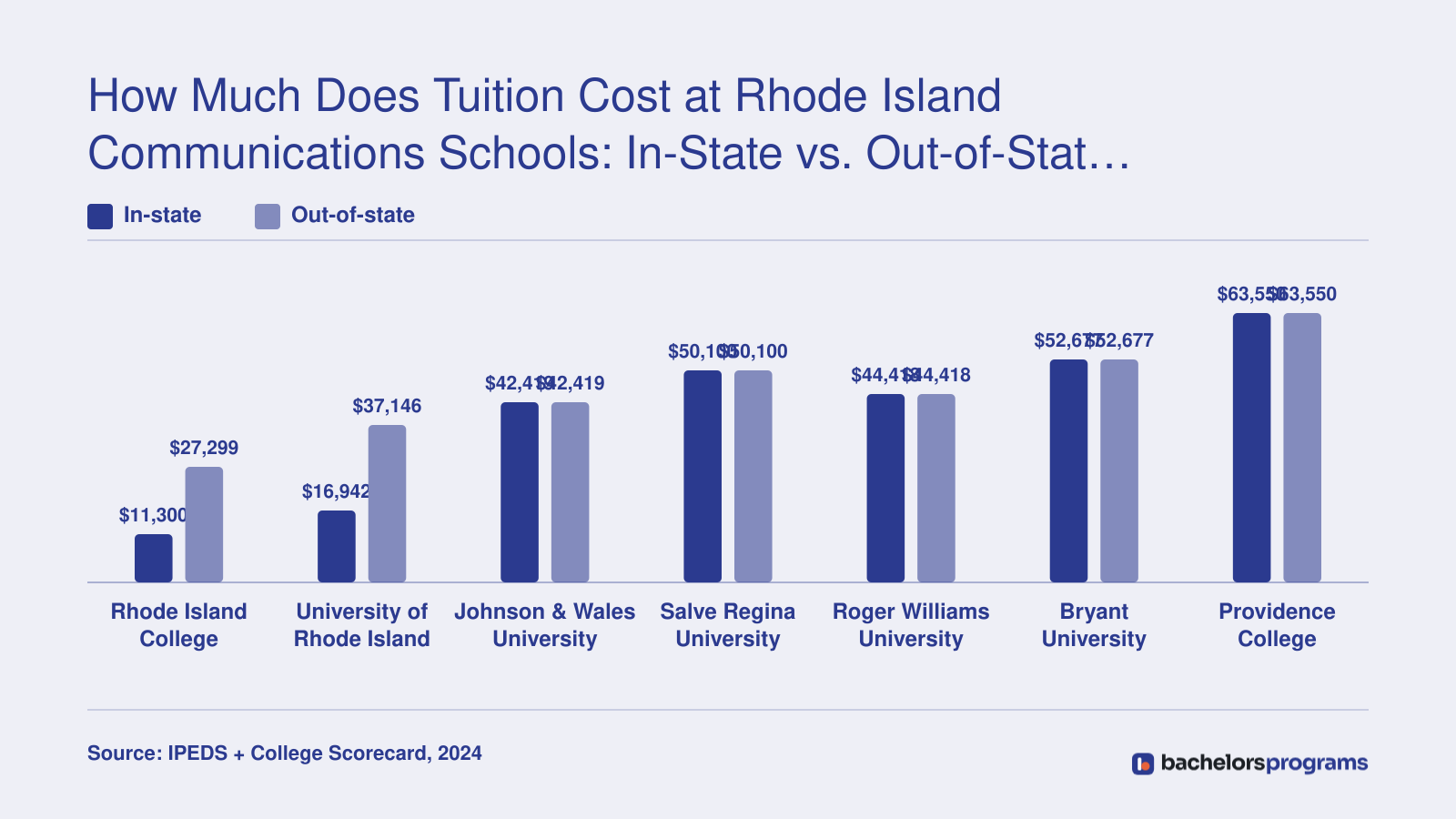
Published tuition and fees tell a different story. At the public schools, out-of-state students pay much more than residents: Rhode Island College lists about $11,300 in-state and $27,299 out-of-state, while URI lists about $16,942 in-state and $37,146 out-of-state. Private colleges publish one rate, from roughly $42,000 at Johnson & Wales to about $63,550 at Providence College. The takeaway: sticker price and net price can differ by thousands because grants and scholarships reduce the bill. Net price is an approximate sector average, so use it as a planning benchmark, not a guarantee.
Four-year planning range
Multiply the annual net prices by four and the range is roughly $38,000 to $194,000 for a bachelor's degree, depending on the school and your aid. That spread is why comparing net price, not just the published tuition line, is the practical way to shop for a communications degree in Rhode Island.
How Much Does Tuition Cost at Rhode Island Communications Schools: In-State vs. Out-of-State?
Rhode Island College is the cheapest option for state residents, with in-state tuition and fees of $11,300, compared with $27,299 for out-of-state students. The University of Rhode Island has the widest gap: residents pay $16,942 and nonresidents pay $37,146, a difference of $20,204. The private schools (Johnson & Wales, Roger Williams, Salve Regina, Bryant and Providence College) charge every student the same rate, so for out-of-state students both public universities still cost less than any private option.
Rhode Island Grants and Scholarships That Cut the Price
The Paul Sherlock Access Scholarship pays $2,000, but only 25 eligible applicants receive it, chosen by random draw.1 The Rhode Island Student Loan Authority (RISLA) funds this need-based award for Rhode Island residents who graduated from an accredited Rhode Island high school, completed recognized home study, or earned a GED. It can be used at accredited colleges, so it is worth entering whichever school you choose. Confirm current terms with RISLA, because the available state materials do not show whether 2026 rules differ.
Rhode Island Hope and Promise
Rhode Island College (RIC) administers the Hope Scholarship, which may fund the final two years of a bachelor's degree. The state lists Rhode Island residency, full-time enrollment and on-track progress toward graduating within four years as requirements.3 The FY2026 budget set aside $5.5 million for Hope, $2.1 million more than the year before.2 That is a program appropriation, not a per-student award, so ask RIC what a typical award covers.
Rhode Island Promise is a last-dollar program: it covers up to two years of tuition and mandatory fees after other aid, but only for full-time students who start at the state's community college right after high school.4 It matters here if you plan to start there and transfer into a communications bachelor's program.
Public vs. Private Schools
Students at the public schools, RIC and the University of Rhode Island, have the most state-linked options, including Hope at RIC. Students at Bryant, Salve Regina, Roger Williams, Johnson & Wales, and Providence College will rely more on each school's own in-state and merit awards. Current award names and amounts at URI, RIC, and Salve Regina were not confirmed, so check each financial aid page. RISLA also lists a Rhode Island State Grant, but its 2026 terms were not confirmed.5
Your Next Step
File the FAFSA as early as you can. Schools and state programs use it to determine need-based aid.
Communications Careers and Earnings in Rhode Island
Communications work keeps shifting toward content, data and digital audiences, and Rhode Island employers are hiring for that mix. A communications degree leads to roles in public relations, marketing, media production, advertising and corporate communications, and the state's job counts show where most of those openings sit.
What the Rhode Island market looks like
The Rhode Island Department of Labor and Training reports about 3,540 Market Research Analysts and Marketing Specialists, the largest group of these occupations.1 Public Relations Specialists number about 1,370. Management roles are smaller: roughly 230 Fundraising Managers, 180 Advertising and Promotions Managers and 130 Public Relations Managers. Rhode Island lists the manager titles separately, so there is no combined state estimate for public relations and fundraising managers.1
For a pay benchmark, the Bureau of Labor Statistics reports national May 2025 medians of $74,750 for public relations specialists and $136,470 for public relations and fundraising managers.2 These are U.S. figures, not Rhode Island wages, and manager jobs usually come after years of experience.
Earnings and debt by program
Program-level federal data shows what graduates of each communications bachelor's program earned four years after completing the degree:
- Roger Williams University: $70,575, with median debt of $26,000.
- Bryant University: $68,518, with median debt of $27,000.
- University of Rhode Island: $64,520, with median debt of $22,813.
- Johnson & Wales University: $51,247, with median debt of $23,786.
- Rhode Island College: $51,105, with median debt of $18,875.
Salve Regina University's program reports only a first-year figure of $33,230, with median debt of $27,000, so it cannot be compared directly with the four-year numbers above. Cohorts are small at some schools, so treat gaps of a few thousand dollars as noise. The larger spread between the top three and the bottom two is more meaningful, though it also reflects which jobs graduates take and where they live.
Rhode Island College offers the lowest median debt here, which matters if your starting salary will be modest. Roger Williams and Bryant pair the highest earnings with debt near $27,000.
Licensure
Communications is not a licensed field. Rhode Island requires no state license or exam to work in public relations, marketing, media or advertising, so your degree, portfolio and internships carry the most weight with employers.
Questions to Ask Yourself
Do you want a broad communication studies degree or a career-focused track in strategic communication or public relations?
Will you need to keep working while you earn the degree?
Is in-state public tuition the deciding factor, or could private aid close the gap?
Compare Communications programs on the data that matters
Explore more Communications & Media majors or browse every field of study.
All Communications & Media programs Browse every field of study