Best Graphic Design Schools in Rhode Island
Compare 5 accredited Graphic Design programs in Rhode Island, with net price after aid, graduation rates, earnings and debt from IPEDS and the U.S. College Scorecard.

A private art school and a public college can post net prices more than $60,000 apart in the same year, and that gap frames most Rhode Island decisions. The bachelor's degree in graphic design is awarded here as a Bachelor of Fine Arts (B.F.A.), a Bachelor of Science (B.S.) or a Bachelor of Arts (B.A.), and every program on this list is delivered on campus.
At one end sits Rhode Island School of Design, near $68,000 in average net price after aid. At the other, Rhode Island College, near $9,500. Aid packages, portfolio reviews and early-career earnings pull the two further apart.
Providence and Newport employers hire through small studios and in-house marketing teams, and the portfolio gets read before the transcript.
Key Points
- RISD pairs its graphic design BFA with an 8-to-1 student-faculty ratio.
- RISD is test-optional for 2027 applicants; your portfolio carries the decision.
- Published prices can differ by over $40,000, so compare net price after aid.
Best Bachelor's Degree in Graphic Design Programs in Rhode Island
Five Rhode Island schools award a bachelor's degree in graphic design, and they split into two groups: one art and design school with a national reputation, and four universities where graphic design sits inside a broader studio art, communications or technology curriculum. Each card below gives the shape of the program, the school's overall graduation rate, and the one detail that separates it from the rest of the list.
Rhode Island School of Design
#1Providence, RI · $50,000 – $55,000/yr (est.)
Best for: Studio-intensive BFA students with strong portfolios
RISD is the most selective art and design school in Rhode Island and the one most applicants already know by name. The Graphic Design BFA is a four-year studio degree: sophomores work through form, image, color and typography, juniors move into communication theory, visual systems and information design, and seniors finish with a self-defined degree project and a portfolio. About 150 undergraduates work in dedicated Design Center studios with bookbinding, papermaking and screenprinting facilities, and juniors and seniors can take professional internships in summer or during the semester. Schools offering this program have a graduation rate of 89%.
- Four-year BFA; sophomore studios in form, image, color and typography
- Juniors cover communication theory, visual systems and information design
- About 150 undergraduate majors working in Design Center studios
- Bookbinding, papermaking and screenprinting facilities on site
- Projects span books, magazines, posters, UX, websites and packaging
- Summer and semester internships for juniors and seniors
- Degree ends with a self-defined project and portfolio
- Visiting designers and critics; first-year and transfer admission routes
Rhode Island College
#2Providence, RI · $9,000/yr (est. net price)
Best for: Budget-conscious Rhode Island residents
Rhode Island College is the public option, and its in-state tuition runs far below the private schools on this list. Graphic design is one of eight concentrations inside the Studio Art BA and BFA, and every art major starts with seven foundations courses in drawing, two-dimensional design, three-dimensional design and digital media before choosing a track. A faculty advisor reviews each plan of study, transfer students can submit a portfolio for art credit review, and the Hope Scholarship covers tuition for eligible Rhode Island students in the junior and senior years. Schools offering this program have a graduation rate of 48%.
- Graphic design is one of eight Studio Art concentrations
- Seven foundations courses across the first four semesters
- Other tracks include ceramics, digital media, metalsmithing and photography
- At least 40 General Education credits across nine categories
- Transfer students submit a portfolio for art credit review
- $50 application fee, waived on Apply to RIC for Free Day
- Hope Scholarship covers tuition for eligible Rhode Island juniors and seniors
- Art faculty advisor reviews your plan of study
Roger Williams University
#3Bristol, RI · ~$38,000/yr (est.)
Best for: Internship-seekers wanting guaranteed placement
Roger Williams University runs its graphic design major through the Feinstein School of Humanities, Arts, and Education, and a guaranteed internship is built into the degree. Students have interned at Walt Disney World, iRobot, Staples and Sailing World Magazine, coursework runs in the Graphic Design Communications Lab, and seniors present work in the Senior Graphic Design Exhibition during the portfolio course. A 3+3 accelerated option pairs the bachelor's with a Juris Doctor, and Global Studio: Japan takes design students abroad. Schools offering this program have a graduation rate of 69%.
- Guaranteed internship for graphic design majors
- Placements include Walt Disney World, iRobot, Staples and Sailing World
- Courses run in the Graphic Design Communications Lab
- Seniors present work in the Senior Graphic Design Exhibition
- 3+3 accelerated path to a Juris Doctor in six years
- Global Studio: Japan study program for design students
- Graphic Design Communication minor also offered
- Graphic Design Club and AIGA chapter on campus
New England Institute of Technology
#4East Greenwich, RI · ~$36,000/yr (est.)
New England Institute of Technology awards a Bachelor of Science in Graphic Design in a career-focused format, with terms VII through XII totaling 90 quarter credit hours and a catalog note that a typical six-term curriculum can finish in as little as 18 months. Coursework covers 3D modeling, motion graphics, digital editing, typography, package design, content management systems, social media and augmented reality marketing, capped by a Senior Portfolio course. Classes meet days or evenings and average 20 to 25 students, and a Cooperative Work Experience elective is available. Schools offering this program have a graduation rate of 60%.
- Bachelor of Science; terms VII through XII total 90 quarter credits
- Catalog notes a six-term curriculum can finish in as little as 18 months
- Coursework in 3D modeling, motion graphics and digital editing
- Also covers typography, package design and augmented reality marketing
- Senior Portfolio course in the final term
- Classes average 20 to 25 students, offered days or evenings
- Cooperative Work Experience elective option
- GMW associate degree required to continue into the bachelor's
Salve Regina University
#5Newport, RI · ~$37,000/yr (est.)
Salve Regina University offers graphic design as a concentration inside a Bachelor of Arts in Studio Art, on a Newport campus with a strong studio arts focus. Majors complete at least 120 credits, including 41 to 44 credits of core courses and 17 to 18 courses in the major, while the concentration adds 12 to 18 credits running from Introduction to Graphic Design through Concentrated Studies: Graphic Design alongside one elective in a 3-D art form. Students sit portfolio reviews in the spring of the freshman and junior years and show work in the Senior Exhibition at the Dorrance H. Hamilton Gallery and in the Juried Senior Show, with a required Professional Practices Capstone. Schools offering this program have a graduation rate of 77%.
- Bachelor of Arts in Studio Art with a graphic design concentration
- At least 120 credits, including 41 to 44 credits of core courses
- Concentration adds 12 to 18 credits in graphic design
- Concentrators also take one elective in a 3-D art form
- Portfolio review in the spring of freshman and junior years
- Senior Exhibition and Juried Senior Show at the Hamilton Gallery
- Professional Practices Capstone required for graduation
- Optional Senior Honors Thesis with faculty approval
Cost & outcomes by school
Federal data for the highest-earning Graphic Design programs, independent of the ranking above. Earnings are this field's bachelor's graduates four years after completing where the Scorecard reports them, else the school's undergraduate median.
| School | Net price / yr | Grad rate | Earnings | Debt | Grads/yr | Format |
|---|---|---|---|---|---|---|
| Salve Regina University RI | $36,967 | 77% | $72,975 | $27,000 | — | Campus |
| Roger Williams University RI | $37,999 | 69% | $70,266 | $26,445 | 16 | Campus |
| Rhode Island School of Design RI | $50,507 | 89% | $67,771 | $27,000 | 119 | Campus |
| Rhode Island College RI | $9,478 | 48% | $56,318 | $20,500 | 18 | Campus |
| New England Institute of Technology RI | $36,483 | 60% | $43,886 | $28,785 | 27 | Campus |
Sources: U.S. Department of Education. Net price, graduation rate, earnings and debt: College Scorecard (earnings and debt for this field's bachelor's graduates where reported, else school-wide); graduates: IPEDS. A dash means no figure is reported.
Cost, debt & payoff
Median earnings of this field's bachelor's graduates (4 yrs after completing, else the school's undergraduate median) vs. their median federal loan debt · U.S. College Scorecard
Across these programs the median graduate earns about $67,771 and finishes with roughly $27,000 in debt — a ratio that clears a common rule of thumb (keep debt below first-year salary). Net price and debt vary widely school to school, so check the per-school figures in the table above before you shortlist.
How We Ranked Rhode Island Bachelor's Programs in Graphic Design
Ranking design programs once meant ranking reputations; program-level earnings and debt reporting have changed what a responsible list can show.
What We Weigh
For each program on this list, we weigh the net price students pay after grant aid, the institution's graduation rate, median earnings for graphic design graduates, median debt at graduation and how selective the school is. The figures come from the federal College Scorecard and IPEDS, the same public databases any family can open. Institutional figures reflect the 2024 Scorecard release; earnings and debt come from the most recent program-level release.
Where This List Differs
Most lists of Rhode Island design schools either fold in campuses from neighboring states or stop at sticker price and reputation. Two kinds of numbers stay separate here: program-level figures (what graphic design graduates earn, what they borrow) and institution-wide figures (net price, graduation rate, acceptance rate). That separation matters, because a strong department can sit inside a school whose overall averages look unremarkable.
What the Numbers Cannot Tell You
- Net price: a sector-level estimate, not your aid offer. File the FAFSA and compare packages side by side.
- Graduation rate: counted across the whole institution, not the design department.
- Earnings: reported as medians for graduates who received federal aid, so the strongest and weakest outcomes never appear.
Treat these as a starting filter, then visit studios and talk to faculty before you commit.
RISD vs. URI: Comparing Bachelor's Graphic Design Programs
Rhode Island School of Design offers a four-year BFA in Graphic Design built around small classes and dedicated studio space. The University of Rhode Island, a public university outside this page's ranked list, lists a B.A./B.F.A. path in graphic design. We could not verify URI's facilities, class sizes or specializations from its program pages or published data, so confirm those details with URI's art department before comparing. The third column shows what the ranked Rhode Island schools publish, which gives you concrete points to compare against RISD.
| Feature | RISD | URI | Other Ranked Rhode Island Options |
|---|---|---|---|
| Degree | BFA in Graphic Design, a four-year dedicated major with a required capstone | B.A./B.F.A. in Graphic Design | New England Tech: B.S. in Graphic Design (18 months, associate degree required for entry); Rhode Island College: Studio Art BA or BFA with a graphic design concentration; Salve Regina: Studio Arts with a graphic design concentration; Roger Williams: Graphic Design major |
| Program size | About 150 undergraduate majors in a school of 2,251 degree-seeking undergraduates (Fall 2026) | Ask the department for current enrollment in the major | Varies by school; check each program page |
| Class size and ratio | Average undergraduate class of 15 and an 8:1 student-to-faculty ratio (Fall 2025); some 2026–27 design courses cap at 10 students | Ask the department about typical studio section sizes | New England Tech classes average 20 to 25 students; student-to-faculty ratios are 10:1 at Roger Williams, 11:1 at New England Tech, 12:1 at Salve Regina and 15:1 at Rhode Island College |
| Facilities | Dedicated studios in the Design Center, plus bookbinding, papermaking and screenprinting facilities | Ask about lab and studio access during a campus visit | Roger Williams majors use the Graphic Design Communications Lab |
| Specializations | No formally named tracks; projects span books, magazines, posters, UX and websites, film graphics, branding and packaging; courses include UI/UX Design: From Mind to Screen | Ask whether UX, motion or branding are formal concentrations or individual courses | Rhode Island College offers eight studio art concentrations and Salve Regina offers five, with graphic design as one option at each |
| Career preparation | Summer and semester internships, visiting designers and critics, and a portfolio completed by graduation | Ask about internship and portfolio requirements | Roger Williams guarantees an internship for graphic design majors; New England Tech offers a cooperative work experience elective and a senior portfolio course |
Is RISD Good for Graphic Design? Acceptance Rate, Outcomes and Trade-Offs
Yes. Rhode Island School of Design is a strong choice for a bachelor's degree in graphic design, especially if you want a studio-centered program with an 8-to-1 student-faculty ratio. Its program draws on dedicated studios in the Design Center, print and bookbinding facilities, visiting designers and critics, and a portfolio finished at graduation. The cost and the odds of admission are the real questions.
Acceptance Rate and Selectivity
RISD admitted 18.66% of applicants in the latest federal data. Rhode Island College admitted 91.82% and Roger Williams University 87.71%. That gap means RISD applicants need a polished portfolio and a backup plan, while the other schools here are far more open.
Outcomes for Graphic Design Graduates
These figures are for RISD's graphic design bachelor's graduates specifically, not the whole school:
- Earnings: The median was $29,489 one year after completion, $67,771 at four years and $68,157 at five years.
- Debt: Median debt for graduates of the program was $27,000.
Those figures are strong for the field, though they describe a small group of graduates and are not a promise for any one student.
The Trade-Offs
Price is the biggest one. RISD's tuition and fees are $62,688, and the average net price after aid is $50,507. Rhode Island College charges $11,300 in-state, with a net price of $9,478. Its art program is a Studio Art BA or BFA with a graphic design concentration, so it is less specialized than RISD's dedicated major.
Choose RISD if you can compete on portfolio strength and the cost makes sense after aid. If price drives your decision, the public option deserves serious attention.
Related Articles
Online and Hybrid Bachelor's in Graphic Design at Rhode Island Schools
Rhode Island's graphic design bachelor's programs are built around the studio, and every school here delivers them on campus. No school in this group publishes an online or hybrid version of its graphic design degree, so do not assume one exists.
Format by School
- Rhode Island School of Design: Campus. The four-year BFA in Graphic Design is described as in-person, with dedicated studios in the Design Center.
- Roger Williams University: Campus. The Graphic Design program in Bristol lists no online option.2
- Rhode Island College: Campus. Graphic Design is a concentration within the Studio Art B.A. or B.F.A., with no online track published.1
- New England Institute of Technology: Campus. The Graphic Design (BS) offers day and evening class times, which is the closest thing to scheduling flexibility here.
- Salve Regina University: Campus. Graphic Design is a concentration within Studio Arts, and no remote format is published.
What This Means for Studio Work and Portfolios
Design coursework depends on critiques, shared equipment and print facilities such as screenprinting and bookbinding at RISD. That is why these programs stay in person. Because none runs online, none publishes a remote portfolio review process. Reviews happen on campus, such as Salve Regina's portfolio reviews in the freshman and junior years, or RIC's portfolio review for transferring art credits.
If You Need Flexibility
Start with New England Tech's evening sections, then ask each admissions office directly about part-time enrollment, transfer credit and any hybrid courses not listed on the program page. If you need a fully online degree, look at programs based outside Rhode Island, and weigh them against the studio access you would give up.
Admissions for Bachelor's Graphic Design Programs: GPA, Test Policy, Portfolio and Transfers
Standardized tests have quietly stopped being the gatekeeper at art and design schools; the portfolio is now the document that decides an application. At the Rhode Island School of Design, SAT and ACT scores are optional for every applicant, domestic and international, and they are not required to complete a Graphic Design BFA application.
GPA and Test Policy
RISD's first-year admissions page sets no minimum, average or recommended GPA for the Graphic Design BFA, so there is no published number to aim at. Scores are optional, and when an applicant does send them they can double as English proficiency evidence, with minimums of 600 on SAT Reading and Writing or 25 on both ACT English and Reading. RISD superscores across test dates, combining the strongest section results from different sittings.
What the Portfolio Requires
First-year applicants submit 12 to 20 recent works through SlideRoom, which opens after you start the Common Application. Any medium is accepted, and pieces may be finished work or sketchbook pages, assigned projects or self-directed ones. RISD strongly recommends direct-observation drawing and painting over work built from imagination, photographs or video. Research and preparatory material belongs in up to three uploads, never more. The published first-year requirements do not list a separate written prompt for Graphic Design, and the portfolio deadline is not stated on the admissions page, so confirm the date with the admissions office before you build a timeline.
Transfers and Credit
Applicants holding more than 21 college credits before their intended entry term are ineligible as first-years and are directed to apply as transfers; transfer portfolios also run 12 to 20 examples. RISD reviews official college transcripts after receipt: courses graded C or better transfer, and a P or equivalent pass/fail grade is read as C or better. Transfer grades stay out of the RISD GPA, and credit applies only where it meets degree requirements. Liberal arts, math, science and foreign language coursework from regionally accredited colleges usually counts toward the 42 liberal arts credits. Studio credits get faculty review, generally do not transfer at entry, and only rarely earn advanced placement. First-years may bring at most nine credits from AP scores of 4 or 5, A-Level grades of C or higher, or HL IB scores of 5 to 7, and AP or IB art credit is not accepted.
For the other schools on this list, requirements differ by program, so read each admissions page directly and ask a counselor where the page is silent.
Questions to Ask Yourself
Does your portfolio show how you work, not just what you finished?
Are you applying to a program that requires a portfolio up front, or one that admits you first?
Could prior college credit transfer, and would that mean a separate transfer portfolio?
How many months do you actually have before your earliest portfolio deadline?
Cost of a Bachelor's Degree in Graphic Design in Rhode Island
A private art school's published price and a public college's can sit more than $40,000 apart in the same year, but the aid package, not the catalog figure, decides what you actually pay. Track two numbers for each school: published tuition and fees, and average net price after grant aid. Net price is a sector-average estimate, not a promise for your family.
Published Price vs. Typical Net Price
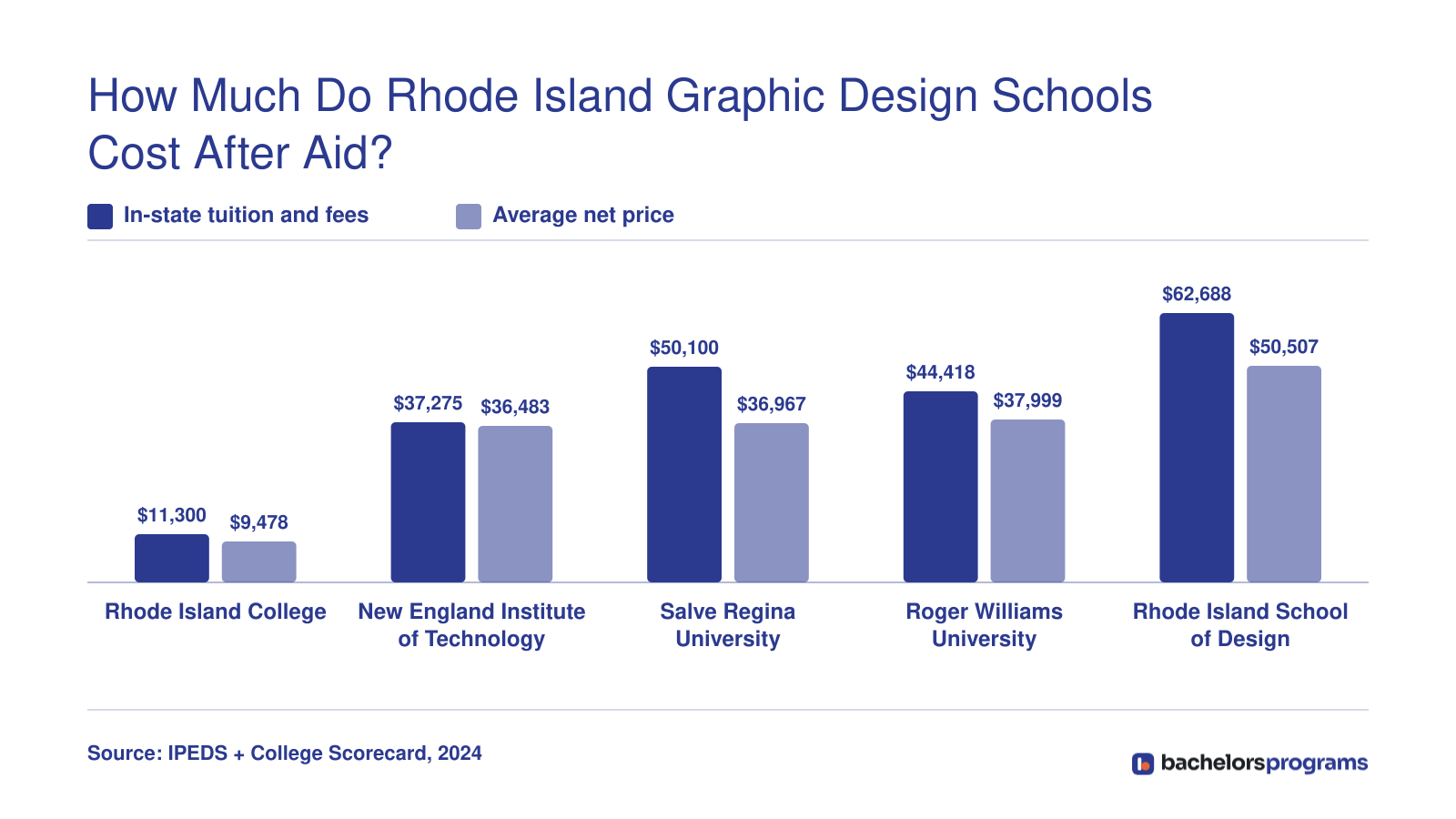
- Rhode Island College: $11,300 in-state tuition and fees; average net price about $9,478.
- Rhode Island School of Design: $62,688; average net price about $50,507.
- Roger Williams University: $44,418; average net price about $37,999.
- Salve Regina University: $50,100; average net price about $36,967.
- New England Institute of Technology: $37,275; average net price about $36,483.
Aid narrows the gap. RISD's net price lands about $12,000 below its sticker and Salve Regina's more than $13,000 below, pulling the private options closer together than their catalogs suggest. Rhode Island College stays the low-cost route for residents.
Rhode Island Aid Worth Chasing
- Rhode Island Promise: Rhode Island residents are considered at URI, and a qualifying award appears on the aid offer.
- State need-based grants: eligibility is set by the Office of the Postsecondary Commissioner1, and funding depends on the annual appropriation. File the FAFSA.
- RI Stay-the-Course (RIC): covers the gap between tuition, fees, the book allowance and your other aid, capped at 60% of cost of attendance2; FAFSA by the priority deadline.
- RI HOPE (RIC): covers remaining tuition and fees for in-state students beginning junior year.3
- Institutional aid: RISD awards need-based aid only, with nothing reserved for portfolio strength4; URI's merit awards (Presidential, University, Transfer Merit, Transfer Achievement, Phi Theta Kappa) are reviewed at admission, not by major, and renew with 12 credits a semester and a 2.8 GPA.
What Borrowing Looks Like
Median debt among graduates who borrowed is $27,000 at RISD, with a 10-year monthly payment near $286; $26,445 and $280 at Roger Williams; and $29,167 and $305 at New England Tech. Those figures assume steady, on-time repayment.
One Practical Move
File the FAFSA before Rhode Island's priority deadline every year, not just freshman year, since state grants and Stay-the-Course are FAFSA-driven and renewed annually. If the total still strains the budget, transferring credits from a community college can cut the semesters you pay for, though several schools here set studio transfer credit by portfolio review.
How Much Do Rhode Island Graphic Design Schools Cost After Aid?
Published tuition and fees are only the starting point. The average net price, what students pay after grants and scholarships, runs lower at every school below, though the size of the gap varies widely. Net price is an institution-wide average for all undergraduates, not a figure specific to graphic design majors, so your own aid award may be higher or lower.
What Graphic Designers Earn in Rhode Island
A bachelor's degree in graphic design prepares you for a Rhode Island market that pays slightly above the national norm.
Compare Graphic Design programs on the data that matters
Explore more Arts & Design majors or browse every field of study.
All Arts & Design programs Browse every field of study