Best Speech Pathology Schools in New York
Compare 24 accredited Speech Pathology programs in New York, with net price after aid, graduation rates, earnings and debt from IPEDS and the U.S. College Scorecard.
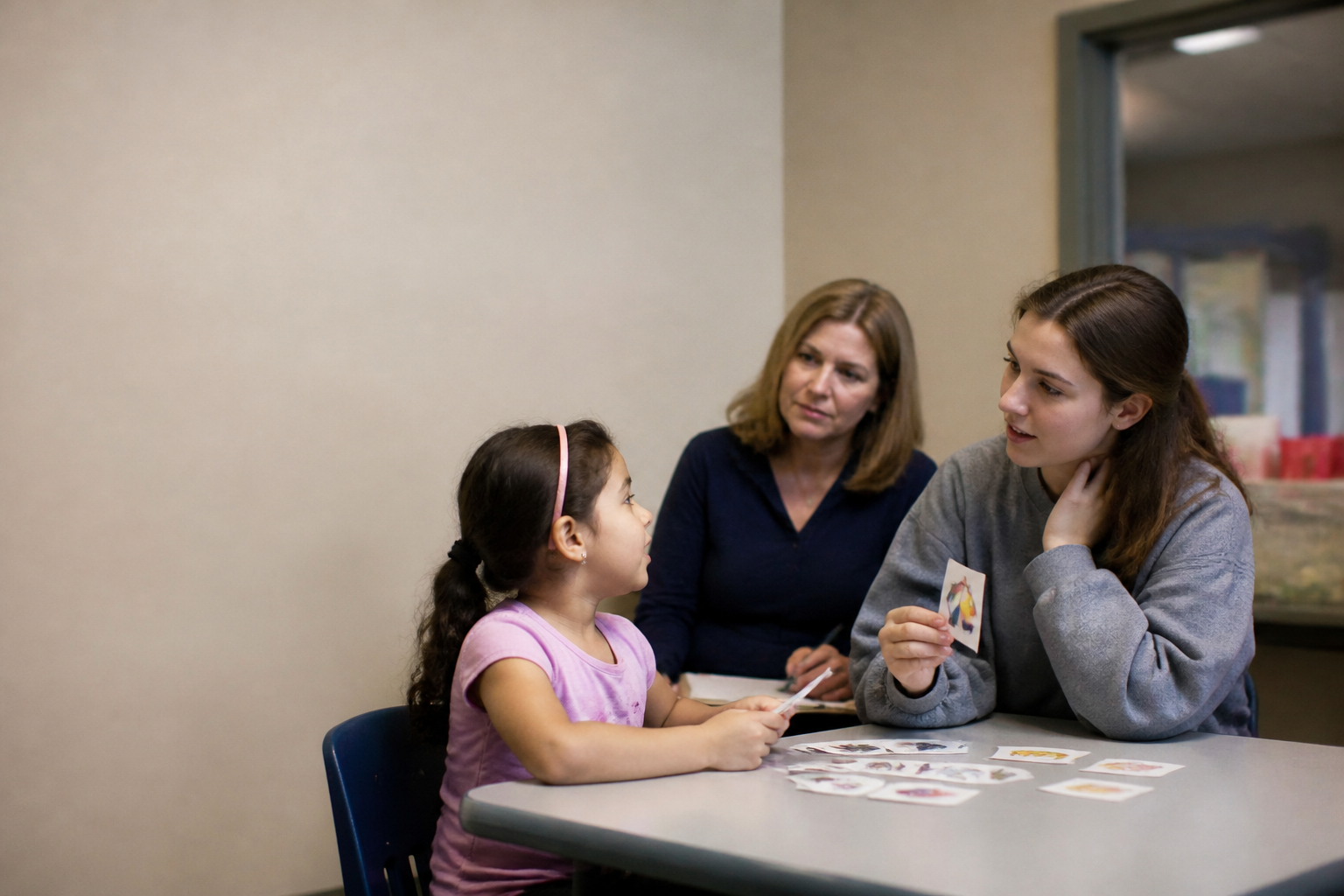
New York licenses speech-language pathologists only at the graduate level, so the undergraduate degree is a stepping stone, not an endpoint. A bachelor's degree in speech pathology, most often a Bachelor of Science (B.S.), covers phonetics, language development, anatomy of speech and hearing, and clinical observation. The master's degree is non-negotiable for licensure; the bachelor's is where the prerequisite coursework and observation hours begin.
The real tension is fit versus cost. Schools label the major Speech Pathology, Speech-Language Pathology or Communication Sciences and Disorders, and net prices vary widely, from CUNY campuses to private universities on Long Island and upstate. Where you start shapes your graduate options, your debt, and how quickly you reach a paid clinical role.
Key Points
- Several CUNY campuses average under $4,000 a year after grants.
- New York licenses speech-language pathologists only after a master's degree or higher.
- Many programs apply GPA rules when you declare the major, not at admission.
Best Bachelor's in Speech Pathology Schools in New York
Ten New York colleges award a bachelor's degree in speech pathology or its close cousin, communication sciences and disorders, and each card below shows what sets that department apart. Public and private campuses sit side by side, from a flagship research university in Buffalo to compact CUNY and SUNY departments across New York City and the Hudson Valley.
University at Buffalo
#1Buffalo, NY · $20,000 – $25,000/yr (est.)
Best for: Upstate students eyeing clinical simulation
The University at Buffalo runs its speech and hearing coursework through the Department of Communicative Disorders and Sciences, and majors complete at least 20 of the 31 departmental credits on campus. The department connects to the Behling Human Simulation Center at the Jacobs School of Medicine, a clinical simulation link that is unusual for a bachelor's program. Institution-wide, about 75% of students graduate and net price after aid runs near $21,000.
- 31 credit hours in the major, 20 of them completed at UB
- Core covers phonetics, speech acoustics and psychoacoustics
- Audiology diagnosis and management coursework included
- Clinical observation, diagnostics and aural rehabilitation courses
- 2.5 GPA required in departmental courses to graduate
- Grades below C- must be retaken; no S/U grading in CDS courses
- Elective on communication in aging adults
- Prepares students for graduate study in speech-language pathology or audiology
New York University
#2New York, NY · ~$37,000/yr (est.)
Best for: Study-abroad seekers in communication sciences
NYU's Steinhardt School teaches communication sciences on a full-time, campus-based schedule in lower Manhattan, with a 128-credit major drawing on linguistics, psychology and physiology. Students take an anatomy and physiology course with a cadaver lab at NYU Langone Medical Center, observe sessions at the on-campus clinic, and honors candidates write a research thesis. The institution-wide graduation rate is about 88% and net price after aid is roughly $37,000.
- 128 credit hours, full-time major
- Anatomy and physiology course with cadaver lab at NYU Langone
- Observation at the on-campus clinic serving infants through adults
- Study abroad at 13 global sites, including a London health services course
- Honors research thesis with a faculty mentor
- Campus chapter of the National Student Speech-Language-Hearing Association
- 2.5 GPA recommended to declare the major
- Deadlines of November 1, January 1 and January 5
State University of New York at New Paltz
#3New Paltz, NY · ~$19,000/yr (est.)
Best for: Liberal arts students wanting a capstone year
SUNY New Paltz offers a 49-50 credit Communication Disorders major inside a small public liberal arts college in the Hudson Valley, capped by a required capstone chosen from diagnosis, seminar or clinical methods options. Students enter the major after 30 completed credits with a 3.0 GPA, and the department will not count grades below C-. About 72% of students graduate institution-wide, and net price after aid is near $18,800.
- 49-50 credit major built on a 36-credit core
- Core covers phonetics, speech and hearing science and child language
- Anatomy and physiology of speech and swallowing included
- 3-4 credit core elective plus 6 credits of other electives
- 4-credit capstone: diagnosis, seminar or clinical methods in audiology
- Admission requires a 3.0 GPA and 30 completed credits
- Grades below C- not accepted; 2.0 CMD average to apply for the degree
- ASL and Deaf Studies courses available
CUNY Brooklyn College
#4Brooklyn, NY · under $5,000/yr (est.)
Brooklyn College teaches a 45-credit Communication Sciences and Disorders B.A. on its Flatbush campus, pulling required courses from communication arts and sciences plus a linguistics course. Majors attend a new majors meeting before declaring and must hold a B average in major courses, with no grade below a C. The Magner Career Center connects students with employers such as the New York City Department of Education and BronxCare Health System.
- 45 credit hours in the major
- Coursework in the anatomy and physiology of speech and hearing
- Covers speech, language, communication and swallowing disorders
- Linguistics 2001 required alongside the CSD courses
- B average required in major courses, no grade below C
- New majors meeting before declaring the major
- Statistics, physical and social science courses recommended for ASHA standards
- Career center partners include NYC Department of Education and BronxCare
CUNY Queens College
#5Queens, NY · ~$4,200/yr (est.)
Queens College admits students to its communication sciences and disorders major on a rolling basis in Flushing, and the department is built around preparation for graduate study and ASHA certification. Majors take two to three CSD courses per semester, typically finishing the sequence in five to six semesters, with clinical observation at the campus Speech-Language-Hearing Center. Institution-wide graduation is about 53% and net price after aid is roughly $4,200.
- Rolling admissions with a 3.0 GPA minimum
- 24 completed credits required before applying to the major
- Competitive review; admission limited by available space
- Typically five to six semesters of CSD coursework
- Clinical observation at the campus Speech-Language-Hearing Center
- Personalized three-step advisement with mandatory meetings
- Pairs well with a second major or minor in Linguistics
- No e-permit for CSD courses
CUNY Lehman College
#6Bronx, NY · $3,100/yr (est. net price)
CUNY Lehman College in the Bronx awards a B.A. in Speech Pathology and Audiology built around typical and atypical development in monolingual and multilingual populations, with a deliberate emphasis on cultural and linguistic difference. Qualified students can use an early admission pathway to start graduate speech-language pathology coursework during senior year. Institution-wide graduation is about 51% and net price after aid is near $3,100.
- Major prepares students for graduate study in speech-language pathology or audiology
- Covers speech, language and hearing development
- Communication disorders across the lifespan
- Emphasis on cultural and linguistic differences
- Early admission pathway to graduate SLP coursework in senior year
State University of New York at Cortland
#7Cortland, NY · $20,000 – $25,000/yr (est.)
SUNY Cortland's 120-credit Speech and Hearing Science major blends theory, research and clinical practice, with an optional schools concentration for students aiming at educational settings. Students observe at the Center for Speech, Language and Hearing Disorders and can pursue independent research with faculty, backed by named departmental scholarships. About 68% of students graduate institution-wide and net price after aid is about $22,300.
- 120 credit hours required
- Blends theory, research and clinical practice
- Concentration in Speech and Hearing Science in Schools available
- Clinical observation at the Center for Speech, Language and Hearing Disorders
- Independent study and faculty research opportunities
- Named scholarships, including the Catherine Suarez Leeolou '81 Scholarship
- Study abroad experiences
- Foundation for graduate study in speech-language pathology or audiology
Touro University
#8New York, NY · $30,000/yr (est. net price)
Touro's Lander College of Arts and Sciences teaches a speech communications major mostly in person during the evening, with Zoom and hybrid options and an accelerated summer-to-summer track for students arriving with seminary or transfer credit. The 25 supervised observation hours run alongside classes, and graduates receive priority consideration for Touro's SLP master's program. Institution-wide graduation is about 72% and net price after aid is near $29,600.
- 25 hours of supervised observation built into the coursework
- Classes primarily in person in the evening, with Zoom and hybrid options
- Accelerated summer-to-summer track for seminary or transfer credit
- Senior Speech Seminar capstone in the final semester
- American Sign Language elective available
- Priority consideration for Touro's MS in Speech-Language Pathology
- No undergraduate internships because of licensure rules
- Small class sizes
Syracuse University
#9Syracuse, NY · $35,000 – $40,000/yr (est.)
Syracuse University's College of Arts and Sciences lists a combined bachelor's and master's pathway in communication sciences and disorders for 2026-2027, alongside graduate speech-language pathology and audiology programs. Published detail on the undergraduate portion, including credit totals and admission requirements, is thin, so confirm specifics with the department before applying. Institution-wide graduation is about 84% and net price after aid is near $38,800.
- Combined bachelor's and master's pathway in communication sciences and disorders
- Listed by the College of Arts and Sciences for 2026-2027
- Department also offers MS, PhD and AuD programs
Yeshiva University
#10New York, NY · ~$50,000/yr (est.)
Yeshiva University's Stern College for Women offers a B.S. in Speech Pathology and Audiology that moves from anatomy and phonetics into clinical coursework in disorders, audiology and aural rehabilitation. Students complete 25 guided observation hours in a clinical methods course and can join an active Speech Pathology-Audiology Club and a student-run journal. Institution-wide graduation is about 83% and net price after aid is near $50,000.
- Sequential curriculum from basic sciences to clinical coursework
- Anatomy, phonetics and aural rehabilitation required
- Clinical methods course with 25 guided observation hours
- Student-run journal and active Speech Pathology-Audiology Club
- Offered at Stern College for Women
- Prepares students for graduate programs leading to ASHA certification
Cost & outcomes by school
Federal data for the highest-earning Speech Pathology programs, independent of the ranking above. Earnings are this field's bachelor's graduates four years after completing where the Scorecard reports them, else the school's undergraduate median.
| School | Net price / yr | Grad rate | Earnings | Debt | Grads/yr | Format |
|---|---|---|---|---|---|---|
| CUNY Queens College NY | $4,195 | 53% | $78,281 | $11,000 | 28 | Campus |
| Iona University NY | $29,188 | 56% | $77,352 | $25,000 | 34 | Campus |
| New York University NY | $37,050 | 88% | $75,970 | $23,195 | 30 | Campus |
| Long Island University NY | $33,062 | 57% | $75,502 | $23,577 | 8 | Campus |
| St. John's University-New York NY | $29,999 | 66% | $74,937 | $23,125 | 64 | Campus |
| Molloy University NY | $24,347 | 70% | $74,070 | $25,250 | 11 | Campus |
| Yeshiva University NY | $49,965 | 83% | $71,353 | $18,250 | 19 | Campus |
| Hofstra University NY | $34,176 | 69% | $68,984 | $26,000 | 24 | Campus |
| CUNY City College NY | $3,776 | 57% | $66,039 | $11,990 | — | Campus |
| Adelphi University NY | $30,783 | 67% | $64,190 | $24,032 | 15 | Campus |
| St. Joseph's University-New York NY | $19,035 | 69% | $63,905 | $22,000 | — | Campus |
| State University of New York at Cortland NY | $22,345 | 68% | $62,122 | $20,187 | 52 | Campus |
Sources: U.S. Department of Education. Net price, graduation rate, earnings and debt: College Scorecard (earnings and debt for this field's bachelor's graduates where reported, else school-wide); graduates: IPEDS. A dash means no figure is reported.
Cost, debt & payoff
Median earnings of this field's bachelor's graduates (4 yrs after completing, else the school's undergraduate median) vs. their median federal loan debt · U.S. College Scorecard
Across these programs the median graduate earns about $61,942 and finishes with roughly $22,000 in debt — a ratio that clears a common rule of thumb (keep debt below first-year salary). Net price and debt vary widely school to school, so check the per-school figures in the table above before you shortlist.
Most Affordable Bachelor's in Speech Pathology Schools in New York
CUNY campuses offer the lowest average net prices, with three of them under $4,000 a year after grants and scholarships. SUNY Buffalo State University costs more but still lists in-state tuition below $9,000. Figures come from 2024 U.S. Department of Education data (IPEDS and College Scorecard).
| School | City | Major Name | Average Net Price | In-State Tuition and Fees | Format |
|---|---|---|---|---|---|
| CUNY Brooklyn College | Brooklyn | Communication Sciences and Disorders | $3,103 | $7,452 | Campus |
| CUNY Lehman College | Bronx | Speech Pathology and Audiology | $3,148 | $7,410 | Campus |
| CUNY City College | Manhattan | Speech Pathology | $3,776 | $7,340 | Campus |
| CUNY Queens College | Queens | Communication Sciences and Disorders | $4,195 | $7,538 | Campus |
| SUNY Buffalo State University | Buffalo | Speech-Language Pathology | $11,346 | $8,533 | Campus |
Compare the Top Bachelor's Programs Side by Side
This table lines up the ranked schools on sector, location, average net price after aid, admission rate and institution-wide graduation rate, drawn from 2024 IPEDS and College Scorecard data from the U.S. Department of Education. Net price figures are approximate averages for aided students, not exact quotes, so check each school's net price calculator for your own cost. Three patterns stand out. The public CUNY colleges in New York City are by far the least expensive, at roughly $3,100 to $4,200 after aid. Upstate SUNY campuses run about $18,800 to $22,300, and the private universities range from about $29,600 to nearly $50,000. Private schools tend to post higher graduation rates, with New York University (88 percent) and Syracuse University (84 percent) leading. New York City options sit at both ends of the price scale, from CUNY Brooklyn College to Yeshiva University, and Touro University stands out for its hybrid format.
| School | Public or Private | NYC or Upstate | Avg. Net Price After Aid (approx.) | Admission Rate | Graduation Rate (institution-wide) | Program Type |
|---|---|---|---|---|---|---|
| University at Buffalo | Public | Upstate (Buffalo) | $20,995 | 74% | 75% | Campus |
| New York University | Private | NYC (Manhattan) | $37,050 | 9% | 88% | Campus |
| State University of New York at New Paltz | Public | Upstate (Hudson Valley) | $18,809 | 62% | 72% | Campus |
| CUNY Brooklyn College | Public | NYC (Brooklyn) | $3,103 | 58% | 54% | Campus |
| CUNY Queens College | Public | NYC (Queens) | $4,195 | 64% | 53% | Campus |
| CUNY Lehman College | Public | NYC (Bronx) | $3,148 | 57% | 51% | Campus |
| State University of New York at Cortland | Public | Upstate (Cortland) | $22,345 | 60% | 68% | Campus |
| Touro University | Private | NYC (Manhattan) | $29,627 | 61% | 72% | Hybrid |
| Syracuse University | Private | Upstate (Syracuse) | $38,793 | 46% | 84% | Campus |
| Yeshiva University | Private | NYC (Manhattan) | $49,965 | 56% | 83% | Campus |
Online and Hybrid Bachelor's in Speech Pathology Options at New York Schools
Online convenience and clinical training pull in opposite directions here: the flexibility that makes an online bachelor's attractive can also leave you short on supervised observation hours. At New York-based schools, that tension shows up clearly in the formats offered.
What the formats actually look like
No New York-based school in the programs below lists a fully online bachelor's in speech pathology or communication sciences and disorders. Hybrid study is the exception, not the rule: Touro University lists a hybrid format with evening classes primarily in person and some Zoom or hybrid options, and University at Buffalo lists both fully in-person and hybrid delivery for its communication disorders and sciences major.1 Most other programs here, including NYU, SUNY New Paltz, Brooklyn College, Queens College, Lehman College, SUNY Cortland, Syracuse and Yeshiva, list campus-based study, and their program pages do not establish an online or hybrid option.
Why the in-person piece matters
Speech pathology is a hands-on field from the start. Undergraduate programs build in guided observation hours, labs in phonetics and speech acoustics, and supervised exposure to clients or campus clinics. Yeshiva includes guided observation hours; Cortland uses its speech and hearing center; NYU runs an on-campus clinic.2 Those experiences are hard to replicate at a distance, and they are the foundation graduate programs look for.
NYC versus upstate
Geography shapes the format decision too. The NYC programs (NYU, Touro, Brooklyn College, Queens College, Lehman College and Yeshiva) suit commuter students who can reach campus by subway or bus, while Buffalo, New Paltz, Cortland and Syracuse are residential or relocation choices. If you need to keep working, a hybrid program within commuting distance is usually more realistic than a fully online option, which these New York schools do not offer.
Admissions for Speech Pathology Bachelor's Programs: GPA, Test Policy and Transfer Credit
What GPA do you need to get into a speech pathology bachelor's program in New York?
There is no single statewide answer. Many programs apply their GPA rules when you declare or continue the major, not when you first apply to the university, so read each number for what it governs and confirm the rest with admissions.
GPA Rules the Programs Publish
- University at Buffalo: 2.5 GPA minimum, 20 credits completed at UB, and any communication disorders course below C- retaken.
- SUNY New Paltz: 3.0 GPA and 30 completed credits before entering the major.
- CUNY Queens College: 3.0 GPA, 24 completed credits, and a competitive review.
- CUNY Brooklyn College: a B average in major courses with no grade below C.1
- Long Island University: 3.0 enrollment GPA, 3.4 major GPA, and departmental approval.2
- NYU: 2.5 GPA recommended for current NYU students declaring the major.3
Test Policy and Transfer Credit
None of the program pages reviewed lists SAT or ACT requirements at the program level; testing policy sits with each university's central admissions office. Transfer credit is just as uneven. Long Island University publishes one concrete rule, waiving a listed 3-credit elective for students who transfer with 60 or more credits. Elsewhere, how major credits are evaluated is often not spelled out. The program pages for Adelphi and Russell Sage do not list a program-level GPA or testing rule, so ask their admissions offices directly.5
Early-Assurance and Combined Routes
Adelphi offers communication disorders students early admission to its M.S.4, Lehman advertises early admission to graduate SLP study, Touro gives priority admission to its own SLP master's, and Syracuse lists a combined B.S./M.S. in communication sciences and disorders. Treat these as features of the bachelor's route. New York licensure as a speech-language pathologist still requires a master's degree.
Before you deposit, email the department, not only the admissions office, and ask how a specific prerequisite such as phonetics or anatomy and physiology of speech transfers. Get the answer in writing.
Related Articles
Cost of a Speech Pathology Bachelor's Degree in New York
Sticker tuition and net price tell two different stories in New York. Tuition is what a school charges. Net price is what students pay for a full year, including housing and other expenses, after grants and scholarships.
Public Tuition vs. What Students Pay
At CUNY, aid works strongly in students' favor. CUNY Brooklyn College lists in-state tuition of $7,452 but an average net price of $3,103. CUNY Lehman College ($7,410 tuition, $3,148 net) and CUNY Queens College ($7,538 tuition, $4,195 net) follow the same pattern.
Residential SUNY campuses run the other way. State University of New York at New Paltz charges $8,572 in tuition but averages $18,809 net. University at Buffalo charges $10,936 and averages $20,995 net, largely because room and board are part of the bill.
Private schools start higher. St. Joseph's University-New York lists $36,550 in tuition, though aid brings its average net price to $19,035.
Treat these figures as averages for students who received aid. Your own package depends on income, residency and enrollment.
State Aid That Lowers the Bill
For 2026-27, SUNY lists resident tuition at its state-operated campuses at $7,070, plus $1,830 in fees, for about $8,900 in direct costs.3 Two state programs can cut that figure:
- TAP: Awards range from $1,000 to $5,665 a year. Dependent students need family income of $125,000 or less and 12 months of New York residency. Full-time awards require 12 credits per semester at an approved college charging at least $200 in tuition.1
- Excelsior Scholarship: Covers SUNY or CUNY tuition, up to SUNY resident tuition, for households with federal adjusted gross income of $125,000 or less. You must take 12 credits a term and 30 a year and stay on track to finish in four years. You also agree to live and work in New York for as many years as you received the award. TAP is applied first, and Excelsior covers the remaining tuition but not fees, housing or books.2
File Early
Submit the FAFSA and New York's state aid application as soon as each opens. The 2026-27 Excelsior window has already closed, so students starting in fall 2027 should plan around the next cycle's deadlines.
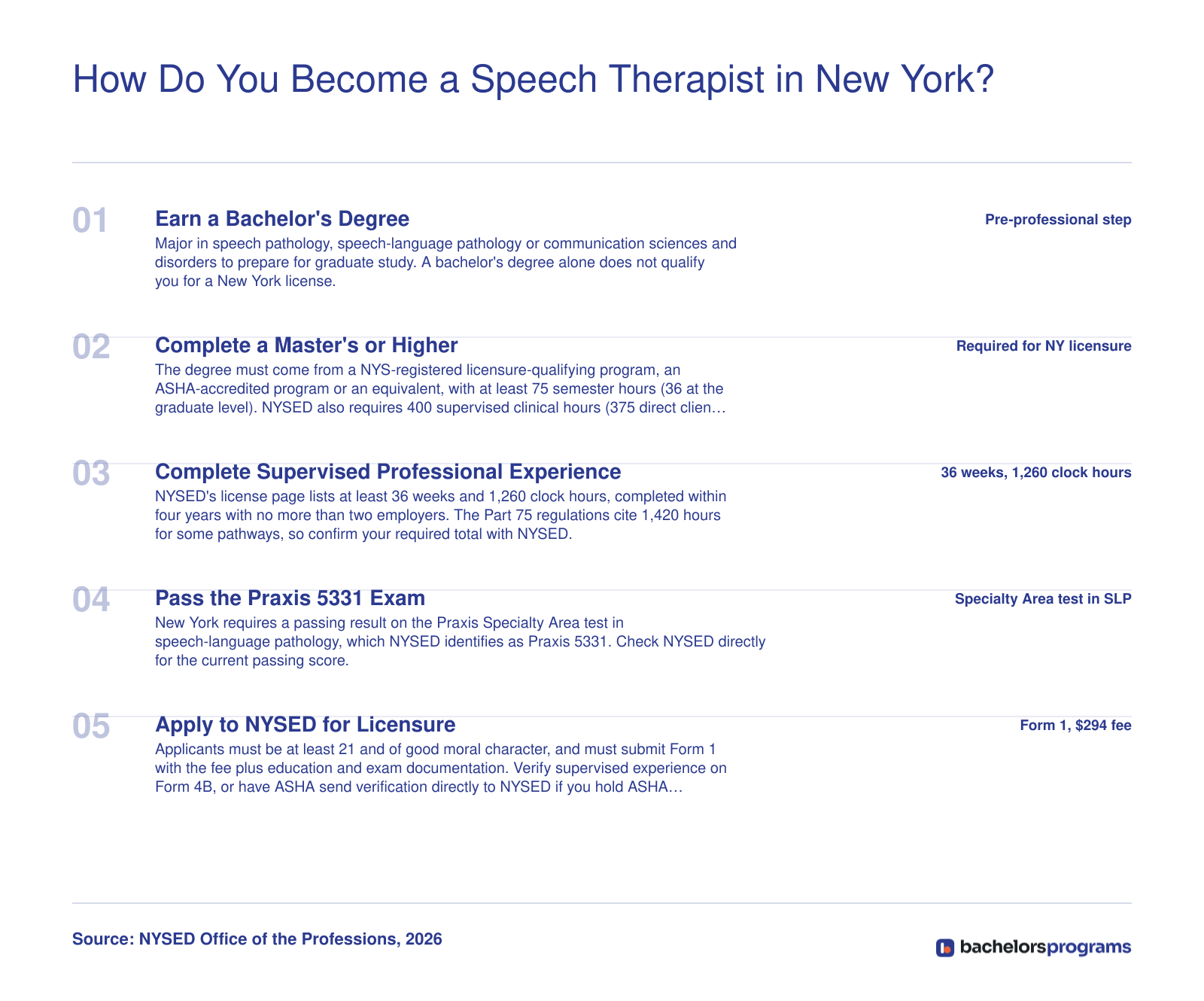
How Do You Become a Speech Therapist in New York?
In New York, licensure as a speech-language pathologist requires a master's degree or higher. The bachelor's degree is the pre-professional step, and it is the only stage this page covers. The steps below follow the New York State Education Department (NYSED) Office of the Professions requirements.
Careers and Wages for Speech Pathology Graduates in New York
A bachelor's degree in speech pathology is a first step, not the finish line, and New York's wage data makes that plain. Practicing as a licensed speech-language pathologist (SLP) requires graduate study after the bachelor's, so most graduates move on to that step before earning SLP wages.
Work Available Before Graduate Study
Graduates who pause between degrees often take support roles. Common options include speech-language pathology assistant positions, school paraprofessional jobs, and aide roles in early intervention or rehabilitation programs. Requirements and pay vary by employer and setting, and these jobs do not carry SLP-level salaries. They do give you direct experience with clients, which helps when you apply to graduate programs.
Where New York SLPs Work
New York SLPs work in public schools, hospitals, rehabilitation and nursing facilities, home health, private practices, and early intervention programs for young children. Nationally, elementary and secondary schools employ the most SLPs (72,130), followed by offices of other health practitioners (49,320) and hospitals (19,740).3 New York had about 15,310 SLPs in May 2025.3
New York SLP Wages
Federal wage data for May 2025 put the New York statewide median for SLPs at $100,610 a year, or $48.37 an hour.2 Pay ranges from $64,980 at the low end to $157,920 at the high end.2
Location matters. The New York City metro median was $107,860, about $7,250 above the state median, with a range of $73,530 to $167,210.4 Upstate metros come in lower, and they differ from one another:
- Kiryas Joel-Poughkeepsie-Newburgh: $96,540
- Syracuse: $85,120
- Buffalo-Cheektowaga: $82,890
- Rochester: $80,220
There is no official upstate average, so treat these as city-by-city medians rather than one upstate figure.
Keep Two Sets of Earnings Separate
The wages above describe working, licensed SLPs, who hold a master's degree and usually have years of experience. The program-level earnings shown earlier on this page measure something else: what bachelor's graduates earn soon after finishing, before graduate training and licensure. Those figures will sit well below the SLP medians, and that gap is expected. Compare programs using the school-level numbers, and use the SLP wages to judge what the full path to licensure can eventually pay.
How to Choose a Bachelor's in Speech Pathology School in New York
Choosing well is a matter of sequence: confirm the graduate pathway first, then the hands-on training, then location, then price. Run the checks in that order and the shortlist narrows itself.
Start with the graduate pathway
The bachelor's degree in speech pathology is a pre-professional step, so the department's graduate offerings matter as much as the undergraduate major. Ask whether the school's master's program in speech-language pathology holds accreditation from the Council on Academic Accreditation in Audiology and Speech-Language Pathology, which is what New York licensure and ASHA certification both depend on. Questions worth putting in writing:
- Does the master's program hold current accreditation, and when was it last reviewed?
- Which undergraduate courses satisfy its prerequisites?
- What share of the department's own seniors are admitted?
Check the lab and clinical side
Ask how early students get observation hours, whether there is a campus clinic, and which labs (phonetics, audiology, speech science) undergraduates can actually use. Vague answers here usually mean supervised observation starts late.
Settle location and cost last
Location drives where you complete fieldwork; cost decides whether the degree is worth it. Compare in-state tuition and net price after aid in the cost section above, and weigh the New York wage picture in the careers section before you commit. If audiology, special education, or public health also interest you, our related specializations pages cover those options.
Questions to Ask Yourself
Would you rather study in New York City or upstate?
Does the school offer a combined or early-assurance route, or will you apply separately for further study?
Can you reach the net price shown after TAP or Excelsior aid without heavy borrowing?
Does the program give you early clinical observation hours?
Compare Speech Pathology programs on the data that matters
Explore more Communications & Media majors or browse every field of study.
All Communications & Media programs Browse every field of study