Best Online Software Engineering Degree Programs
Compare 20+ accredited online Software Engineering programs, with net price after aid, graduation rates, earnings and debt from IPEDS and the U.S. College Scorecard.

The price of a bachelor's degree in software engineering varies far more than the curriculum does. Can you get one online? Yes. Every school ranked here offers the degree 100% online, with no hybrid or residency requirement.
Programs here typically award the Bachelor of Science (B.S.) in Software Engineering. Each entry covers ABET status, net price, graduate debt, completion time, and whether the degree pays off.
Cost shows the spread. Western Governors University charges a flat $4,375 per six-month term, while the University of Arizona lists $525 per credit across 120 credit hours. Pace, transfer credit, and accreditation shift the final bill as much as the sticker rate.
Key Points
- ABET's Engineering Accreditation Commission reviews bachelor's programs titled software engineering.
- Most online B.S. programs require about 120 credits; transfer credit shortens that.
- Unlike computer science, software engineering stresses testing, design, DevOps and project management.
Top 10 Fully Online Software Engineering Bachelor's Programs for 2027
Every program below is a bachelor's degree in software engineering that can be completed online, and hybrid-only or campus-only routes were left off the list. The ten entries range from large public research universities to dedicated online institutions and smaller teaching-focused campuses, so cost, pace and structure vary a lot. Each card notes what the program is known for and the kind of student it tends to fit.
University of Arizona
#1Tucson, AZ · ~$17,000/yr (est.)
Best for: Working adults wanting a research university
Arizona's online software engineering degree sits inside a large public research university, and its online bachelor's programs were placed in the top 5 percent nationally by U.S. News for 2026. The curriculum runs from an introductory software engineering course through requirements analysis, design, assurance and security, DevOps and project management, with calculus, physics and discrete math underneath. It suits students who want a research university name on the diploma and a structured, math-grounded path, and who can work with a per-credit price rather than a flat term rate.
- 120 credits at $525 per credit
- ABET accredited
- Sequence runs from introduction to software engineering through project management
- Math base in calculus, physics and discrete math
- Agile development, automated testing with continuous integration, and DevOps
- Software assurance and security course
Kennesaw State University
#2Kennesaw, GA · ~$15,000/yr (est.)
Best for: Cost-focused students wanting small classes
Kennesaw State runs a 120-credit software engineering bachelor's with three start points a year and a reputation for keeping costs low. Classes stay small, project work is team-based, and a Double Owl pathway lets students begin graduate software engineering coursework while finishing the bachelor's. It fits cost-conscious students who want a conventional four-year campus experience with an online track and a clear route to a master's.
- 120 credits, four-year degree with fall, spring or summer start dates
- Small class sizes, with day and after-hours class options
- Team and group project work alongside lab and classroom training
- Double Owl pathway into the Software Engineering M.S.
- Primary campus in Marietta
Western Governors University
#3Salt Lake City, UT · ~$13,000/yr (est.)
Best for: Self-paced learners balancing full-time jobs
Western Governors University built its software engineering bachelor's for working adults: asynchronous courses, twelve start dates a year, and a flat six-month term that lets students move faster without paying more. The 39-course sequence covers full-stack development, cloud deployment, APIs, security and Agile workflows, then closes with a capstone proposal, build and post-implementation report. Five certifications come with tuition, and an accelerated pathway swaps undergraduate courses for graduate bridge courses on the way to a master's.
- 39 courses, with asynchronous classes students complete on their own schedule
- Capstone: technical proposal, implementation, post-implementation report
- AWS Certified Developer Associate, ITIL 4 Foundation and three microcredentials included
- Flat tuition of $4,125 per six-month term
- 12 start dates a year and a $0 application fee
- Admission needs a diploma plus one of five readiness options; no ACT or SAT
- 60% of graduates finish within 35 months
- Accelerated bachelor's-to-master's pathway with graduate bridge courses
University of Michigan-Dearborn
#4Dearborn, MI · ~$9,000/yr (est.)
Michigan-Dearborn's software engineering B.S. is ABET-accredited and organized around four sequences: information systems, computer game design, web engineering and artificial intelligence. Admissions are rolling, early applicants get priority for aid and scholarships, and the Go Blue Guarantee covers tuition for qualifying in-state students. It suits students who want an engineering college with named specializations and a defined five-year bachelor's-to-master's route.
- Accredited by the Engineering Accreditation Commission of ABET
- Four sequences: information systems, computer game design, web engineering, AI
- Rolling admissions; early applicants get priority for aid and scholarships
- Five-year bachelor's-to-master's path: 60 undergraduate credits, 3.2 GPA
- Go Blue Guarantee covers tuition for qualifying in-state undergraduates
- Team-based projects balance theory and practice
Arizona State University
#5Scottsdale, AZ
Arizona State's software engineering B.S. is ABET-accredited and taught through the Fulton Schools of Engineering, with a project-driven curriculum and technical electives in web, mobile and embedded systems. Online students earn the same diploma as campus students, and a five-year accelerated track leads into a master's. It suits students who want a large engineering school's resources and a widely recognized name without relocating.
- 120 credits; online students earn the same diploma as campus students
- ABET accredited through the Fulton Schools of Engineering
- First-year entry: 1210 SAT, 24 ACT or a 3.00 high school GPA
- Technical electives in web, mobile and embedded systems
- Team-based project work each semester
- Accelerated bachelor's plus master's in five years
- 24-month STEM-OPT extension for F-1 students
Colorado State University-Fort Collins
#6Fort Collins, CO · ~$21,000/yr (est.)
Colorado State offers software engineering as a concentration inside its computer science bachelor's, taught by the Computer Science department in the College of Natural Sciences. The concentration is listed for the Fort Collins campus and for online study, so students get a computer science core with a software engineering focus rather than a standalone engineering degree. It suits students who want room to move between the broader CS core and the software track.
- Concentration inside the Computer Science B.S.
- Taught by the Computer Science department in the College of Natural Sciences
- Listed for both the Fort Collins campus and online study
- Software engineering focus within a broader computer science core
University of Minnesota-Crookston
#7Crookston, MN · ~$12,000/yr (est.)
Minnesota Crookston keeps its software engineering bachelor's practical, with three areas of emphasis: financial and e-commerce systems, network-centric systems, and gaming, 3D modeling and simulation. Students work in the campus collaborative learning and applied research lab, and interns and graduates have landed at Amazon, NASA, Microsoft and Medtronic. It suits students who want applied, project-heavy work and a smaller-campus feel, and who may want a cybersecurity minor alongside the major.
- Three areas of emphasis: financial and e-commerce, network-centric, gaming
- Electives include data warehousing, mining and 3D simulation programming
- Work in the Undergraduate Collaborative Learning and Experiential Applied Research Lab
- Minor in cybersecurity and information assurance available
- Interns and graduates hired at Amazon, NASA, Microsoft and Medtronic
Saint Cloud State University
#8Saint Cloud, MN · ~$14,000/yr (est.)
Saint Cloud State teaches its software engineering major as a project-driven degree where students complete a significant project every semester. The curriculum was built with industry input and is one of only two software engineering programs in the Minnesota State system, with game design, mobile and web development, big data and software security among the coursework. It suits students who learn by building and want the option of an accelerated online bachelor's.
- Accelerated online B.S. option available
- Significant project every semester builds communication and teamwork
- Curriculum developed with industry; one of two such programs in Minnesota State
- Covers game design, mobile and web apps, big data analytics, software security
- Same faculty teach the face-to-face and online versions
- Software Engineering scholarships available
Grand Canyon University
#9Phoenix, AZ · ~$22,000/yr (est.)
Grand Canyon's software engineering bachelor's requires 120 credits and runs online courses in seven-week terms, so students concentrate on fewer subjects at a time. A capstone is required, up to 90 transfer credits are accepted, and the coursework spans Python, Java, C, cloud computing and embedded systems. It suits students who want frequent start points, a fast term structure and a defined capstone to show employers.
- 120 credits; online courses in seven-week terms
- $490 per credit for online coursework
- 2.8 unweighted GPA, or 2.5 with an ACT of 19 or SAT of 1000
- Capstone project required
- Up to 90 transfer credits accepted
- Python, Java, C, cloud computing and embedded systems
Bellarmine University
#10Louisville, KY · ~$21,000/yr (est.)
Bellarmine's software and data engineering degree is an accelerated second bachelor's for people who already hold a non-computing degree from a regionally accredited college. Applicants need one college-level math course and a 2.5 cumulative GPA, and applicants with non-U.S. credentials submit a TOEFL or IELTS score. It suits career changers who want a focused route into building software products rather than a four-year start from scratch.
- Accelerated second degree for non-computing bachelor's holders
- Requires one college-level math course and a 2.5 cumulative GPA
- TOEFL or IELTS required for applicants from non-U.S. institutions
- Focus on building internal and external software products with modern tools
Cost & outcomes by school
Federal data for the highest-earning Software Engineering programs, independent of the ranking above. Earnings are this field's bachelor's graduates four years after completing where the Scorecard reports them, else the school's undergraduate median.
| School | Net price / yr | Grad rate | Earnings | Debt | Grads/yr | Format |
|---|---|---|---|---|---|---|
| Arizona State University AZ | $14,967 | 68% | $112,543 | $25,000 | 202 | Online or campus |
| Pennsylvania State University PA | $32,875 | 86% | $112,269 | $26,471 | 93 | Online or campus |
| University of Michigan-Dearborn MI | $9,492 | 58% | $111,740 | $21,064 | 56 | Online or campus |
| Kennesaw State University GA | $15,048 | 52% | $103,054 | $23,250 | 146 | Online or campus |
| Oregon State University OR | $19,604 | 70% | $64,010 | $21,221 | — | Online or campus |
| Western Governors University UT | $12,548 | 46% | $60,615 | $11,116 | 880 | Online |
Sources: U.S. Department of Education. Net price, graduation rate, earnings and debt: College Scorecard (earnings and debt for this field's bachelor's graduates where reported, else school-wide); graduates: IPEDS. A dash means no figure is reported.
Cost, debt & payoff
Median earnings of this field's bachelor's graduates (4 yrs after completing, else the school's undergraduate median) vs. their median federal loan debt · U.S. College Scorecard
Across these programs the median graduate earns about $70,550 and finishes with roughly $23,000 in debt — a ratio that clears a common rule of thumb (keep debt below first-year salary). Net price and debt vary widely school to school, so check the per-school figures in the table above before you shortlist.
How We Ranked Fully Online Software Engineering Bachelor's Programs
Ranking online software engineering programs starts with deciding which ones qualify for comparison, then weighing what the survivors actually deliver.
The Eligibility Filter
A program had to be a bachelor's degree in software engineering, or a closely titled equivalent, delivered fully online. Hybrid formats, where any required coursework happens on campus, were excluded outright, along with graduate certificates and master's programs that tend to surface in the same search results.
What Went Into the Composite
Four measures were blended rather than sorted on a single number: average net price, the institution's graduation and retention rates, selectivity, and, where the College Scorecard publishes them, program-level earnings and typical graduate debt. Blending matters because a low price paired with weak completion tells a very different story than a mid-priced program where students finish and find work.
Where the Data Comes From
Institution and program files from the College Scorecard supplied earnings, debt, graduation, and retention figures; IPEDS supplied tuition. ABET status and delivery format were verified separately, on school pages and in the ABET directory, because neither appears in the federal files.
The Limits
A graduation rate reflects the entire institution, not its software engineering majors. Average net price shifts with family income, so treat it as a starting point rather than a quote. And some programs publish no earnings data at all, which means silence, not a poor outcome.
ABET Accreditation and Why It Matters for a Bachelor's Degree in Software Engineering
ABET is a nonprofit accreditor that reviews individual college programs, not whole institutions, against published standards for curriculum, faculty, and student outcomes. Bachelor's programs titled as engineering, including software engineering, are reviewed by its Engineering Accreditation Commission (EAC). Computing programs such as computer science are usually reviewed by its Computing Accreditation Commission (CAC). So, are there ABET-accredited online software engineering degrees? They can exist. ABET applies the same criteria to online programs as to campus programs, and it labels a program "100% online" when, at its most recent review, students could meet every graduation requirement through online coursework. That label can change between reviews, and a program missing from ABET's online listing may still offer a lot of online content. ABET's program-name search returns 64 institutions with a Software Engineering program, and the schools in the third row of the table hold ABET-accredited programs. However, the commission and online coverage for a specific fully online bachelor's in software engineering need to be confirmed program by program. For that reason, the table shows what to look for rather than certifying individual schools. ABET status matters most in three situations. An ABET-accredited engineering degree is the standard first step toward Professional Engineer (PE) licensure in most states. Some federal and defense employers list it as a hiring qualification. Graduate engineering programs often look for it. Many private-sector tech employers weigh portfolios and coding skills more heavily than ABET status, so treat accreditation as essential if one of those three paths is part of your plan.
| School | Online Program | ABET Accredited? | Commission (EAC/CAC) | Online Delivery Covered? |
|---|---|---|---|---|
| Schools with an engineering-titled program | B.S. in Software Engineering | Possible; confirm on ABET's accredited program search | EAC | Yes, if ABET lists the program as 100% online |
| Schools with a computing-titled program | B.S. in Computer Science or a related computing field | Possible; confirm on ABET's accredited program search | CAC | Yes, if ABET lists the program as 100% online |
| Arizona State, Arizona, Arkansas at Little Rock, Central Florida, Florida, North Florida, South Florida, Capella, Capitol Technology, Embry-Riddle Worldwide | Varies by school; check each program title | Yes, for at least some programs | Varies by program | Check ABET's 100% online listing for each program |
Related Articles
Questions to Ask Yourself
Will your work schedule allow live synchronous classes, or do you need fully asynchronous courses?
Can you sit for proctored exams with a webcam at home, or would a testing-center requirement be a problem?
How many of your existing college or community college credits will transfer, and how much does that cut the real cost?
Are you comparing net price after aid, or the sticker per-credit rate a non-aided student actually pays?
How Long Does an Online Software Engineering Degree Take?
A student starting from scratch and a student arriving with an associate degree can finish the same bachelor's in very different amounts of time. The baseline is the same for both: most B.S. programs here require about 120 credits, which at a full-time pace is roughly four years.6 St. Cloud State is a slight exception at 122 credits.1
Transfer Credit Can Cut the Calendar
St. Cloud State accepts up to 90 transfer credits and says completion can be faster as a result.1 Champlain College Online also accepts up to 90, and its page notes that maximum transfer may leave as few as 10 courses, about 5 terms.2 The University of Oklahoma's online degree-completion program in software development and integration lists 24 to 36 months, though that pathway is built for students who arrive with credits already earned.3 Caps and course-by-course rules vary, so these figures are not interchangeable.
Accelerated and Competency-Based Formats
Shorter terms let you stack more courses into a year. St. Cloud State runs 7-week courses with multiple start dates, and Oklahoma uses asynchronous 8-week courses. Western Governors University takes a different route: it is competency-based, and full-time undergraduates must complete at least 12 competency units per term, with no maximum pace.4 Its four-year figure applies to the accelerated bachelor's-and-master's pathway, so do not read it as the bachelor's alone.4
Part-Time Timelines
Going part-time is where the estimates diverge most. Fisher College lists 20 terms (3 years 4 months) for students enrolled continuously in two courses per term.5 Champlain's two-course example runs 3 years 8 months, and some of its courses are offered only in 15-week format.2 Anything lighter than two courses per term, or any gap in enrollment, pushes you past those examples, and neither school sets a universal definition of part-time. Across the programs here, a planning range of about 40 to 48 months is reasonable for continuously enrolled students.2
A Practical Step Before You Enroll
Before committing, ask admissions for an unofficial transcript evaluation. It shows how many of your credits count toward the major and how many terms remain, which is the only way to turn a school's best-case timeline into your own.
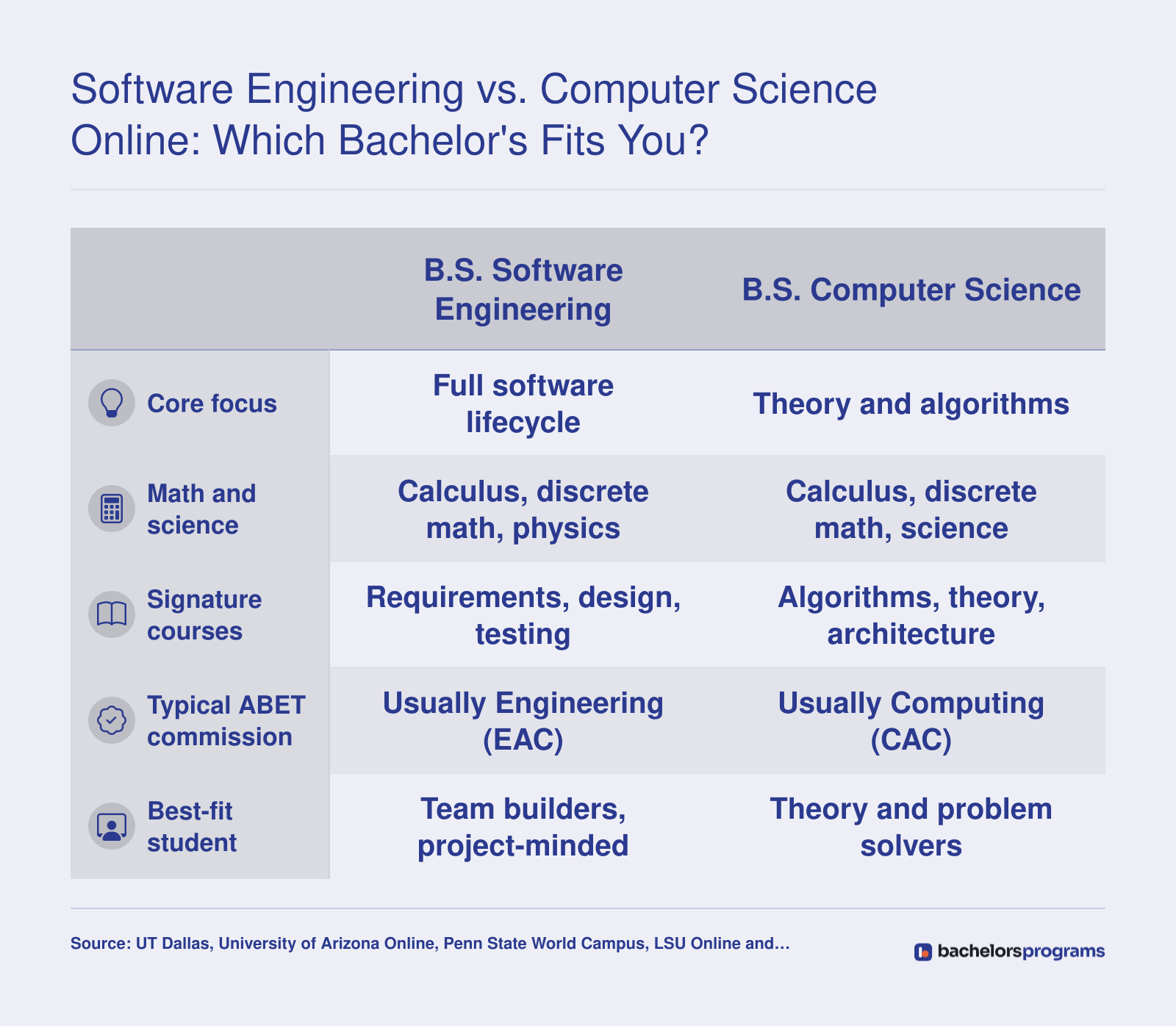
Software Engineering vs. Computer Science Online: Which Bachelor's Fits You?
Both degrees share a math and programming core, but a B.S. in Software Engineering adds the full build lifecycle (requirements, design, testing, assurance, DevOps and project management), while a B.S. in Computer Science leans harder on theory, algorithms and computer architecture. Career changers without a strong math background are not shut out: Johnson & Wales lists MATH 1030 Precalculus ahead of discrete math and physics, UT Dallas starts beginners with ECS 1100, ECS 1210 and CS 1436, and LSU Online offers a bridge pathway through LSUE or CLTCC that requires 12 college-level credits with a C or better and a 2.0 GPA. Check entry rules closely, because Penn State World Campus asks direct-transfer applicants with fewer than 45 transferable credits for a 2.7 GPA plus 8 calculus, 4 calculus-based physics and 4 chemistry lab credits, and calculus depth varies from school to school.
Questions to Ask Yourself
Do you want to design and maintain large software systems, or study algorithms and theory?
Are you comfortable taking calculus and discrete math early in the program?
Is a PE license or a federal engineering job on your radar?
If you are switching careers, would a portfolio and capstone matter more than theory?
Checklist: How to Choose a 100% Online Software Engineering Program
Use this checklist to confirm that a program fits your schedule, location and career goals.
- Truly 100% onlineCheck for hidden requirements such as on-campus residencies, in-person labs or a capstone presented on site.
- Class formatSynchronous courses meet live at set times. Asynchronous courses let you work on your own schedule. Pick the format that fits your work and family commitments.
- Proctoring methodFind out whether exams use remote webcam proctoring or require a visit to an approved testing center.
- State authorizationConfirm that the school is authorized to enroll residents of your state before you apply.
- Math prerequisites and placementSoftware engineering coursework leans on calculus and discrete math. Ask how placement works and whether you need refresher courses first.
- Transfer-credit capsAsk how many credits the school accepts and whether your prior coursework counts toward major requirements.
- ABET statusIf professional licensure or employer requirements matter to you, verify that the program holds ABET accreditation.
- Internship and career servicesAsk whether online students get help with internship placement, résumé reviews and employer connections.
- Next stepRequest program information from two or three schools and compare their answers on each point above.
Software Engineering programs by state
Online Software Engineering Degree FAQs
Is there a free online software engineering degree?
What is the cheapest software engineering degree online?
Can you get a software engineering degree online?
Can I use federal financial aid for an online software engineering degree?
Compare Software Engineering programs on the data that matters
Explore more Science & Engineering majors or browse every field of study.
All Science & Engineering programs Browse every field of study