Best Computer Science Schools in Virginia
Compare 53 accredited Computer Science programs in Virginia at 31 colleges, with net price after aid, graduation rates, earnings and debt from IPEDS and the U.S. College Scorecard.

Which Virginia school offers the best bachelor's degree in computer science for the money? The answer varies more than most students expect. Schools award the degree as a Bachelor of Science (B.S.) or a Bachelor of Arts (B.A.) in Computer Science, and Virginia colleges offer both campus and online options.
Five years after graduating, William & Mary computer science alumni report median earnings of $145,337, while state-supported Virginia schools average $15,356 in in-state tuition and fees for 2026-27. That gap between price and payoff, plus ABET accreditation and each school's rules for entering the major, separates these programs more than name recognition does.
Key Points
- William & Mary CS graduates report $145,337 median earnings five years out.
- UVA Wise posts the lowest average net price after aid, $9,210.
- Virginia public colleges average $15,356 in-state tuition and fees for 2026-27.
The 10 Best Computer Science Bachelor's Programs in Virginia
Virginia's computer science bachelor's programs range from a small military college with a required cyber track to a 120-credit engineering degree beside the Washington, D.C. job market. Each entry below names the credential the school actually awards, the concentration choices inside it, and the requirements that shape four years of study. Prices, delivery formats, and program links sit with each listing.
William & Mary
#1Williamsburg, VA · $15,000 – $20,000/yr (est.)
Best for: Cybersecurity and AI concentration seekers
William & Mary is a public research university in Williamsburg where computer science has its own School of Computing and admission is highly selective. Undergraduates earn a B.S. in Computer Science with a choice of general, artificial intelligence and machine learning, or cybersecurity concentrations, and the major builds on calculus and linear algebra. The department requires at least half of the major coursework to be taken in Williamsburg, which keeps the upper-level experience tied closely to its own faculty.
- 36-37 credit major, 48-51 credits with required mathematics
- Tracks: general, AI and machine learning, cybersecurity
- Core covers data structures, algorithms, computer organization, automata theory
- Calculus I and II plus linear algebra required
- At least half of major courses must be taken at William & Mary
- At most two 300- or 400-level courses taken elsewhere count toward the major
Washington and Lee University
#2Lexington, VA · ~$24,000/yr (est.)
Best for: Students combining CS with another major
Washington and Lee University is a private liberal arts university in Lexington that awards both a Bachelor of Arts and a Bachelor of Science in Computer Science. Classes are small, faculty supervise individual and team research that often becomes an honors thesis, and students can pair the major with a second field. Summer internships at government laboratories and companies give students a way to test career paths before graduation.
- Both a Bachelor of Arts and a Bachelor of Science are offered
- Small classes with close faculty relationships
- Honors thesis option built on individual or team research
- Summer internships at government labs and companies
- Major can be combined with a second field
- Coursework spans algorithm design, systems, and computing ethics
George Mason University
#3Fairfax, VA · $15,000 – $20,000/yr (est.)
Best for: Students aiming at D.C. area tech employers
George Mason University is a large public research university in Fairfax, positioned next to the Washington, D.C. technology and federal contracting market. Its B.S. in Computer Science is a 120-credit, ABET-accredited degree with a 32-credit core and senior electives that reach into artificial intelligence, deep learning, graphics, and robotics. A separate B.S. in Applied Computer Science adds five concentration options for students who want a more applied path, and an honors program plus an industry-sponsored senior design project give strong students room to go further.
- ABET-accredited 120-credit Bachelor of Science
- 32-credit CS core from introductory programming through database concepts
- 12 credits of senior electives including AI, deep learning, graphics, robotics
- 17 credits of mathematics, 3 of statistics, 12 of natural science
- Change-of-major applicants need a 2.75 GPA in CS and math courses
- CS Honors Program adds a research project and requires a 3.50 GPA
- Industry-sponsored senior design project
- Bachelor of Science in Applied Computer Science
- Five concentration options, including bioinformatics and software engineering
- Highlights include security clearance preparation for federal work
Virginia Military Institute
#4Lexington, VA · $21,000 – $53,000/yr (est.)
Virginia Military Institute is a public senior military college in Lexington where every cadet takes ROTC training alongside a full technical curriculum. The computer science B.S. runs 137 semester hours and finishes with a capstone, with tracks in cybersecurity and information technology. Upper-level electives in computer forensics, network security, and mobile computing let cadets shape the degree toward government and defense technology work.
- 137 semester hours, culminating in a senior capstone
- 2.00 GPA required in major courses
- Tracks: cybersecurity and information technology
- ROTC training required every semester
- Electives include computer forensics, advanced network security, mobile computing
- Recommended minors in business, psychology, applied mathematics, computer engineering
Christopher Newport University
#5Newport News, VA · $17,000 – $31,000/yr (est.)
Christopher Newport University is a public liberal arts university in Newport News with a computer science department inside its School of Engineering and Computing. The B.S. in Computer Science covers programming languages, data structures, algorithms, operating systems, and software engineering, then adds electives in artificial intelligence, robotics, cybersecurity, and databases. A required capstone pulls the work together, and the surrounding calculus, physics, and discrete structures requirements keep the degree technically grounded.
- Capstone project required
- Covers programming languages, data structures, algorithms, operating systems
- Electives in artificial intelligence, robotics, cybersecurity, database systems
- Requires calculus, physics, and discrete structures
- Housed in the School of Engineering and Computing
Virginia Commonwealth University
#6Richmond, VA · ~$23,000/yr (est.)
Virginia Commonwealth University is a large public research university in Richmond whose computer science B.S. sits in the College of Engineering. The 120-credit degree runs from algorithm analysis and operating systems through electives in artificial intelligence, machine learning, cloud computing, and natural language processing. Students choose a concentration in cybersecurity, data science, or software engineering, and the program leans on Richmond-area industry connections and a dedicated career services office.
- 120-credit Bachelor of Science in the College of Engineering
- Tracks: cybersecurity, data science
- Electives include AI, machine learning, cloud computing, natural language processing
- Core includes algorithm analysis, operating systems, data communication
- ABET accredited
- First-year priority deadline Jan. 15; transfer priority March 17
- Software engineering concentration inside the computer science bachelor's
- First-year priority deadline Jan. 15 with rolling review afterward
- University scholarship deadline Nov. 1
University of Virginia's College at Wise
#7Wise, VA · $12,000 – $28,000/yr (est.)
The University of Virginia's College at Wise is a small public college in southwest Virginia, and its computer science B.S. is accredited by the Computing Accreditation Commission of ABET. A cybersecurity concentration is open to computer science, management information systems, and software engineering majors. The Wise Works program shares intern wages with employers, and students have interned at Northrop Grumman, CGI, Booz Allen, and the Virginia Department of Energy.
- ABET Computing Accreditation Commission accredited
- Cybersecurity concentration available
- Wise Works shares intern wages with employers
- Interns placed at Northrop Grumman, CGI, Booz Allen, and state agencies
- Lovelace Society for computer science students
Longwood University
#8Farmville, VA · ~$19,000/yr (est.)
Longwood University is a public university in Farmville that awards either a Bachelor of Arts or a Bachelor of Science in Computer Science. The 120-credit degree carries a 44-credit major: 30 credits of computer science foundations, a mathematics foundation, and 12 credits of upper-level electives, capped by a senior capstone. Students must show proficiency in more than one programming language, and the Civitae Core adds roughly 40 credits of general education.
- 120 total credits, 44 in the major
- 30 credits of CS foundations plus 12 credits of upper-level electives
- Senior capstone (CMSC 461) required
- C-minus or better required in CMSC courses counted toward the major
- Proficiency in more than one programming language required
- Civitae Core adds 39 to 40 credits
Eastern Mennonite University
#9Harrisonburg, VA · $25,000/yr (est. net price)
Eastern Mennonite University is a private university in Harrisonburg with a computer science major built around a custom plan of study. The 48-semester-hour major splits evenly across foundations, mathematics and engineering, software and systems development, and electives drawn from computer science and computer engineering, following ACM curriculum guidelines. A capstone is required, and the university reports that financial aid reaches nearly all undergraduates with an average package above $37,000.
- 48 semester hours in the major
- 12 credits each in foundations, math and engineering, software and systems
- Capstone required, may be completed through the engineering capstone
- Curriculum follows ACM 2013 guidelines
- Custom plan of study built with a faculty advisor
- Average financial aid package above $37,000
Roanoke College
#10Salem, VA · ~$25,000/yr (est.)
Roanoke College is a private liberal arts college in Salem that offers computer science as a major and a minor. The program emphasizes hands-on work: research with faculty, internships with area businesses, independent study, and part-time IT jobs on campus. Labs include virtual reality equipment and a heterogeneous computing cluster, and an Intensive Learning Term gives students a short, focused block for projects.
- Major and minor offered on campus
- Research with faculty, internships, and independent study
- Labs include virtual reality equipment and a heterogeneous computing cluster
- Part-time IT work available to students
- Intensive Learning Term for focused projects
Cost & outcomes by school
Federal data for the highest-earning Computer Science programs, independent of the ranking above. Earnings are this field's bachelor's graduates four years after completing where the Scorecard reports them, else the school's undergraduate median.
| School | Net price / yr | Grad rate | Earnings | Debt | Grads/yr | Format |
|---|---|---|---|---|---|---|
| William & Mary VA | $19,096 | 89% | $127,851 | $19,794 | 151 | Campus |
| Christopher Newport University VA | $23,015 | 72% | $101,900 | $21,750 | 71 | Campus |
| Washington and Lee University VA | $23,781 | 94% | $94,810 | $19,500 | 28 | Campus |
| Virginia Military Institute VA | $17,113 | 76% | $94,397 | $26,000 | 23 | Campus |
| Longwood University VA | $19,066 | 61% | $91,313 | $25,000 | 18 | Campus |
| Radford University VA | $14,578 | 49% | $87,740 | $24,636 | 28 | Campus |
| University of Virginia VA | $21,565 | 96% | $86,863 | $17,500 | — | Campus |
| Virginia Polytechnic Institute and State University VA | $24,953 | 86% | $81,698 | $21,500 | — | Campus |
| Bridgewater College VA | $17,800 | 53% | $81,050 | $26,000 | 12 | Campus |
| George Mason University VA | $17,915 | 68% | $76,343 | $19,500 | 25 | Campus |
| James Madison University VA | $23,322 | 80% | $69,954 | $20,093 | — | Campus |
| University of Management and Technology VA | — | 33% | $68,530 | — | 2 | Online |
Sources: U.S. Department of Education. Net price, graduation rate, earnings and debt: College Scorecard (earnings and debt for this field's bachelor's graduates where reported, else school-wide); graduates: IPEDS. A dash means no figure is reported.
Cost, debt & payoff
Median earnings of this field's bachelor's graduates (4 yrs after completing, else the school's undergraduate median) vs. their median federal loan debt · U.S. College Scorecard
Across these programs the median graduate earns about $58,448 and finishes with roughly $24,517 in debt — a ratio that clears a common rule of thumb (keep debt below first-year salary). Net price and debt vary widely school to school, so check the per-school figures in the table above before you shortlist.
ABET-Accredited Computer Science Bachelor's Programs in Virginia
Why CAC Accreditation Matters
ABET's Computing Accreditation Commission (CAC) accredits computing programs at three levels: associate, bachelor's, and master's.1 For a bachelor's degree in computer science, that review signals that the curriculum, faculty, and student outcomes meet a national standard many employers recognize. Some federal agencies and defense contractors treat an ABET-accredited degree as a preferred or qualifying credential. Some graduate programs also read it as evidence of a rigorous undergraduate foundation.
ABET accredits programs, not whole institutions.1 A university with accredited engineering degrees does not automatically have an accredited computer science degree, and two computing majors at the same school can hold different statuses.
Accreditation Status at Virginia Schools
ABET's public search results did not show a verified program name, degree, or current 2026 status for any Virginia bachelor's in computer science. Rather than guess, treat the accreditation status of every school ranked here as unconfirmed until you check it yourself.
That caution matters most where a school offers more than one computing degree:
- George Mason University: Offers both a B.S. in Computer Science and a B.S. in Applied Computer Science. Confirm each one separately.
- Averett University: Offers a B.S. in Computer Science and a B.S. in Computer Information Systems. These are distinct programs with potentially different reviews.
- Large public programs: The University of Virginia, Virginia Tech, Virginia Commonwealth University, Old Dominion University, and James Madison University are worth checking first if accreditation is a priority, but confirm current status rather than assume it.
Takeaway If You Need ABET Accreditation
If a target employer, a federal job posting, or a graduate program requires an ABET-accredited degree, verify before you apply. Search the school by name on ABET's accredited program directory and confirm three details: the exact degree title, the Computing Accreditation Commission as the accrediting body, and accreditation dates that cover your expected graduation year. Then ask the department to confirm in writing. If accreditation is optional for your goals, weigh it alongside cost, outcomes, and course offerings rather than letting it decide your list on its own.
Online and Hybrid Computer Science Bachelor's Options at Virginia Schools
Most of the top-ranked Virginia programs are campus-based. William & Mary, Washington and Lee, George Mason, VMI, Christopher Newport, Virginia Commonwealth, UVA Wise, Longwood, Eastern Mennonite and Roanoke all list on-campus programs. A fully online bachelor's in computer science from one of those schools is unlikely to exist. VCU's program page does not describe an online or hybrid route3, and the same is true of the University of Virginia's B.S. and B.A. pages.
Schools That List Online Delivery
Two Virginia schools in our directory list an online option for the Bachelor of Science in Computer Science.
- Regent University: The program page lists both "On Campus" and "Online" delivery for a degree of 120 or more credits.1 It does not make clear whether the online version is fully remote or has any campus requirement, so confirm that with admissions.
- Old Dominion University: The page lists "Online" and "On-Campus" delivery and says courses are offered live and online.2 That points to a flexible, hybrid-style model. It does not state a universal campus attendance rule for online students.
Virginia State University lists a 120-credit B.S., but the pages we reviewed do not say how it is delivered.
What to Ask Before You Enroll
The research does not establish pace, cohort structure or term length for these online options, so ask each school directly. Useful questions include:
- Are classes live at set times or self-paced?
- Do you move through a fixed cohort or choose your own course load?
- Are labs, exams or capstone work ever done in person?
- Is the online program ABET accredited, or only the campus version?
The research also does not confirm whether online tuition differs from on-campus rates at either school. Check each school's bursar page for the current per-credit rate and any technology fees before comparing costs.
Admissions: GPA, Test Policies, and Transfer Credit for Virginia CS Programs
Admission to a Virginia computer science program depends on each school's own rules, not on any statewide standard, and those rules often tighten once you move from university admission to the CS major itself.
How Selective Are These Schools?
Admission rates vary widely across the programs below:
- Most selective: Washington and Lee University admits about 14% of applicants, University of Virginia's College at Wise about 29%, and William & Mary about 34%.
- Moderately selective: Virginia Military Institute admits about 71%.
- Broad access: Roanoke College (about 83%), Christopher Newport University (86%), George Mason University (87%), Longwood University (90%), and Virginia Commonwealth University (93%) admit most applicants. Eastern Mennonite University reports a 100% admission rate.
A high admission rate does not mean an easy path through the major. The program-level GPA and grade rules below are what keep you enrolled in CS.
GPA and Testing Policies
Our research did not confirm typical first-year GPA ranges for the schools ranked here. Treat secondhand figures with caution and check each school's admissions page for the current cycle. Testing policies also change from year to year, so confirm whether SAT or ACT scores are optional before you apply.
VCU's transfer rules are clearer. It reviews transfer applicants on a test-optional basis and treats a 2.5 cumulative GPA as the competitive mark. Applicants with 24 or more semester credits generally do not need to submit high school transcripts or test scores unless the program requires them.
Several programs set their own academic standards for the major:
- George Mason University: The CS program lists a 2.8 GPA minimum and accepts an AP Computer Science score of 4.
- Virginia Military Institute: The program lists a 2.0 GPA minimum.
- Longwood University: Students need a C- or better in their computer science courses.
- VCU: Guidance for transfers into its engineering school points to Calculus I and one lab science. It describes a 2.7 GPA as the recommended floor and a 3.0 with strong math and science grades as more competitive.
Virginia's public community colleges hold guaranteed-admission agreements with several four-year schools. The details matter.
- Virginia Tech: Transfer admission is major-specific. Its CS pathway summary calls for a 3.2 cumulative GPA, calculated under the community college system's rules (repeated courses included), plus a C or higher in every required roadmap course.
- University of Virginia: Applicants need at least 24 transferable semester hours and must be a full year past high school by enrollment. AP and dual-enrollment credits do not count toward the 24 hours. SAT and ACT scores are not required for transfer. UVA's guarantee places you in a school, not a specific major, and you must finish an approved transferable associate degree by the spring before fall enrollment.
Before you commit to a two-year plan, match your associate degree coursework to the CS prerequisites at your target school.
Related Articles
What a Bachelor's Degree in Computer Science Costs in Virginia
Virginia's state-supported colleges and universities charge an average of $15,356 in in-state tuition and mandatory fees for 2026-27, according to SCHEV.1 That is up $510, or 3.4%, from the prior year.1 Individual schools vary widely around that average, and the gap between in-state and out-of-state pricing is large.
In-State and Out-of-State Sticker Prices
Annual undergraduate tuition and fees vary widely across these schools (in-state first, out-of-state second):
- University of Virginia's College at Wise: $11,780 and $28,010.
- George Mason University: $14,220 and $38,688.
- Longwood University: $15,744 and $27,978.
- Virginia Military Institute: $21,046 and $52,638.
- William & Mary: $25,914 and $51,038.
The average net price after grants and scholarships runs lower for many students. It is about $9,210 at UVA Wise, $17,113 at VMI, $17,915 at George Mason, $19,066 at Longwood and $19,096 at William & Mary. Treat these as sector-average estimates. Your own net price depends on family income, aid eligibility and enrollment, so it will not match these estimates exactly.
Virginia State Aid Programs
Three SCHEV-administered programs matter most for undergraduates. Amounts depend on funding and on each school's calculations, so confirm what your school offers.
- Virginia Guaranteed Assistance Program (VGAP): For full-time students with financial need who graduated from a Virginia high school or qualifying home-school program with at least a 2.5 GPA. Home-school completers need an SAT score of at least 980 or an ACT of at least 19.2 Awards cover up to tuition, required fees and a book allowance, for one year per class level. There is no separate application.
- Commonwealth Award: Need-based aid for students enrolled at least half-time in an approved program at a Virginia public college. Awards are proportional to need and cannot exceed tuition and required fees.3
- Virginia Tuition Assistance Grant (VTAG): For full-time Virginia undergraduates at eligible institutions. The 2026-27 maximum is $5,250 a year ($2,625 per semester) for students not in distance learning.4 New distance-learning students max out at $2,625 a year, and a $250-per-semester teacher bonus may apply.
All three require Virginia student status, which can come through domicile, eligible military-dependent status or Tuition Equity.
Out-of-State Students and Next Steps
In-state rates generally require Virginia domicile, so most out-of-state students pay the higher figures above. We have not confirmed a statewide reciprocity program, but individual schools may offer merit scholarships or tuition discounts for nonresidents. Check each school's financial aid page.
Start with the FAFSA (or the Virginia Student Aid Application, VASA, if it applies to you) before each school's priority deadline. Then review the scholarship pages at the schools you are considering, since institutional awards often change the final price more than state aid does.
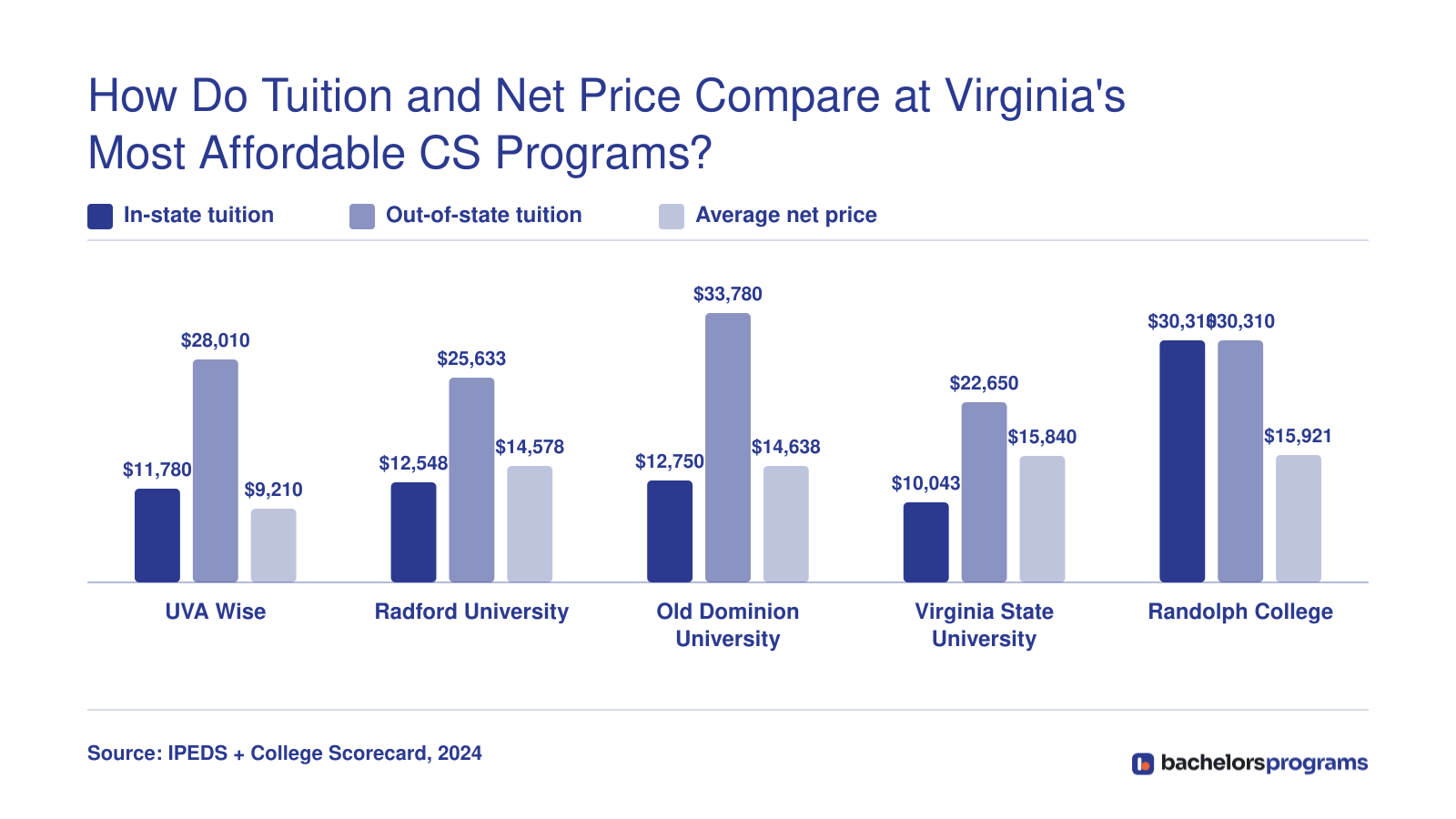
How Do Tuition and Net Price Compare at Virginia's Most Affordable CS Programs?
University of Virginia's College at Wise posts the lowest average net price after aid, $9,210, while Virginia State University has the lowest in-state tuition at $10,043. Randolph College, a private school, charges $30,310 to every student regardless of residency, yet its average net price drops to $15,921 after aid. Net price figures are institution-wide averages for all undergraduates, not computer science students specifically, so treat them as approximate and confirm your own aid package with each school.
Questions to Ask Yourself
Does your in-state status make a public Virginia school the stronger value than a pricier private one?
How much student debt can you carry against the first-job salary this program's graduates actually earn?
Would a co-op, internship, or scholarship offset change the math more than the published tuition does?
Careers and Salaries for Virginia Computer Science Bachelor's Graduates
Five years after completing the bachelor's degree, William & Mary computer science graduates report median earnings of $145,337, the strongest program-level figure among the schools ranked here. George Mason University's computer science graduates follow at $116,307 five years out, and Christopher Newport University graduates reach $94,012 in the same window.
What the earnings windows show
Earnings climb sharply in the first few years on the job, so the window matters as much as the number:
- William & Mary: $84,956 one year after completion, $127,851 at four years, $145,337 at five years.
- George Mason University: $84,632 one year after completion, rising to $116,307 at five years.
- Christopher Newport University: $72,128 one year out, $101,900 at four years, $94,012 at five years.
- Virginia Military Institute: $58,225 one year after completion and $94,397 four years out.
- Radford University, in our directory, reports $66,857 one year out and $95,921 at five years.
Treat these as program results for computer science specifically, not as a school-wide average. Where you see a single earnings figure attached to an entire university, it covers every major and is usually measured from the point a student first enrolled, which is a different question altogether.
Employment and debt after graduation
Employment outcomes are the quieter half of the story, and they are strong. Every George Mason computer science graduate tracked one year after completion was working, and the share employed at one year reaches 96 percent at William & Mary, 97 percent at Christopher Newport, and 89 percent at VMI. Radford reports 94 percent.
Borrowing stays modest relative to those salaries. Median debt among computer science completers runs $19,794 at William & Mary, $21,750 at Christopher Newport, $26,000 at VMI, and $24,636 at Radford. Against first-year earnings in the $58,000 to $85,000 range, that is a manageable ratio for most graduates.
No license required, so skills carry the weight
Virginia does not license computer scientists or software developers. There is no exam to sit and no state board to register with, which means employers judge you on what you can demonstrate: internship history, project portfolio, security clearance eligibility (a real advantage in Northern Virginia and Hampton Roads), and the credibility of an ABET-accredited program. Build the resume while you are enrolled, not after.
Top Early-Career Earnings Among Virginia CS Programs
William & Mary posts the strongest early-career pay in our earnings data for Virginia computer science graduates.
Compare Computer Science programs on the data that matters
Explore more Computers & IT majors or browse every field of study.
All Computers & IT programs Browse every field of study