Best Information Technology Schools in New York
Compare 35 accredited Information Technology programs in New York at 31 colleges, with net price after aid, graduation rates, earnings and debt from IPEDS and the U.S. College Scorecard.

A bachelor's degree in information technology trains students to build, secure and run the networks, databases and systems that organizations depend on. The standard New York title is the Bachelor of Science (B.S.) in Information Technology, though schools also label the degree informatics, information systems or computer information technology.
The spread is wide. Annual net price runs from roughly $14,500 at Monroe University to about $38,800 at Syracuse University, and median earnings for graduates range from the low $40,000s to well above $100,000. Programs at New York-based schools range from SUNY campuses to private universities in the city, delivered on campus or online.
Sticker price and pay rarely line up, so the cheapest program is not automatically the best value.
Key Points
- CUNY Lehman College posts the lowest average net price: $3,148 yearly.
- University at Albany's 120-credit B.S. in Informatics runs fully online.
- Two state aid programs can cover most public tuition for eligible residents.
Best Bachelor's Degree in Information Technology Schools in New York, Ranked
New York's strongest information technology bachelor's programs sit in very different settings: a management school in Buffalo, an informatics department in Albany, a private polytechnic in Troy, and career-focused colleges across New York City. Each entry below covers what the degree teaches, who it is built for, and the details that separate one program from the next.
University at Buffalo
#1Buffalo, NY · $20,000 – $25,000/yr (est.)
Best for: Business-minded IT students wanting management training
A flagship SUNY campus where the IT major sits inside the School of Management rather than a standalone computing department. Students leave with a technical foundation plus a business vocabulary, which suits roles that sit between systems teams and operations. The program is STEM designated, and staying in the major depends on meeting GPA thresholds rather than a single admissions decision.
- Housed in the School of Management, blending IT and business coursework
- Described as the only SUNY tech-business undergraduate program
- STEM designation adds 24 months of optional practical training
- Continuation requires a 3.000 major GPA and 2.750 overall GPA
- Minimum B grades required in MGS 101 and MGS 102
- Major admission begins in a fall semester
University at Albany
#2Albany, NY · ~$17,000/yr (est.)
Best for: Adults returning to school fully online
The informatics department in Albany runs one of the state's more flexible IT paths, with nine concentrations and an IT track that can be completed entirely online. Coursework covers networking, security and interactive design, and there is an accelerated route into a related master's degree. It suits students who want to start in one specialization and shift later without changing schools.
- Information Technology is one of nine concentrations
- The IT concentration can be completed entirely online
- Full-time students finish in four years; part-time enrollment available
- Courses include Programming for IT and Network Administration
- Combined bachelor's and master's option counts 12 credits toward both
- Honors track requires a thesis proposal seminar and thesis project
Touro University
#3New York, NY · $30,000/yr (est. net price)
Best for: Military-connected students using GI Bill benefits
A private university with campuses in Manhattan, Brooklyn and Queens, teaching IT through its New York School of Career and Applied Studies. The school is unusually direct about military and government tuition assistance, and students who reach the full award level can have tuition covered inside Post-9/11 GI Bill benefits. The bachelor's runs alongside associate programs in the same field, so students can enter at either level.
- Awarded through the New York School of Career and Applied Studies
- Campuses in Manhattan, Brooklyn and Queens
- Accepts government tuition assistance and Post-9/11 GI Bill benefits
- Full award level can mean tuition covered by the GI Bill
- Also grants associate degrees in information technology
- Financial aid available for students who qualify
New York University
#4New York, NY · ~$37,000/yr (est.)
New York University's School of Professional Studies awards the BS in Information Systems and Technology, and the fully online completion option makes it one of the few nationally known names on this list open to distance students. The curriculum is applied rather than theoretical, covering database design, systems analysis and project management with electives in cybersecurity, cloud computing and health informatics. Admission uses holistic review, with a high school diploma or GED as the stated baseline.
- 120 credits, with a fully online completion option
- Core covers database design, systems analysis and project management
- Electives include cybersecurity, cloud computing and UX design
- STEM OPT designation extends work authorization for F-1 students
- Holistic review; high school diploma or GED required
- Choose a thesis, capstone, internship or SPS Real World experience
Syracuse University
#5Syracuse, NY · $35,000 – $40,000/yr (est.)
Syracuse's School of Information Studies is a dedicated information school rather than a computer science department, and the IT degree reflects that with concentrations in security management, network and cloud computing and project management. Students complete an international experience requirement and can work in the student-run NEXIS lab. The school reports a 91% placement rate for its 2025 graduates.
- 120 credits, with 30 to 31 in the major
- Seven concentrations, including Information Security Management
- International experience requirement built into the degree
- Student-run NEXIS lab explores emerging technologies
- Internships have included Microsoft, Amazon, Disney and KPMG
- Average starting salary of $73,329 reported for the 2025 class
St. Joseph's University-New York
#6Brooklyn, NY · ~$19,000/yr (est.)
A small private university in Brooklyn where the IT major emphasizes programming, databases and desktop support alongside a liberal arts core. Evening sections make the degree workable for students who are already employed, and the school points to internships at Microsoft, Google and NASA. It is the kind of program that trades national name recognition for access and scheduling flexibility.
- Taught on the Brooklyn campus, with evening sections available
- Coursework in programming, database management and desktop support
- Pairs with minors in business administration, marketing or mathematics
- Students have interned at Microsoft, Google and NASA
- Graduates work as software developers, database administrators and network architects
Rensselaer Polytechnic Institute
#7Troy, NY · ~$36,000/yr (est.)
Rensselaer pairs a rigorous technical core with an unusually broad set of focus tracks, so students can aim the IT degree at data science, security, networking or even pre-law. The credit load is heavy and The Arch summer semester is built into year three. It suits students who want an engineering-adjacent workload and are prepared for a larger financial investment.
- 128 to 130 credit hours across core, focus track and electives
- More than 20 focus tracks, including data science and information security
- Students can design their own focus track with a faculty advisor
- Professional track ends in a capstone; research track adds a thesis
- Core courses include Web Systems Development and Managing IT Resources
- The Arch summer semester is built into the third year
St. John's University-New York
#8Queens, NY · ~$30,000/yr (est.)
St. John's runs its IT degree through the Collins College of Professional Studies at the Queens campus, with day and evening sections that accommodate working students. The major carries a capstone plus coursework in networking, information assurance and system administration. The campus ACM chapter runs industry nights and coding competitions, and students can apply to a free, virtual Cornell-run AI program.
- 120 credits, with 39 in the major area
- Capstone plus coursework in networking, database systems and information assurance
- Instructional labs housed in St. Augustine Hall
- ACM chapter runs industry nights and national coding competitions
- Free virtual one-year Break Through Tech AI program from Cornell
- Honor society available within Collins College
Monroe University
#9Bronx, NY · $15,000/yr (est. net price)
A Bronx institution with a long-running technology school, offering a BS in Computer Information Systems and an associate option in the same field. Upper-level courses reach into wireless communication, VR networks and cryptography, and faculty include sitting chief information officers and security analysts. Graduates have landed at Google, Salesforce, Accenture and Infosys, and scheduling is built around students who work.
- Upper-level coursework in wireless communication, VR networks and cryptography
- Faculty include chief information officers and network and security analysts
- Also offers an associate degree in the same field
- Graduates have been hired at Google, Salesforce, Accenture and Infosys
- Internships at tech firms, financial institutions and government agencies
State University of New York at Plattsburgh
#10Plattsburgh, NY · $17,000/yr (est. net price)
SUNY Plattsburgh offers a compact IT major, 52 credits for the BS or 40 for the BA, which makes it realistic to pair with a second field without extending time to graduation. The capstone runs across two Software Engineering courses, and internships happen on campus at the Helpdesk or off campus at firms such as Google and IBM. It is also one of the lower-cost four-year routes on this list.
- BS requires 52 credits in the major; the BA requires 40
- 33 general education credits required on top of the major
- Capstone spans Software Engineering I and II
- Internships on campus at the Helpdesk or off campus at Google and IBM
- Tracks in system, network, web and GUI programming
- STEM OPT eligible, with a 24-month extension for F-1 students
- Major can be added as a second field of study
Cost & outcomes by school
Federal data for the highest-earning Information Technology programs, independent of the ranking above. Earnings are this field's bachelor's graduates four years after completing where the Scorecard reports them, else the school's undergraduate median.
| School | Net price / yr | Grad rate | Earnings | Debt | Grads/yr | Format |
|---|---|---|---|---|---|---|
| New York University NY | $37,050 | 88% | $142,495 | $19,500 | 698 | Online |
| Syracuse University NY | $38,793 | 84% | $120,773 | $27,000 | 91 | Campus |
| Rensselaer Polytechnic Institute NY | $36,228 | 84% | $115,100 | $27,000 | 26 | Campus |
| Marist University NY | $41,544 | 80% | $102,640 | $27,000 | 16 | Campus |
| Rochester Institute of Technology NY | $34,906 | 70% | $100,367 | $27,000 | 102 | Campus |
| Fordham University NY | $44,338 | 82% | $97,265 | $26,424 | 95 | Campus |
| New York Institute of Technology NY | $22,443 | 59% | $83,710 | $23,000 | 128 | Campus |
| University at Albany NY | $17,167 | 62% | $80,285 | $20,000 | 144 | Online or campus |
| St. John's University-New York NY | $29,999 | 66% | $79,960 | $26,000 | 77 | Campus |
| Excelsior University NY | — | — | $78,493 | $13,769 | 16 | Online |
| State University of New York at Plattsburgh NY | $17,156 | 59% | $73,383 | $18,250 | 9 | Campus |
| University at Buffalo NY | $20,995 | 75% | $70,814 | $19,000 | — | Campus |
Sources: U.S. Department of Education. Net price, graduation rate, earnings and debt: College Scorecard (earnings and debt for this field's bachelor's graduates where reported, else school-wide); graduates: IPEDS. A dash means no figure is reported.
Cost, debt & payoff
Median earnings of this field's bachelor's graduates (4 yrs after completing, else the school's undergraduate median) vs. their median federal loan debt · U.S. College Scorecard
Across these programs the median graduate earns about $58,013 and finishes with roughly $20,000 in debt — a ratio that clears a common rule of thumb (keep debt below first-year salary). Net price and debt vary widely school to school, so check the per-school figures in the table above before you shortlist.
How We Ranked New York Bachelor's in IT Programs
A strong IT program shows up in the numbers: what graduates earn, what the degree costs and how many students actually finish. This ranking is built on federal data, not reputation or marketing claims.
Where the Data Comes From
- College Scorecard: earnings for graduates of each school's information technology program, plus institution-wide graduation rates.
- IPEDS tuition data: published in-state and out-of-state tuition reported by each school to the U.S. Department of Education.
- Cost and completions: total cost figures and the number of bachelor's degrees each school awards in the field, which signals whether a program is established or small.
IT vs. Computer Science vs. Information Systems
These majors overlap, but they train for different work. Information technology focuses on keeping technology running: networks, systems administration, cybersecurity and user support. Computer science leans toward theory, algorithms and software engineering. Information systems sits closer to business, teaching how organizations select and manage the systems behind their operations. Program titles in New York reflect that mix, the B.S. in Information Technology, the Bachelor of Technology, degrees labeled informatics or information management, so read the curriculum, not just the name.
Scope and Limits
Every program listed is a bachelor's degree from a school based in New York, offered on campus, online or in a hybrid format. Two figures deserve caution. Neither the graduation rate nor the average net price belongs to the IT department; both describe the whole institution. Net price is also an estimate built from averages for the school's sector, so your actual cost after aid may differ. Run each school's net price calculator before comparing final offers.
Cheapest Bachelor's Degree in Information Technology Programs in New York
Public CUNY and SUNY campuses dominate the low end of the cost scale: CUNY Lehman College posts the lowest average net price in this table at $3,148 a year, and the public schools all charge in-state tuition between $7,332 and $8,892, while Monroe University, the private option shown, lists $18,464 in tuition for both in-state and out-of-state students. Net price is the average annual cost after grants and scholarships, drawn from IPEDS and College Scorecard (2024) data, so a school with low sticker tuition can still land higher once aid is factored in, as SUNY College of Technology at Alfred and Empire State University show. Your own cost will depend on your family income, residency and the aid package you receive, so run each school's net price calculator before you compare offers.
| School | City | Program | In-State Tuition | Average Net Price | Format |
|---|---|---|---|---|---|
| CUNY Lehman College | Bronx | Computer Information Systems, B.S. | $7,410 | $3,148 | Campus |
| CUNY New York City College of Technology | Brooklyn | Computer Systems | $7,332 | $5,127 | Campus and online |
| Empire State University | Saratoga Springs | Information Technology: B.S. | $7,648 | $11,676 | Online |
| Monroe University | Bronx | Computer Information Systems | $18,464 | $14,522 | Campus and online |
| SUNY College of Technology at Alfred | Alfred | Information Technology: Applications Software Development | $8,892 | $15,016 | Campus |
Questions to Ask Yourself
What will this program cost you beyond the published tuition rate?
What do entry-level IT roles pay in the metro area where you want to work?
Can prior coursework or certifications shorten your degree?
Have you confirmed the program is accredited and that aid will follow you?
Online and Hybrid Bachelor's in Information Technology Options at New York Schools
## Fully Online Routes Through SUNY Online
SUNY Online is the state system's multi-campus catalog. It lists several IT-area bachelor's degrees you can finish without visiting campus:
- **University at Albany:** The B.S. in Informatics runs 120 credits, 100% online, with no campus attendance expected and no set login time.[[CITE:1]] - **SUNY College of Technology at Canton:** The Bachelor of Technology in Computer and Information Technology is 125 credits[[CITE:2]], fully online, with no in-person requirements and no set login time.[[CITE:3]] - **Empire State University:** SUNY Online lists its B.S. in Information Science as 100% online at 124 credits.[[CITE:4]] The school also offers an Information Technology B.S.
Albany and Canton both note that live, real-time sessions can happen, but neither fixes a login time, so coursework can fit around a job. Empire State's listing does not say whether classes are fully asynchronous, so ask an advisor.
## Ranked Schools With Online Formats
Among the ranked schools, University at Albany and Monroe University offer their programs in both campus and online formats. New York University's Information Systems and Technology B.S., offered through its professional studies school, is listed as online, with 120 credits and a fully online option.
## Campus-Based Programs
University at Buffalo, Touro University, Syracuse University, St. Joseph's University-New York, Rensselaer Polytechnic Institute, St. John's University-New York and State University of New York at Plattsburgh deliver their IT bachelor's on campus. Working students still have choices: St. Joseph's offers evening scheduling in Brooklyn, and St. John's runs day and evening classes in Queens.
## Before You Enroll
Ask each school three things: whether any live sessions are mandatory, whether exams or labs require a campus visit, and whether online students pay the same tuition as campus students. Get the tuition answer in writing.
Admissions for New York Bachelor's in IT Programs: GPA, Test Policy and Transfer Credit
Transfer credit has quietly become the deciding variable in New York IT admissions, now that most applicants arrive with college coursework already on a transcript.
What the Schools Publish on GPA and Testing
NYU's School of Professional Studies, which offers the BS in Information Systems and Technology, is test-optional and publishes no general minimum GPA; its guaranteed-admission route instead asks for a 3.0 GPA in your most recent degree, a completed associate degree, or U.S. active-duty or veteran status with 60 baccalaureate credits.1 NYIT's B.S. in Information Technology is also test-optional, and its catalog excerpt lists no minimum GPA and no maximum transfer credit. Pace University states a 120-credit requirement for its IT bachelor's but does not post GPA or testing rules on the program page. St. Joseph's University-New York, Monroe University and SUNY Plattsburgh also left admissions and transfer specifics unpublished, so ask each office directly rather than assuming a campus-wide default.
How SUNY and CUNY Credit Travels
New York runs two statewide articulation frameworks: SUNY Transfer Paths, which map lower-division coursework toward a matching bachelor's, and CUNY Pathways, which guarantees that the common core carries across CUNY colleges. Both smooth the path, but neither guarantees a seat in an IT major, and none of the programs above publishes a guaranteed-admission agreement tied to them. Excelsior accepts transferred courses graded C or higher with no stated cap, inside a 120-credit degree that reserves 60 credits in arts and sciences and 30 at the upper level.2 NYU draws the line at 80 transfer credits.1
Three Habits That Save a Semester
- Get equivalencies in writing: request a course-by-course evaluation before you commit, especially for programming and database courses.
- Send transcripts early: official copies take time to process, and an incomplete file stalls review regardless of your GPA.
- Ask about the credit cap: the same transcript can land you at different points in a 120-credit degree depending on whether a school takes 80 credits or sets no ceiling.
Related Articles
Cost of an IT Bachelor's Degree in New York: Tuition, Net Price and State Aid
In New York, sticker price is only a starting point, because two state programs can erase most or all of public tuition for eligible residents.
Public Versus Private Prices
Public tuition is the lower number. For 2026-27, SUNY charges $7,070 a year and CUNY $6,930.4 Among the ranked schools, SUNY Plattsburgh lists in-state tuition of $9,035 and University at Albany $10,866. Monroe University, a private school in the Bronx, lists $18,464.
Net price, the average cost after grants and scholarships, narrows the gap. Monroe averages $14,522, below Plattsburgh at $17,156 and Albany at $17,167. In our directory, CUNY New York City College of Technology averages $5,127 and Empire State University $11,676. These averages can include costs beyond tuition, so compare them as a guide rather than a bill.
TAP: Need-Based Aid for Public and Private Schools
The Tuition Assistance Program (TAP) pays between $1,000 and $5,665 a year in 2026-27, depending on income, family size, tuition and when you first received state aid.1 Dependent undergraduates qualify with New York net taxable income of $125,000 or less. Independent single students without tax dependents face a $30,000 cap, and independent married students without tax dependents a $60,000 cap.
You must be a New York resident for 12 continuous months, study full time (12 credits a semester) at an approved college, stay in good standing, and be charged at least $200 in tuition.1
Excelsior Scholarship: Last-Dollar Tuition Help
Excelsior applies only at participating SUNY and CUNY colleges. It covers tuition left after TAP and Pell, up to $5,500 a year, for households with federal adjusted gross income of $125,000 or less.2 You must apply for TAP, though receiving it is not required. At SUNY, a maximum TAP award leaves about $1,405 of tuition, which Excelsior would cover.
The conditions matter:
- Pace: Complete 30 credits a year, including summer and winter terms, and stay on track for four years.2
- Citizenship and residency: Be a U.S. citizen or eligible noncitizen with 12 continuous months of New York residency.
- After graduation: Live in New York for as many years as you received the award, and work in the state if employed.2
Fall short and the award converts to a no-interest loan. HESC publishes the repayment terms, so read them before accepting.3
How Much Aid Cuts the Price
At a public school, TAP plus Excelsior can cover full tuition. At a private school, TAP's maximum covers less than a third of Monroe's listed tuition, so institutional scholarships carry more of the load. Net price is an average across all aided students, so your own figure could land higher or lower.
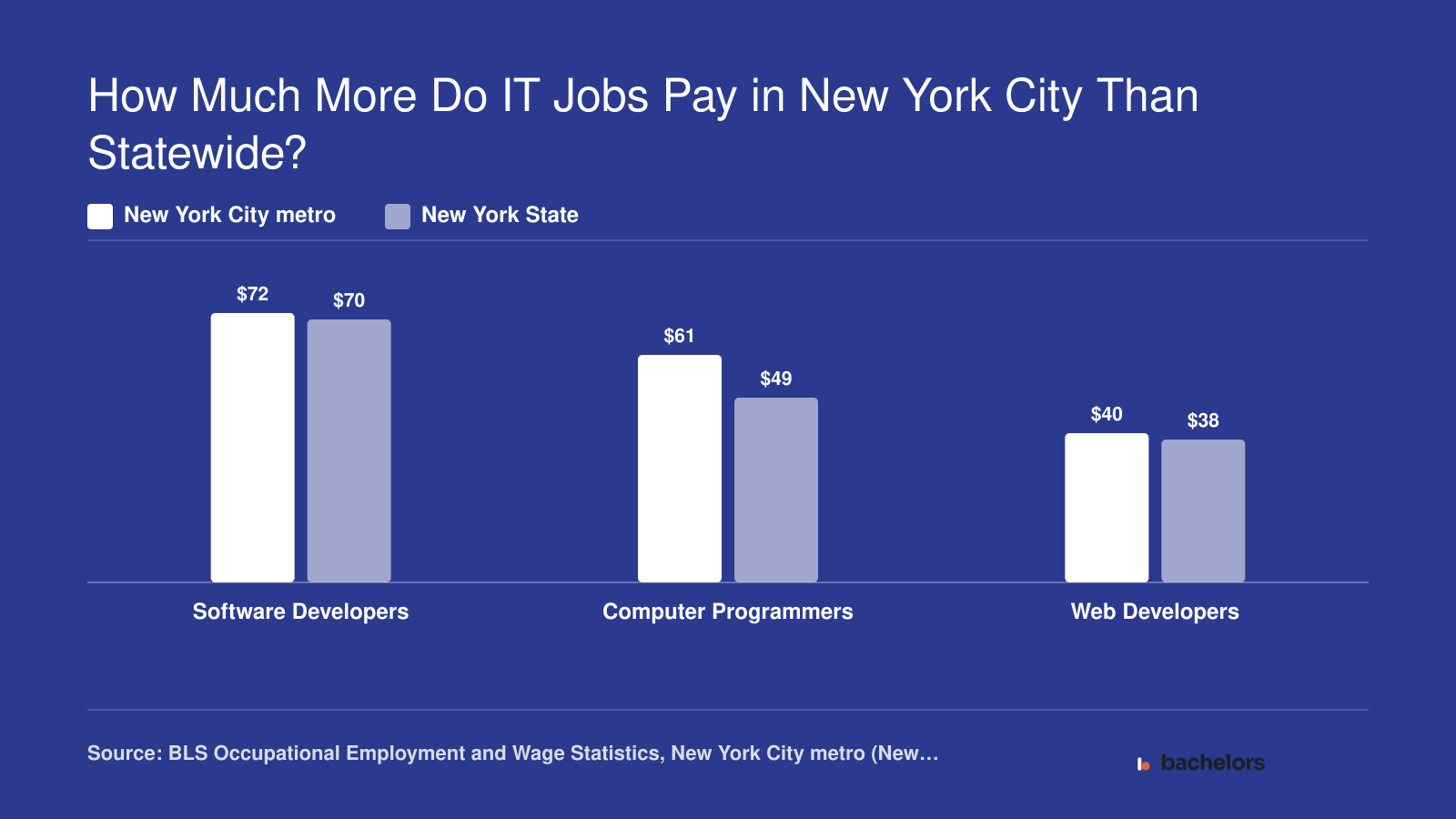
How Much More Do IT Jobs Pay in New York City Than Statewide?
The chart compares median hourly wages for three core IT occupations in the New York City metro area with the same occupations across New York State, using Bureau of Labor Statistics data from May 2023. Occupation-level medians for Long Island, the Capital Region, Rochester and Buffalo were not reported in the data reviewed, so the statewide figure serves as the closest benchmark for upstate and suburban markets. New York City's pay edge is real, especially for programmers, but the region's higher housing and living costs can absorb much of that premium.
Common Questions About IT Bachelor's Programs in New York
These answers draw on program pages from the schools themselves. Titles vary, so confirm credit rules and accreditation directly with each school before you apply.
Which New York schools offer a bachelor's degree in information technology online?
Are New York information technology bachelor's programs accredited?
Can I transfer from a SUNY or CUNY community college into an IT bachelor's program?
Is an information technology degree or a computer science degree better for my goals?
Compare Information Technology programs on the data that matters
Explore more Computers & IT majors or browse every field of study.
All Computers & IT programs Browse every field of study