Best Criminology Schools in Iowa
Compare 7 accredited Criminology programs in Iowa, with net price after aid, graduation rates, earnings and debt from IPEDS and the U.S. College Scorecard.
What does a bachelor's degree in criminology cost in Iowa, and where can you earn one? Schools award it as a Bachelor of Arts (B.A.) or Bachelor of Science (B.S.) in Criminology, on Iowa campuses or online. Published in-state tuition and fees run from $9,936 at the University of Northern Iowa to $52,130 at Drake University.
The ranked list, online formats, admissions, cost, Iowa salaries and school selection all concern bachelor's programs only.
Price is only half the decision. Several schools fold criminology into a sociology major or a concentration, so the title on the diploma can differ from the coursework behind it.
Key Points
- University of Northern Iowa offers a fully online criminology bachelor's route.
- UNI graduates earn a $43,914 median one year after finishing.
- No Iowa license exists for criminology; officers certify through ILEA.
Best Bachelor's in Criminology Programs in Iowa: Ranked List
Seven Iowa colleges award a bachelor's degree in criminology or a close variant, running from the state's flagship public universities to small private campuses in Storm Lake and Oskaloosa. The list mixes standalone criminology degrees with sociology majors that carry a criminology track, because that is how the field is organized in Iowa. Each entry notes what the school does differently so you can match a program to the career you have in mind.
University of Iowa
#1Iowa City, IA · $11,000 – $33,000/yr (est.)
Best for: Aspiring lawyers and policy analysts
Iowa's flagship public university houses criminology, law and justice inside its sociology department, pairing a broad liberal arts core with a required quantitative methods sequence. Students finish with a capstone, research practicum, or criminal justice internship plus a graduation portfolio in the final semester. Formal 2 Plus 2 agreements with Des Moines Area Community College and Eastern Iowa Community Colleges smooth the transfer path, and the Iowa City setting suits readers aiming at law school, policy work, or state and federal agencies.
- Capstone, research practicum, or criminal justice internship option
- Graduation portfolio completed in the final semester
- Quantitative statistics and research methods coursework required
- Electives include policing, white-collar crime, and environmental criminology
- 2 Plus 2 transfer pathways with Iowa community colleges
- Major admission requires admission to the College of Liberal Arts and Sciences
University of Northern Iowa
#2Cedar Falls, IA · $10,000 – $22,000/yr (est.)
Best for: Community college transfers finishing online
This Cedar Falls public university keeps its criminology and criminal justice major compact at 39 credit hours inside a 120-hour degree, with a law enforcement emphasis for students headed into policing. A UNI@IACC partnership lets Iowans start at a community college and finish the bachelor's online, and eligible students may receive a Future Ready Award toward the tuition difference. The department builds in a field placement course and a career preparation course, and the 2.0 major GPA threshold is stated plainly.
- 39 credit hours in the major within a 120-hour degree
- Law Enforcement Emphasis adds 9 elective hours for a 48-hour major
- At least 15 upper-division CRIM credits must be taken at UNI
- 2.0 major GPA required to graduate
- Online completion option through the UNI@IACC partnership
- Field placement and career preparation courses available
- Interdisciplinary electives drawn from eight departments
Buena Vista University
#3Storm Lake, IA · $15,000 – $20,000/yr (est.)
Best for: Hands-on learners wanting crime scene practice
A private university in Storm Lake, Buena Vista pairs its criminology track with practical training in simulations, investigations, and crime scene analysis. Partnerships with regional agencies feed internships, and Value Added Funding can cover certifications and travel that would otherwise come out of pocket. The program is small and campus based, and graduates have gone to work for the Iowa Division of Criminal Investigation, the City of Des Moines, and the Storm Lake Police Department.
- Bachelor of Arts criminology track taught on the Storm Lake campus
- Coursework in criminal behavior, victimization, and criminal law
- Simulations, crime scene analysis, and capstone experiences
- Internships with regional agencies and organizations
- Value Added Funding can support internships, certifications, and travel
- Graduates hired by Iowa DCI, the City of Des Moines, and Storm Lake Police
William Penn University
#4Oskaloosa, IA · ~$23,000/yr (est.)
William Penn's criminology offering sits inside the sociology major as a dedicated emphasis, so students build a theory and research methods core before adding criminological theory and juvenile delinquency. Every sociology major completes 100 hours of internship work arranged with faculty help, at sites such as the Oskaloosa Police Department, state law enforcement, and the Department of Human Services. The Oskaloosa campus keeps classes small and the surrounding region supplies the field placements.
- Criminology emphasis inside the sociology major
- 100 hours of internship experience required for sociology majors
- Courses in criminological theory and juvenile delinquency
- Core in sociological theory and research methodology
- Internship sites include the Oskaloosa Police Department and DHS
- Social and Behavioral Sciences Club open to all students
Drake University
#5Des Moines, IA · $25,000 – $30,000/yr (est.)
Drake University's Des Moines campus offers a sociology major with a Crime, Violence and Justice concentration, drawing on the city for service learning and internships. The 42 to 43 credit major blends criminology, theories of inequality, data literacy, and a senior seminar built around community engagement. Students must earn at least a C- in each core course, and the urban setting suits readers thinking about law school, public administration, or policy work.
- 42 to 43 credit hours required for the major
- Core includes criminology, theories of inequality, and data literacy
- Senior seminar focused on community engagement
- 9 credits of sociology electives, at least 3 at the upper level
- 9 credits of cognate electives, capped at 6 per discipline
- C- or higher required in each core course
- Service learning and internships with Des Moines partners
Luther College
#6Decorah, IA · ~$23,000/yr (est.)
In Decorah, Luther College folds criminology into a sociology major as a three-course track, which suits students who want a strong liberal arts foundation rather than a narrow pre-police curriculum. The core covers theory, research methods, and statistics, with room to substitute a statistics course from another department and space for a 400-level seminar. Faculty encourage research collaboration and internships for students weighing graduate study.
- Criminology track adds SOC 248, 253 and 345 to the major
- Two additional sociology courses, one at the 400 level
- Core includes sociological theory, research methods, and statistics
- A comparable statistics course from another department may substitute
- SOC 301 fulfills the writing requirement
- Faculty research and internships encouraged for graduate study
Wartburg College
#7Waverly, IA · ~$33,000/yr (est.)
Wartburg College in Waverly structures its criminology and sociology major around 12 to 13 course credits, with a Criminal Justice concentration for readers aiming at law enforcement, corrections, or law. The concentration adds juvenile justice, crime and deviance, victimology, and white-collar crime, plus a field experience in community sociology. A six-credit core in statistics, theory, and research methods anchors both concentrations.
- 12 to 13 course credits to graduate
- Criminal Justice concentration adds 7 course credits
- Courses in juvenile justice, crime and deviance, and victimology
- Criminal Law and Legal Processes offered as an elective
- Field Experience in Community Sociology available
- Core covers statistics, theory, and qualitative research methods
Cost & outcomes by school
Federal data for the highest-earning Criminology programs, independent of the ranking above. Earnings are this field's bachelor's graduates four years after completing where the Scorecard reports them, else the school's undergraduate median.
| School | Net price / yr | Grad rate | Earnings | Debt | Grads/yr | Format |
|---|---|---|---|---|---|---|
| Drake University IA | $29,127 | 74% | $71,901 | $23,000 | — | Campus |
| University of Iowa IA | $22,531 | 75% | $60,947 | $21,500 | 99 | Campus |
| Luther College IA | $23,097 | 71% | $59,850 | $27,000 | — | Campus |
| Wartburg College IA | $32,908 | 64% | $56,201 | $27,000 | — | Campus |
| University of Northern Iowa IA | $15,901 | 68% | $54,993 | $20,278 | 44 | Online or campus |
| Buena Vista University IA | $18,846 | 62% | $49,156 | $25,000 | 6 | Campus |
| William Penn University IA | $22,601 | 33% | $48,936 | $22,415 | 16 | Campus |
Sources: U.S. Department of Education. Net price, graduation rate, earnings and debt: College Scorecard (earnings and debt for this field's bachelor's graduates where reported, else school-wide); graduates: IPEDS. A dash means no figure is reported.
Cost, debt & payoff
Median earnings of this field's bachelor's graduates (4 yrs after completing, else the school's undergraduate median) vs. their median federal loan debt · U.S. College Scorecard
Across these programs the median graduate earns about $56,201 and finishes with roughly $23,000 in debt — a ratio that clears a common rule of thumb (keep debt below first-year salary). Net price and debt vary widely school to school, so check the per-school figures in the table above before you shortlist.
How We Ranked Iowa's Bachelor's in Criminology Programs
Most of the figures behind this ranking come from College Scorecard, the U.S. Department of Education's public database. Five factors shaped it: net price after aid, graduation rate, program-level earnings, selectivity and delivery format.
What Covers the Whole School
Several of these numbers describe the entire institution, not the criminology major.
- Net price after aid: The average amount students pay once grants and scholarships are subtracted, across all undergraduates.
- Graduation rate: The share of a school's first-time students who finish within six years, across every major.
- Selectivity: The share of applicants a school admits, which tells you how competitive entry is overall.
Treat these as institution-wide averages. Your own net price and your odds of finishing will depend on your aid package and your path.
What Covers the Program
Earnings are the main program-specific figure. They track graduates of the criminology bachelor's itself, but Scorecard reports them only where enough graduates exist to protect privacy. Smaller programs often show no earnings, so a gap there says nothing about quality.
Delivery format comes from each school's own program page. Most programs here are taught on campus, and a few offer more flexibility.
What to Weigh Most
Start with net price and program fit. A school's average earnings and graduation rate help, but the specific major, internship options and your expected aid matter more to your outcome.
Online and Hybrid Bachelor's Options at Iowa Schools
You can earn a bachelor's degree in criminology online from a school based in Iowa. Among the schools on this list, the University of Northern Iowa publishes a fully online route, and it comes in two versions.
The Online B.A. at UNI
UNI's online B.A. in Criminology and Criminal Justice is a degree-completion track for students who already hold an Associate of Arts or Associate of Science. Coursework is entirely online and asynchronous, with live Zoom sessions possible, and terms start in fall, spring and summer. The program page lists both part-time and full-time enrollment, which matters if you plan to work while you finish. The degree still requires 120 credit hours, including at least 15 upper-division criminology credits completed at UNI.1
A Second Online Option: The B.A.S.
UNI's online Criminal Justice B.A.S. is built for graduates of an Associate of Applied Science program. Admission requires the accredited A.A.S., a 2.00 GPA and two years of relevant work experience.2 Classes are structured for people who are employed full time.
Campus-First Programs
UNI's on-campus B.A. lists select online course options rather than a hybrid format, so plan on being in Cedar Falls. The other schools on this list present their criminology and sociology programs as campus degrees; check the current program page before you assume a remote schedule is possible.
Who Each Route Fits
- Working adults and transfer students: an online completion track lets you keep your job and apply an associate degree toward the bachelor's.
- Traditional first-years: campus study puts you in reach of field placements, internships and the faculty who supervise them, which is hard to replicate at a distance.
Admissions for a Bachelor's Degree in Criminology in Iowa
Admission to a criminology bachelor's program in Iowa is mostly a matter of getting into the school itself. The programs ranked here set their real benchmarks at graduation and at the transfer stage, not at admission.
University of Iowa
The Bachelor of Arts in Criminology, Law, and Justice sits in the College of Liberal Arts and Sciences. The program's admissions page points applicants to that college's requirements rather than listing its own GPA cutoff or test policy. The 2.00 GPA in Iowa's published materials belongs to the 2 Plus 2 transfer plan, not to admission as a first-year student.
Transfer rules are where the university gets specific: - Eligible credit: Coursework from accredited institutions recognized by the U.S. Department of Education can transfer. - Transfer GPA: Every transfer grade counts, including Ds and Fs. Career-technical grades are excluded. - Residency in the major: Transfer students must complete at least 24 semester hours of criminology, law, and justice on campus, and transferred courses need approval from a sociology adviser. - Associate degree shortcut: An AA from an Iowa or Illinois community college clears the general education core except World Language and Understanding Cultural Perspectives.
Excess credits and two-year college grades can satisfy GPA and course requirements but do not count toward total graduation hours.
University of Northern Iowa
UNI's Bachelor of Arts in Criminology and Criminal Justice requires at least 120 total hours, with a minimum of 15 upper-division criminology hours completed at UNI.1 The online version of the degree is built with transfer students in mind. UNI's program and catalog pages do not post a GPA expectation, testing policy or transfer credit cap for this major, so confirm those details with the admissions office.1
Private Colleges on This List
Buena Vista University, William Penn University, Drake University, Luther College and Wartburg College offer criminology through dedicated tracks, concentrations or sociology majors. Before applying, put three questions to each admissions office: - GPA: What GPA do admitted students typically hold? - Testing: Are ACT or SAT scores required, optional or not considered? - Transfer credit: How many transferred credits apply to the major itself?
Get the answers in writing if you plan to transfer, since residency rules like those at the University of Iowa and UNI decide how much coursework you still need to finish on campus.
Transfer Pathways and Hands-on Experience: 2+2 Routes and Internships
Iowa's transfer system has shifted from one-off credit deals between campuses to a statewide framework that standardizes what a criminal justice associate degree should contain.
How the 2+2 Route Works
Two years at an Iowa community college, then two years at a four-year school. The statewide Criminal Justice Transfer Major Discipline Framework, approved in 2019 and revised in 2024, sets the associate of arts coursework that Iowa State, the University of Northern Iowa, and the University of Iowa accept from participating community colleges.1 DMACC's 64-credit Criminal Justice Transfer Major AA is built on that framework and is designed for transfer to Iowa State and UNI.2
The University of Iowa Guarantee
Iowa publishes a 2 Plus 2 Guaranteed Graduation Plan for Criminology, Law, and Justice, and DMACC is named in the pathway. The guarantee carries conditions: finish the AA, hold at least a 2.00 cumulative transfer GPA from every college attended, satisfy the world language requirement, complete two of CRJ 100, SOC 240, and SOC 110, complete MAT 156, and take CRJ 111 and SOC 120 at DMACC or Iowa. Meet all of them and Iowa commits to your junior and senior sequence.
Where the Supervised Hours Come From
The published 2+2 plans spell out coursework, GPA, and language requirements, not field placements. Hands-on hours sit in the community college program instead: DMACC's criminal justice internship requires 24 credits in the program, a 2.0 GPA, and 120 supervised hours at a criminal justice agency with supervisor evaluations.2
Meet a transfer advisor at the four-year school before you register for your first community college semester, so every course you take counts.
Related Articles
Criminology vs. Criminal Justice Degrees in Iowa
At the University of Iowa, the degree carries the title Criminology, Law, and Justice. At Wartburg College, students earn a Criminology/Sociology B.A. and pick a Criminal Justice concentration. Those two labels capture the split you will see across Iowa: one side studies why crime happens, the other studies how the system responds.
Two questions, two degrees
Criminology is the research side. Coursework leans on theory, sociology, research methods and data, asking why crime rates rise in some neighborhoods and fall in others. Criminal justice is the operations side: policing, courts, corrections, and the policies that govern them. Most bachelor's programs blend both, and the core courses often overlap, so the difference is one of emphasis rather than a firm dividing line.
How Iowa schools title the degree
- Criminology in the name: The University of Iowa, the University of Northern Iowa and Buena Vista University all put criminology on the credential, with Northern Iowa and Buena Vista pairing it with criminal justice.
- Sociology with a crime focus: William Penn University awards a Sociology degree with a Criminology emphasis. Drake University offers a Sociology B.A. with a concentration in Crime, Violence & Justice. At Luther College, criminology is a track inside the sociology major.
- Combined title: Wartburg's Criminology/Sociology B.A. sits between the two, with a Criminal Justice concentration for students pointed at law enforcement.
Which student fits which
Choose criminology if you want research, policy analysis, graduate study or data-driven work. Choose criminal justice or a combined degree if you already picture yourself in a patrol car, a courtroom or a corrections agency. A sociology-based route suits students who want flexibility and a broader social science foundation.
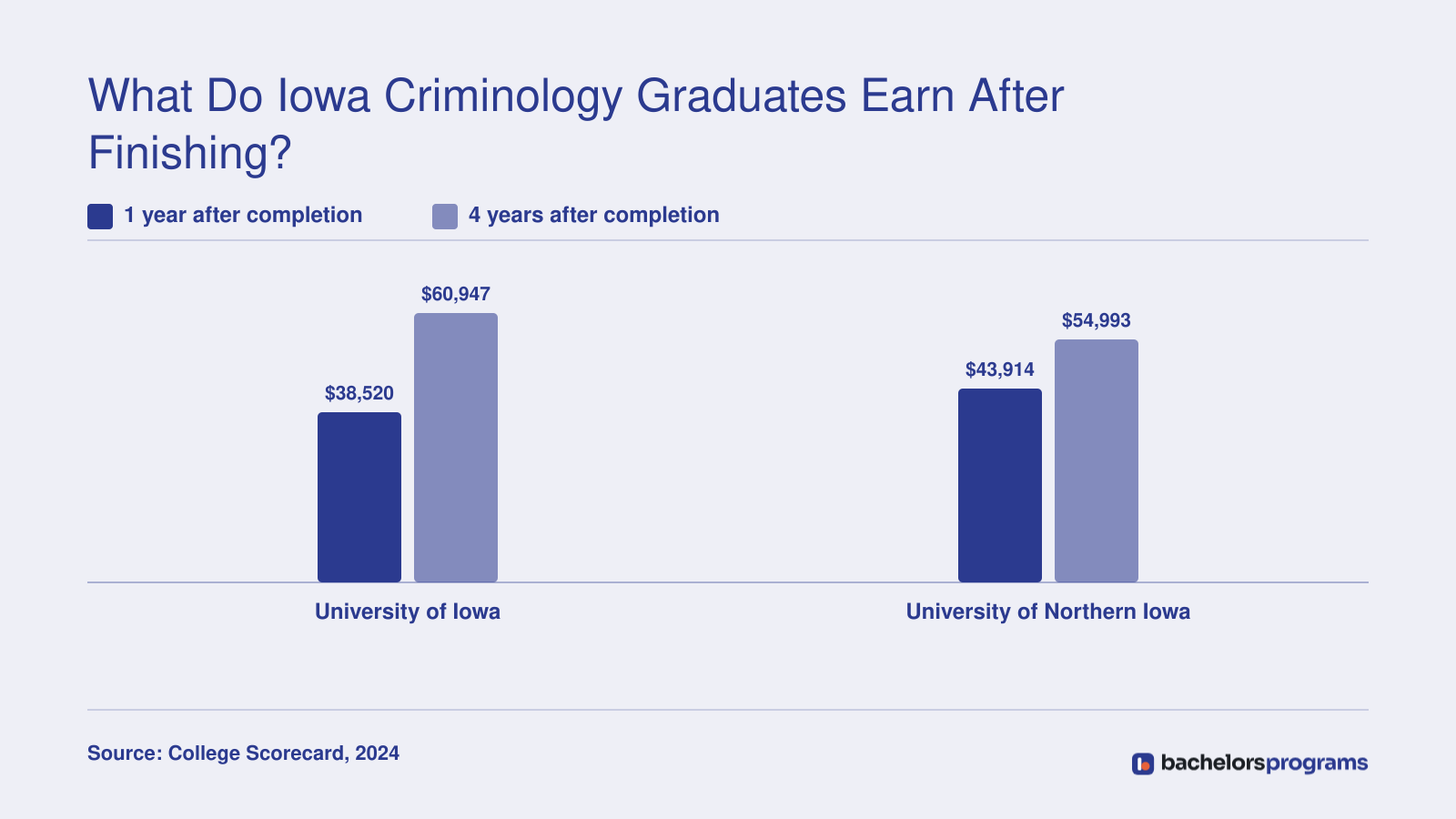
What Do Iowa Criminology Graduates Earn After Finishing?
Program-level earnings for criminology bachelor's graduates are published for the University of Iowa and the University of Northern Iowa. One year after completion, UNI graduates post a higher median ($43,914 vs. $38,520). By four years out, University of Iowa graduates lead ($60,947 vs. $54,993), a gap of nearly $6,000. The other schools have too few graduates for a program-level figure, so they are left out rather than shown with a school-wide number.
Iowa Law Enforcement Certification: What a Criminology Degree Does and Doesn't Cover
Criminology has no Iowa license. A bachelor's degree in criminology is an academic credential, not a permit to practice. Graduates who want to become peace officers go through the Iowa Law Enforcement Academy (ILEA), and the state sets these steps.
- Meet baseline eligibilityBe at least 18, be a U.S. citizen, and hold a high school diploma or GED. You do not need to be an Iowa resident when you apply.
- Pass ILEA hiring testsComplete physical-fitness, cognitive and psychological testing, given at ILEA on the first and third Tuesday of each month. Hiring agencies may add their own screening.
- Clear medical and background screeningMeet the vision standard (20/100 uncorrected, correctable to 20/20) and the color-vision standard. Hearing loss cannot exceed 25 dB. You will also take a drug screen, background and fingerprint checks, the MMPI-2, an oral board and a polygraph.
- Get hired or sponsored firstThe Basic Academy is not open to the public. Recruits enter only after an agency hires or sponsors them. Training runs 639 hours over 16 weeks.
- Certify within one year of hireYou must pass certification testing within one year of being hired or stop working as an officer. Some qualifications, such as firearms qualification with the agency's weapon, are available only after you are employed in Iowa.
- Know where the degree fitsNo college degree is required. State rules do recognize at least 20 credit hours of criminal justice or police-science coursework, with grades of C- or better, for certain alternate training and reciprocity routes.
Questions to Ask Yourself
Do you want to work in law enforcement or corrections, or in research, policy or law school?
Do you need an online or part-time format, or can you attend on campus in Iowa?
Would starting at a community college and transferring through a 2+2 route lower your total cost?
Where do you want to work after graduation, and does the school's location support it?
How to Choose the Right Iowa Criminology School
Iowa's criminology options split along a clear line: University of Iowa and University of Northern Iowa run dedicated criminology and criminal justice majors, while Drake University, Luther College and Wartburg College fold the field into a sociology major or a concentration. The structure matters less than the fit, so work backward from the job you want.
Match the Program to Your Goal
- Law enforcement: Prioritize internship placement and location. Ask where interns are placed and whether the class schedule leaves room for a part-time job with a department you would actually apply to.
- Corrections and probation: Prioritize coursework in deviance, mental health and reentry, plus any practicum that puts you inside a facility before graduation.
- Policy and advocacy: Prioritize research methods, statistics and a placement in Des Moines or with a nonprofit or state agency.
- Research or law school: Prioritize faculty depth and a strong methods sequence over convenience, and confirm the program requires statistics and research design.
Use the Numbers Carefully
The cost section above covers in-state tuition and net price, but remember that net price and graduation rate are school-wide figures, not criminology-specific ones. Read the program page for required courses, then ask an admissions counselor how many students finish in four years and where recent graduates land. A lower sticker price stretched over five years can cost more than a higher one finished in four.
If you are weighing a distance option, the online and hybrid section above explains which Iowa schools deliver the degree remotely and how labs or practicums are handled.
Your Next Step
Choose two or three schools from the ranking, request program information from each, and compare net price, internship placement and format side by side before you commit.
Compare Criminology programs on the data that matters
Explore more Criminal Justice & Law majors or browse every field of study.
All Criminal Justice & Law programs Browse every field of study