Best Biomedical Science Degree Programs
Compare 290+ accredited Biomedical Science programs, with net price after aid, graduation rates, earnings and debt from IPEDS and the U.S. College Scorecard.

A bachelor's degree in biomedical science, usually the Bachelor of Science (B.S.) in Biomedical Science, is built around organic chemistry, biochemistry, anatomy, and physiology. Graduates move into laboratory and technical work, health careers, or the application cycle for medical, dental, PA, and pharmacy school.
The major itself rarely qualifies you for a clinical license. Many graduates need a professional program next, and the schools here differ in cost, advising, and how well they prepare students for that step.
A biomedical science degree is a strong foundation, but what you do with it depends on lab experience and admissions advising as much as on the diploma.
Key Points
- Net prices after aid range from about $3,000 to $22,300 yearly.
- Among ranked programs, Purdue University reports the strongest first-year graduate earnings.
- Every top-ranked program is taught on campus; none run fully online.
Best Biomedical Science Schools Ranked for 2027
The ten programs below span a wide price range: average net price after aid runs from roughly $3,000 to about $22,300 a year, and all ten are delivered on campus rather than online. Each entry shows the school's institution-wide graduation rate and average net price after aid, plus program-level earnings measured one year after completion where the federal data reports them.
University of California-Santa Barbara
#1Santa Barbara, CA · $15,000 – $20,000/yr (est.)
Best for: Pharmacology-focused students eyeing pharmacy school
A large public research university on the California coast, UCSB built its reputation on the sciences and draws a strong pre-health undergraduate population. It launched the nation's first undergraduate pharmacological sciences curriculum in 1974, and that pharmacology emphasis remains the campus's calling card for students heading toward pharmacy, toxicology, or biomedical research. The program treats pharmacology as a basic science, covering drug chemistry and how drugs act on cells and organisms rather than the therapeutic side of medicine. Transfer applicants face selective major admission, so acceptance to the university does not by itself secure a seat in the emphasis.
- First undergraduate pharmacology curriculum in the US, launched in 1974
- Treats pharmacology as a basic science, not therapeutic practice
- Covers drug structures, chemistry, and effects on cells and organisms
- Selective major for transfers; admission to UCSB is separate
- Prepares students for pharmacist, toxicologist, and biomedical scientist roles
- Employers include university and industrial research laboratories
- Related majors include biochemistry-molecular biology and microbiology
University of South Florida
#2Tampa, FL · ~$10,000/yr (est.)
Best for: Pre-health majors seeking combined professional pathways
A large urban public university in Tampa with a health sciences corridor and one of the biggest biomedical sciences enrollments in the country. The major is built as a 120-credit degree with 63 required hours and a 42-credit block of state common prerequisites, so the first two years lean heavily on biology, general and organic chemistry, physics, and calculus. Advising is organized around pre-health plans of study, and the department publishes both two-year and four-year schedules. B.S./M.D. and B.S./PharmD pathways give strong students a defined route into USF's professional programs.
- 120 credit hours, with 63 in required coursework
- 42-credit block of state common prerequisites
- Major core: biochemistry plus microbiology or cell biology and genetics, with labs
- 14 credits of upper-level electives such as virology and immunology
- 2.0 GPA minimum for admission to the major
- B.S./M.D. and B.S./PharmD pathway options
- 30 of the final 60 hours must be earned in residence at USF
- Dedicated pre-health advisors and published plans of study
University of California-San Diego
#3La Jolla, CA · $10,000 – $15,000/yr (est.)
Best for: Chemistry-strong learners preparing for PharmD study
A research-intensive University of California campus in La Jolla with a deep bench in biochemistry and molecular biophysics. Its pharmacological chemistry major sits inside that department and leans harder on physical chemistry and laboratory work than a general biology degree does. Students who want the American Chemical Society credential can add coursework to earn it, and study abroad credit can count toward the major. The surrounding San Diego biotechnology industry is a practical draw for research placements and first jobs.
- 120 to 122 total units: 72 lower-division and 48 to 50 upper-division
- Two quarters of physical chemistry and three quarters of biochemistry
- Three laboratory courses, including a medicinal chemistry lab option
- Restricted electives in pharmacology, toxicology, and drug design
- Designed primarily as preparation for pharmacy school (PharmD)
- Coursework can be augmented for American Chemical Society certification
- Study abroad credit can count toward the major
- 2.0 GPA minimum to graduate
University of California-Irvine
#4Irvine, CA · $14,000/yr (est. net price)
A UC campus in Orange County with a school of pharmacy and pharmaceutical sciences that also serves undergraduates. The pharmaceutical sciences degree runs three years of biology, chemistry, physics, and math before the core begins with molecular pharmacology and pharmacotherapy. The medicinal pharmacology specialization adds human anatomy, physiology, microbiology, and upper-division electives alongside a medicinal chemistry lab. Most graduates go on to Ph.D., M.D., or Pharm.D. study, and transfers need a 3.0 GPA with the full chemistry and biology sequences finished.
- First three years cover biology, chemistry, physics, and math
- Core begins in year three with molecular pharmacology and pharmacotherapy
- Medicinal chemistry laboratory is part of the specialization
- Adds human anatomy, physiology, and microbiology coursework
- 8 units of upper-division electives
- Transfer applicants need a 3.0 GPA and completed chemistry and biology sequences
- Most graduates pursue Ph.D., M.D., or Pharm.D. programs
- Honors recognition for the top 16 percent
Florida State University
#5Tallahassee, FL · ~$11,000/yr (est.)
Florida State's biomedical sciences degree is offered at its Panama City campus in partnership with the FSU College of Medicine, which gives the program a clinical and interprofessional flavor. Experiential learning is a graduation requirement, and a multi-course capstone closes the degree. Upper-division electives are drawn from partner health programs and can double as prerequisites for professional school. The competency-based design suits students aiming at medical school, health research, or health administration rather than a single lab career.
- Offered at FSU Panama City with the FSU College of Medicine
- Minimum 256 experiential learning hours, at least 64 per year
- Capstone spans three to four one-credit courses
- Competencies include healthcare-team roles and system navigation
- Upper-division electives come from partner health programs
- Prepares students for medical school and graduate health programs
CUNY Hunter College
#6New York, NY · ~$3,000/yr (est.)
A public college in Manhattan, part of the City University of New York, with the lowest net price in this group by a wide margin. Its biomedical science major is housed in medical laboratory sciences, so coursework blends basic science with clinical subspecialties and advanced biomedical topics. The department also runs a separate clinical science major that carries New York licensure eligibility, which the biomedical science major does not. Rolling admissions, fall and spring starts, part-time study, and some evening classes make it workable for students who are already employed.
- Requires 60 credits before entry, including general chemistry and biology labs
- 2.5 GPA minimum plus prerequisite coursework
- Rolling admissions with fall and spring starts
- Fall deadline February 1, spring deadline September 15
- Part-time study and some evening classes available
- Does not satisfy New York licensure rules for clinical laboratory technologists
- Clinical Science BS is the licensure-qualifying alternative
- Apply under CUNY curriculum code 0344
Texas A&M University-College Station
#7College Station, TX · ~$21,000/yr (est.)
A large land-grant university in College Station with a veterinary and biomedical sciences college and a strong health professions pipeline. The biomedical sciences BS is a 120-credit degree with a capstone, anatomy and physiology sequences, and directed electives chosen with an advisor. Coursework is also offered at the Texas A&M Higher Education Center in McAllen, and the department builds an individual course package around each student's target professional program. A three-year Early Admission Option lets strong students count the first year of professional school toward the bachelor's.
- 120 semester credit hours including a capstone
- Anatomy and physiology sequences plus 16 hours of BIMS directed electives
- Offered at College Station and at the McAllen higher education center
- Individualized course package built with an advisor
- Three-year Early Admission Option counts the first year of professional school
- Leads to human medicine, veterinary, dental, and pharmacy programs
University of Central Florida
#8Orlando, FL · ~$10,000/yr (est.)
A large metropolitan university in Orlando whose biomedical sciences program sits inside the College of Medicine's Burnett School of Biomedical Sciences. That placement puts undergraduates near medical school faculty, and the school enrolls close to 3,000 undergraduates. Students choose a core degree or a track in neuroscience, molecular cell biology, or molecular microbiology, with research areas spanning cancer and cardiovascular disease. Directed research with faculty, honors in the major, and a 120-credit path with no thesis requirement are the practical options.
- Housed in the Burnett School of Biomedical Sciences, College of Medicine
- 47 to 48 credits of core and restricted electives in a 120-credit degree
- Tracks in neuroscience, molecular cell biology, and molecular microbiology
- Required courses include General Microbiology and Medical Biochemistry
- 3.0 GPA required across core and restricted electives
- Prerequisites: Biology I, Chemistry Fundamentals I and II, Organic Chemistry I
- No thesis or capstone required; directed research is optional
- Honors in the Major available
University of Georgia
#9Athens, GA · ~$14,000/yr (est.)
A flagship public university in Athens whose College of Pharmacy runs the undergraduate pharmaceutical and biomedical sciences degree. The biomedical sciences emphasis covers anatomy, physiology, pharmacology, pathophysiology, immunology, and biomedical data science, and the college is recognized among the stronger pharmacy schools nationally. Core courses must be completed with a C or higher. A BS/MS dual degree and a BS/PharmD Double Dawgs option let students shorten the route to an advanced credential.
- Two areas of emphasis, including Biomedical Sciences
- Coursework in anatomy, physiology, pharmacology, pathophysiology, and immunology
- Biomedical data science is part of the emphasis
- Grade of C or higher required in all biology, chemistry, English, math, physics, and pharmacy courses
- At most one C-minus or D in those prefixes counts
- BS/MS dual degree and BS/PharmD Double Dawgs option available
- Minor requires nine upper-division hours and six major elective hours
Clemson University
#10Clemson, SC · $20,000 – $25,000/yr (est.)
A public land-grant university in upstate South Carolina with a College of Science that awards degrees across mathematics and the physical and life sciences. Its biomedicine concentration lives inside the microbiology BS, so students get a microbiology core with biomedical coursework rather than a stand-alone biomedical degree. The college frames its programs around preparation for graduate and professional school, teaching, and industry or government science positions. Some Clemson degree programs require a modern language sequence through a specific level, so check that detail early.
- Biomedicine concentration inside the microbiology BS
- Housed in the Department of Biological Sciences, College of Science
- Built around preparation for graduate and professional school
- Some Clemson programs require a modern language through a set level
Cost & outcomes by school
Federal data for the highest-earning Biomedical Science programs, independent of the ranking above. Earnings are this field's bachelor's graduates four years after completing where the Scorecard reports them, else the school's undergraduate median.
| School | Net price / yr | Grad rate | Earnings | Debt | Grads/yr | Format |
|---|---|---|---|---|---|---|
| University of Health Sciences and Pharmacy in St. Louis MO | $31,817 | 62% | $137,047 | $17,755 | — | Campus |
| Albany College of Pharmacy and Health Sciences NY | $29,882 | 68% | $131,426 | $25,500 | — | Campus |
| Carnegie Mellon University PA | $31,944 | 94% | $114,862 | $21,750 | — | Campus |
| University of Pennsylvania PA | $28,699 | 97% | $111,371 | $15,715 | — | Campus |
| University of California-Santa Barbara CA | $16,109 | 83% | $98,462 | $14,500 | 58 | Campus |
| Duke University NC | $29,612 | 97% | $97,800 | $13,000 | — | Campus |
| University of Southern California CA | $32,740 | 92% | $92,498 | $18,000 | 36 | Campus |
| Trinity College CT | $34,832 | 84% | $90,779 | $23,000 | — | Campus |
| University of California-San Diego CA | $12,470 | 86% | $84,943 | $15,500 | — | Campus |
| Tufts University MA | $39,998 | 94% | $83,214 | $16,250 | — | Campus |
| University of Portland OR | $28,210 | 80% | $82,804 | $21,370 | — | Campus |
| New York University NY | $37,050 | 88% | $82,509 | $20,500 | — | Campus |
Sources: U.S. Department of Education. Net price, graduation rate, earnings and debt: College Scorecard (earnings and debt for this field's bachelor's graduates where reported, else school-wide); graduates: IPEDS. A dash means no figure is reported.
Cost, debt & payoff
Median earnings of this field's bachelor's graduates (4 yrs after completing, else the school's undergraduate median) vs. their median federal loan debt · U.S. College Scorecard
Across these programs the median graduate earns about $55,134 and finishes with roughly $22,500 in debt — a ratio that clears a common rule of thumb (keep debt below first-year salary). Net price and debt vary widely school to school, so check the per-school figures in the table above before you shortlist.
How We Ranked Biomedical Science Bachelor's Programs
The schools with the strongest outcomes are not always the ones a family can comfortably afford, and a low net price rarely comes with a high graduation rate. The ranking weighs both, along with the earnings and debt that follow graduates, so no single factor decides the order.
What Counts, and Where It Comes From
Figures come from the federal College Scorecard and from IPEDS, the government's collection of institutional data. Affordability is measured by net price, the average cost to students after grant aid. Outcomes rest on graduation and retention rates. Earnings and typical debt after completion come from the Scorecard. Admission rate gives a read on selectivity, and completions show how large the program is.
School-Wide Versus Program-Level
Some of those numbers describe the whole institution; others attach to the specific field of study. Net price, admission rate, and graduation and retention rates apply to the school. Earnings and debt are reported for the program's field, which is closer to what a biomedical science graduate experiences but still blends related majors. Read the two together rather than treating either as a verdict.
Online and on-campus programs were eligible on equal terms and ranked in one list. Format never adds or subtracts points; an online degree stands on the same measures as a classroom one.
What the Numbers Cannot Tell You
The ranking does not measure lab facilities, undergraduate research opportunities, or how many graduates are accepted into medical, dental, or veterinary school. Those matter enormously in this field, and only the school can answer them. Ask directly about research placement, lab access, and professional-school acceptance before you apply.
What a Bachelor's Degree in Biomedical Science Covers
What classes do you actually take in a biomedical science bachelor's degree? The answer is a chemistry-heavy, lab-heavy science core aimed at human health and disease, plus electives that let you specialize.
The Core Coursework
Expect general and organic chemistry, biochemistry, physics, and math or statistics in the first two years, alongside introductory biology. Upper-level work moves into physiology, microbiology, genetics, immunology, and cell and molecular biology. Programs differ in name and sequence, but the center of gravity is consistent: how the human body works, how it fails, and how disease is diagnosed and treated.
Credit Hours and Lab Load
Total requirements typically land near 120 credits. Indiana University Indianapolis lists 120 credits with 45 in the major, 19 of them a biology core and 4 from two required biology labs.1 St. John's requires 121 credits, with labs in biology, organic chemistry, anatomy and physiology, physics, and biochemistry.2 Quinnipiac requires at least 120 credits, including 35 in foundational science.3 The degree is lab-intensive by design, and many programs add undergraduate research or a capstone.
How It Differs From Biology and Biochemistry
General biology is broader, covering ecology, evolution, and organismal and plant life. Biochemistry leans harder into chemistry. Biomedical science sits in between but points at health: anatomy and physiology, microbiology, immunology, and pathophysiology are standard, and the University of Alabama at Birmingham goes further with clinical anatomy, histology, clinical microbiology, and clinical immunology.4
Concentrations
Common tracks include pre-professional (medical, dental, veterinary), medical laboratory science, and pharmacology. The University of Central Florida, for example, requires at least five restricted electives, two of them with labs, and limits how many can come from outside the College of Medicine.
Biomedical Science Degree Cost: Lowest Net Prices Among Ranked Schools
Net price is each school's average yearly cost after grants and scholarships across aided undergraduates, so treat it as an institution-wide benchmark rather than a quote for your own bill, which depends on income and aid. The most affordable options here are all CUNY campuses, with published in-state tuition of $7,340 to $7,410 and out-of-state tuition of $15,290 to $15,360. By comparison, the College Board's 2026-27 average sticker prices before aid are $12,290 for public in-state, $32,730 for public out-of-state, and $46,350 for private nonprofit four-year schools. Median program debt runs from $12,500 to $14,983, or roughly $133 to $159 a month on a 10-year repayment plan.
| School | Location | Avg. Net Price After Aid | In-State Tuition | Out-of-State Tuition | Median Program Debt | Est. 10-Year Monthly Payment | Pell Grant Recipients |
|---|---|---|---|---|---|---|---|
| CUNY Hunter College | New York, NY | $2,984 | $7,382 | $15,332 | $12,500 | $133 | 88% |
| CUNY Lehman College | Bronx, NY | $3,148 | $7,410 | $15,360 | $14,983 | $159 | 89% |
| CUNY City College | New York, NY | $3,776 | $7,340 | $15,290 | $13,382 | $142 | 90% |
Related Articles
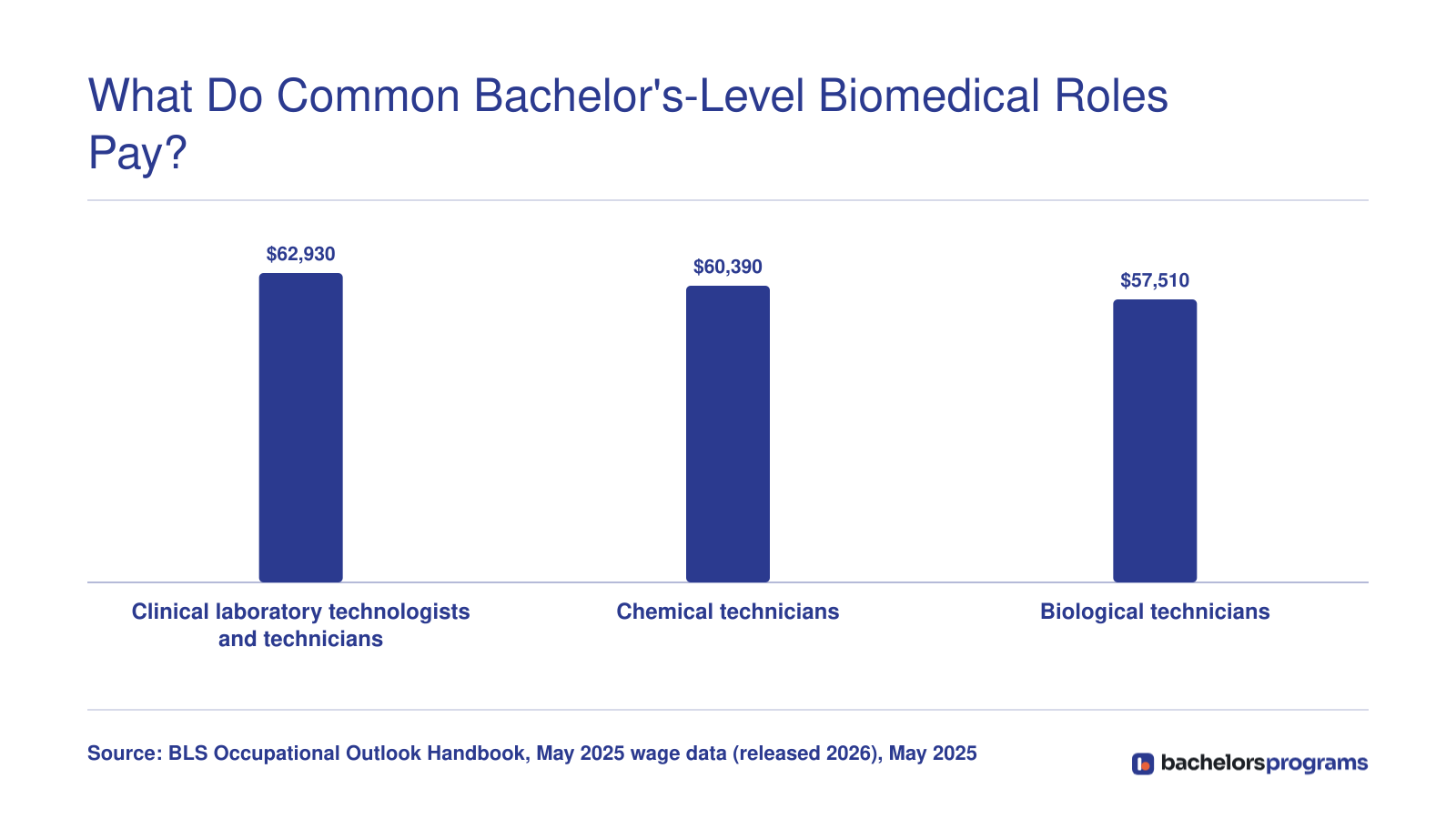
What Do Common Bachelor's-Level Biomedical Roles Pay?
A bachelor's degree in biomedical science prepares you for hands-on laboratory and technical work. The chart compares national median annual wages for three roles biomedical science graduates often pursue, using the latest federal wage data, released in 2026. Clinical laboratory technologists and technicians lead this group at $62,930, followed by chemical technicians at $60,390 and biological technicians at $57,510.
Online vs. On-Campus Biomedical Science Degrees
Online and on-campus bachelor's programs in biomedical science can lead to the same B.S., but they differ most in how labs are delivered and how pre-health admissions offices view that coursework. Published policies from PA programs vary school by school, so confirm the rules at every program you plan to apply to before you enroll. The format label in the rankings above shows which schools offer online, campus, or both formats.
| Factor | Online | On-Campus |
|---|---|---|
| Lab delivery | Immersive virtual labs and at-home lab kits. The online degree we reviewed requires no in-person lab sessions, though an optional in-person organic chemistry lab is available. | In-person lab sections taught in campus facilities, the standard format for Biology I and II and General Chemistry I and II with labs. |
| PA school view of online lecture courses | Pacific University strongly discourages online prerequisite courses except in extraordinary circumstances. | In-person prerequisite courses are the standard accepted format. |
| PA school view of online labs | Mixed. Pacific University accepts online coursework and labs from regionally accredited institutions. FIU accepts online labs but may reject some fully online programs or courses. Midwestern University does not accept an online lab component for biology or chemistry prerequisites. | In-person labs from regionally accredited institutions are accepted and generally avoid the format concern raised by schools that restrict online labs. |
| Flexibility | Coursework is completed remotely, which suits students balancing work or family. Lab kits and virtual labs can be done on your own schedule. | Fixed class and lab times and campus attendance. Less flexible, but the structure keeps pacing consistent. |
| Research access | Faculty-led research is typically harder to join remotely, so you may need to arrange lab or clinical experience on your own. | Easier access to faculty labs, research assistantships, and in-person mentoring. |
| Typical student profile | Often working adults, transfer students, and career changers finishing prerequisites or a degree. | Often traditional-age, full-time students who plan to move directly into pre-health study or graduate programs. |
Top Early-Career Earnings Among Ranked Programs
Among the programs ranked here, Purdue University reports the strongest first-year pay for graduates.
Questions to Ask Yourself
Are you aiming for medical, PA, or pharmacy school after graduation?
Will the professional schools on your list accept lab credits earned online?
Do you want hands-on research, or is a capstone enough?
Is a lab career straight out of college a better fit than pre-professional study?
Biomedical Science Program Accreditation: What to Check Before You Apply
For a bachelor's degree in biomedical science, the institution, not the major, is usually what carries accreditation. Use this checklist to confirm a program will support financial aid, transfer plans and later applications to professional school.
- Confirm institutional accreditationThe U.S. has 19 recognized institutional accreditors, including HLC, NECHE and NWCCU. Check the school in the directories kept by CHEA and the U.S. Department of Education. This status affects federal aid eligibility, whether other schools accept your credits, and how graduate and professional programs view your degree.
- Know which programmatic accreditor, if any, appliesNo single programmatic accreditor covers a general biomedical science B.S., and one isn't required. NAACLS applies only to clinical laboratory tracks, such as medical laboratory science. ABET accredits biomedical engineering, which follows engineering criteria. Pharmacy accreditation covers the professional pharmacy degree, not pre-pharmacy coursework.
- Match courses to professional school prerequisitesCompare the curriculum with the published prerequisites of the medical, PA or pharmacy schools you're targeting. Confirm that the required sciences fit into your four-year plan.
- Review transfer credit policiesIf you're starting at a community college, ask how the program evaluates lower-division science courses. Find out whether those courses count toward major requirements or only general electives.
- Verify how lab courses are deliveredIf you're pre-health, find out whether labs are taken in person. Then check whether your target professional schools accept online lab credit.
Biomedical Science programs by state
Biomedical Science Degree FAQs
Can you get a bachelor's degree in biomedical science online?
How much does a biomedical science degree cost?
Is biomedical science harder than a biology major?
Can you become a physician assistant with a biomedical science degree?
Do you need a master's degree to work in a research lab?
Compare Biomedical Science programs on the data that matters
Explore more Science & Engineering majors or browse every field of study.
All Science & Engineering programs Browse every field of study