Best Forensic Science Schools in New York
Compare 16 accredited Forensic Science programs in New York at 14 colleges, with net price after aid, graduation rates, earnings and debt from IPEDS and the U.S. College Scorecard.
A forensic science bachelor's degree in New York runs from $7,470 a year in tuition at CUNY John Jay College of Criminal Justice to $65,528 at Syracuse University. Schools award it as a Bachelor of Science (B.S.) or Bachelor of Arts (B.A.) in Forensic Science, and the coursework can look similar on paper.
The ranking weighs net price, earnings, graduation rate and accreditation for every campus and online bachelor's program in New York. It then covers FEPAC accreditation, admissions, cost and New York career paths.
Price is the easy comparison. The harder one is which program's chemistry and biology sequence, lab hours and internships will qualify you for a bench position in a crime lab.
Key Points
- John Jay's B.S. in Forensic Science includes three concentrations and an internship.
- Syracuse graduates report the highest median pay: $69,491 four years out.
- In-state tuition: $7,470 at John Jay, $8,742 at SUNY Canton.
Best Forensic Science Schools in New York: Top 10 Ranked
John Jay College of Criminal Justice is the strongest answer for most students: a chemistry-heavy Bachelor of Science in Forensic Science with three concentrations, a required internship and a clear community-college pathway inside CUNY. The nine schools behind it range from a FEPAC-listed technology program in Allegany County to private options in Rochester, Syracuse, Long Island and New York City.
CUNY John Jay College of Criminal Justice
#1New York, NY · ~$3,200/yr (est.)
Best for: New York City crime-lab aspirants
John Jay is CUNY's criminal justice college in Manhattan and the most established forensic science address in the state. The Bachelor of Science builds on organic, analytical and physical chemistry, adds biology, physics and law, and requires an internship, with tracks in criminalistics, molecular biology and toxicology. A CUNY Justice Academy pathway brings community college students in once they finish the science sequence, and an accelerated bachelor's-to-master's route lets students stay on for the graduate degree.
- Chemistry core: organic, analytical and physical chemistry
- Required forensic science internship
- Coursework also spans biology, physics and law
- Trains for forensic lab researcher and administrator roles
- Accelerated BS/MS in Forensic Science option
- Concentration pairs forensic coursework with molecular biology
- Internship required for the major
- Prepares graduates for forensic laboratory research roles
- Toxicology concentration inside the forensic science BS
- Coursework blends chemistry with biology and law
- Careers in forensic science laboratories
Syracuse University
#2Syracuse, NY · $35,000 – $40,000/yr (est.)
Best for: Students adding a second major
Syracuse treats forensic science as an integrated learning major, so every student pairs it with a second major, and that second major determines whether the B.A. or the B.S. is awarded. Chemistry, biology or biochemistry is the recommended partner for students aiming at lab careers. Classes of 15 to 30 are taught by practicing forensic professionals, a capstone ties the two majors together, and recent interns have worked at the FBI and the Onondaga County Center for Forensic Sciences.
- Integrated learning major with a required second major
- Chemistry, biology or biochemistry recommended as the partner major
- Class sizes of 15 to 30 students
- Capstone required
- Taught by practicing forensic science professionals
- Recent internships at the FBI and Onondaga County forensics center
- A B.S. is also offered with identical forensic science requirements
- Hosted by the Forensic and National Security Sciences Institute
SUNY College of Technology at Alfred
#3Alfred, NY · ~$15,000/yr (est.)
Best for: Forensic technology track students
Alfred State runs a four-year forensic science technology program on its small campus in Allegany County, and the college describes the program as FEPAC accredited. The curriculum leans on biology, chemistry and microscopy, with hands-on lab work on DNA and fingerprints, and the campus maintains more than 200 laboratories. It sits among the lowest-priced four-year options on this list for New York residents.
- Four-year program on the Alfred campus
- Program page lists FEPAC accreditation
- 200+ labs on campus
- Coursework in biology, chemistry and microscopy
- Hands-on work with DNA and fingerprint evidence
- Prepares for crime lab, law enforcement and research roles
- Entering students need algebra, geometry, biology and chemistry
- Physics recommended in high school
Roberts Wesleyan University
#4Rochester, NY · ~$23,000/yr (est.)
Roberts Wesleyan is a private university in Rochester with a laboratory-centered Bachelor of Science in Forensic Science. Students run crime scene simulations, work in dedicated lab space, and intern at sites including the Monroe County Crime Lab and the Massachusetts State Police Lab. The department also offers a 25-hour forensic science minor, and the application carries no fee.
- Crime scene simulations and evidence analysis
- State-of-the-art laboratories for evidence work
- Internships at the Monroe County Crime Lab
- Internships at the Massachusetts State Police Lab
- Coursework in biochemistry and molecular biology
- Courses in criminal procedure and law
- 25-hour forensic science minor available
- No application fee
Hofstra University
#5Hempstead, NY · $30,000 – $35,000/yr (est.)
Hofstra offers a Bachelor of Science in Forensic Science as a major on its Hempstead campus, in the middle of Long Island's private-university corridor. The cohort is small, and the program suits students who want a forensic science major inside a large private university rather than a standalone criminal justice college.
- BS major in forensic science at the Hempstead campus
- Small cohort, with about a dozen forensic science degrees awarded yearly
SUNY College of Technology at Canton
#6Canton, NY · ~$15,000/yr (est.)
SUNY Canton awards a Bachelor of Technology in Criminal and Forensic Investigation rather than a B.S., and most of it is delivered online. Core investigative courses meet face to face in a total-immersion format, and students can take an optional 600-hour investigative internship with an agency such as the Bureau of Alcohol, Tobacco, Firearms and Explosives or a medical examiner's office. Coursework covers forensic photography, latent prints, crime scene work and death investigation.
- 75% online hybrid format
- Bachelor of Technology, not a B.S. or B.A.
- Upper-level core courses meet face to face in immersion format
- Optional 600-hour investigative internship
- Placements with ATF and medical examiner offices
- Coursework in forensic photography and latent prints
- Online courses run in fall, spring, winter and summer
St. Thomas Aquinas College
#7Sparkill, NY · ~$20,000/yr (est.)
St. Thomas Aquinas is a small private college in Sparkill, near the New Jersey line, with a four-year Bachelor of Science in Forensic Science. Students take forensic biology and instrumental methods of analysis, work in on-campus labs, and complete a required intensive internship in the summer after junior year, usually at a forensic laboratory somewhere in the New York metro area. Interns and alumni have placed at the ATF and the DEA Northeast Laboratory.
- Required intensive internship in summer of junior year
- Placements in forensic labs across the New York metro area
- Coursework in forensic biology and instrumental methods of analysis
- Covers DNA profile construction and body fluid identification
- Common minors: biology, criminal justice, psychology
- Interns and alumni have worked at ATF and the DEA Northeast Laboratory
Pace University
#8New York, NY · $30,000 – $35,000/yr (est.)
Pace's forensic science major sits at the New York City campus in lower Manhattan, close to the labs and agencies where graduates want to end up. The 120-credit degree carries 66 credits of major coursework across chemistry, instrumental analysis, biochemistry, toxicology and genetics, plus criminalistics and crime scene processing. Faculty hold working affiliations with major forensic laboratories and law enforcement agencies, and the program maintains DNA sequencing and virtual crime-scene reconstruction facilities.
- 120-credit degree, 66 credits in the major
- Taught at the New York City campus
- Coursework spans organic chemistry, instrumental analysis and toxicology
- Forensic science seminar in the final year
- ACS certification option available
- DNA sequencing and virtual crime-scene reconstruction facilities
- Faculty hold affiliations with major forensic labs and agencies
Hilbert College
#9Hamburg, NY · ~$23,000/yr (est.)
Hilbert College, south of Buffalo in Hamburg, focuses its forensic science Bachelor of Science on laboratory science. Students log more than 400 classroom hours of lab practice, take courses in population genetics and the rules of evidence, and work through a moot court component, with faculty drawn from the FBI and New York State Police. A combined 4+1 option adds a master's in criminal justice administration in five years.
- 400+ classroom hours of laboratory training
- Internships with forensic labs and law enforcement agencies
- Faculty drawn from the FBI and New York State Police
- Coursework in population genetics and rules of evidence
- Moot court component
- Small classes with direct professor access
- Combined 4+1 plan with a master's in criminal justice administration
Long Island University
#10Brookville, NY · $30,000 – $35,000/yr (est.)
Long Island University awards its forensic science Bachelor of Science through the College of Science on the Post campus in Brookville. The major stacks 19 credits of specialized science with 22 credits of forensic coursework in criminalistics, toxicology, forensic anthropology and forensic biology, then closes with a 200-hour internship at Long Island and Manhattan crime labs, health departments or medical examiners' offices. Classes are taught by practicing forensic scientists and medical professionals.
- 22 credits of forensic science courses
- 19 credits of specialized science courses
- 2-credit, 200-hour internship at Long Island and Manhattan labs
- Coursework in criminalistics, toxicology and forensic anthropology
- Studies molecular pathology and human genetics
- Taught by practicing forensic scientists and medical professionals
Cost & outcomes by school
Federal data for the highest-earning Forensic Science programs, independent of the ranking above. Earnings are this field's bachelor's graduates four years after completing where the Scorecard reports them, else the school's undergraduate median.
| School | Net price / yr | Grad rate | Earnings | Debt | Grads/yr | Format |
|---|---|---|---|---|---|---|
| Pace University NY | $30,892 | 60% | $70,378 | $23,250 | 4 | Campus |
| Syracuse University NY | $38,793 | 84% | $69,491 | $27,000 | 78 | Campus |
| Hofstra University NY | $34,176 | 69% | $69,039 | $23,621 | 21 | Campus |
| St. Thomas Aquinas College NY | $19,994 | 54% | $62,909 | $23,198 | 1 | Campus |
| CUNY John Jay College of Criminal Justice NY | $3,203 | 56% | $60,416 | $15,500 | 116 | Campus |
| Long Island University NY | $33,062 | 57% | $59,950 | $23,577 | 6 | Campus |
| Elmira College NY | $22,386 | 65% | $57,550 | $27,000 | — | Campus |
| Roberts Wesleyan University NY | $23,130 | 67% | $55,031 | $23,750 | 2 | Campus |
| Hilbert College NY | $22,723 | 56% | $54,589 | $27,000 | 33 | Campus |
| SUNY Brockport NY | $16,353 | 55% | $54,496 | $20,000 | — | Campus |
| Mercy University NY | $14,072 | 46% | $52,055 | $19,637 | — | Campus |
| SUNY College of Technology at Alfred NY | $15,016 | 55% | $50,445 | $13,750 | 11 | Campus |
Sources: U.S. Department of Education. Net price, graduation rate, earnings and debt: College Scorecard (earnings and debt for this field's bachelor's graduates where reported, else school-wide); graduates: IPEDS. A dash means no figure is reported.
Cost, debt & payoff
Median earnings of this field's bachelor's graduates (4 yrs after completing, else the school's undergraduate median) vs. their median federal loan debt · U.S. College Scorecard
Across these programs the median graduate earns about $58,750 and finishes with roughly $23,224 in debt — a ratio that clears a common rule of thumb (keep debt below first-year salary). Net price and debt vary widely school to school, so check the per-school figures in the table above before you shortlist.
Most Affordable Bachelor's Programs in Forensic Science in New York
The programs below have the lowest average net price, meaning the average yearly cost after grants and scholarships, so your own cost will depend on family income and the aid you receive. Public CUNY and SUNY campuses charge in-state tuition and fees between $7,470 and $8,892, while private Mercy University lists $22,880, yet aid narrows that gap: Mercy's average net price of $14,072 sits close to the SUNY campuses. CUNY John Jay College of Criminal Justice stands apart at an average net price of $3,203, according to 2024 IPEDS and College Scorecard data from the U.S. Department of Education.
| School | City | Sector | Program | Format | In-State Tuition and Fees | Average Net Price (After Aid) |
|---|---|---|---|---|---|---|
| CUNY John Jay College of Criminal Justice | New York | Public | Forensic Science | Campus | $7,470 | $3,203 |
| Mercy University | Dobbs Ferry | Private nonprofit | Criminal Justice: Forensic Investigations | Campus | $22,880 | $14,072 |
| SUNY College of Technology at Alfred | Alfred | Public | Forensic Science Technology | Campus | $8,892 | $15,016 |
| SUNY College of Technology at Canton | Canton | Public | Criminal and Forensic Investigation | Hybrid | $8,742 | $15,268 |
| SUNY Brockport | Brockport | Public | Forensic Science | Campus | $8,752 | $16,353 |
Where New York Forensic Science Graduates Earn the Most
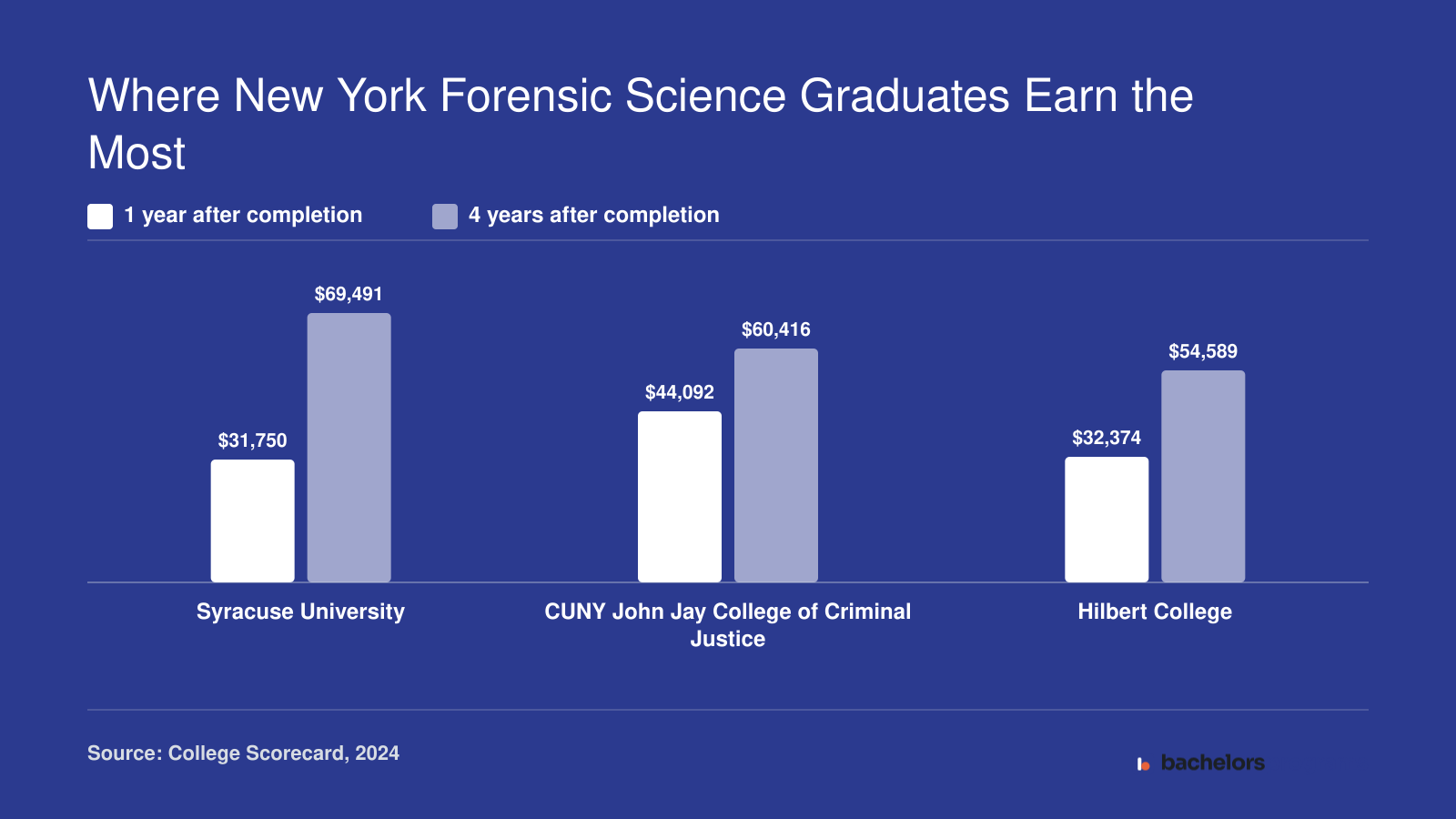
Among the forensic science bachelor's programs ranked here that have federal earnings data, Syracuse University graduates report the highest median pay four years after completion, at $69,491, followed by CUNY John Jay College of Criminal Justice at $60,416 and Hilbert College at $54,589. One year after completion the order shifts: John Jay leads at $44,092, ahead of Hilbert at $32,374 and Syracuse at $31,750, so Syracuse graduates show the steepest climb over their first four years. Program-level earnings are not reported for Pace University or Hofstra University.
How We Ranked New York Bachelor's Programs in Forensic Science
A ranking built on reputation and a ranking built on federal data can point you to very different schools. This ranking leans on what can be checked and shows several measures at once, because a college can look strong on one and ordinary on the next.
What Counts in the Comparison
- Net price: the average cost after federal, state and institutional aid. It is institution-wide, not a forensic science major's bill alone.
- Earnings: median earnings of former students 10 years after they entered, taken from the federal College Scorecard and reported for the whole institution.
- Graduation rate: the share of students who finish, again for the whole college rather than the major.
- Program completions: how many students actually finish a forensic science credential each year, a rough signal of how large the cohort is.
- Accreditation: whether the forensic science program itself holds recognized accreditation, such as FEPAC.
Scope and One Caveat
Only bachelor's programs at New York schools, whether campus or online, entered the comparison. Graduate degrees and institutions based elsewhere did not.
One caveat matters. Forensic science cohorts are small, so a few graduates landing high-paying lab jobs can move a median earnings figure sharply from year to year. Treat that number as one signal among several.
Online and Hybrid Bachelor's Options at New York Schools
An online or hybrid bachelor's degree lets you complete some or all coursework remotely instead of attending every class in person. For forensic science at New York schools, that option is narrow.
The Hybrid Option: SUNY Canton
SUNY Canton's Bachelor of Technology in Criminal and Forensic Investigation is the one hybrid program on this list. It runs about 75% online across 123 credits, with online courses in fall, spring, winter and summer. Core courses are taught face to face in a total-immersion format, so plan for time in Canton. Coursework covers forensic evidence analysis, crime-scene preservation, evidence collection and laboratory processing; an optional 600-hour investigative internship is also available.
Why Most Programs Stay on Campus
Every other ranked program is listed as campus-based. Forensic science depends on supervised lab work in chemistry, biology, microscopy and instrumentation that is hard to replicate at home. John Jay's B.S. rests on organic, analytical and physical chemistry. Hilbert College cites more than 400 classroom hours of lab practice, and Alfred State's FEPAC-accredited program trains students in a campus with 200-plus labs.
A Fully Online Related Major
If remote study matters most, SUNY Canton also offers a 100% online B.S. in Crime Analysis (121 credits) covering digital forensic analysis, crime mapping, cybersecurity, data analytics and GIS. It suits analyst roles, but it is not a lab-science forensic degree, so it is a weaker fit if your goal is bench work in a crime lab.
Admission Requirements: GPA, Test Policy and Transfer Credit
What GPA and test scores do New York forensic science programs actually require?
Fewer programs publish hard numbers than you might expect, and that gap matters when you build a shortlist. Here is what the schools actually state.
What the schools publish
- SUNY Alfred (Alfred State): A recommended overall high school average of 75 for programs taught on the Alfred campus. The forensic science technology program does not publish its own minimum GPA or required coursework. SAT and ACT are not required for admission or for merit scholarships. Transfer applicants are recommended to hold a 2.0 cumulative GPA with a C or better in each course from their most recent semester; that is a recommendation, not a program-specific cutoff.
- Pace, Hofstra and St. Thomas Aquinas: No program-level GPA, test, or transfer-credit policy appears in the material reviewed for this page. Treat general university admissions standards as your guide and confirm details directly with each office.
Prerequisites worth planning for
Where science programs list expectations, chemistry and biology sit at the core, with calculus or precalculus close behind. Strong performance in those courses signals you can handle lab-heavy upper-level work in instrumental analysis and toxicology.
Transfer credit: one practical tip
Ask two questions before you enroll anywhere: what is the minimum grade accepted for a course to count, and how many credits must be earned in residence? At Alfred State, transfer credit from accredited institutions is reviewed for applicability, equivalent courses generally need a C or above, and at least 30 credits must be earned at Alfred, a residency rule that can cap how much you bring in. New York community college coursework within SUNY frequently moves with less friction than credit from outside the system, so request a written credit evaluation before you commit.
Related Articles
Cost of a Forensic Science Degree in New York
Public and private schools price this degree very differently, and the gap narrows once aid is counted. Among the ranked programs, Alfred State and SUNY Canton list in-state tuition of $8,892 and $8,742. CUNY John Jay lists $7,470. Pace lists $53,290, St. Thomas Aquinas $39,450, Roberts Wesleyan $38,826 and Hilbert $33,740.
Sticker price vs net price
Net price is what students pay on average after grants, and it narrows the gap. John Jay's is $3,203, the lowest here. Alfred and Canton land near $15,000. Among the privates, St. Thomas Aquinas averages $19,994, Hilbert $22,723, Roberts Wesleyan $23,130 and Pace $30,892. Because that figure averages every aided student, your own bill depends on income, aid and housing choices.
TAP and Excelsior
The Tuition Assistance Program (TAP) is a grant that does not have to be repaid. For 2026-27 it ranges from $1,000 to $5,665 a year.1 Dependent undergraduates qualify with New York net taxable income of $125,000 or less, and you need 12 continuous months of state residency before enrolling.1 Full-time study generally means 12 credits a semester, and TAP can be used at approved private colleges too.1
The Excelsior Scholarship works differently. It covers whatever tuition remains after other grants, for households with federal adjusted gross income up to $125,000.2 It applies only at SUNY and CUNY, requires 12 credits a term and 30 credits a year, and does not cover fees, housing or books. Recipients also sign an agreement to live and work in New York after graduating. The 2026-27 application window closed August 31, 2026.2
Lowest-cost route
SUNY's 2026-27 resident rate is $8,900 a year in tuition and fees at state-operated campuses, before housing, food and books.3 SUNY and CUNY remain the cheapest paths, and stacking TAP or Excelsior can shrink tuition sharply.
One concrete step: file the FAFSA and the TAP application as early as possible rather than waiting for the June 30, 2027 deadline for 2026-27. Early filing also keeps you in line for Excelsior in later years.
Internships and Crime-Lab Partnerships at New York Schools
A forensic science internship is supervised work at a laboratory, medical examiner's office or agency, where you handle the kind of casework a classroom can only describe. Some New York schools name their sites publicly. Others say little, and that gap is worth knowing about before you apply.
What Schools Publish
- Pace University: The B.S. in Forensic Science lists internships with New York City forensic laboratories, specifically the DEA and the NYPD. Faculty also hold full-time affiliations with major local and federal law-enforcement labs.
- Hofstra University: The program lists student internships at the Suffolk County Medical Examiner's Office, the Suffolk County Crime Lab, the FBI, Cold Spring Harbor Laboratories, Applied Forensics, Bio-Botanica, Garden State Labs and the Rhode Island Department of Health.
- St. Thomas Aquinas College and SUNY College of Technology at Alfred: The pages we reviewed do not describe internships, practicums or crime-lab partnerships. Ask these schools directly rather than assuming they exist.
The published pages do not say whether an internship is required, how long it runs, whether it earns credit, or whether a listed site will be open the year you apply. A named site is not a guaranteed placement.
What to Ask
Before you commit, put these questions to admissions or a faculty member:
- Is an internship required, and how many credits does it carry?
- Which sites took students in the last two years, and how are placements arranged?
- Do those sites require background checks, fingerprinting or drug screening, and when?
- Who is responsible if a placement falls through?
New York Forensic Laboratory Accreditation and Licensure at a Glance
Questions to Ask Yourself
Do you want lab work or crime-scene and field work, and does the program's FEPAC status fit that goal?
Would you rather live in New York City or upstate, and is commuting or living on campus realistic for lab schedules?
Does your net price after TAP, Excelsior or other aid fit your budget at a public or private school?
Compare Forensic Science programs on the data that matters
Explore more Criminal Justice & Law majors or browse every field of study.
All Criminal Justice & Law programs Browse every field of study