Best Security Management Degree Programs
Compare 30+ accredited Security Management programs at 20+ colleges, with net price after aid, graduation rates, earnings and debt from IPEDS and the U.S. College Scorecard.

Average net price after grant aid varies widely among the schools ranked here, so a bachelor's degree in security management can cost several times more at one campus than another. The Bachelor of Science (B.S.) in Security Management is the usual credential, though programs also appear as security and emergency management, information security management, and safety management. Graduation rates and early-career earnings vary nearly as much.
Format adds another variable: some programs run fully online for working officers, others meet weekly on campus or mix both.
Cost, completion and early-career pay, not brand, settle most of these comparisons.
Key Points
- Several programs here keep average net price under $15,000 yearly.
- John Jay security management graduates' pay rises about 59% by year four.
- American Military University's B.A. requires 120 credits, including 27 in the major.
The 10 Best Security Management Degree Programs for 2027
What separates the strongest programs on this list is a combination of affordability, on-time completion, and the earnings graduates report one year after finishing. Several of these ten keep the average net price after aid under $15,000 a year, and the best of them pair that value with a required internship, practicum, or cooperative education block. Each entry shows the university's institution-wide graduation rate alongside the program-level earnings figure where one is reported.
CUNY John Jay College of Criminal Justice
#1New York, NY · ~$3,200/yr (est.)
Best for: New Yorkers wanting federal security internships
John Jay College of Criminal Justice is a CUNY senior college in Manhattan devoted almost entirely to criminal justice, forensic science, and public safety, which gives security management majors an unusually deep bench of related coursework and agency contacts. The major requires an internship or practicum with a security services organization, and students have placed with the Department of Homeland Security, Oak Ridge National Laboratory, and the National Security Agency. The university graduates 56% of students, and graduates of the security management program reported median earnings of $37,284 one year after finishing.
- Internship or practicum with a security services organization required
- Placements have included Homeland Security, Oak Ridge lab, and the NSA
- Coursework in situational crime prevention, data protection, emergency planning
- Also covers homeland defense, legal liability, and criminological theory
- Senior seminar researching a contemporary security issue
- Prepares graduates for roles as managers, consultants, and entrepreneurs
American Public University System
#2Charles Town, WV · $5,000 – $10,000/yr (est.)
Best for: Working adults needing fully online study
American Public University System serves a largely military, veteran, and working-adult population, and it delivers its security management degree entirely online, which makes it the most flexible option on this list. The 120-credit bachelor's program splits into four concentrations, including Government Security and Loss Prevention Management, with major coursework in global terrorism, physical security, and security administration. The university graduates 57% of students, and graduates of the security management program reported median earnings of $57,409 one year after finishing, the highest figure on this list.
- 120 credit hours, fully online
- 30 general education, 27 major, 45 elective credits
- General concentration selects five courses across the program
- Options include Border and Coastal Security and Port Security
- Also School and Campus Security, Industrial Espionage, Protective Services
- Ends with a 3-credit senior seminar in Security Management
- 15 semester hours in the concentration
- Covers the U.S. Constitution and executive orders
- Personnel security and background investigations
- Information assurance for government security applications
- Leads to roles in law enforcement and military service
- 15-credit Information Security concentration
- Builds risk analysis and vulnerability assessment skills
- Major coursework includes global terrorism and physical security
- Senior seminar is taken last, before graduation
John Brown University
#3Siloam Springs, AR · $20,000 – $25,000/yr (est.)
Best for: Career changers seeking certification-aligned coursework
John Brown University is a private Christian university in northwest Arkansas whose online division carries much of its adult and degree-completion enrollment. Its security management focus sits inside a B.S. in Cybersecurity, so students take programming, networking, forensics, and firewall coursework alongside the management track, and several courses map directly to industry certification exams. The university graduates 72% of students, one of the higher completion rates here, and the online program charges a flat $335 per credit hour with no hidden fees.
- Security Management concentration inside the B.S. in Cybersecurity
- $335 per credit hour with no hidden fees
- Test optional; 2.0 GPA minimum; no prior college credits needed
- Information security course maps to the CompTIA Security+ exam
- Linux Fundamentals maps to CompTIA Linux+; networking preps for Cisco CCENT
- Internships at NASA, Texas Instruments, and Lockheed Martin
- 4+1 option finishes a bachelor's and a master's in five years
Georgia College & State University
#4Milledgeville, GA · $9,000 – $30,000/yr (est.)
Georgia College & State University is Georgia's public liberal arts university, and its security management coursework sits in the business school rather than a criminal justice department. The Networking & Security Management concentration lives inside the Management Information Systems B.B.A., so graduates leave with a business credential and a technology specialty, and the department reports that more than half of its graduates finish debt-free. The university graduates 64% of students, and graduates of the program reported median earnings of $39,133 one year after finishing.
- Networking & Security Management concentration in the MIS B.B.A.
- Career paths include cybersecurity analyst and IT compliance manager
- Department reports $69k average alumni salary five years out
- More than half of graduates finish with no student debt
- Other tracks: Enterprise Systems & Data Analytics; Project Management
Utah Valley University
#5Orem, UT · $5,000 – $10,000/yr (est.)
Utah Valley University is one of the largest public universities in Utah and has built its reputation on workforce-oriented technology degrees with relatively low published prices. Security management is taught as an emphasis inside the Information Systems B.S., with upper-division electives in ethical hacking, malware reverse engineering, threat hunting, and industrial control systems security. The university graduates 45% of students, and graduates of the program reported median earnings of $44,051 one year after finishing.
- 120 credits: 90 in information systems, 30 in the emphasis
- Emphasis covers database security and auditing, data security analytics
- 9 upper-division elective credits include ethical hacking and threat hunting
- 2.5 GPA required in discipline core and elective courses
- 30 residency hours at UVU and 40 upper-division credits required
- Prepares for information security analyst and IT management roles
University of North Alabama
#6Florence, AL · $12,000 – $22,000/yr (est.)
The University of North Alabama is a public regional university in the Shoals region, and its security and emergency management degree blends criminal justice, emergency response, and security coursework into a single interdisciplinary major. Every course is available online, so students can finish entirely at a distance or attend evening and summer sessions on campus, and field practicum exercises and internships are built in. The university graduates 55% of students, and graduates of the program reported median earnings of $31,595 one year after finishing.
- 128 credits, including 24 in upper-level security and emergency management
- Every course available online; finish fully online or on campus
- Field practicum exercises and internships built into the coursework
- Evening and night classes plus summer sessions
- Prepares for law enforcement, corrections, and security management roles
Nicholls State University
#7Thibodaux, LA · $8,000 – $9,000/yr (est.)
Nicholls State University is a public university in bayou country south of New Orleans, and its safety management program is built around the petrochemical, construction, and maritime employers that dominate the regional economy. The degree holds Qualified Academic Program status from the Board of Certified Safety Professionals, and the schedule is arranged to fit 14-days-on, 14-days-off rotational work, with classes meeting once a week and recorded lectures posted online. The university graduates 54% of students.
- 120 credits: 72 in the major, 48 in general education and electives
- Board of Certified Safety Professionals Qualified Academic Program
- Graduates can apply for the Graduate Safety Practitioner designation
- GSP designation waives the Associate Safety Professional exam
- Fits 14-days-on, 14-days-off rotational work schedules
- Classes meet once weekly with recorded lectures posted online
- Cannot be completed fully online
Rochester Institute of Technology
#8Rochester, NY · $35,000/yr (est. net price)
Rochester Institute of Technology is a private technology university in western New York with a long-standing cooperative education requirement across its computing degrees. Security management is one of four disciplines students choose in the B.S. in Cybersecurity, and the program runs out of a dedicated Global Cybersecurity Institute with its own cyber range. The university graduates 70% of students, and graduates of the program reported median earnings of $35,872 one year after finishing.
- Security management is one of four disciplines in the Cybersecurity B.S.
- First two years: programming, networking, systems, security foundations
- Two blocks of cooperative education required
- NSA-designated Center of Academic Excellence
- 52,000-square-foot Global Cybersecurity Institute houses a cyber range
- Accelerated BS/MS option completes both degrees in five years
University of Nebraska at Omaha
#9Omaha, NE · $10,000 – $15,000/yr (est.)
The University of Nebraska at Omaha is the metro campus for the Omaha area, and its information systems department sits close to the insurance, banking, and defense employers that hire its graduates. The information security management concentration pairs security governance, risk, privacy, and compliance coursework with a full business information systems core, and capstone projects have students build systems for real clients. The university graduates 47% of students, and graduates of the program reported median earnings of $38,756 one year after finishing.
- Information Security Management concentration in the MIS B.S.
- Covers security governance, risk management, privacy, and compliance
- Study fully online, hybrid, or in person
- Capstone projects analyze and build systems for real clients
- Students can design their own concentration
- AI fluency built into the curriculum
Wayne State College
#10Wayne, NE · ~$15,000/yr (est.)
Wayne State College is a small public college in northeast Nebraska with a long history of applied technology and safety programs, and it charges the same locked tuition rate to in-state and out-of-state students. Its safety management degree is one of the few on this list that leads directly to Graduate Safety Practitioner eligibility and waives the Associate Safety Professional exam on the way to the CSP credential. The university graduates 52% of students, and graduates of the program reported median earnings of $41,869 one year after finishing.
- 63 program credits: 27 in industrial technology, 36 in safety management
- ATMAE accreditation for the Industrial Technology programs
- Automatic GSP eligibility; waives the ASP exam on the way to CSP
- 3-credit co-op or internship completes the degree
- $209.50 per credit under a locked tuition guarantee
- Same tuition rate for in-state and out-of-state students
- Internships at Nucor and CNH Industrial
Cost & outcomes by school
Federal data for the highest-earning Security Management programs, independent of the ranking above. Earnings are this field's bachelor's graduates four years after completing where the Scorecard reports them, else the school's undergraduate median.
| School | Net price / yr | Grad rate | Earnings | Debt | Grads/yr | Format |
|---|---|---|---|---|---|---|
| National University CA | $22,878 | 43% | $81,299 | $25,000 | 131 | Online or campus |
| Nova Southeastern University FL | $30,371 | 63% | $71,972 | $24,250 | 24 | Campus |
| American Public University System WV | $9,597 | 57% | $69,546 | $20,888 | 550 | Online |
| Utah Valley University UT | $6,376 | 45% | $68,296 | $19,586 | 83 | Campus |
| Western Connecticut State University CT | $17,604 | 52% | $66,510 | $24,000 | 70 | Campus |
| Southwestern College KS | $29,824 | 36% | $63,138 | $25,000 | 15 | Online |
| Southern New Hampshire University NH | $36,708 | 43% | $61,027 | $22,000 | 1,160 | Online |
| University of Alaska Fairbanks AK | $10,892 | 38% | $60,306 | $20,291 | 19 | Online or campus |
| CUNY John Jay College of Criminal Justice NY | $3,203 | 56% | $59,343 | $10,350 | 1,127 | Campus |
| University of Nebraska at Omaha NE | $13,441 | 47% | $57,957 | $19,688 | 247 | Online or campus |
| Radford University VA | $14,578 | 49% | $56,996 | $22,250 | 82 | Campus |
| Mississippi Christian University MS | $27,712 | 59% | $55,832 | $24,250 | 13 | Online or campus |
Sources: U.S. Department of Education. Net price, graduation rate, earnings and debt: College Scorecard (earnings and debt for this field's bachelor's graduates where reported, else school-wide); graduates: IPEDS. A dash means no figure is reported.
Cost, debt & payoff
Median earnings of this field's bachelor's graduates (4 yrs after completing, else the school's undergraduate median) vs. their median federal loan debt · U.S. College Scorecard
Across these programs the median graduate earns about $55,485 and finishes with roughly $22,675 in debt — a ratio that clears a common rule of thumb (keep debt below first-year salary). Net price and debt vary widely school to school, so check the per-school figures in the table above before you shortlist.
How We Ranked These Bachelor's Degree Programs
What Goes Into the List
We start with the numbers that hit a family's finances: average net price after grant aid, the school's graduation and retention rates, and College Scorecard figures for program-level earnings and median federal debt among graduates who borrowed. Format flexibility counts too, because many people in this field work full time while finishing the degree.
Why Program-Level Numbers Come First
Earnings and debt for security management graduates say more than a school-wide average, because an institution's overall figures blend majors with very different outcomes. When a program is too small to publish its own numbers, we say so and fall back on school-wide context, which is a weaker signal and should be read that way.
What We Screened For
Only bachelor's-level security management programs at regionally or nationally accredited institutions were considered. Graduate study, associate degrees and unaccredited offerings were set aside, since none of them delivers the four-year credential this page is about.
Limits Worth Knowing
Graduation rates describe the whole institution, not one major. Net price is an average and shifts with family income. Small cohorts often lack published earnings.
How to Use This List
Treat the ranking as a shortlist, not a verdict. Check each program against your budget, ask how transfer credits apply, and confirm the capstone or internship fits the career you want. A program ranked lower here may still be the better fit for your circumstances.
What a Bachelor's Degree in Security Management Covers
How the Credits Break Down
American Military University's Bachelor of Arts in Security Management follows a common blueprint: 120 total credits, split into 30 semester hours of general education, 27 in the major, 15 in a concentration and 45 in electives. It is a B.A. rather than a B.S., but the layout mirrors many security programs. Utah Valley University's information security management emphasis and Nicholls State University's safety management program also total 120 credits. The University of North Alabama's security and emergency management track runs 128.
Most programs end with a culminating requirement. Southwestern College's capstone asks for two projects completed within the last 9 credit hours1. AMU's 3-semester-hour capstone opens only after 106 credits. John Jay College requires an internship or practicum and adds a senior seminar on contemporary issues.
Core Courses You Can Expect
- Risk analysis: Internal and external enterprise risks and mitigation strategies.
- Physical security: CPTED, security surveys, barriers, locks, lighting, alarms, entry control and CCTV.
- Investigations: Investigative methods and how security works with law enforcement.
- Security law and ethics: Arrest, search and seizure, detention and surveillance.
- Business continuity: Keeping operations running through disruption.
- Information security: Protecting data alongside physical assets.
Concentrations Available
Specializations vary. American Military University offers concentration options including government security and information security. Utah Valley and the University of Nebraska at Omaha emphasize information security management, Georgia College pairs networking with security management, and Wayne State College focuses on safety management. John Brown University and Rochester Institute of Technology offer security management as a track within a cybersecurity B.S.
Why the Management Side Matters
Administrative coursework separates this degree from guard training and from an IT-only path. John Jay's curriculum pairs security technology with loss-reduction administration and the interpretation of laws, codes and standards. Nebraska at Omaha stresses governance, risk, privacy and compliance. When comparing programs, look for coursework in policy, personnel oversight and program administration. Those courses prepare you to run a security operation rather than staff one.
Related Articles
Security Management vs. Cybersecurity, Homeland Security, Emergency Management and Criminal Justice
A bachelor's degree in security management trains you to protect people, assets and operations, while a cybersecurity degree trains you to protect networks and data through network security, digital forensics and ethical hacking. All five degrees below overlap in risk assessment, threat assessment and continuity planning, which is why business continuity roles appear in homeland security programs and why security management prepares graduates for both private-sector and government work. If you want broad options without committing to a technical IT track or a policing career, security management or homeland security keeps the most doors open.
| Degree | Core Focus | Typical Coursework | Common Job Titles |
|---|---|---|---|
| Security Management | Security risk assessment, protective services, threat assessment and security leadership in government and private-sector settings | Security risk assessment; threat assessment; protective services; emergency preparedness; security leadership | Security Risk Assessment Specialist; Threat Assessment Analyst; Corporate Security Officer; Security Supervisor |
| Cybersecurity | Network security, digital forensics, cyber intelligence, cybercrime law and policy, ethical hacking | Foundations of Cybersecurity; Introduction to Network Security; Digital Forensics Investigation; Ethical Hacking; Cyber Law and Policy | Information Security Officer; Cyber Threat Intelligence Analyst; Computer Forensic Investigator |
| Homeland Security | A multidisciplinary mix of physical security, critical infrastructure protection, risk analysis, homeland security technology and disaster response | Emergency management; physical security; critical infrastructure protection; risk analysis; disaster preparedness and response | Intelligence Analyst; Risk Manager; Business Continuity Specialist; Critical Infrastructure Analyst; Counterterrorism Analyst |
| Emergency Management | Emergency planning, preparedness, response measures, threat assessment and public safety | Emergency Planning and Security Measures; emergency response measures; emergency preparedness | Emergency Management Director; Emergency Preparedness Coordinator; Disaster Recovery Coordinator; Public Safety Officer |
| Criminal Justice | Criminal investigation, criminal law, criminology, the judicial process and law enforcement | Criminal Investigation; Criminal Law and Criminology; Judicial Process; Theory and Practice of Law Enforcement | Law Enforcement Officer; Criminal Investigator or Detective |
Online vs. Campus Security Management Programs
CUNY John Jay College of Criminal Justice runs its B.S. in Security Management entirely on campus in New York, while American Public University System delivers its security management bachelor's fully online. Other schools do both, and that split matters most for students juggling a security job with coursework.
How the programs split by format
Among these schools, several offer a fully online track, a handful run campus-only programs, and a few offer both, usually by putting lectures online and keeping labs, practicum work, or evening sections in person. New York holds the strongest concentration of campus options, with John Jay and RIT both in the state, and Pennsylvania, Nebraska, Utah and Georgia each anchoring at least one brick-and-mortar program. For "near me" searches, the Northeast and the Plains states give you the most choices.
Are accredited online programs available?
Yes. When the school itself is regionally accredited, the online security management degree carries the same credential and the same institutional accreditation as the campus version. A degree earned remotely from an accredited institution carries no asterisk.
What each format buys you
- Online: suits working security professionals and transfer students who need evening or asynchronous coursework, and it removes the relocation cost entirely.
- Campus: delivers in-person internships, lab facilities, and the employer networking that comes from career fairs and local agency recruiting.
A note for international students
Under 8 CFR 214.2(f), an F-1 undergraduate needs a full course load of at least 12 semester or quarter hours, and no more than one online class or 3 credits per term may count toward it.1 In practice that means roughly 9 in-person credits and 3 online. A fully online U.S. bachelor's generally cannot support F-1 status, so F-1 applicants should plan on a campus program at an SEVP-certified school.1
Security Management Degree Cost and Financial Aid
What a Security Management Degree Costs
The number that matters is net price: what students pay on average after grants and scholarships, not the sticker price. Among the public schools ranked here, net price runs from $3,203 at CUNY John Jay College of Criminal Justice to $14,578 at Radford University. The private option, American Public University System, comes in at $9,597, with tuition of $8,400 for every student regardless of residency.
The gap between published tuition and net price shows what aid does. John Jay lists $7,470 in-state and $15,420 out-of-state tuition, yet its net price is only $3,203. Radford lists $12,548 in-state and $25,633 out-of-state, and its net price is $14,578, so aid trims much less there. Net price also folds in housing and other living costs, which is why it can top in-state tuition, as at Columbus State University ($5,898 tuition, $13,115 net price).
Debt After Graduation
Program-level borrowing varies widely. Median federal debt for graduates ranges from $10,350 at John Jay, a payment of about $110 a month over 10 years, to $28,740 at Columbus State, about $305 a month. Utah Valley University ($19,586, $208 a month) and the University of Nebraska at Omaha ($19,688, $209 a month) sit near the middle. Debt figures are not published for every program here.
Schools Serving Lower-Income Students
A high Pell share suggests a school supports students who rely on need-based aid. About 90 percent of students at John Jay and 87 percent at American Public University System receive Pell Grants. Southeastern Oklahoma State University (77 percent) and Utah Valley University (74 percent) also serve many lower-income students.
Aid Routes Worth Using
- FAFSA: Filing it opens the door to nearly every federal and many state and school awards.
- Pell Grants: Need-based money that does not have to be repaid.
- Federal loans: Borrow only what you need after grants, since federal loans carry repayment protections.
- Employer tuition assistance: Many security and government employers help pay for coursework, especially in online programs.
How Much Do Graduates of the Top-Earning Security Management Programs Make?
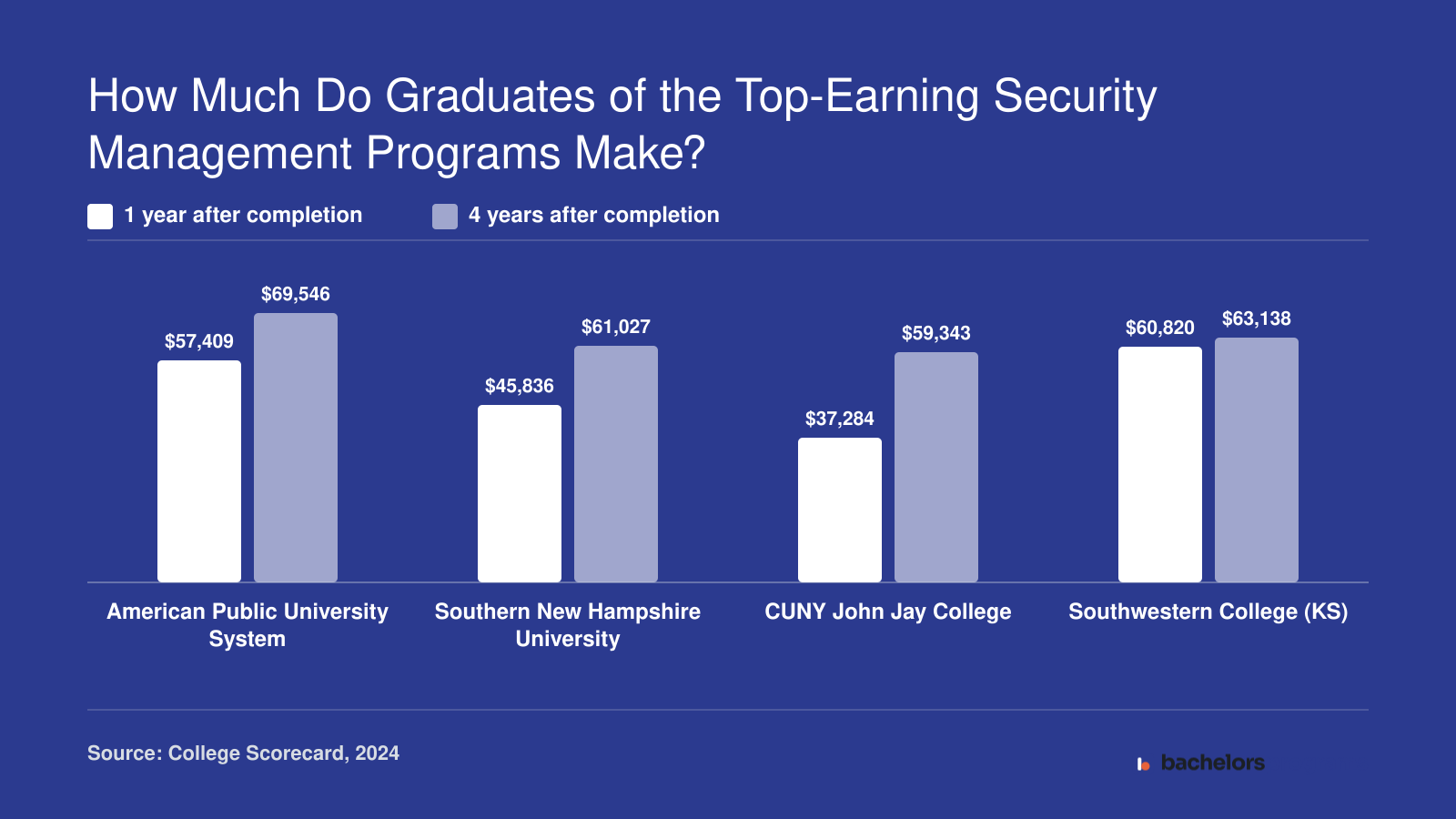
These program-level medians track graduates of each school's security management bachelor's degree one year and four years after completion. Pay rises fastest where starting salaries are lowest: John Jay graduates gain about 59% and SNHU graduates about 33% by year four, as many move from entry roles toward supervisory work. Nova Southeastern's cybersecurity management track posts the highest four-year median, $71,972, but it is not charted because its one-year figure is not reported.
Where Experienced Security Managers Land
Emergency management directors, who plan and lead an organization's response to disasters and security incidents, are one leadership path a security management degree can lead to.
Questions to Ask Yourself
Will the school accept your prior coursework, military training or security experience?
Is the schedule fully asynchronous if you plan to keep working security shifts?
Will the coursework and any internship count toward the experience you need for the CPP or PSP?
Is the institution accredited by an agency recognized by the U.S. Department of Education, and can you confirm it yourself?
Security Management programs by state
Compare Security Management programs on the data that matters
Explore more Criminal Justice & Law majors or browse every field of study.
All Criminal Justice & Law programs Browse every field of study