Best Online Security Management Degree Programs
Compare 19 accredited online Security Management programs, with net price after aid, graduation rates, earnings and debt from IPEDS and the U.S. College Scorecard.

A fully online, accredited bachelor's degree in security management is a cost decision as much as a convenience one. The programs priced nearest the Defense Department's $250-per-credit tuition assistance cap rarely post the strongest graduate earnings, so cheap and lucrative split apart early.
The credential itself is a Bachelor of Science (B.S.) or Bachelor of Arts (B.A.) in Security Management, typically 120 semester credits built for security, loss prevention, and emergency management roles. Pricing across online programs clusters around that federal cap, so net price after aid varies far more than published tuition suggests.
Key Points
- Most online security management bachelor's degrees require 120 semester credits.
- Top budget picks average roughly $9,600 to $13,100 a year after aid.
- American Public University System posts the strongest program-level graduate earnings here.
Top 10 Fully Online Bachelor's in Security Management Programs
These ten programs are fully online, listed in order by a composite that weighs online delivery, cost, outcomes and degree completions. Each entry shows what the school does best and the kind of student it fits, from federal-career aspirants to shift workers stacking safety credentials.
American Public University System
#1Charles Town, WV · $5,000 – $10,000/yr (est.)
Best for: Working adults eyeing federal security careers
American Public University System runs an online catalog built around working adults, and security management is one of its largest majors, with four concentration tracks and a required senior seminar. Coursework covers global terrorism, physical security and security administration, and graduates move into federal civil service, law enforcement and private security. University career materials point to federal agency partnerships that supply summer placements and recruiters. Graduates earned a median of about $69,500 four years after finishing.
- 120 semester hours: 30 general education, 27 in the major, 45 electives
- Four concentrations: General, Government Security, Information Security, Loss Prevention
- 15-credit concentration plus a 3-credit senior seminar
- Coursework in global terrorism, physical security and security administration
- Electives include port security, school and campus security, industrial espionage
- Government track covers personnel security and background investigations
- Prepares for federal civil service, law enforcement and private security roles
- Offered fully online
University of North Alabama
#2Florence, AL · $12,000 – $22,000/yr (est.)
Best for: Alabama students mixing online and campus classes
North Alabama awards its security and emergency management degree as an interdisciplinary bachelor's, with every course available online as well as on campus in Florence. Field practicum exercises and internships are built into the coursework, and faculty bring backgrounds in forensics, intelligence, emergency response and disaster management. The program hosted the 2026 Preparedness for Alabama Resilience Summit, keeping students tied to state and regional emergency networks. Graduates earned a median of about $48,900 four years after finishing.
- 128 credit hours, completable fully online or on campus
- 24 upper-level hours in the security and emergency management emphasis
- 49 hours of SEM courses and open electives
- Field practicum exercises and internships built into courses
- Evening, night and summer sessions available
- Leads to law enforcement, corrections and court administration roles
Nicholls State University
#3Thibodaux, LA · $8,000 – $9,000/yr (est.)
Best for: Rotational shift workers earning safety credentials
Nicholls State's safety management degree is a Board of Certified Safety Professionals Qualified Academic Program, which lets graduates apply for the Graduate Safety Practitioner designation and waive the Associate Safety Professional exam. The 120-credit curriculum leans on loss control, industrial hygiene, ergonomics, hazardous materials and OSHA general industry and construction standards. Scheduling is arranged around 14-days-on, 14-days-off rotational work. Traditional classes meet once a week with recorded lectures posted online, so the degree is not offered fully online.
- 120 credit hours: 72 in the major, 48 general education and electives
- Board of Certified Safety Professionals Qualified Academic Program
- Graduates can apply for the Graduate Safety Practitioner designation
- Waives the Associate Safety Professional exam requirement
- Built around 14-days-on, 14-days-off rotational schedules
- Coursework in loss control, industrial hygiene, ergonomics and OSHA standards
- Traditional classes meet weekly; lectures recorded and posted online
University of Nebraska at Omaha
#4Omaha, NE · $10,000 – $15,000/yr (est.)
The University of Nebraska at Omaha houses its information security management track inside the management information systems degree, blending security governance, risk, privacy and compliance with programming, analytics and IT infrastructure. Capstone teams analyze and build systems for real client organizations, and an AI fluency thread runs through the curriculum. Students can study fully online, in a hybrid format or on campus. Graduates earned a median of about $58,000 four years after finishing.
- Information Security Management concentration covers governance, risk and compliance
- Alternate tracks in data science and business application development
- Capstone projects built for real client organizations
- AI fluency built into the curriculum
- Students may design their own concentration
- Study fully online, hybrid or in person
- Options to double major or continue to graduate study
John Brown University
#5Siloam Springs, AR · $20,000 – $25,000/yr (est.)
John Brown University's cybersecurity degree carries a security management concentration and is delivered 100% online at a flat $335 per credit hour with no hidden fees; first-time students need a 2.0 GPA and no test scores. Coursework maps to industry credentials including CompTIA Security+, CompTIA Linux+ and Cisco CCENT exams. Students have landed summer internships at NASA, Texas Instruments and Lockheed Martin, and a 4+1 track lets undergraduates finish a bachelor's and a master's in five years.
- $335 per credit hour with no hidden fees
- 100% online; 2.0 GPA and no test scores required
- No prior college credits needed to enroll
- Information security course maps to the CompTIA Security+ exam
- Linux Fundamentals maps to CompTIA Linux+ certification
- Networking coursework prepares students for Cisco CCENT exams
- Internships at NASA, Texas Instruments and Lockheed Martin
- 4+1 option finishes bachelor's and master's in five years
University of Alaska Fairbanks
#6Fairbanks, AK · ~$11,000/yr (est.)
Fairbanks offers a Bachelor of Security and Emergency Management with six concentrations, from fire administration and homeland security to cybersecurity and emergency medical and public health management. The degree sits inside the business school, so disaster preparedness coursework runs alongside crisis management, risk management and leadership. Online students pay in-state rates, and the university estimates the full online program at about $46,490 at current tuition. Military, healthcare, first responder and ROTC experience can count toward requirements, and graduates earned a median of about $60,300 four years after finishing.
- Six concentrations, including fire administration and homeland security
- Complete on campus in Fairbanks, fully online, or a mix of both
- Estimated total cost of the online program is $46,490
- Taught inside the business school with crisis and risk management
- Credit granted for military, healthcare, first responder and ROTC experience
- Online students pay in-state tuition rates
- Member of the FEMA Higher Education Program with an IAEM student chapter
University of Colorado Colorado Springs
#7Colorado Springs, CO · $10,000 – $24,000/yr (est.)
Colorado Springs delivers its cybersecurity management emphasis through the business school, so students take IT risk management and security auditing alongside accounting, finance and management courses. The 120-credit degree requires at least 24 semester hours in the emphasis taken at UCCS, with electives in ethical hacking, cloud security, project management and advanced networking. It is offered on campus, online or in hybrid format. Graduates earned a median of about $53,200 four years after finishing.
- 120 credits, with at least 24 semester hours in the emphasis at UCCS
- On campus, online or hybrid delivery
- Courses in IT risk management and IT security auditing
- Electives include ethical hacking, cloud security and advanced networking
- 2.5 GPA required in emphasis courses and in business courses
- Double emphasis option available
- Prepares for cybersecurity analyst, risk analyst and IT auditor roles
Columbus State University
#8Columbus, GA · ~$13,000/yr (est.)
Columbus State's cybersecurity management concentration sits inside the BBA in management information systems, so majors graduate with a business credential plus coursework in digital forensics, information security assurance and cybersecurity strategy. Admission needs a 2.0 GPA and there are no program-specific entrance requirements, which makes it a practical choice for students transferring in with prior credit. Potential roles include IT auditor, risk analyst, cybersecurity analyst and consultant. Graduates earned a median of about $50,000 four years after finishing.
- 120 credits: 42 core, 27 BBA, 21 major and 12 elective
- Cybersecurity Management concentration with digital forensics coursework
- Covers cybersecurity risk management and information security assurance
- 2.0 GPA minimum with no program-specific admission requirements
- Need a C or better in Area F and a C average in business electives
- Prepares for IT auditor, risk analyst and cybersecurity consultant roles
Indiana Wesleyan University
#9Marion, IN · ~$17,000/yr (est.)
Indiana Wesleyan's global security and strategy management major is fully online and built for adults who arrive with prior credit: students need at least 60 transferable hours before starting major coursework, and military training can count toward that total. The 120-credit degree covers global security, strategy, leadership and ethical decision-making, with 12 upper-level hours required in the major. A credit crossover policy grants advanced standing toward an MBA, a Master of Science in Management or a master's in organizational leadership. Graduates earned a median of about $52,600 four years after finishing.
- 120 credits, fully online, with 30 hours of general education
- At least 60 transferable credits needed before major courses
- 12 hours in the major must be at the 300 or 400 level
- Military specialty credit accepted for prior training
- Credit crossover into MBA and master's in management programs
- 2.25 GPA in major courses and 2.0 cumulative to graduate
Grand Canyon University
#10Phoenix, AZ · ~$22,000/yr (est.)
Grand Canyon University's cybersecurity management degree is offered by the Colangelo College of Business, with online courses running in seven-week blocks and up to 90 transfer credits accepted. The 120-credit curriculum mixes cyberlaw and privacy, IT ethics, accounting and business finance with a strategic management capstone. Online tuition runs $490 per credit, and admission requires a 2.8 unweighted GPA, or a 2.5 GPA with an ACT of 19 or an SAT of 1000. Graduates earned a median of about $55,600 four years after finishing.
- Online tuition of $490 per credit; 120 credits total
- Up to 90 transfer credits accepted, 84 from lower-division work
- Online courses run in 7-week blocks
- Capstone course in strategic management
- Admission needs a 2.8 unweighted GPA, or 2.5 with ACT 19 or SAT 1000
- Coursework includes cyberlaw, IT ethics and business finance
- Online tutoring and learning resources included
Cost & outcomes by school
Federal data for the highest-earning Security Management programs, independent of the ranking above. Earnings are this field's bachelor's graduates four years after completing where the Scorecard reports them, else the school's undergraduate median.
| School | Net price / yr | Grad rate | Earnings | Debt | Grads/yr | Format |
|---|---|---|---|---|---|---|
| National University CA | $22,878 | 43% | $81,299 | $25,000 | 131 | Online or campus |
| American Public University System WV | $9,597 | 57% | $69,546 | $20,888 | 550 | Online |
| Southwestern College KS | $29,824 | 36% | $63,138 | $25,000 | 15 | Online |
| Southern New Hampshire University NH | $36,708 | 43% | $61,027 | $22,000 | 1,160 | Online |
| University of Alaska Fairbanks AK | $10,892 | 38% | $60,306 | $20,291 | 19 | Online or campus |
| University of Nebraska at Omaha NE | $13,441 | 47% | $57,957 | $19,688 | 247 | Online or campus |
| Mississippi Christian University MS | $27,712 | 59% | $55,832 | $24,250 | 13 | Online or campus |
| Grand Canyon University AZ | $22,472 | 44% | $55,600 | $26,599 | 275 | Online or campus |
| John Brown University AR | $20,397 | 72% | $53,907 | $21,250 | 7 | Online |
| University of Colorado Colorado Springs CO | $15,788 | 47% | $53,198 | $17,750 | 116 | Online or campus |
| Indiana Wesleyan University IN | $22,866 | 67% | $52,629 | $26,563 | 15 | Online |
| Indiana Wesleyan University IN | $16,898 | 35% | $52,629 | $26,563 | 17 | Online |
Sources: U.S. Department of Education. Net price, graduation rate, earnings and debt: College Scorecard (earnings and debt for this field's bachelor's graduates where reported, else school-wide); graduates: IPEDS. A dash means no figure is reported.
Cost, debt & payoff
Median earnings of this field's bachelor's graduates (4 yrs after completing, else the school's undergraduate median) vs. their median federal loan debt · U.S. College Scorecard
Across these programs the median graduate earns about $55,485 and finishes with roughly $22,675 in debt — a ratio that clears a common rule of thumb (keep debt below first-year salary). Net price and debt vary widely school to school, so check the per-school figures in the table above before you shortlist.
How We Ranked Fully Online Security Management Programs
Only fully online bachelor's programs qualified. Hybrid programs that require campus visits were excluded.
Each school's composite score blends five inputs: net price after financial aid, institutional graduation and retention rates, College Scorecard program earnings, median debt, and how many students complete each program.
Two caveats apply. Graduation rate reflects the whole institution, not just the security management program. Net price is an average across aid recipients, not a personal quote, so your own cost will differ.
The ranking draws on federal data. No school paid for placement, and none can buy a higher spot.
What You Learn in a Bachelor's Degree in Security Management
Most online bachelor's degrees in security management are built on 120 semester credits. John Jay College's B.S. devotes 39 credits to the major, 18 of them in named core courses such as SEC 315 Private Security and the Law and SEC 270 Security of Computers and Their Data.1
Core coursework across programs tends to cover risk assessment, physical security, security law and ethics, investigations, emergency planning, and an introduction to cybersecurity.
Concentrations are where the career path gets specific: - Corporate security: private-sector security management, facilities, and executive protection. - Information and cyber security: analyst and security governance roles. - Homeland security: government, emergency management, and policy work. - Loss prevention: retail and asset protection management.
Plan on four years of full-time study at 120 credits, though transfer credit and accelerated online terms can shorten that. Pick your concentration by the job you want, not by the course titles that sound most interesting.
Online Security Management Degree Tuition and Total Cost
Online security management pricing increasingly tracks the Defense Department's tuition assistance cap, and the cap shapes what many students actually pay.
After aid, the most affordable programs here average roughly $9,600 to $13,100 a year in net price, led by American Public University System, the parent of American Military University.
Per-Credit Math
Multiply the per-credit rate by 120 credits for a rough total:
- American Military University: $360 per credit comes to about $43,200 (this rate applies to its online B.A. in Security Management).
- Columbia Southern University: $278 per credit comes to about $33,360.1
- East Carolina University: $429 in-state comes to about $51,480, and $510 out-of-state comes to about $61,200.2
Biggest Savings Levers
Military rates are the first lever. American Military University, Liberty University (2026-2027), Columbia Southern, UMGC, and Norwich University all list $250 per credit for eligible service members, about $30,000 over 120 credits. Post University lists $250 for active duty and $275 for other military-affiliated students (2025-2026).3
Transfer credit is the second. American Military University accepts up to 90 credits, and Liberty accepts up to 75% of the degree. At AMU's standard rate, 90 transferred credits leave only 30 to pay for, about $10,800. Confirm the exact policy before you apply.
What Security Management Graduates Earn After Finishing
Among the online programs here, the strongest program-level earnings come from American Public University System.
Accreditation, Transfer Credits, and International Eligibility
The quickest confirmation that an online security management program comes from a legitimate school is DAPIP, the U.S. Department of Education's accreditation database. "Accredited" should mean institutional accreditation from a recognized accreditor such as the Higher Learning Commission (HLC), the Middle States Commission on Higher Education (MSCHE), or SACSCOC. Institutional accreditation covers the whole school. Programmatic accreditation applies only to specific programs.
Verify in two steps:
- DAPIP: Search the school's exact legal name and confirm its institutional accreditor and current status, including any probation or warning.
- CHEA directory: Check that the same accreditor appears there. DAPIP data are not audited and may be incomplete1, so contact the accreditor if the records disagree.
Transfer policies vary by school, so ask how your prior credits will be evaluated before you apply.
State authorization is a separate issue. A school needs legal permission to enroll distance students in your state, often through NC-SARA, and eligibility depends on where you physically live.2 Internships or in-person requirements may need separate approval.2
International students living abroad generally do not need an F-1 visa for fully online study.1 Online enrollment will not qualify you for one, and F-1 students in the U.S. cannot study solely online.3 Each school sets its own English proficiency rules, and many accept TOEFL iBT, IELTS Academic, or Duolingo scores.1 Some schools also limit enrollment from certain countries.
Related Articles
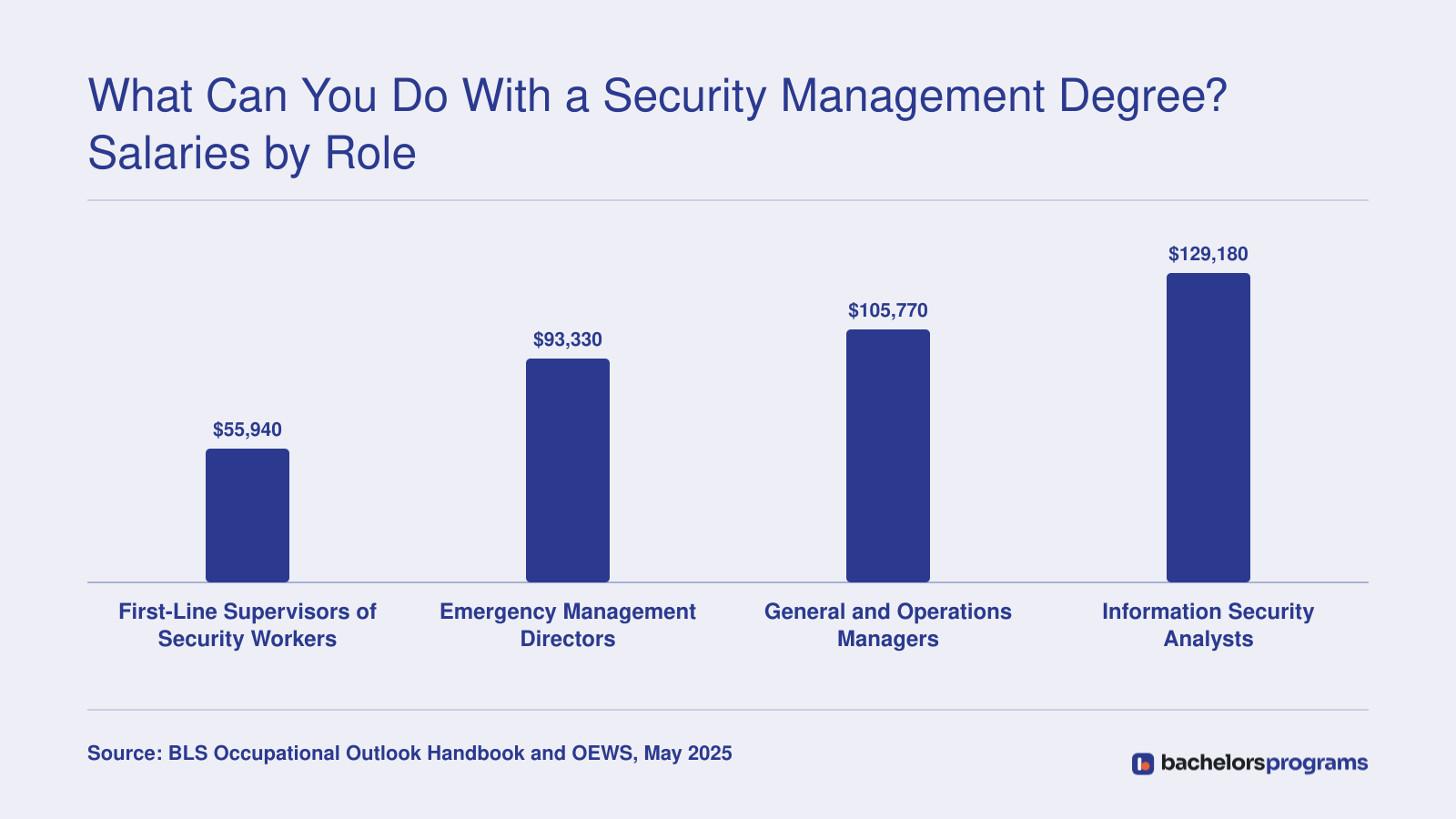
What Can You Do With a Security Management Degree? Salaries by Role
These BLS median wages (May 2025) describe each occupation as a whole, not recent graduates; program-level graduate earnings from the College Scorecard are covered separately in the salary section. Security supervisors direct and coordinate guards (4% projected growth, 2025-2035), emergency management directors plan disaster response (4%), information security analysts protect networks and data (21%), and general and operations managers oversee daily business operations. Most of these roles expect experience, so new graduates often start as security supervisors or analysts.
Certifications That Build on Your Security Management Degree
A bachelor's degree in security management shortens the experience needed for several leading professional credentials. Here is how the main options compare.
- Certified Protection Professional (CPP), ASIS InternationalRequires 6 years of security experience with a bachelor's degree versus 7 without one. Separately, at least 3 years must be in responsible charge of a security function, regardless of degree.
- Physical Security Professional (PSP), ASIS InternationalRequires 4 years of physical security experience with a bachelor's degree versus 5 without one.
- Certified Fraud Examiner (CFE), ACFEA bachelor's degree in any field earns 40 points, enough to sit for the CFE Exam. Without a degree, each full year of college earns 10 points, and fraud-related experience can substitute for academic study. To receive the credential, everyone needs 50 points plus at least 2 years of fraud-related experience.
- Cybersecurity credentials (Security+ or CISSP)Worth considering if you choose an information security concentration and plan to work on the technical side of security.
- Bachelor's versus associate or certificate optionsAn associate degree or certificate suits students who only need an entry-level credential. The bachelor's degree is the option that reduces experience requirements for the CPP and PSP and qualifies you to sit for the CFE Exam.
How to Choose the Right Online Security Management Program
The right program is the one that fits a working professional's schedule, target role, and existing credits, not the one with the biggest name.
Start with format. Asynchronous courses and multiple start dates suit most working security professionals better than fixed live sessions.
Next, match the concentration to your goal, whether corporate security, cyber, homeland security, or loss prevention. Confirm the coursework supports CPP or PSP preparation.
Then press schools on prior learning. Ask each school how it credits military training, police academy work, and industry certifications, since these can shorten your path and lower your bill.
Before applying, verify institutional accreditation and state authorization, then compare net price and program-level debt using the ranking above.
Your next step: request information from two or three ranked programs and compare their transfer evaluations side by side.
Security Management programs by state
Compare Security Management programs on the data that matters
Explore more Criminal Justice & Law majors or browse every field of study.
All Criminal Justice & Law programs Browse every field of study