Best Early Childhood Education Schools in Georgia
Compare 7 accredited Early Childhood Education programs in Georgia, with net price after aid, graduation rates, earnings and debt from IPEDS and the U.S. College Scorecard.

A bachelor's degree in early childhood education is the standard route to leading a Georgia classroom, and the state has tightened the path: since June 1, 2025, educators in a GaPSC-approved program must pass the content and reading exams to be certificated.
Schools usually title the degree Bachelor of Science (B.S.) in Early Childhood Education, though names vary, from Birth Through Five at Georgia State to Child Development at Point University. The schools ranked here, on campus and online, differ on cost, admissions and format.
The label matters less than whether a program leads to GaPSC certification.
Key Points
- Kennesaw State and Georgia State list in-state tuition under $9,000 yearly.
- Since June 2025, GaPSC certification requires passing content and reading exams.
- Georgia State's Birth Through Five B.S.Ed. runs fully online, plus field hours.
Best Bachelor's Degree in Early Childhood Education Schools in Georgia, Ranked
Georgia's bachelor's degree in early childhood education options run from a fully online birth through five program based in downtown Atlanta to a campus-based birth through kindergarten degree in Kennesaw, and every school below pairs coursework with supervised field experience in infant, toddler, preschool, or kindergarten settings. Program-level earnings four years after completion range from about $47,000 to $56,000 where federal data is reported. Institution-wide graduation rates at these seven schools run from about 34 percent to 70 percent, which reflects each institution's overall student body rather than any single program.
Mercer University
#1Macon, GA · ~$24,000/yr (est.)
Best for: Certification-track students wanting online coursework
Mercer University is a private university in Macon whose Tift College of Education awards the B.S.Ed. in Early Learning and Development, a degree built around child development, observation and assessment, and child care administration. Students choose a Birth through Kindergarten certification track or a non-certification Birth through 5 track, and all of them complete the Georgia Educator Ethics assessment plus an embedded Special Education Preschool endorsement. Classes blend synchronous and asynchronous online instruction with in-person field experiences, and the median graduate earns about $51,500 four years after completion.
- Two tracks: Birth through Kindergarten certification or non-certification Birth through 5
- 2.5 GPA minimum for entry
- Embedded Special Education Preschool endorsement
- 8-week sessions with five starts a year
- No GACE Program Admission assessment required
- Synchronous and asynchronous online courses
- Field experiences include pre-practicum and student teaching
- Most students take two courses per session
Georgia State University
#2Atlanta, GA · $9,000 – $25,000/yr (est.)
Best for: Atlanta career changers studying fully online
Georgia State University is a large public research university in downtown Atlanta, and its Birth Through Five, B.S.Ed. is delivered entirely online. The program prepares teachers and early care professionals to work with children from infancy through kindergarten, including children with disabilities, and clinical field experience happens in a work-based setting that can be the student's own child-centric workplace. Two concentrations separate a teacher certification route from a non-certification route, and the degree can be finished in as little as a year. Median earnings four years after completion are $54,899.
- 100% online coursework
- Teacher certification and non-certification concentrations
- Clinical field experience in work-based settings
- Practicum can be completed at a child-centric workplace
- Covers infancy through kindergarten, including children with disabilities
- Can be completed in as little as one year
- Out-of-state students should check their state licensing board
Georgia Southern University
#3Statesboro, GA · $15,000 – $20,000/yr (est.)
Best for: Hands-on learners wanting an on-campus child center
Georgia Southern University is a public university in Statesboro where child development study sits inside the Bachelor of Science in Human Development and Family Science, taken through the Child Development Career Pathway on campus or online. The 124-credit degree covers birth-to-5 developmental theory, working with children who have special needs, parent education, and family coursework. Statesboro campus students can log practicum hours at the Child Development Center with infants as young as 6 weeks, and the program reports that more than 75 percent of graduates gain employment immediately. Median earnings four years after completion are $47,109.
- Child Development Career Pathway inside a 124-credit degree
- Offered on the Statesboro campus and fully online
- Covers infants, toddlers, preschoolers and kindergarteners
- On-campus Child Development Center serves infants from 6 weeks
- Coursework in developmental theory, special needs and parent education
- Two named program scholarships with a Feb. 1 deadline
- $30 application fee
Kennesaw State University
#4Kennesaw, GA · ~$15,000/yr (est.)
Kennesaw State University is a large public university in the Atlanta metro whose Bachelor of Science in Early Childhood Education: Birth through Kindergarten is taught face to face on the Kennesaw campus. Students complete 120 credit hours over four years, start in fall, spring, or summer, and finish a student teaching practicum before graduation. Coursework spans prenatal development, infants and toddlers, preschool program administration, English Language Learners, and lesson planning and assessment, with a Traditional Certification concentration and a Non-Certification option. Median earnings four years after completion are $51,386.
- 120 credit hours over four years
- Face-to-face classes on the Kennesaw campus
- Starts in fall, spring, or summer
- Traditional Certification and Non-Certification concentrations
- Student teaching practicum required
- Prepares graduates to teach children ages 6 weeks through 5 years
- Coursework in preschool program administration and ELL learners
- Double Owl Pathway toward a graduate degree
Point University
#5West Point, GA · $25,000 – $30,000/yr (est.)
Point University is a private Christian university in West Point that offers a Bachelor of Science in Child Development entirely online in its Point Connect format. The degree prepares students for work with children from birth through age 8 in preschools, day care centers, private Christian schools, churches, camps, and nonprofit programs, using a constructivist approach with a live two-hour videoconference each week. Two 6-credit practica put students on site, and the degree meets the minimum education requirement for Lead Teacher in a Georgia PreK classroom without leading to PreK-5 teacher certification. Median earnings four years after completion are $55,626.
- Fully online in the Point Connect format
- Weekly live two-hour videoconference plus asynchronous work
- Birth through age 8 focus
- Practicum I: 6 credits, about 16 site hours weekly
- Practicum II: 6 credits, about 25 site hours weekly
- Meets the Georgia PreK Lead Teacher requirement, not PreK-5 certification
- Practicum application deadline of December 1
- Coursework toward an ACSI Early Education certificate
Clark Atlanta University
#6Atlanta, GA · $38,000/yr (est. net price)
Clark Atlanta University is a private, historically Black university in Atlanta whose Bachelor of Arts in Educational Studies-Child Development sits among its education offerings. The program is framed around the idea that public classroom teaching is only one of many paths open to education graduates, with emphasis on graduates as imaginative agents of change who can address persistent problems in schools and communities. It is a campus-based degree in Atlanta.
- Bachelor of Arts in Educational Studies with a child development focus
- Campus-based program in Atlanta
- Frames education careers beyond public classroom teaching
Morehouse College
#7Atlanta, GA · ~$39,000/yr (est.)
Morehouse College is a private, historically Black liberal arts college for men in Atlanta whose Education Department awards a Bachelor of Arts in Early Childhood Education alongside B.A. programs in Education Studies and Secondary Education. Graduates are eligible for teaching certification and prepared to teach grades PreK-5. The program sits under the Morehouse Center for Excellence in Education, which works with partner schools such as Utopian Academy for the Arts on teaching strategy and instructional technology research, and runs a CANDLE Lecture series built on culturally relevant pedagogy.
- Bachelor of Arts in Early Childhood Education
- Graduates eligible for teaching certification
- Prepares students to teach grades PreK-5
- One of several majors in the Education Department
- Center for Excellence in Education partners with area schools
- CANDLE Lecture series on culturally relevant pedagogy
Cost & outcomes by school
Federal data for the highest-earning Early Childhood Education programs, independent of the ranking above. Earnings are this field's bachelor's graduates four years after completing where the Scorecard reports them, else the school's undergraduate median.
| School | Net price / yr | Grad rate | Earnings | Debt | Grads/yr | Format |
|---|---|---|---|---|---|---|
| Point University GA | $25,335 | 34% | $55,626 | $25,250 | 8 | Online |
| Georgia State University GA | $15,931 | 53% | $54,899 | $24,750 | 85 | Online |
| Morehouse College GA | $39,013 | 59% | $52,889 | $25,000 | — | Campus |
| Mercer University GA | $23,847 | 70% | $51,513 | $35,500 | 61 | Online |
| Kennesaw State University GA | $15,048 | 52% | $51,386 | $25,000 | 238 | Campus |
| Georgia Southern University GA | $15,267 | 55% | $47,109 | $25,000 | 234 | Online or campus |
| Clark Atlanta University GA | $37,702 | 49% | $42,712 | $27,000 | 24 | Campus |
Sources: U.S. Department of Education. Net price, graduation rate, earnings and debt: College Scorecard (earnings and debt for this field's bachelor's graduates where reported, else school-wide); graduates: IPEDS. A dash means no figure is reported.
Cost, debt & payoff
Median earnings of this field's bachelor's graduates (4 yrs after completing, else the school's undergraduate median) vs. their median federal loan debt · U.S. College Scorecard
Across these programs the median graduate earns about $51,513 and finishes with roughly $25,000 in debt — a ratio that clears a common rule of thumb (keep debt below first-year salary). Net price and debt vary widely school to school, so check the per-school figures in the table above before you shortlist.
How We Ranked Georgia's Early Childhood Education Schools
A school's reputation and its results for graduates are not the same thing, and a ranking built on either one alone can point you the wrong way.
The Inputs That Move the List
Four measures carry the most weight. Net price shows what students actually pay after grant aid, not the sticker tuition printed in a catalog. Completions data indicates whether a program turns out graduates in meaningful numbers. Selectivity, read through acceptance rates and incoming test scores, gives a sense of the academic profile a school admits. A program that scores well on earnings but poorly on affordability, or the reverse, will not rank the same as one that holds up across all four.
Where the Numbers Stop
Net price and graduation rate are institution-wide averages. They describe a school's typical student, not a promise about your specific bill or your specific four years. Financial aid packages vary by family income and by year, and graduation rates pool every major on campus, including students who entered a decade ago. Treat these figures as a starting comparison, then confirm the details with each admissions and financial aid office.
What This List Covers
Every school profiled here offers a bachelor's degree in early childhood education or a closely related child development program, and every one is based in Georgia. Campus and online formats both count, so a program you can complete from Valdosta without relocating belongs on the same list as one in Atlanta.
Admissions: GPA, Test Policy, and Program Entry at Georgia Schools
Getting into an early childhood education bachelor's program in Georgia usually happens in two stages: the university admits you first, and the education department admits you later to upper-level coursework and classroom placements. We could not confirm a published minimum GPA, SAT/ACT policy, transfer credit rule, or separate program entry requirement for any of these programs, so ask each school's admissions office and education department before you apply. Tracks that lead to Georgia teacher certification often add steps such as a criminal background check or a state educator ethics assessment before field experiences, so confirm which steps apply to the program you choose.
| School | Bachelor's Program | Minimum GPA / Selectivity | Test Policy | Transfer Credit Policy | Education Program Entry Requirements |
|---|---|---|---|---|---|
| Mercer University (Macon) | B.S.Ed. in Early Learning and Development | Not confirmed; ask admissions | Not confirmed; ask admissions | Not confirmed; ask admissions | Not confirmed; ask the education department |
| Georgia State University (Atlanta) | Birth Through Five, B.S.Ed. | Not confirmed; ask admissions | Not confirmed; ask admissions | Not confirmed; ask admissions | Not confirmed; ask the education department |
| Georgia Southern University (Statesboro) | Bachelor of Science in Human Development and Family Science | Not confirmed; ask admissions | Not confirmed; ask admissions | Not confirmed; ask admissions | Not confirmed; ask the academic department |
| Kennesaw State University (Kennesaw) | Bachelor of Science in Early Childhood Education: Birth through Kindergarten | Not confirmed; ask admissions | Not confirmed; ask admissions | Not confirmed; ask admissions | Not confirmed; ask the education department |
| Point University (West Point) | Child Development | Not confirmed; ask admissions | Not confirmed; ask admissions | Not confirmed; ask admissions | Not confirmed; ask the academic department |
| Clark Atlanta University (Atlanta) | Educational Studies-Child Development | Not confirmed; ask admissions | Not confirmed; ask admissions | Not confirmed; ask admissions | Not confirmed; ask the education department |
| Morehouse College (Atlanta) | Early Childhood Education | Not confirmed; ask admissions | Not confirmed; ask admissions | Not confirmed; ask admissions | Not confirmed; ask the education department |
Transferring From a Georgia Technical College Into a Bachelor's Program
Transfer credit is what sits between a technical college and a bachelor's degree, and Georgia's published agreements cover general education far more reliably than they cover early childhood coursework itself.
What transfers, and what does not
What is not published is an early childhood-specific statewide deal: nothing establishes that Early Childhood Care and Education (ECCE) occupational courses move as a block into every USG bachelor's program. A February 2025 state board discussion recommended exploring statewide 2+2 or 2+3 agreements in the field, a sign the pathway is still being built.
Four steps before you enroll
- Ask course by course. Request a written evaluation of each class you have taken, not a general assurance that credits transfer.
- Separate general education from certification coursework. A course can transfer as credit and still not satisfy a state certification requirement. Confirm both.
- Ask about the 2+2 Associate of Science in Education route. It is a 61-credit pathway aimed at certified K-12 educators, with 2026 and 2027 start dates, and it is not the same as the standard ECCE associate degree.
- Talk to advisors at both schools before you register, and keep the answer in writing.
An hour with an advisor is cheap next to repeating a semester of tuition.
Related Articles
Online and Hybrid Early Childhood Education Bachelor's Options at Georgia Schools
An online or hybrid bachelor's in early childhood education delivers coursework through a screen but still sends you into real classrooms. No program here lets you skip in-person hours.
Which Schools Offer What
Kennesaw State, Clark Atlanta, and Morehouse deliver their programs on campus. Mercer, Georgia State, and Point deliver theirs online. Georgia Southern offers both formats through its Human Development and Family Science degree and its Child Development pathway, which is a related route rather than a standard teacher-prep degree.
Mercer describes a blended online and field-based format with 8-week sessions and synchronous and asynchronous options. Georgia State's Birth Through Five B.S.Ed. can be completed fully online.
How Field Placements Work
Georgia State says many clinical field experiences can happen in approved work-based settings, and student teaching requires at least 9 semester hours. Published details do not make clear how placements are arranged if you lack an eligible workplace, or whether sites outside Georgia are allowed. Mercer lists student teaching among its field experiences. Point requires two practicums, at 16 and 25 site hours per week, plus a background check and proof of tort liability.
For placements in Georgia schools, the Georgia Professional Standards Commission requires a Pre-Service Certificate. That involves a criminal-record check and the Georgia Educator Ethics-Program Entry Assessment.1
What to Confirm Before You Apply
- Placement rules: Ask whether you arrange your own site, whether it must be in Georgia, and whether your current job can count.
- Pacing: Compare session length and course load. Mercer's students typically take two courses per 8-week session, while Georgia State advertises completion in as little as a year.
- Certification: Check that the online route leads to Georgia teacher certification. Point's program meets the Georgia PreK Lead Teacher requirement but is not PreK-5 teacher certification.
- Deadlines: Practicum applications can close early. Point's is December 1.
What a Bachelor's Degree in Early Childhood Education Costs in Georgia
Georgia's public universities charge in-state students far less than the private schools here: Kennesaw State, Georgia Southern and Georgia State list in-state tuition and fees under $9,000 a year, and their average net price after aid falls between $15,048 and $15,931. The private schools, Mercer, Point, Clark Atlanta and Morehouse, have average net prices of $23,847 to $39,013, so state aid matters most for students weighing them. According to the Georgia Student Finance Commission, Georgia residents who earn a 3.00 high school GPA can qualify for the HOPE Scholarship, which at private schools paid $2,985 per full-time semester in 2025-26 and at public schools covers tuition on up to 15 hours per term; the Zell Miller Scholarship pays the same private-school amount and requires a 3.30 college GPA to keep.
| School | Type | In-State Tuition and Fees (per year) | Out-of-State Tuition and Fees (per year) | Average Net Price After Aid (per year) | Median Debt at Graduation (school-wide) |
|---|---|---|---|---|---|
| Kennesaw State University | Public | $5,808 | $17,736 | $15,048 | $23,833 |
| Georgia Southern University | Public | $6,022 | $17,734 | $15,267 | $23,250 |
| Georgia State University | Public | $8,664 | $24,840 | $15,931 | $20,903 |
| Mercer University | Private nonprofit | $42,312 | $42,312 | $23,847 | $24,199 |
| Point University | Private nonprofit | $24,000 | $24,000 | $25,335 | $25,250 |
| Clark Atlanta University | Private nonprofit | $28,310 | $28,310 | $37,702 | $27,000 |
| Morehouse College | Private nonprofit | $32,893 | $32,893 | $39,013 | $25,000 |
Georgia Certification for Early Childhood Educators: Gapsc Routes and GACE Exams
Georgia treats its content and reading exams as certification requirements in their own right: since June 1, 2025, educators in a GaPSC-approved program must pass them to be certificated, not merely to finish the degree.1 The credential itself comes from the Georgia Professional Standards Commission (GaPSC), and early childhood candidates choose between two routes.
The Two GaPSC Routes
Birth Through Kindergarten covers two pathways, one for infants and toddlers (birth through age 3) and one for ages 2½ through 6.4 Elementary Education P-5 covers kindergarten through fifth grade. Both routes require a bachelor's degree, completion of a GaPSC-approved or accepted preparation program, a passing GACE content assessment at Induction level or higher (the Birth Through Kindergarten assessment or the Elementary Education P-5 assessment), the Georgia Educator Ethics Assessment (Test Code 351), and a literacy assessment.2 For both routes the reading requirement is the Application of the Science of Reading Assessment.3
Do You Need a Bachelor's Degree to Teach Pre-K in Georgia?
For a GaPSC certificate, yes. The bachelor's degree is the baseline, and candidates whose degree or major is not clearly aligned with the field may need to pass the content assessment at program admission and take additional coursework.5 One caution: Georgia's Pre-K program is run by Bright from the Start, which sets lead-teacher employment qualifications under its own standards, separate from GaPSC certification. Confirm that standard directly with the provider you are considering.
Certification Track vs. Non-Certification
Certification-track programs prepare you for a GaPSC certificate and for teaching in public school pre-K and elementary classrooms. Non-certification programs in child development, human development and family science, or educational studies suit child care administration, Head Start, early intervention, and family support work, and generally do not lead to a certificate on their own. Program titles alone will not tell you which is which.
What to Confirm With a Program
- Whether graduates are recommended for GaPSC certification
- Which GACE content assessment the program prepares you for
- When the ethics and literacy assessments must be passed
- Which age groups your field placements cover
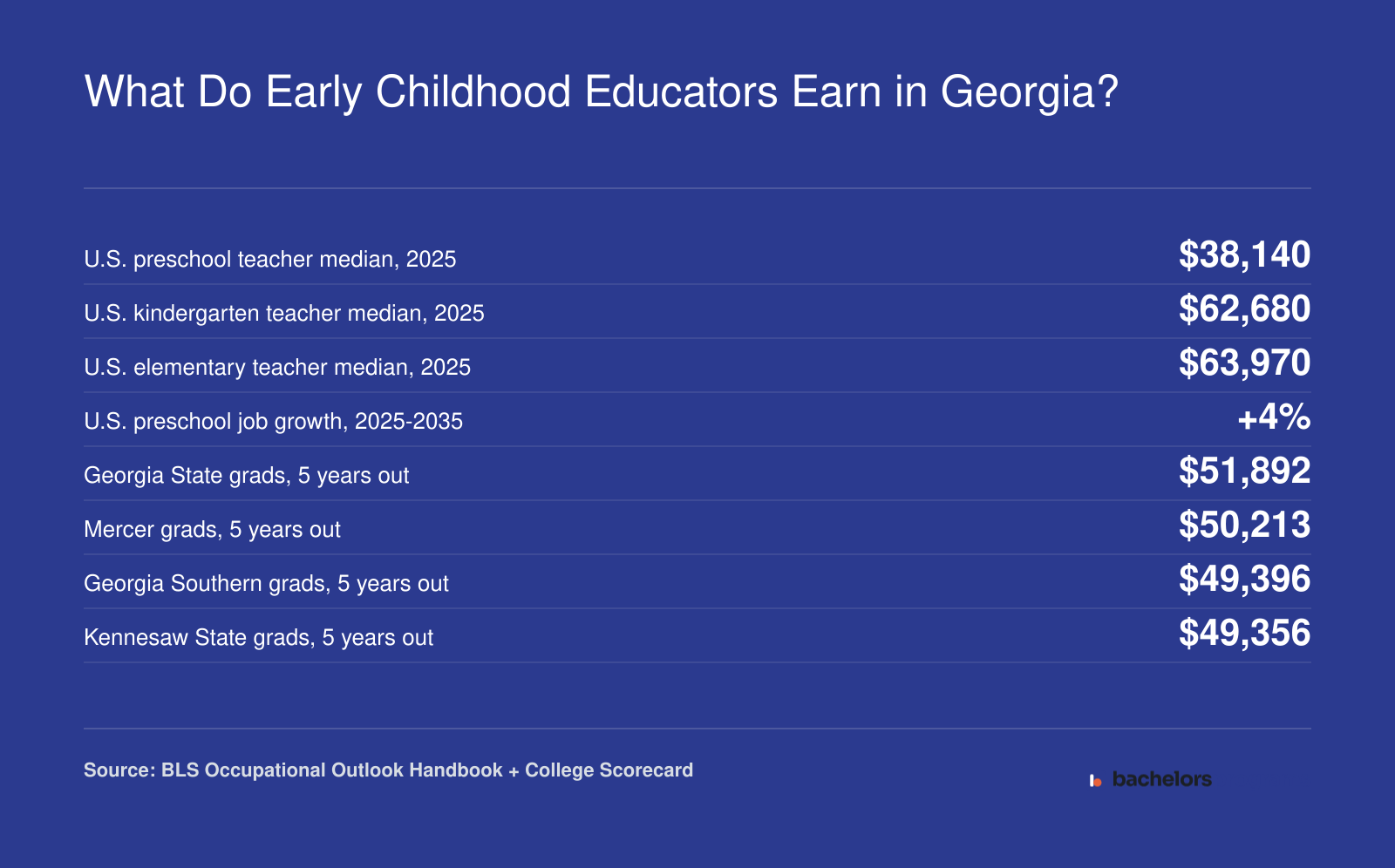
What Do Early Childhood Educators Earn in Georgia?
The occupation figures are 2025 national median wages from the Bureau of Labor Statistics. The school figures are College Scorecard median earnings for each school's own early childhood education bachelor's completers five years after finishing, not campus-wide results. For job outlook, BLS projects 4% national growth for preschool teachers from 2025 to 2035 and little or no change for kindergarten and elementary teachers, though turnover and retirements still create about 99,400 kindergarten and elementary openings a year nationwide.
How to Choose Between Georgia Early Childhood Education Schools
Start with the job you want, because pay in Georgia varies widely by role. The state's early care and education workforce had a median wage of $11.44 per hour in 2022, with child care workers at $10.00 and preschool teachers at $11.77. Elementary and middle school teachers, counted as a separate occupation, had a median of $30.49. Georgia Pre-K lead teachers averaged $38,987.50 in 2020, and 95% held a bachelor's degree in early childhood education or higher. Use the table to match each school's program title to your goal, then confirm certification details with the school.
| School | Location | Program title | Focus suggested by the title | Question to ask before applying |
|---|---|---|---|---|
| Mercer University | Macon | B.S.Ed. in Early Learning and Development | Education degree centered on early learning | Which Georgia certification route does this program prepare me for? |
| Georgia State University | Atlanta | Birth Through Five, B.S.Ed. | Infants through age five, including Pre-K settings | How are clinical placements arranged in the Atlanta area? |
| Georgia Southern University | Statesboro | Bachelor of Science in Human Development and Family Science | Broader child and family development | Does this degree lead to a teaching certificate, or to other child and family roles? |
| Kennesaw State University | Kennesaw | Bachelor of Science in Early Childhood Education: Birth through Kindergarten | Birth through kindergarten teaching | Which classroom levels does the program prepare me to teach? |
| Point University | West Point | Child Development | Child development rather than a teaching title | Does the program include a teacher preparation track? |
| Clark Atlanta University | Atlanta | Educational Studies-Child Development | Education studies with a child development emphasis | Which licensure or career paths do graduates typically pursue? |
| Morehouse College | Atlanta | Early Childhood Education | Early childhood education as the named field | What field experience and certification support does the program offer? |
Frequently Asked Questions About Early Childhood Education Degrees in Georgia
Which Georgia colleges offer a bachelor's degree in early childhood education?
How much does an early childhood education degree cost in Georgia?
How much do early childhood education teachers make in Georgia?
Can you get a bachelor's degree in early childhood education online in Georgia?
Do you need a bachelor's degree to teach pre-K in Georgia?
What is the difference between certification and non-certification early childhood education tracks in Georgia?
Compare Early Childhood Education programs on the data that matters
Explore more Education & Teaching majors or browse every field of study.
All Education & Teaching programs Browse every field of study