Best Early Childhood Education Schools in Minnesota
Compare 10 accredited Early Childhood Education programs in Minnesota, with net price after aid, graduation rates, earnings and debt from IPEDS and the U.S. College Scorecard.

A licensure track and a child development degree can look alike on a course list, yet only one leads to a Minnesota birth through grade three teaching license. That split shapes every decision about a bachelor's degree in early childhood education, including what a school's Bachelor of Science (B.S.) in Early Childhood Education, the most common credential, actually qualifies you to do.
Each ranked campus and online program is profiled for cost, admissions, licensure and career outcomes. The figures come from institution-level College Scorecard data, so they are a starting point for a shortlist rather than a final answer.
Check licensure status first. Metropolitan State University and Walden University offer non-licensure degrees, and Martin Luther College students admitted for 2026-27 are ineligible for Minnesota licensure.
Key Points
- University of Minnesota-Twin Cities graduates lead, earning $56,388 five years out.
- Public in-state tuition here starts around $9,572 before financial aid.
- Online formats exist, but Minnesota licensure tracks still require in-person classroom time.
Best Bachelor's Degree in Early Childhood Education Schools in Minnesota
Minnesota's early childhood bachelor's programs split into two broad types: licensure tracks that prepare teachers for birth through grade three classrooms, and child development or studies degrees aimed at directors, administrators and family services roles. The ten schools below range from a large public research university and regional Minnesota State campuses to private colleges and one fully online institution, so readers can weigh delivery format, price and clinical hours before shortlisting.
University of Minnesota-Twin Cities
#1Minneapolis, MN · ~$17,000/yr (est.)
Best for: Future birth-to-third-grade teachers seeking licensure
The University of Minnesota Twin Cities is the state's flagship public research university, and its early childhood major sits inside a large college of education with formal school and district partnerships. Undergraduates pick among three tracks, and the licensure routes add a fifth year to earn a master's degree and apply for Minnesota licensure to teach birth through third grade. Practicum or student teaching appears in more than half of semesters, including a term at the campus Child Development Laboratory School. Community college students also have a guaranteed transfer route into selected university majors through the Minnesota Cooperative Admissions Program.
- Three tracks: early education, early and elementary, individualized studies
- 120 total credit hours
- Licensure for birth through grade 3, or birth through grade 6
- Optional fifth year earns an MEd alongside licensure
- Practicum or student teaching in more than half of semesters
- Student teaching at the campus Child Development Laboratory School
- Automatic consideration for the Campbell Scholarship for Education
- Study abroad in Montpellier, France with no French background required
Martin Luther College
#2New Ulm, MN · ~$18,000/yr (est.)
Best for: Lutheran educators preparing for church ministry
Martin Luther College is a small private college in New Ulm operated by the Wisconsin Evangelical Lutheran Synod, and its early childhood major trains teachers for Lutheran early childhood ministries rather than the state licensure pipeline. Graduates are assigned to ministries serving children from birth through grade three. The 130-credit program divides into content courses, professional education and field experiences, ending with student teaching in infant, toddler and preprimary settings plus a portfolio review. New and transferring students admitted for 2026-27 are not eligible for Minnesota licensure, so it suits readers whose goal is church-based early childhood work.
- 130 total credit hours completed in four years
- Prepares for Wisconsin Evangelical Lutheran Synod early childhood ministry
- Graduates assigned to ministries serving birth through grade 3
- 25 credits of required content courses
- 47 credits of professional education coursework
- 20 credits of field experience ending in student teaching
- Student teaching in infant, toddler and preprimary settings
- 2026-27 admits are not eligible for Minnesota licensure
Winona State University
#3Winona, MN · ~$18,000/yr (est.)
Best for: Online transfer students balancing work and school
Winona State University is a regional public university in southeastern Minnesota whose early childhood education degree is built as a transfer pathway for students arriving with prior college credit. The major runs entirely online, with mostly asynchronous work plus three synchronous sessions each semester, and clinical placements draw on partnerships with more than 90 school districts. A 15-hour early clinical experience is required before admission to teacher education, and the final semester is student teaching. Graduates are prepared to apply for Minnesota Early Childhood Education licensure.
- 57 credits in the major within a 120-credit degree
- Fully online with mostly asynchronous coursework
- Three synchronous sessions each semester
- Transfer pathway for students entering with prior credit
- 15 hours of early clinical experience before teacher education admission
- Student teaching with a network of more than 90 school districts
- Prepares for Minnesota Early Childhood Education licensure
- Not F-1 eligible for international students
Minnesota State University Moorhead
#4Moorhead, MN · ~$18,000/yr (est.)
Minnesota State University Moorhead is a regional public university in the Red River Valley with a long-standing teacher preparation tradition. Early childhood majors log 200 hours of in-classroom practicum and choose between fully online and on-campus delivery, with an on-campus Early Education Center serving children from 16 months to 5 years old. The program holds CAEP accreditation and reports a 100% MTLE pass rate. Student teaching abroad, a first-year education learning community and six education student organizations round out the experience for students who want a cohort feel.
- 200 hours of in-classroom practicum
- Choose fully online or on-campus delivery
- CAEP accredited program
- Program reports a 100% MTLE pass rate
- Prepares teachers for birth through grade 3
- On-campus Early Education Center for children 16 months to 5 years
- Student teaching abroad available
- First-year education learning community and six student organizations
Minnesota State University-Mankato
#5Mankato, MN · $10,000 – $19,000/yr (est.)
Minnesota State University Mankato is one of the larger public universities in the Minnesota State system, and its child development and family science degree takes a broader human services angle than a teaching licensure track. The 120-credit program includes 57 major credits, a supervised internship and 18 credits of restricted electives, and it is certified by the National Council on Family Relations. Classes run at the Mankato campus and online, and admission is open to any interested student who completes major coursework with a C- or better. The emphasis on family policy, ethics and parent-child relations points graduates toward human services and education support roles.
- 120 total credits, including 57 in the major
- 18 credits of restricted electives
- Certified by the National Council on Family Relations
- Supervised internship available
- Classes at the Mankato campus or online
- Open admission; major courses require C- or better
- Coursework in family policy, ethics and parent-child relations
Metropolitan State University
#6Saint Paul, MN · ~$17,000/yr (est.)
Metropolitan State University is a Saint Paul public university built around adult learners and transfer students, and its early childhood studies degree is designed for people already working in child care. The applied science degree requires a practicum, includes MnAEYC Director's Credential coursework and awards credit for a CDA credential or AMI diploma through prior learning assessment. It does not lead to a Minnesota teaching license, so it fits readers aiming at director, trainer or administrator roles in centers, Head Start programs and preschools. Admission requires a program declaration form and a Minnesota Department of Human Services background study with photo and fingerprint.
- 120 total credits, 43 in the major
- Required 20-hour practicum
- MnAEYC Director's Credential coursework included
- Credit for a CDA credential or AMI diploma via prior learning assessment
- Does not lead to a Minnesota teaching license
- Transfer pathway from Minnesota State colleges
- Capstone in professionalism and ethics
- Admission requires a state background study with fingerprints
Southwest Minnesota State University
#7Marshall, MN · ~$15,000/yr (est.)
Southwest Minnesota State University is a small public university in Marshall with an early childhood education degree built directly around state teaching standards. The 75-credit major layers early childhood content, the Standards of Effective Practice and 12 credits of student teaching, with dedicated courses in infants and toddlers, kindergarten methods and early childhood leadership and advocacy. Literacy coursework plus special education and multilingual learner foundations are folded into the sequence, and wellness, safety and nutrition content runs from birth to grade three. The final term pairs student teaching with teacher licensure coursework.
- 75 credits in the major
- 22 credits in the Standards of Effective Practice
- 41 credits of early childhood content
- 12 credits of student teaching plus licensure coursework
- Dedicated courses in infants and toddlers and kindergarten methods
- Practicum in early childhood leadership and advocacy
- Wellness, safety and nutrition course for birth through grade 3
- Includes special education and multilingual learner foundations
Concordia University-Saint Paul
#8Saint Paul, MN · ~$18,000/yr (est.)
Concordia University Saint Paul is a private Christian university in the state capital whose child development major is offered fully online for adult students. The 42-credit major follows NAEYC standards for initial professional preparation and covers infants and toddlers, children's play and learning, language development and emergent literacy, dual language learners and the young child with special needs. The degree does not lead to a teaching license, and readers who want a Minnesota birth through grade three license should look at the university's separate early childhood education major. Three prerequisite courses gate the rest of the sequence, and the program closes with a child development capstone.
- 42 credits in the major within a 120-credit degree
- Fully online for adult students
- Aligned with NAEYC initial preparation standards
- Three prerequisite courses gate the rest of the sequence
- Child Development capstone required
- Does not lead to a teaching license
- Separate Birth through Grade Three licensure major available
Saint Cloud State University
#9Saint Cloud, MN · ~$14,000/yr (est.)
Saint Cloud State University is a public university in central Minnesota offering an on-campus early childhood education degree. The 120-credit program carries 82 credits in the major and covers child development, work with parents and community, inclusive educational practices, diversity and equity, and authentic assessment. Fieldwork ends with 12 weeks of pre-kindergarten student teaching and 8 weeks in a K-3 setting. The program prepares teachers for birth through grade three and also points toward program coordination, center direction and children's museum roles.
- 120 total credits, 82 in the major
- 12 weeks of pre-kindergarten student teaching
- 8 weeks of K-3 student teaching
- Prepares teachers for birth through grade 3
- Coursework in inclusive practice, diversity and authentic assessment
- On-campus delivery in St. Cloud
- Also prepares program coordinators and directors
Walden University
#10Minneapolis, MN · $34,000/yr (est. net price)
Walden University is a fully online institution with a Minneapolis address, and its early childhood studies bachelor's degree runs on a competency-based subscription model rather than per-course tuition. Students pay a flat rate per three-month term and move ahead as they demonstrate competencies, with an academic coach assigned from start to graduation and up to 135 quarter credits accepted in transfer. Coursework is aligned with NAEYC standards, and the degree is non-licensure, aimed at preschool and daycare administrators. Admission requires a high school diploma or equivalent plus one of several readiness benchmarks, with no application fee, essay, SAT or ACT.
- 180 quarter credits, fully online
- Flat-rate 3-month subscription billing instead of per course
- Competency-based format through Tempo Learning
- Academic coach assigned from start to graduation
- Up to 135 quarter credits accepted in transfer
- No application fee, essay, SAT or ACT required
- Coursework aligned with NAEYC standards
- Non-licensure; does not lead to teacher certification
Cost & outcomes by school
Federal data for the highest-earning Early Childhood Education programs, independent of the ranking above. Earnings are this field's bachelor's graduates four years after completing where the Scorecard reports them, else the school's undergraduate median.
| School | Net price / yr | Grad rate | Earnings | Debt | Grads/yr | Format |
|---|---|---|---|---|---|---|
| Martin Luther College MN | $18,463 | 72% | $56,435 | $20,695 | 65 | Campus |
| University of Minnesota-Twin Cities MN | $16,778 | 85% | $53,276 | $19,497 | 103 | Campus |
| Metropolitan State University MN | $16,863 | 44% | $49,025 | $27,778 | 29 | Campus |
| Minnesota State University-Mankato MN | $19,139 | 54% | $48,632 | $25,000 | 78 | Online or campus |
| Winona State University MN | $17,503 | 57% | $46,863 | $22,000 | 126 | Online |
| Saint Cloud State University MN | $13,529 | 40% | $45,386 | $23,250 | 50 | Campus |
| Minnesota State University Moorhead MN | $17,997 | 57% | $45,142 | $25,165 | 66 | Online or campus |
| Southwest Minnesota State University MN | $15,291 | 45% | $43,904 | $21,977 | 60 | Online or campus |
| Walden University MN | $33,817 | — | $42,810 | $36,500 | 356 | Online |
| Concordia University-Saint Paul MN | $18,462 | 46% | $40,801 | $20,000 | 34 | Online |
Sources: U.S. Department of Education. Net price, graduation rate, earnings and debt: College Scorecard (earnings and debt for this field's bachelor's graduates where reported, else school-wide); graduates: IPEDS. A dash means no figure is reported.
Cost, debt & payoff
Median earnings of this field's bachelor's graduates (4 yrs after completing, else the school's undergraduate median) vs. their median federal loan debt · U.S. College Scorecard
Across these programs the median graduate earns about $46,125 and finishes with roughly $22,625 in debt — a ratio that clears a common rule of thumb (keep debt below first-year salary). Net price and debt vary widely school to school, so check the per-school figures in the table above before you shortlist.
Most Affordable Minnesota Early Childhood Bachelor's Programs
The cost figure below is the average annual net price after grants and scholarships for full-time undergraduates receiving aid, based on 2024 IPEDS and College Scorecard data from the U.S. Department of Education. In-state tuition and fees before aid are listed alongside for comparison. Each net price is a school-wide average for students who receive aid at these public universities, not a quote for any individual student, and your own cost will depend on family income and the aid you qualify for. The cost section later on this page covers Minnesota state grant and scholarship programs that can lower these figures further.
| School | City | Program | Format | Average Net Price After Aid (per year) | In-State Tuition and Fees (per year) | Graduation Rate | Licensure Focus |
|---|---|---|---|---|---|---|---|
| Saint Cloud State University | Saint Cloud | Early Childhood Education | Campus | $13,529 | $10,245 | 40% | Birth through grade 3, with Pre-K and K-3 student teaching |
| Southwest Minnesota State University | Marshall | Early Childhood Education, BS | Campus and online | $15,291 | $10,361 | 45% | Includes teacher licensure coursework, birth to grade 3 |
| University of Minnesota-Twin Cities | Minneapolis | Bachelor of Science (BS) in Early Childhood | Campus | $16,778 | $17,214 | 85% | Licensure for birth through 3rd or 6th grade |
| Metropolitan State University | Saint Paul | Early Childhood Studies BAS | Campus | $16,863 | $9,840 | 44% | Does not lead to a Minnesota teaching license |
| Winona State University | Winona | Early Childhood Education (Birth-Grade 3) | Online option | $17,503 | $10,576 | 57% | Prepares for Minnesota teaching licensure |
Which Minnesota Early Childhood Programs Lead to the Highest Earnings?
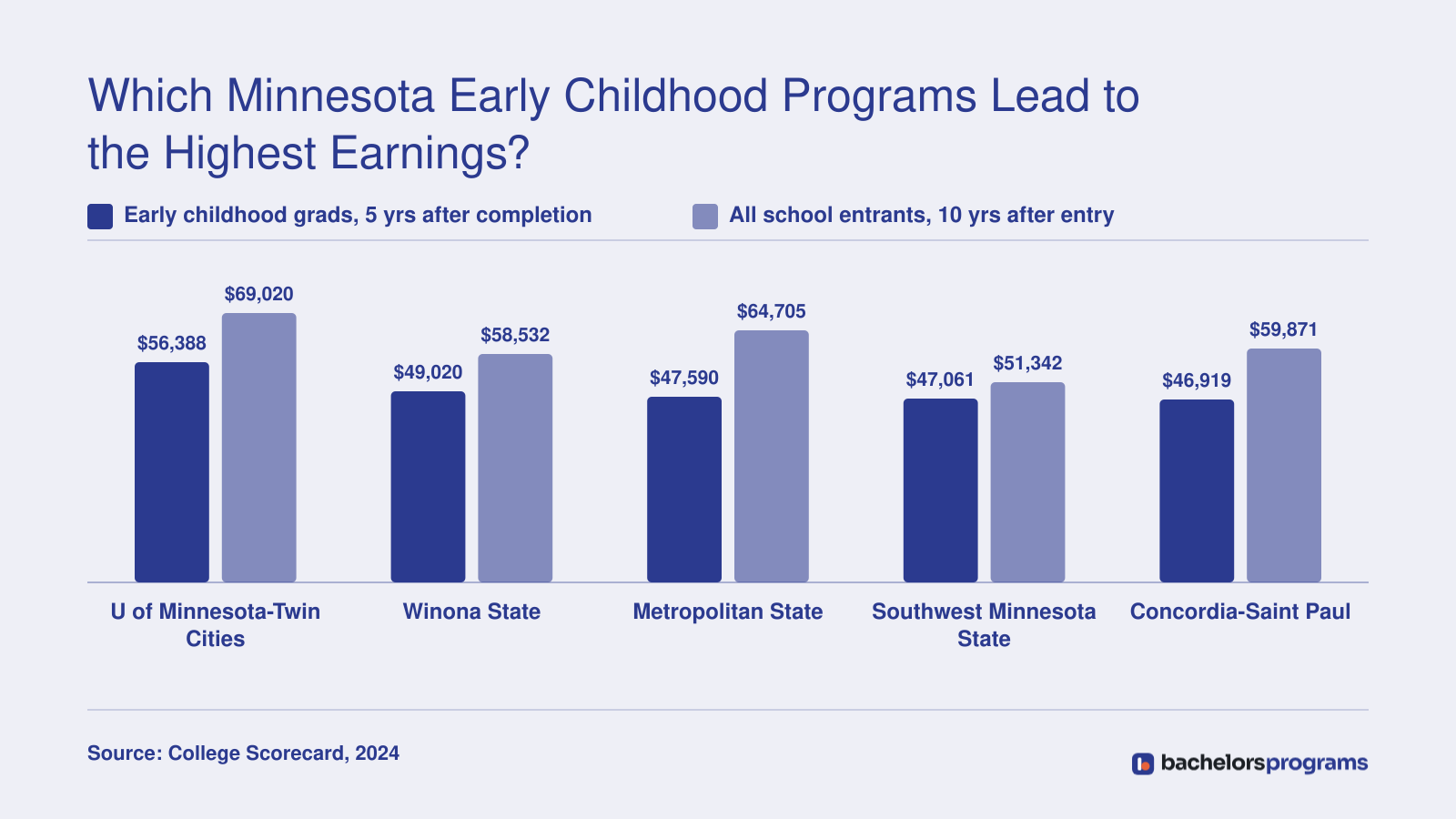
Five years after completing an early childhood bachelor's program, median earnings run from $46,919 at Concordia University-Saint Paul to $56,388 at the University of Minnesota-Twin Cities. The second bar for each school is institution-wide: median earnings for all students who entered that school, measured ten years after entry, not the early childhood program's own result. Average annual net price after aid at these schools ranges from $15,291 at Southwest Minnesota State to $18,462 at Concordia, a much narrower spread than the gap in graduate earnings.
Online and Hybrid Bachelor's Options at Minnesota Schools
Several Minnesota schools let you earn a bachelor's degree in early childhood education without relocating. Licensure tracks, however, still require in-person classroom time. Each format handles campus time differently.
Which Schools Offer Online or Hybrid Formats
- Online: Winona State University (Birth-Grade 3), Concordia University-Saint Paul (Child Development) and Walden University (BS in Early Childhood Studies).
- Online or on campus: Minnesota State University Moorhead, Minnesota State University-Mankato and Southwest Minnesota State University let you choose either format.
- Campus-based: University of Minnesota-Twin Cities, Martin Luther College, Metropolitan State University and Saint Cloud State University.
Student Teaching When You Live Far From Campus
Online coursework does not mean online student teaching. Southwest Minnesota State's program page explains that the state's Professional Educator Licensing and Standards Board (PELSB) requires all field experiences, practicums and student teaching to take place in a Minnesota public school under a Minnesota-licensed teacher.1 Its final-year placement runs 12 to 16 weeks full-time with a cooperating teacher.1 If you live outside Minnesota, plan to spend that semester in the state.
Winona State arranges student teaching through a network of more than 90 districts, which can widen your placement options. Minnesota State Moorhead requires 200 clinical hours and offers student teaching abroad. Ask each school how it assigns placements and whether it will work with districts near your home.
Class Schedules and Completion Time
Southwest Minnesota State's online program is asynchronous, with no set class times.1 Winona State offers both synchronous and asynchronous options, so check which courses require live attendance. Walden runs on flat-rate, three-month subscription terms and lists a 15-month program for students who transfer in substantial credit.
Completion time depends on your credit load. At Southwest Minnesota State, the program generally takes 2 to 4 years.1 Full-time students typically take 12 to 15 credits a semester, while part-time students taking 6 to 9 credits often need 3 to 4 years.
Confirm Licensure Approval Before You Enroll
If a Minnesota teaching license is your goal, confirm the program leads to one before anything else. Several online options here are explicitly non-licensure:
- Concordia-Saint Paul's online Child Development major. Concordia offers a separate Birth-Grade Three licensure major.
- Walden's Early Childhood Studies degree, which carries no teacher certification.
Ask the admissions office directly whether the program is PELSB-approved for Minnesota licensure. Get the answer in writing before you pay a deposit.
Related Articles
Cost of an Early Childhood Education Bachelor's Degree in Minnesota
Minnesota's public universities charge far less in sticker tuition than its private ones, but the gap shrinks once aid and living costs are counted.
Tuition vs. Net Price
Among the public schools here, in-state tuition runs from about $9,572 at Minnesota State University-Mankato to $10,576 at Winona State University. Metropolitan State University ($9,840), Saint Cloud State University ($10,245), Southwest Minnesota State University ($10,361) and Minnesota State University Moorhead ($10,428) fall in that band. The University of Minnesota-Twin Cities is higher at $17,214.
Private sticker prices are steeper: Concordia University-Saint Paul lists $25,600 and Martin Luther College $18,120. Yet their net prices after aid, $18,462 and $18,463, sit close to Mankato's $19,139 and Moorhead's $17,997. Net price includes living costs, so it can exceed tuition at public schools. The University of Minnesota-Twin Cities is the reverse, with a net price ($16,778) just under its tuition. Walden University advertises $8,000 total program tuition for its 15-month online degree, though its institution-wide net price is much higher, so confirm your own cost with the school.
Where program-level borrowing figures exist, median debt among graduates runs from roughly $19,500 at the University of Minnesota-Twin Cities to $36,500 at Walden University.
Minnesota Aid You Can Stack
- Minnesota State Grant: Need-based aid for Minnesota residents who are at least 17, enrolled at least 3 credits per term at an eligible institution, and not in default on student loans.1 It is not limited by major, so early childhood students may qualify.
- Teacher Candidate Grant: Now called the Minnesota Student Teachers in Shortage Areas Grant.2 It requires financial need, satisfactory progress and a program with at least 12 weeks of student teaching.2 You must also plan to teach in a rural district or shortage area, or belong to a group underrepresented in the teacher workforce.
- Great Start Compensation Support: The state pays this to eligible child care programs to raise educator pay; it is not a tuition award. Ask your employer whether it applies.
- T.E.A.C.H. Early Childhood Minnesota: Scholarships for people already working in early childhood settings, usually with an employer sponsor and a commitment to stay in the field.
Award amounts change by year and by need, so confirm current figures with the Minnesota Office of Higher Education and each program before budgeting.
One Tip That Lowers Your Price
File the FAFSA as soon as it opens each fall (typically October 1), since school priority deadlines vary and state grants depend on it. Students who can't file the FAFSA can complete the Minnesota Dream Act application through the Office of Higher Education.
What Early Childhood Teachers Earn in Minnesota
Preschool teachers in Minnesota earn a median of $44,637 a year, above the national median hourly rate of $18.85.
Questions to Ask Yourself
Do you need a Minnesota birth to grade 3 teaching license, or will a non-licensure degree get you to the job you want?
Can you complete daytime student teaching in a Minnesota classroom?
Is the school's net price after the Minnesota State Grant within your budget?
Compare Early Childhood Education programs on the data that matters
Explore more Education & Teaching majors or browse every field of study.
All Education & Teaching programs Browse every field of study