Best Early Childhood Education Schools in North Carolina
Compare 16 accredited Early Childhood Education programs in North Carolina at 14 colleges, with net price after aid, graduation rates, earnings and debt from IPEDS and the U.S. College Scorecard.
Licensed Birth through Kindergarten teachers in North Carolina get there through a bachelor's degree, and the license itself comes from the state's Department of Public Instruction, not the university. Most programs award a Bachelor of Science (B.S.) in Early Childhood Education, though some schools label the major child development or family studies.
That labeling gap matters. Some programs include a licensure track and student teaching, while others lead toward family services. The schools ranked here are all North Carolina-based, with campus and online formats, and their cost and earnings outcomes vary widely.
A program's title rarely reveals whether it leads to a classroom.
Key Points
- UNC Chapel Hill graduates leave with a median $12,000 in federal loans.
- North Carolina kindergarten teachers earned a $53,180 median wage in May 2025.
- Appalachian State splits child development into licensure and non-licensure tracks.
Best Bachelor's in Early Childhood Education Schools in North Carolina
North Carolina offers more than a dozen bachelor's programs in early childhood education and child development, and they are far from interchangeable. Some lead straight to Birth through Kindergarten licensure and a classroom, while others prepare students for family services, child life, or graduate study. The ten below combine solid completion outcomes, manageable cost, and real depth in the field, and the methodology note explains how those factors were weighed.
University of North Carolina at Chapel Hill
#1Chapel Hill, NC · ~$12,000/yr (est.)
Best for: Family science students eyeing research careers
Carolina's human development and family science major is a Bachelor of Arts in Education housed in the School of Education, with optional concentrations in child and family health or family life education. Students take 48 credit hours, including a nine-credit senior internship and a research methods sequence, and the program supplies coursework for the Certified Family Life Educator credential. The Frank Porter Graham Child Development Institute gives undergraduates a statewide view of early-childhood policy, research, and practice. Graduation rates at schools offering this program run near 91 percent, an institution-wide figure that reflects the whole university rather than the major alone.
- 48 credit hours, including a 9-credit senior internship
- Two optional concentrations: child and family health, family life education
- Admission each semester on a recommended 2.5 GPA
- Coursework covers development from prenatal through age 12
- Prepares students for the Certified Family Life Educator credential
- Senior honors thesis open to students with a 3.3 GPA
- C or better required in every major course
University of North Carolina at Charlotte
#2Charlotte, NC · $15,000 – $20,000/yr (est.)
Best for: Charlotte-area students pursuing birth-kindergarten licensure
UNC Charlotte folds early childhood study into a Bachelor of Arts in Child and Family Development, with a Birth-Kindergarten licensure option sitting alongside elementary, middle grades, and special education majors. Students study within the same college that prepares the Charlotte region's teachers, which keeps fieldwork and school partnerships close at hand. The major graduates a steady cohort each year and appeals to students who want licensure without leaving an urban campus. Institution-wide graduation rates at schools offering this program sit near 69 percent, a whole-university measure rather than one tied to the major.
- Bachelor of Arts in Child & Family Development
- Birth-Kindergarten licensure option available
- Listed among the college's undergraduate education majors alongside elementary and special education
Appalachian State University
#3Boone, NC · $8,000 – $25,000/yr (est.)
Best for: Future teachers seeking dual special education certification
Appalachian State awards a Bachelor of Science in Child Development with a Birth to Kindergarten licensure track through the Reich College of Education, plus a non-licensure child and family science route. The licensure track leads to North Carolina "A" licensure with dual certification in regular and special education, and students train at the Lucy Brock Child Development Lab on the Boone campus. Teacher education programs carry Council for the Accreditation of Educator Preparation accreditation, and no minor is required. School-wide graduation rates at institutions offering this program land near 75 percent.
- CAEP-accredited teacher preparation
- Fully online option available
- Leads to North Carolina "A" licensure with dual regular and special education certification
- Training at the Lucy Brock Child Development Lab
- No minor required
- Accelerated bachelor's to master's option
- Scholarships and financial aid available
- Non-licensure route in child and family science
- Coursework spans prenatal development through adolescence
- Family studies coursework alongside child development
- Two required field experiences
- Prepares students for early intervention agencies and family support roles
Elizabeth City State University
#4Elizabeth City, NC · $5,000 – $10,000/yr (est.)
Elizabeth City State University runs a Birth through Kindergarten baccalaureate program at the initial-licensure level, and its educator preparation programs hold CAEP accreditation as of April 2024. The department reports that all of its program completers were hired within a year of finishing, and the university maintains transfer partnerships with community colleges across northeastern North Carolina. Admission to the educator preparation program requires a 2.7 undergraduate GPA, a background check, and 15 hours of classroom field experience. Graduation rates at schools offering this program sit near 44 percent, an institution-wide measure covering the entire university.
- Initial-licensure program in birth through kindergarten
- CAEP-accredited undergraduate educator preparation
- Educator Preparation Program admission requires a 2.7 GPA
- 15 hours of classroom field experience before admission
- Criminal background check required
- Prepares candidates for edTPA
- Department reports 100% of completers hired within one year
- Freshman admission: 2.5 weighted GPA and a $30 application fee
East Carolina University
#5Greenville, NC · ~$16,000/yr (est.)
East Carolina University's Bachelor of Science in Birth through Kindergarten Professional Studies leads to North Carolina BK teaching licensure, with at least 120 semester hours split among general education, core, and concentration coursework. Practicums happen at the NAEYC-accredited Nancy W. Darden Child Development Center, and the program reports a 100 percent edTPA pass rate. Upper-division admission requires Praxis Core scores and a 2.7 cumulative GPA, and a semester-long internship caps the degree. Institution-wide graduation rates at schools offering this program are around 63 percent.
- At least 120 semester hours: 40 general education, 44 core, 31 concentration
- Fully online option available
- Practicums at the NAEYC-accredited Nancy W. Darden Child Development Center
- Program reports a 100% edTPA pass rate
- Upper-division admission requires Praxis Core and a 2.7 GPA
- Semester-long internship, applied for a year in advance
- Employed students can complete practicums at their own workplace
- Minimum C grade required in major courses
University of North Carolina at Greensboro
#6Greensboro, NC · $11,000/yr (est. net price)
UNC Greensboro's Bachelor of Science in Early Childhood Development and Education offers two concentrations, Birth Through Kindergarten Teacher Licensure and Early Care and Education, in traditional and online formats. The licensure track adds supervised student teaching and a seminar, while the early care track pulls electives from administration and management, world cultures, or healthy lifestyles. Admission to Teacher Education requires a 3.0 overall GPA. Graduation rates at schools offering this program sit near 56 percent, an institution-wide figure rather than a program-specific one.
- 52 required credits plus 18 to 19 related-area credits
- Electives in administration and management, world cultures, or healthy lifestyles
- Teaching Practicum I and II included
- Traditional and online formats available
- 120 credit hours, 36 at the 300 level or above
- 46 required credits, 12 to 13 related-area, 27 teacher education credits
- Supervised student teaching plus a seminar
- Admission to Teacher Education requires a 3.0 overall GPA
- Coursework in infant and toddler development and preschool curriculum
- Leadership course in early childhood education
- Disciplinary Honors available at a 3.70 GPA
North Carolina A & T State University
#7Greensboro, NC · ~$11,000/yr (est.)
North Carolina A&T State University offers a Bachelor of Science in Child Development and Family Studies with a B-K licensure concentration inside the Department of Family and Consumer Sciences. The track prepares students to teach infants, toddlers, preschoolers, and kindergartners with and without disabilities, with fieldwork at the Child Development Laboratory, which holds a 5-Star state rating. The curriculum carries North Carolina Department of Public Instruction approval and qualifies for the Certified Family Life Educator designation. Institution-wide graduation rates at schools offering this program are about 57 percent.
- NCATE-accredited and approved by the NC Department of Public Instruction
- Prepares for North Carolina Birth-Kindergarten licensure
- Fieldwork at the Child Development Laboratory, rated 5 stars by the state
- Certified Family Life Educator option
- Coursework spans human development, family studies, and special education
- Placements in infant, toddler, preschool, and kindergarten programs
North Carolina Central University
#8Durham, NC · $15,000 – $20,000/yr (est.)
North Carolina Central University's Bachelor of Science in Early Childhood Education carries a concentration in child development and family relations and takes a four-year, theory-to-practice approach. Coursework spans family and social systems, orientation to teaching, diversity and pedagogy, and administration and supervision of human development programs. Graduates move into preschool and youth programs, family resource centers, child care referral agencies, Cooperative Extension, and government agencies. Graduation rates at schools offering this program run near 42 percent, a university-wide measure.
- Four-year curriculum with a child development and family relations concentration
- Courses include Orientation to Teaching and Diversity, Pedagogy and Social Change
- Administration and Supervision of Human Development Programs course
- Prepares students for preschool, youth, and family resource center roles
- Pathway to graduate study in related disciplines
Elon University
#9Elon, NC · ~$42,000/yr (est.)
Elon University's Dr. Jo Watts Williams School of Education offers a bachelor's major in early childhood education, and its initial licensure programs hold Council for the Accreditation of Educator Preparation accreditation. The school enrolls nearly 300 undergraduates across education majors and hosts the Elon Teaching Fellows Program, a four-year cohort experience. Education majors can spend a semester abroad at the University of Otago in New Zealand through a partnership with Arcadia University. School-wide graduation rates at institutions offering this program are around 84 percent.
- CAEP-accredited initial licensure program
- Elon Teaching Fellows Program, a four-year undergraduate cohort
- Semester abroad option at the University of Otago in New Zealand
- Nearly 300 undergraduates across the school's education majors
Meredith College
#10Raleigh, NC · ~$22,000/yr (est.)
Meredith College offers a bachelor's degree in child development through a multidisciplinary major that can be combined with Birth through Kindergarten or K-6 licensure requirements for North Carolina teacher certification. Students intern across Meredith's Raleigh community contacts and can observe and work at the Ellen Brewer House, an on-campus program serving children from six weeks to age two. Named scholarships support majors, and graduates go into early education, child care, child life, early intervention, and nonprofit work. Graduation rates at schools offering this program sit near 70 percent.
- Multidisciplinary major in physical, social, emotional, linguistic, and intellectual growth
- Can combine with Birth through Kindergarten or K-6 licensure requirements
- Internships through Meredith's Raleigh community contacts
- Observation and work at the Ellen Brewer House, serving ages 6 weeks to 2 years
- Named scholarships including the Sue Ballard and Marilyn Stuber awards
- Student group: Meredith Advocates for Young Children
Cost & outcomes by school
Federal data for the highest-earning Early Childhood Education programs, independent of the ranking above. Earnings are this field's bachelor's graduates four years after completing where the Scorecard reports them, else the school's undergraduate median.
| School | Net price / yr | Grad rate | Earnings | Debt | Grads/yr | Format |
|---|---|---|---|---|---|---|
| Elon University NC | $41,555 | 84% | $63,041 | $20,000 | 49 | Campus |
| North Carolina Central University NC | $15,359 | 42% | $53,794 | $27,000 | 74 | Campus |
| University of North Carolina at Greensboro NC | $10,965 | 56% | $51,778 | $22,354 | 67 | Online or campus |
| Meredith College NC | $22,488 | 70% | $51,539 | $25,000 | — | Campus |
| Fayetteville State University NC | $7,892 | 39% | $50,732 | $27,000 | 35 | Hybrid |
| Elizabeth City State University NC | $6,364 | 44% | $50,146 | $21,463 | 22 | Campus |
| University of North Carolina at Chapel Hill NC | $11,655 | 91% | $49,209 | $12,000 | 116 | Campus |
| University of North Carolina at Charlotte NC | $15,435 | 69% | $48,399 | $22,381 | 117 | Campus |
| East Carolina University NC | $15,739 | 63% | $47,970 | $21,517 | 139 | Online or campus |
| Barton College NC | $23,626 | 46% | $47,913 | $25,877 | 9 | Campus |
| University of Mount Olive NC | $18,853 | 52% | $47,411 | $31,250 | 44 | Online |
| Appalachian State University NC | $16,836 | 75% | $46,057 | $20,500 | 180 | Online or campus |
Sources: U.S. Department of Education. Net price, graduation rate, earnings and debt: College Scorecard (earnings and debt for this field's bachelor's graduates where reported, else school-wide); graduates: IPEDS. A dash means no figure is reported.
Cost, debt & payoff
Median earnings of this field's bachelor's graduates (4 yrs after completing, else the school's undergraduate median) vs. their median federal loan debt · U.S. College Scorecard
Across these programs the median graduate earns about $48,804 and finishes with roughly $22,368 in debt — a ratio that clears a common rule of thumb (keep debt below first-year salary). Net price and debt vary widely school to school, so check the per-school figures in the table above before you shortlist.
Cheapest Early Childhood Education Bachelor's Programs in North Carolina
These are the lowest-cost options by average net price after aid, drawn from 2024 IPEDS and College Scorecard data from the U.S. Department of Education. Net price is an average across aided students at each school, so treat it as an estimate rather than a quote for your own bill. Over four years, that average works out to roughly $25,456 at Elizabeth City State University and about $46,620 at UNC Chapel Hill, a gap of more than $21,000 before housing choices or transfer credit shorten or lengthen your path.
| School | City | Program | Format | In-State Tuition and Fees | Average Net Price After Aid | Median Debt, Program Graduates |
|---|---|---|---|---|---|---|
| Elizabeth City State University | Elizabeth City | Birth-Kindergarten (B-K) | Campus | $6,536 | $6,364 | N/A |
| Fayetteville State University | Fayetteville | Birth through Kindergarten | Hybrid | $4,353 | $7,892 | $27,000 |
| North Carolina A & T State University | Greensboro | Child Development and Family Studies (B-K Licensure) | Campus | $6,813 | $10,846 | N/A |
| University of North Carolina at Greensboro | Greensboro | Early Childhood Development and Education, B.S. | Campus and online | $7,661 | $10,965 | $22,354 |
| University of North Carolina at Chapel Hill | Chapel Hill | Human Development and Family Science, B.A.Ed. | Campus | $8,994 | $11,655 | $12,000 |
Online and Hybrid Bachelor's in Early Childhood Education at NC Schools
Several North Carolina schools now offer birth-through-kindergarten teaching degrees online, but each comes with conditions worth checking before you apply.
Which Schools Offer What
Three of the ranked schools list both campus and online delivery: Appalachian State University, East Carolina University, and the University of North Carolina at Greensboro. Appalachian State and East Carolina each describe a fully online option, and UNCG lists traditional and online formats for its B.S. in Early Childhood Development and Education. The other ranked schools list campus delivery only: UNC Chapel Hill, UNC Charlotte, Elizabeth City State, North Carolina A & T, North Carolina Central, Elon, and Meredith.
The Transfer Gate at UNCG
UNCG's online birth-through-kindergarten licensure bachelor's is the clearest case of a program with a hard prerequisite. Online students enter as "2+" transfers holding an Associate in Applied Science in Early Childhood from a North Carolina community college. The program is fully online, with a mix of asynchronous and synchronous courses, and some live meetings fall at lunchtime or in the evening. The degree totals 120 semester hours, at least 36 of them at the 300 level or above.
That AAS requirement applies to the online route. UNCG says main-campus students can begin the related program in year one. UNCG's articulation document for transfer students also sets a 3.0 overall GPA for Teacher Education admission, a C or better in transferred courses, and First Aid/CPR before student teaching. The document is labeled AS-to-BS, so confirm with an advisor which associate degree applies to your situation.
Appalachian State and East Carolina publish no comparable community-college requirement for their online options in the program details we reviewed. East Carolina does list prerequisite courses and a 2.7 GPA minimum.
In-Person Obligations
Online does not mean fieldwork-free. UNCG requires field placements in an inclusive early-childhood setting plus a teaching internship. East Carolina describes online practicums in local communities, says employed students can use their workplace, and requires a two-semester student teaching internship.
Can You Earn This Degree Online in North Carolina?
Yes. UNCG's online degree is a licensure program, and East Carolina's and Appalachian State's are tied to birth-through-kindergarten licensure, so online students can still qualify. Expect supervised classroom hours in every case.
The official pages we reviewed do not require you to live on campus or establish a residency. They also do not say whether placements or the internship can happen outside North Carolina, so a student planning to finish in-state should expect local placements and confirm details with the program before enrolling.
Related Articles
Admission Requirements: GPA, Test Policy, and Transfer Credit
Getting into a university and getting into its teacher education track are often two separate steps in North Carolina. These figures come from 2026-2027 transfer guides and program pages; confirm them with each school before you apply.
GPA and Test Policy
UNC Greensboro and UNC Charlotte both list a 2.0 cumulative GPA for transfer applicants with at least 24 transferable semester hours.1 Elizabeth City State lists a 2.7 minimum for its Birth-Kindergarten program and a 2.5 weighted GPA for freshmen. East Carolina lists a 2.7 minimum, and UNC Chapel Hill lists 2.5 for its human development major. SAT and ACT policies were not confirmed for any school here, so check each admissions page. For Appalachian State, North Carolina A & T, North Carolina Central, Elon, Meredith, and Fayetteville State, we found no GPA floor to quote, so ask directly.
Transfer Credit and the 2+2 Pathway
The Uniform Articulation Agreement for Early Childhood Education lets community college students apply 60 semester hours toward North Carolina public bachelor's programs in birth-through-kindergarten licensure and non-licensure tracks. It is not an admission guarantee.3 You still have to meet the receiving university's criteria, which can include GPA, Praxis scores, and deadlines. Some schools also have their own 2+2 agreements. North Carolina Central, for example, has one with a community college partner, though terms for transfer applicants should be verified.4
The Second Gate: Teacher Education
General admission rarely finishes the process. Typical second-step requirements include:
- UNC Greensboro: a 3.0 overall GPA for Teacher Education admission.1
- UNC Charlotte: 30 hours, a 2.7 GPA, a C or better in EDU 216 and EDU 221, a TEAL application, and a satisfactory criminal background check.2 Entry is fall only, and continuing majors need a 2.5.
- East Carolina: prerequisite courses, Praxis testing, and upper-division teacher education admission.
How Selective Each School Is
Admission rates run from about 15 percent at UNC Chapel Hill to roughly 90 percent at Appalachian State. Most others fall between 64 and 89 percent. North Carolina A & T admits about 50 percent. Elon (66 percent) and Meredith (74 percent) are private and moderately selective. Pell grant share tracks family income: about 28 percent at Elon and 45 percent at Meredith, but 77 percent at North Carolina Central and 86 percent at Elizabeth City State.
What to Ask an Admissions Office
Ask three things: what GPA and Praxis scores are needed for the teacher education program, not just the university; whether every transferred credit counts toward the major or only as electives; and when the next admission window opens. Several programs start cohorts only in the fall, so a missed deadline can cost a full year.
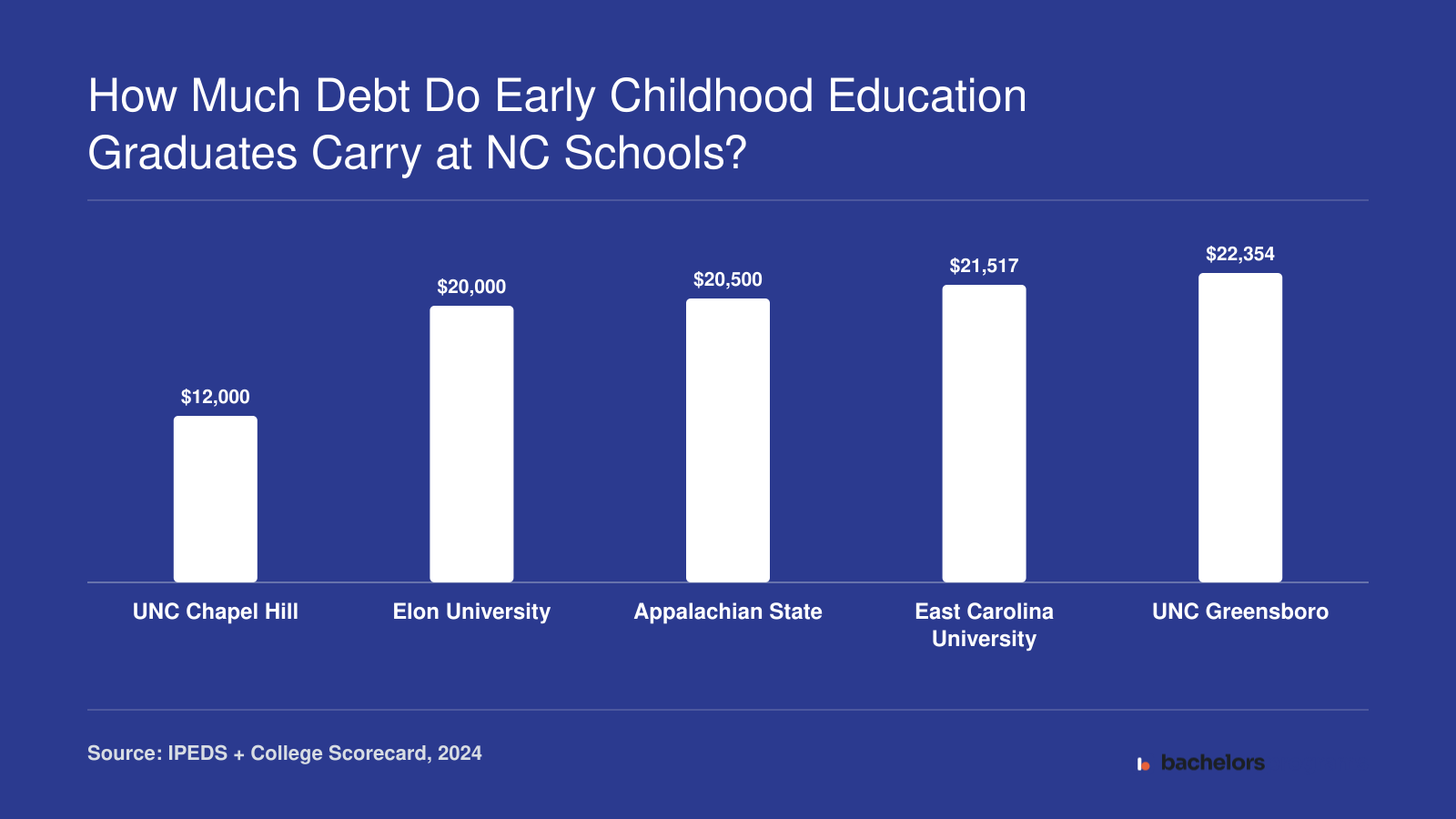
How Much Debt Do Early Childhood Education Graduates Carry at NC Schools?
Among the North Carolina schools with the lowest program-level debt, UNC Chapel Hill graduates leave with a median of $12,000 in federal loans. Elon, Appalachian State, East Carolina and UNC Greensboro cluster between $20,000 and $22,354. On a standard 10-year repayment plan, those balances work out to about $127 a month for a Chapel Hill graduate, $212 at Elon, $217 at Appalachian State, $228 at East Carolina and $237 at UNC Greensboro. Weigh that payment against a first-year teaching salary. A $110 monthly gap adds up to more than $13,000 over a decade. Schools without a published program-level debt figure are left out of this chart rather than shown with a campus-wide number.
North Carolina Birth–Kindergarten Licensure at a Glance
What North Carolina Educators Earn in the Classroom
Kindergarten teachers in North Carolina earned a median annual wage of $53,180 as of May 2025.
Compare Early Childhood Education programs on the data that matters
Explore more Education & Teaching majors or browse every field of study.
All Education & Teaching programs Browse every field of study